Permeability, not strength, is often the property that determines how long a concrete structure actually lasts in service. Water and dissolved chlorides move through concrete via its capillary pore network, and once they reach embedded steel, corrosion begins regardless of how high the compressive strength rating is on paper. Water reducing agents are usually discussed in terms of workability and strength, but their effect on permeability is just as significant, and in many durability-critical projects, it’s the primary reason they’re specified. This article explains the direct link between water reduction and impermeability, how the mechanism works at the pore level, and what this means for specification and mix design.
Why Permeability Matters More Than Strength Alone
A concrete structure can meet its design strength and still fail prematurely if water, chlorides, sulfates, or carbon dioxide can move freely through its pore structure. Water carries these aggressive agents to embedded reinforcement, where chloride ingress triggers corrosion of steel, and the resulting expansion of corrosion products cracks and spalls the surrounding concrete from the inside out.
Carbonation, driven by the diffusion of atmospheric CO2 through the pore network, similarly reduces the alkalinity that normally protects steel reinforcement. In both cases, the rate of deterioration is governed almost entirely by how permeable the concrete is, which is why impermeability of concrete has become a central specification requirement for structures such as bridges, marine works, water tanks, and parking structures, independent of the strength grade specified.
The Link Between Water-Cement Ratio and Permeability
Concrete’s permeability is governed primarily by its capillary porosity, which in turn is governed by the water-cement ratio used in the mix. When more water is added to a mix than is needed for cement hydration, that excess water eventually evaporates or remains unreacted, leaving behind a network of interconnected capillary pores.
The higher the water-cement ratio, the coarser and more interconnected this pore network becomes, providing continuous pathways through which water and dissolved ions can migrate. Lowering the water-cement ratio, without compromising workability, is the single most effective way to reduce capillary porosity and, by extension, permeability. This is precisely the function a water reducing agent performs.
How Water Reducing Agents Reduce Permeability
Water reducing agents work by dispersing cement particles that would otherwise clump together in agglomerated clusters, trapping water inside these clusters and away from the hydration reaction. The agent’s molecules adsorb onto the surface of cement particles, giving them a like electrical charge that causes mutual repulsion.
This dispersion frees the trapped water, meaning the same workability can be achieved with significantly less total mixing water. Because less water is used relative to cement, the resulting hardened paste has a lower water-cement ratio, which produces a denser matrix of hydration products, primarily calcium-silicate-hydrate (C-S-H) gel, with fewer and finer capillary pores. Rather than acting on permeability directly, a water reducing agent achieves it as a direct consequence of reducing mixing water while preserving workability, which is why the effect scales with the degree of water reduction achieved.
| Water Reduction Level | Typical Water-Cement Ratio Reduction | Relative Impact on Permeability |
| Normal water reducer | 5–10% | Moderate reduction in capillary porosity |
| Mid-range water reducer | 10–15% | Noticeable reduction, improved finishability |
| High-range water reducer (HRWR / superplasticizer) | 15–30% | Significant reduction, enables low w/c ratio mixes |
High-Range Water Reducers and Low-Permeability Concrete
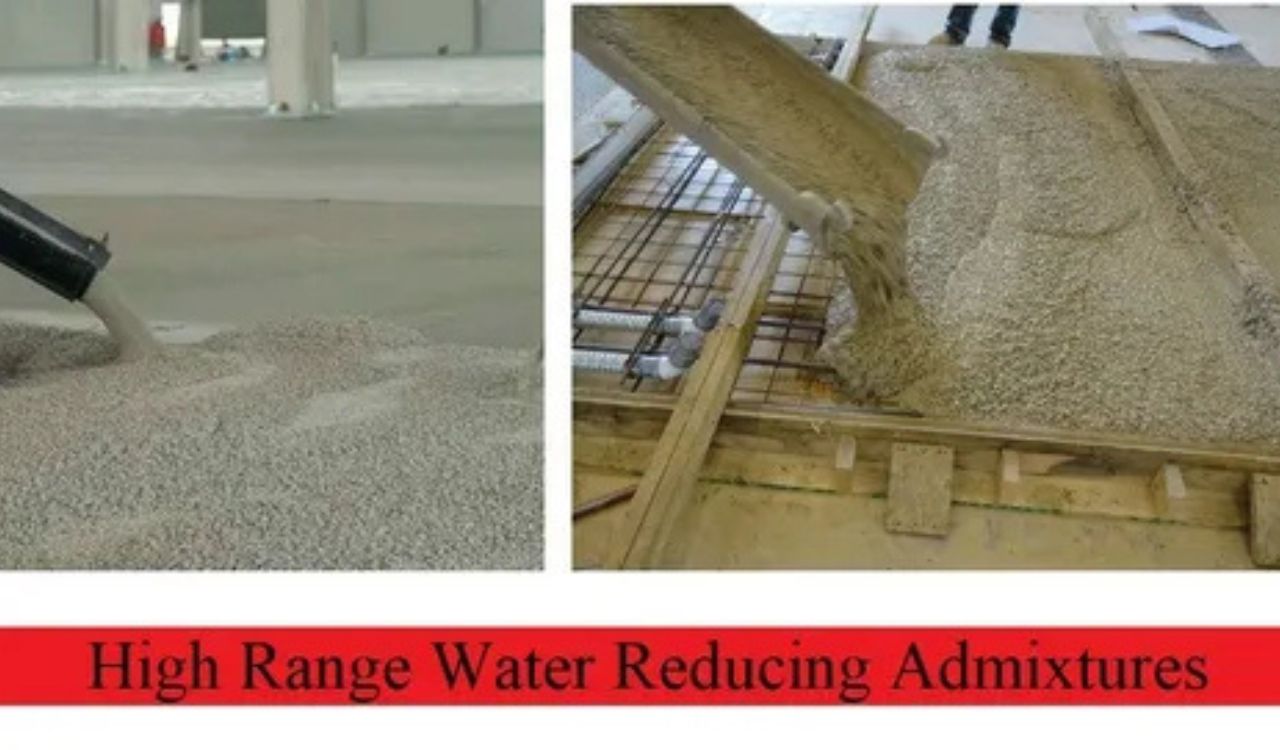
For projects with strict durability requirements, such as marine structures, water-retaining tanks, and bridge decks exposed to deicing salts, normal water reducers often cannot achieve the water-cement ratio reduction needed. This is where HRWR concrete mixes, using high-range water reducers or superplasticizers, become necessary.
These admixtures can reduce mixing water by 15 to 30 percent while maintaining workable slump, allowing designers to specify water-cement ratios as low as 0.35 to 0.40 without sacrificing placeability. At these lower ratios, the capillary pore network becomes discontinuous rather than interconnected, which is the threshold at which permeability drops sharply rather than gradually. This discontinuity is what separates ordinary durable concrete from genuinely low-permeability concrete used in aggressive exposure conditions.
Benefits Beyond Permeability
While permeability reduction is the durability-focused benefit, water reducing agents deliver related advantages that reinforce the same outcome. Lower porosity concrete also tends to have higher compressive and flexural strength, since the same dense hydration matrix that blocks water pathways also carries load more effectively.
Reduced permeability lowers the rate of chloride diffusion, directly extending the time before reinforcement corrosion initiates, which is often the single largest factor in a structure’s service life calculation. Improved workability at lower water content also reduces the risk of bleeding and segregation during placement, both of which can create localized zones of higher porosity and weakness if left unaddressed.
Applications Where Impermeability Is the Priority
Certain structures are specified primarily on the basis of permeability performance rather than strength alone, and water reducing agents play a central role in achieving these targets. Marine and coastal structures require low chloride diffusion coefficients to resist seawater exposure over decades of service. Water and wastewater treatment structures need low permeability both to prevent leakage and to resist chemical attack from the contained fluids.
Bridge decks and parking structures exposed to deicing salts rely on low-permeability concrete to delay the onset of reinforcement corrosion, and basements and below-grade structures depend on reduced capillary porosity to limit water ingress even before any additional waterproofing membrane or admixture is applied.
Important Factors to Consider
Achieving a genuine permeability benefit from a water reducing agent depends on more than simply adding the product to the mix. The dosage must be sufficient to achieve the targeted water-cement ratio reduction; underdosing limits the effect, while overdosing certain formulations can cause excessive retardation or segregation that offsets the durability gain.
Cement type and fineness affect how much water reduction is achievable at a given dosage, so trial mixes with project-specific materials remain essential. Adequate curing is equally critical, since a low water-cement ratio mix that dries out before hydration is sufficiently advanced will not achieve its intended low-permeability microstructure, regardless of the admixture used. Supplementary cementitious materials, such as fly ash or slag, are often used alongside water reducers in low-permeability mix designs, as they further refine the pore structure through pozzolanic reaction.
Limitations
Water reducing agents lower permeability primarily by reducing capillary porosity, but they do not address all pathways for water and ion ingress. Cracking, whether from shrinkage, thermal effects, or structural loading, creates direct pathways that bypass the benefit of a dense pore structure entirely, so crack control measures remain necessary regardless of water-cement ratio.
Surface permeability can also be affected by finishing practices and curing quality, meaning a well-designed low water-cement ratio mix can still underperform if placement and curing are not executed correctly. Water reducers alone are also not a substitute for dedicated waterproofing systems in structures with hydrostatic pressure requirements, such as basements below the water table, where a combined approach is typically specified.
Conclusion
The relationship between water reducing agents and concrete impermeability comes down to a simple mechanism with significant consequences: less mixing water means a denser, less porous hydration matrix, and a less porous matrix is fundamentally harder for water, chlorides, and other aggressive agents to penetrate. For projects where durability and service life are as important as compressive strength, from marine structures to water-retaining tanks, specifying an appropriate water reducing agent, at the correct dosage and supported by proper curing, is one of the most direct and well-established ways to achieve low-permeability concrete.
FAQs
How does a water reducing agent make concrete more impermeable?
It disperses cement particles so the same workability can be achieved with less mixing water, which lowers the water-cement ratio and produces a denser hydration matrix with fewer interconnected capillary pores.
What is the difference between a normal water reducer and an HRWR for permeability control?
A normal water reducer typically lowers the water-cement ratio by 5–10%, while a high-range water reducer (HRWR) can achieve 15–30%, enabling the very low water-cement ratios needed for genuinely low-permeability concrete.
Does a lower water-cement ratio always mean lower permeability?
Generally yes, since lower water content reduces capillary porosity, but the benefit depends on proper curing and the absence of cracking, both of which can create alternative pathways for water ingress.
Can water reducing agents replace waterproofing admixtures?
No. Water reducing agents reduce capillary porosity throughout the concrete matrix, while waterproofing admixtures often target specific pore-blocking or hydrophobic mechanisms; structures with hydrostatic pressure typically need both.
What water-cement ratio is considered low-permeability concrete?
Water-cement ratios of around 0.40 or lower are generally associated with a discontinuous capillary pore structure and significantly reduced permeability, though this depends on cement type and curing.
Why is impermeability important for reinforced concrete durability?
Permeability controls the rate at which water and chlorides reach embedded steel reinforcement; lower permeability delays the onset of corrosion, which is often the primary factor limiting a structure’s service life.
Do water reducing agents affect the strength of concrete as well as permeability?
Yes. The same reduction in water-cement ratio that lowers permeability also increases compressive and flexural strength, since both properties depend on the density of the hydrated cement paste.