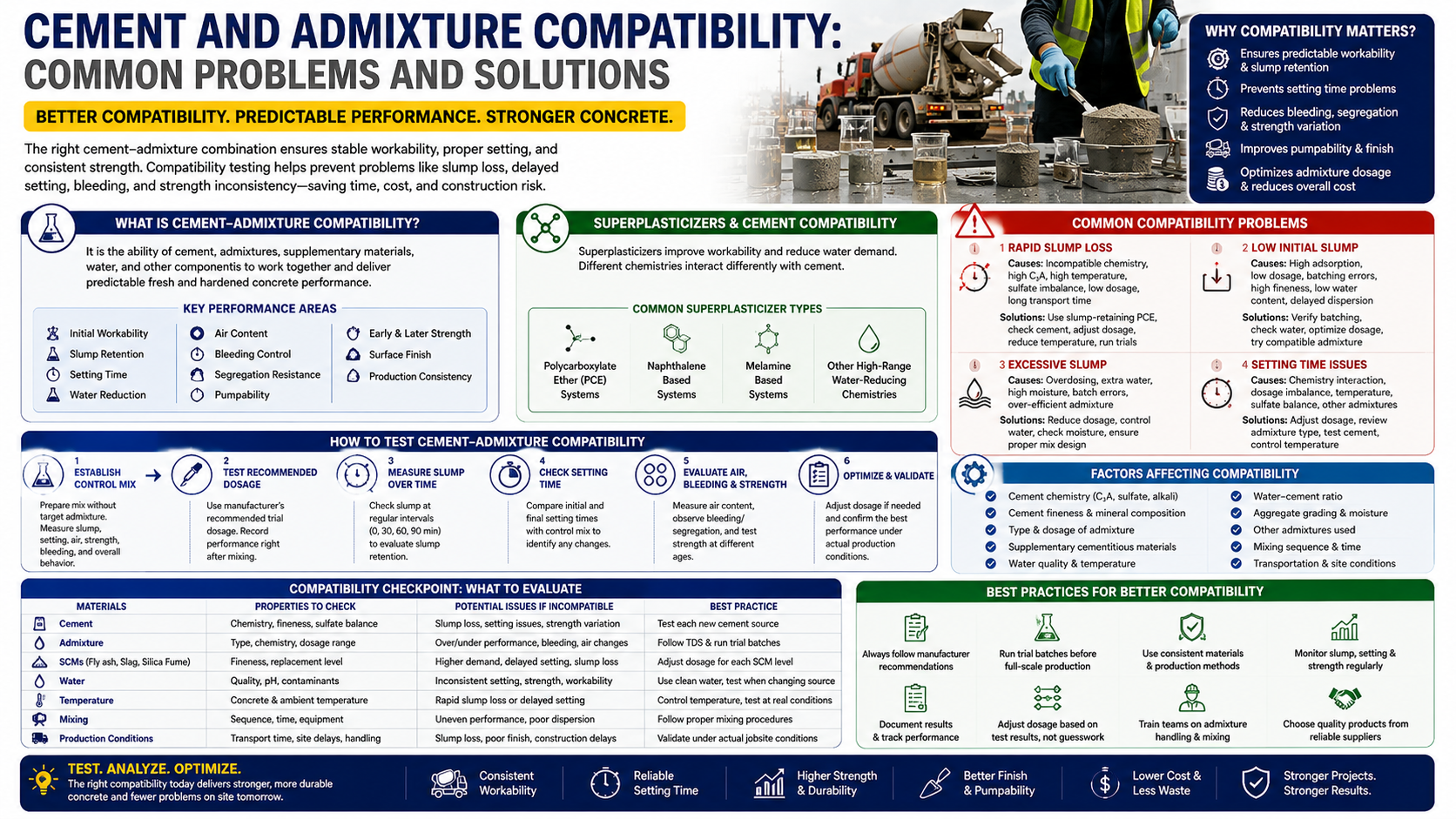
Concrete performance depends on more than the quality of cement or the quality of an admixture considered separately.
The real performance comes from how the materials interact with each other.
A cement that performs well with one water reducer may show rapid slump loss with another. A superplasticizer that produces excellent flow with one cement source may cause delayed setting, excessive air, or inconsistent workability with another.
This is why cement and admixture compatibility is an important part of concrete mix design.
Compatibility refers to whether cement, chemical admixtures, supplementary cementitious materials, water reducing admixture, and other components work together to produce predictable fresh and hardened concrete properties.
For concrete producers, contractors, precast manufacturers, engineers, and chemical buyers, understanding compatibility can help reduce problems such as slump loss, abnormal setting, bleeding, segregation, inconsistent strength, and excessive admixture consumption.
What Is Cement and Admixture Compatibility?
Cement and admixture compatibility describes how effectively a chemical admixture performs when combined with a particular cement system.
A compatible combination should provide reasonably predictable performance in areas such as:
- Initial workability
- Slump retention
- Setting time
- Water reduction
- Air content
- Bleeding
- Segregation resistance
- Pumpability
- Early strength
- Later-age strength
- Surface finish
- Production consistency
Compatibility does not mean that every cement and admixture combination will produce identical results.
Different cements have different chemical and physical characteristics.
Different admixtures also have different active components, concentrations, molecular structures, and intended functions.
The objective is therefore to find a combination that delivers the required concrete performance consistently.
Common Compatibility Problem 1: Rapid Slump Loss
Rapid slump loss is one of the most common problems encountered in high-performance concrete.
The concrete may have acceptable workability immediately after mixing but stiffen much faster than expected.
Possible causes include:
- Cement-admixture incompatibility
- High concrete temperature
- High C₃A content
- Sulfate imbalance
- Excessive cement fineness
- Incorrect admixture chemistry
- Low admixture dosage
- Inadequate slump-retention component
- Long transportation time
- High supplementary material demand
Rapid slump loss can create significant problems for ready-mix concrete.
These may include:
- Difficult pumping
- Difficult placement
- Additional site water demand
- Poor consolidation
- Construction delays
- Inconsistent finishing
Possible Solutions
The investigation may include:
- Testing another admixture chemistry
- Evaluating a slump-retaining PCE
- Adjusting dosage within the approved range
- Checking cement chemistry
- Reducing concrete temperature
- Reviewing transportation time
- Testing admixture addition sequence
- Conducting compatibility trials with the actual cement
The solution should be confirmed through testing rather than uncontrolled site adjustments.
Common Compatibility Problem 2: Low Initial Slump
Another common problem is insufficient initial workability.
Concrete may appear stiff even when the expected admixture dosage has been added.
Possible reasons include:
- High admixture adsorption
- Low effective dosage
- Incorrect batching
- High cement surface area
- High silica fume content
- Low water content
- Moisture correction errors
- Cement chemistry differences
- Delayed admixture dispersion
Before increasing dosage, the producer should first verify batching accuracy and actual water content.
Increasing chemical dosage without understanding the cause may not solve the problem efficiently.
Common Compatibility Problem 3: Excessive Slump
Sometimes the opposite problem occurs.
Concrete may become much more fluid than expected.
Potential causes include:
- Excessive admixture dosage
- Incorrect water addition
- High aggregate moisture
- Batch calculation errors
- Change in cement demand
- Over-efficient admixture response
- Incorrect admixture product
Excessive slump may contribute to:
- Segregation
- Bleeding
- Poor stability
- Surface defects
- Reduced uniformity
The solution is usually not to judge concrete only by slump.
Stability and cohesion must also be evaluated.
Calcined Clay and Other Low-Carbon Binders
Low-carbon cement systems increasingly use higher levels of supplementary materials.
These systems may have different surface chemistry and water demand compared with traditional Portland cement.
Admixture compatibility becomes especially important when moving from conventional concrete to newer binder systems.
Mixing Time Is Also Important
Insufficient mixing time may prevent uniform admixture distribution.
Excessive or inconsistent mixing may also influence concrete behavior.
A compatibility test should therefore reproduce actual plant mixing procedures as closely as possible.
How to Test Cement and Admixture Compatibility
The most reliable compatibility evaluation uses the actual materials intended for production.
This should include:
- Actual cement
- Actual supplementary cementitious materials
- Actual aggregates
- Actual water
- Actual admixtures
- Target mix proportions
- Realistic temperatures
Step 1: Establish a Control Mix
Prepare a concrete mix without the target admixture where appropriate.
This provides a baseline for:
- Slump
- Setting
- Air content
- Strength
- Bleeding
- General behavior
Step 2: Test the Recommended Admixture Dosage
Use the manufacturer’s recommended trial dosage.
Record performance immediately after mixing.
Step 3: Measure Slump Over Time
For ready-mix applications, initial slump alone is not sufficient.
Measure workability at intervals such as:
- Initial
- 30 minutes
- 60 minutes
- 90 minutes
- Longer where project conditions require
This helps identify whether the system has acceptable slump retention.
Step 4: Measure Setting Time
Setting-time testing helps identify abnormal acceleration or retardation.
Compare the admixture mix against the control.
Step 5: Check Air Content
Where relevant, verify whether the admixture changes entrained or entrapped air.
Step 6: Observe Bleeding and Segregation
Visual observation and appropriate testing can help identify mixture instability.
Step 7: Measure Strength
Test early and later-age strength to determine whether the admixture system affects development.
Step 8: Repeat at Different Dosages
If necessary, evaluate several admixture levels.
The objective is to identify a practical dosage range that provides stable performance.
Step 9: Compare Different Admixture Chemistries
If a cement performs poorly with one admixture, changing dosage may not always be the best solution.
A different admixture chemistry may provide better performance.
This is particularly relevant with PCE superplasticizers because molecular structure can strongly influence cement interaction.
Practical Compatibility Test Matrix
A simple evaluation may look like this:
| Trial | Cement | Admixture | Dosage | Main Purpose |
| A | Cement 1 | None | 0 | Control |
| B | Cement 1 | Admixture A | Low | Initial response |
| C | Cement 1 | Admixture A | Medium | Target performance |
| D | Cement 1 | Admixture A | High | Upper response |
| E | Cement 1 | Admixture B | Medium | Chemistry comparison |
| F | Cement 2 | Admixture A | Medium | Cement comparison |
This type of structured approach makes troubleshooting much easier than making random production adjustments.
How to Troubleshoot Compatibility Problems
A systematic troubleshooting process is more effective than changing several variables simultaneously.
1. Verify batching accuracy
Check cement, water, aggregates, and admixture quantities.
2. Check aggregate moisture
Incorrect moisture corrections can create false workability problems.
3. Confirm admixture identity
Make sure the correct product is being used.
4. Review cement changes
Check whether the cement batch, source, or composition has changed.
5. Check temperature
Compare concrete and ambient temperatures with previous production.
6. Review mixing sequence
Determine whether the addition sequence has changed.
7. Review admixture dosage
Confirm that the dosage is within the appropriate range.
8. Conduct controlled trials
Change one variable at a time wherever practical.
9. Compare alternative admixtures
If dosage adjustments do not solve the issue, test another suitable chemistry.
How to Select a Compatible Admixture
A practical selection process can be reduced to several stages.
1. Define the required performance
Determine the target slump, retention time, strength, setting behavior, and application.
2. Identify the cement system
Record cement type, supplier, fineness, supplementary materials, and relevant chemistry.
3. Select suitable admixture chemistry
Choose a product designed for the intended concrete application.
4. Start within the recommended dosage range
Use manufacturer guidance as the starting point.
5. Conduct laboratory trials
Measure workability, retention, setting, stability, and strength.
6. Compare alternatives where necessary
Test another admixture if compatibility remains poor.
7. Validate under production conditions
Confirm performance in the actual plant and construction environment.
Where Luke Chemicals Fits Into Compatibility Evaluation
For concrete producers and industrial buyers, selecting a chemical admixture should involve more than comparing price or product category.
Luke Chemicals supplies materials for multiple concrete admixture applications, including water-reducing systems, accelerating admixtures, waterproofing solutions, corrosion-control products, and other construction chemical materials.
When evaluating an admixture, the product should be considered as part of the complete concrete system.
Cement source, supplementary cementitious materials, water content, aggregate characteristics, temperature, mixing sequence, dosage, and other admixtures can all influence final performance.
Project-specific compatibility trials therefore provide the strongest basis for selecting and optimizing an admixture before full-scale production.
Conclusion
Cement and admixture compatibility is one of the most important factors influencing the consistency of modern concrete.
A high-quality admixture can still produce disappointing results if it is poorly matched with the cement system.
Likewise, a cement that performs reliably with one admixture may behave differently when another chemical is introduced.
The most common compatibility problems include:
- Rapid slump loss
- Low initial workability
- Excessive slump
- Delayed setting
- Rapid setting
- Bleeding
- Segregation
- Air-content variation
- Strength inconsistency
Frequently Asked Questions
What does cement and admixture compatibility mean?
It refers to how effectively a chemical admixture works with a specific cement and concrete system. A compatible combination should provide predictable workability, setting, stability, strength, and other required properties.
Why does the same admixture behave differently with different cement brands?
Different cements can vary in mineral composition, sulfate balance, fineness, alkali content, and other characteristics. These differences can change how admixture molecules interact with cement particles.
What causes rapid slump loss in concrete?
Possible causes include high temperature, cement chemistry, unsuitable admixture chemistry, low dosage, high admixture adsorption, supplementary cementitious materials, long transportation time, and incompatibility between cement and superplasticizer.