Introduction
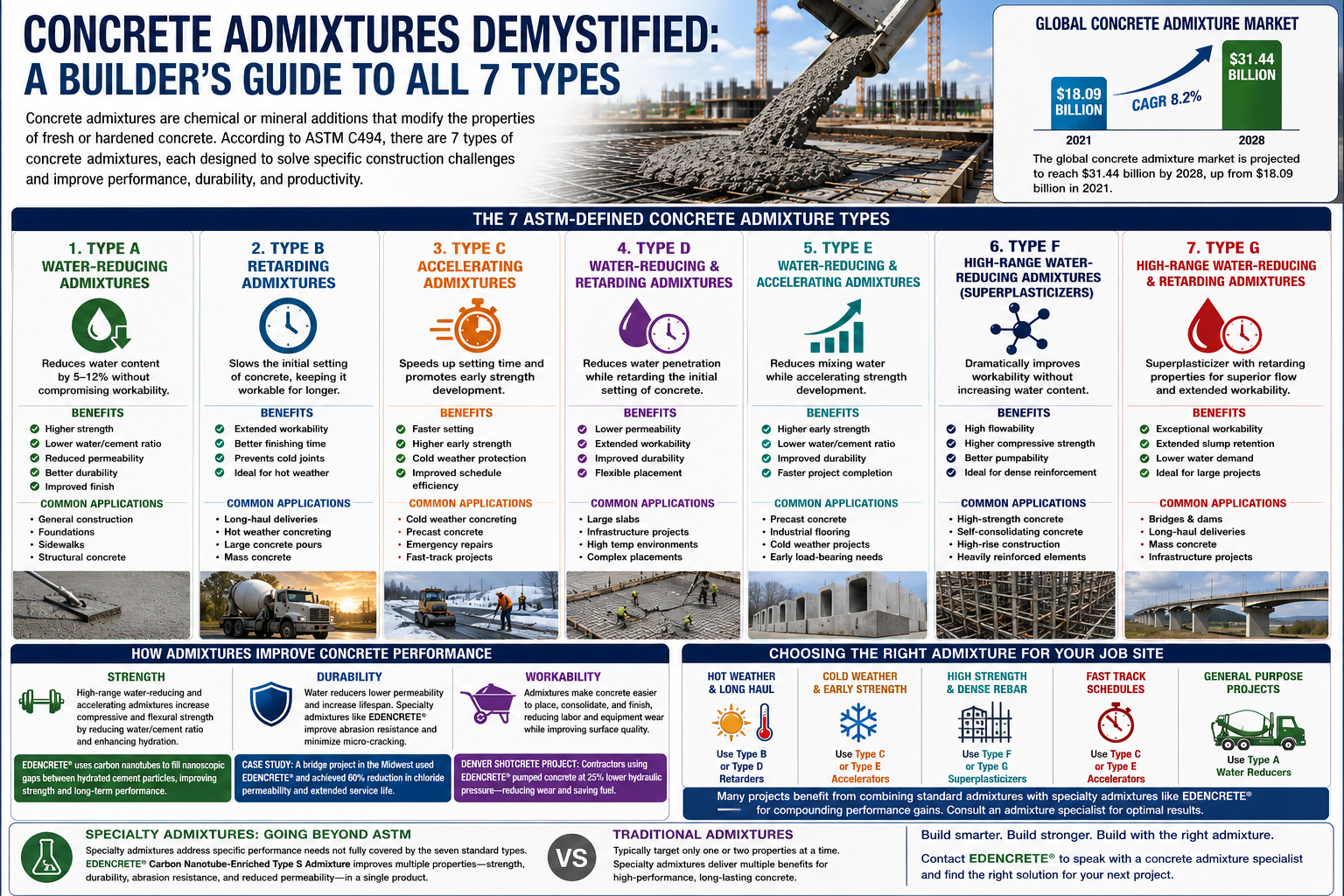
Concrete admixtures have become one of the most important innovations in modern construction. In fact, the global concrete admixture market is projected to grow from approximately $18.09 billion in 2021 to more than $31.44 billion by 2028, highlighting the increasing demand for higher-performing, more durable concrete solutions.
While many people think concrete consists only of cement, water, and aggregates, today’s construction projects rely heavily on concrete admixtures to improve strength, workability, durability, setting time, and long-term performance.
Concrete admixtures are chemical or mineral ingredients added before or during mixing to modify the properties of fresh or hardened concrete. According to ASTM C494, chemical admixtures are classified into seven primary categories, each designed to solve specific construction challenges.
In this guide, we’ll explore all seven ASTM-defined concrete admixture types, explain their benefits and applications, and help you determine which admixture is best suited for your next project.
What Are Concrete Admixtures?
Concrete admixtures are materials added to a concrete mix to alter its behavior during mixing, placement, curing, or after hardening.
According to the American Concrete Institute (ACI), admixtures can:
- Increase workability
- Reduce water demand
- Accelerate or retard setting time
- Improve durability
- Enhance strength development
- Reduce permeability
- Improve freeze-thaw resistance
- Control shrinkage and cracking
- Protect reinforcing steel from corrosion
Modern concrete mixtures often contain multiple admixtures working together to achieve specific performance requirements.
The 7 ASTM-Defined Concrete Admixture Types
Type A – Water-Reducing Admixtures
Type A admixtures reduce the amount of water required in a concrete mix while maintaining the same level of workability.
Typically, these admixtures reduce water content by approximately 5% to 12%.
Benefits
- Higher compressive strength
- Lower water-cement ratio
- Reduced permeability
- Improved durability
- Better finishing characteristics
Common Applications
- Residential construction
- Commercial buildings
- Foundations
- Sidewalks
- General structural concrete
Because less water is needed, the resulting concrete becomes denser and stronger while remaining easy to place.
Type B – Retarding Admixtures
Retarding admixtures slow the hydration process of cement and delay initial setting.
Benefits
- Extended placement time
- Reduced risk of cold joints
- Better finishing opportunities
- Improved control during large pours
Common Applications
- Hot weather concreting
- Long-distance concrete deliveries
- Large foundations
- Bridge decks
- Mass concrete placements
Retarders are particularly useful when high temperatures would otherwise cause concrete to set too quickly.
Type C – Accelerating Admixtures
Accelerating admixtures increase the rate of cement hydration, allowing concrete to set faster and gain strength earlier.
Benefits
- Faster formwork removal
- Earlier finishing operations
- Improved cold-weather performance
- Accelerated project schedules
Common Applications
- Winter construction
- Emergency pavement repairs
- Precast concrete production
- Fast-track construction projects
Many modern accelerators are chloride-free, helping avoid corrosion concerns associated with traditional calcium chloride products.
Type D – Water-Reducing and Retarding Admixtures
Type D admixtures combine the functions of Type A and Type B admixtures.
They reduce water demand while simultaneously extending setting time.
Benefits
- Lower permeability
- Improved strength
- Extended workability
- Better placement flexibility
Common Applications
- Large commercial slabs
- High-temperature environments
- Infrastructure projects
- Long-duration placements
These dual-purpose admixtures are ideal when both durability and extended working time are required.
Type E – Water-Reducing and Accelerating Admixtures
Type E admixtures combine water reduction and accelerated strength development.
Benefits
- Improved early-age strength
- Lower water-cement ratio
- Faster construction schedules
- Better cold-weather performance
Common Applications
- Precast concrete
- Cold-weather pours
- Industrial flooring
- Structural concrete requiring early loading
This combination offers the advantages of stronger concrete without sacrificing productivity.
Type F – High-Range Water-Reducing Admixtures (Superplasticizers)
Type F admixtures, commonly known as superplasticizers, significantly improve workability without adding extra water.
They can reduce water content by up to 30% or more.
Benefits
- Extremely high flowability
- Increased compressive strength
- Reduced permeability
- Easier placement around dense reinforcement
Common Applications
- High-strength concrete
- Self-consolidating concrete (SCC)
- High-rise construction
- Heavily reinforced structural elements
Superplasticizers transform low-slump concrete into highly workable mixes while maintaining excellent mechanical properties.
Type G – High-Range Water-Reducing and Retarding Admixtures
Type G admixtures combine superplasticizer performance with retarding properties.
Benefits
- Exceptional workability
- Extended slump retention
- Reduced water content
- Improved strength and durability
Common Applications
- Large infrastructure projects
- Bridges
- Dams
- Long-haul ready-mix deliveries
- Mass concrete placements
These admixtures provide maximum flexibility when projects require both superior flow and longer working times.
How Concrete Admixtures Improve Performance
Increased Compressive and Flexural Strength
Water-reducing and high-range water-reducing admixtures allow lower water-cement ratios, creating denser concrete with fewer capillary pores.
The result is:
- Higher compressive strength
- Improved flexural strength
- Better load-bearing capacity
- Enhanced structural performance
These properties are critical for bridges, commercial buildings, parking structures, and industrial facilities.
Enhanced Durability
Durability determines how long a concrete structure can withstand environmental exposure.
Concrete admixtures help improve durability by:
- Reducing permeability
- Increasing freeze-thaw resistance
- Limiting chloride penetration
- Minimizing shrinkage cracking
- Improving abrasion resistance
Structures exposed to marine environments, deicing salts, or harsh weather particularly benefit from admixture technology.
Improved Workability
Workability affects how easily concrete can be transported, pumped, placed, consolidated, and finished.
Admixtures improve workability by:
- Increasing slump
- Reducing segregation
- Improving pumpability
- Enhancing finishability
- Maintaining consistency throughout placement
Better workability often leads to faster construction and higher-quality finished concrete.
Choosing the Right Admixture for Your Job Site
Selecting the appropriate admixture depends on project conditions and performance requirements.
Cold Weather Construction
Recommended Types:
- Type C
- Type E
- Air-entraining admixtures
Purpose:
- Faster setting
- Earlier strength gain
- Improved freeze-thaw protection
Hot Weather Construction
Recommended Types:
- Type B
- Type D
Purpose:
- Extended working time
- Reduced risk of premature setting
- Better finishing conditions
High-Strength Concrete
Recommended Types:
- Type F
- Type G
Purpose:
- Lower water-cement ratio
- Increased compressive strength
- Improved durability
Long Haul Deliveries
Recommended Types:
- Type B
- Type D
- Type G
Purpose:
- Maintain slump
- Preserve workability
- Reduce placement challenges
Fast-Track Projects
Recommended Types:
- Type C
- Type E
Purpose:
- Accelerated strength gain
- Faster project completion
- Earlier form removal
Always conduct trial batches and consult admixture manufacturers before finalizing mix designs.
Specialty Admixtures: Beyond ASTM Classification
In addition to the seven standard ASTM classifications, specialty admixtures address unique project requirements.
Examples include:
Corrosion Inhibitors
Protect reinforcing steel from chloride-induced corrosion.
Shrinkage-Reducing Admixtures
Reduce drying shrinkage and cracking.
Alkali-Silica Reaction (ASR) Inhibitors
Prevent expansion and cracking caused by reactive aggregates.
Permeability-Reducing Admixtures
Limit water penetration and improve waterproofing performance.
Cold Weather Admixtures
Enable concrete placement and curing at subfreezing temperatures.
Self-Consolidating Concrete Admixtures
Improve flowability while preventing segregation.
These specialty products often provide multiple benefits simultaneously and are increasingly used in high-performance concrete applications.
Frequently Asked Questions
What type of concrete admixture is best for cold weather?
Type C accelerating admixtures and Type E water-reducing accelerators are commonly used in cold-weather concreting. Air-entraining admixtures also improve freeze-thaw durability.
How do water-reducing admixtures work?
Water reducers disperse cement particles more effectively, allowing the same workability with less mixing water.
What is the difference between Type F and Type G admixtures?
Type F provides high-range water reduction, while Type G combines high-range water reduction with retarding properties for extended workability.
Can multiple admixtures be used together?
Yes. Many modern concrete mixtures use multiple compatible admixtures to achieve specific performance goals.
Do admixtures increase concrete strength?
Many admixtures indirectly increase strength by reducing water content, improving cement dispersion, and enhancing hydration efficiency.
Conclusion
Concrete admixtures have transformed modern construction by giving engineers, contractors, and producers unprecedented control over concrete performance.
Understanding the seven ASTM-defined admixture types—Types A through G—helps project teams select the right solution for their specific needs, whether the goal is higher strength, faster setting, improved workability, enhanced durability, or extended placement time.
The key is recognizing that admixtures are not interchangeable. Each type serves a unique purpose, and selecting the right admixture can significantly impact project quality, schedule, cost, and long-term performance.
Before finalizing any mix design, consult with an experienced admixture supplier or concrete specialist to ensure compatibility, compliance, and optimal performance for your project.