Introduction
Did you know that one of the most important ingredients in durable concrete isn’t cement, aggregate, or water—it’s air?
While most people think air bubbles are a defect in concrete, intentionally entrained microscopic air bubbles are actually essential for long-term durability in cold climates. Air-entraining admixtures are among the most widely used concrete admixtures because they protect concrete from freeze-thaw damage, improve workability, and increase resistance to deicing salts.
Whether you’re constructing highways, bridge decks, parking lots, sidewalks, or residential driveways, understanding how air-entraining admixtures for concrete work can help improve concrete performance and extend service life.
In this guide, you’ll learn what air-entraining admixtures are, how they work, the difference between entrained and entrapped air, their benefits, limitations, and best practices for achieving optimal concrete durability.
What Are Air-Entraining Admixtures?
Air-entraining admixtures are chemical additives used during concrete mixing to create and stabilize millions of microscopic air bubbles throughout the concrete mixture.
These microscopic air voids provide critical protection against damage caused by freezing and thawing cycles.
Unlike larger accidental air pockets, intentionally entrained air is carefully distributed throughout the concrete matrix to improve durability and performance.
Key Functions of Air-Entraining Admixtures
- Improve freeze-thaw durability
- Increase resistance to deicing salt scaling
- Enhance workability
- Reduce segregation
- Minimize bleeding
- Improve long-term service life
Air entrainment has become standard practice for concrete exposed to harsh weather conditions and repeated freezing temperatures.
Entrained Air vs. Entrapped Air
Many construction professionals confuse entrained air with entrapped air, but they serve very different purposes.
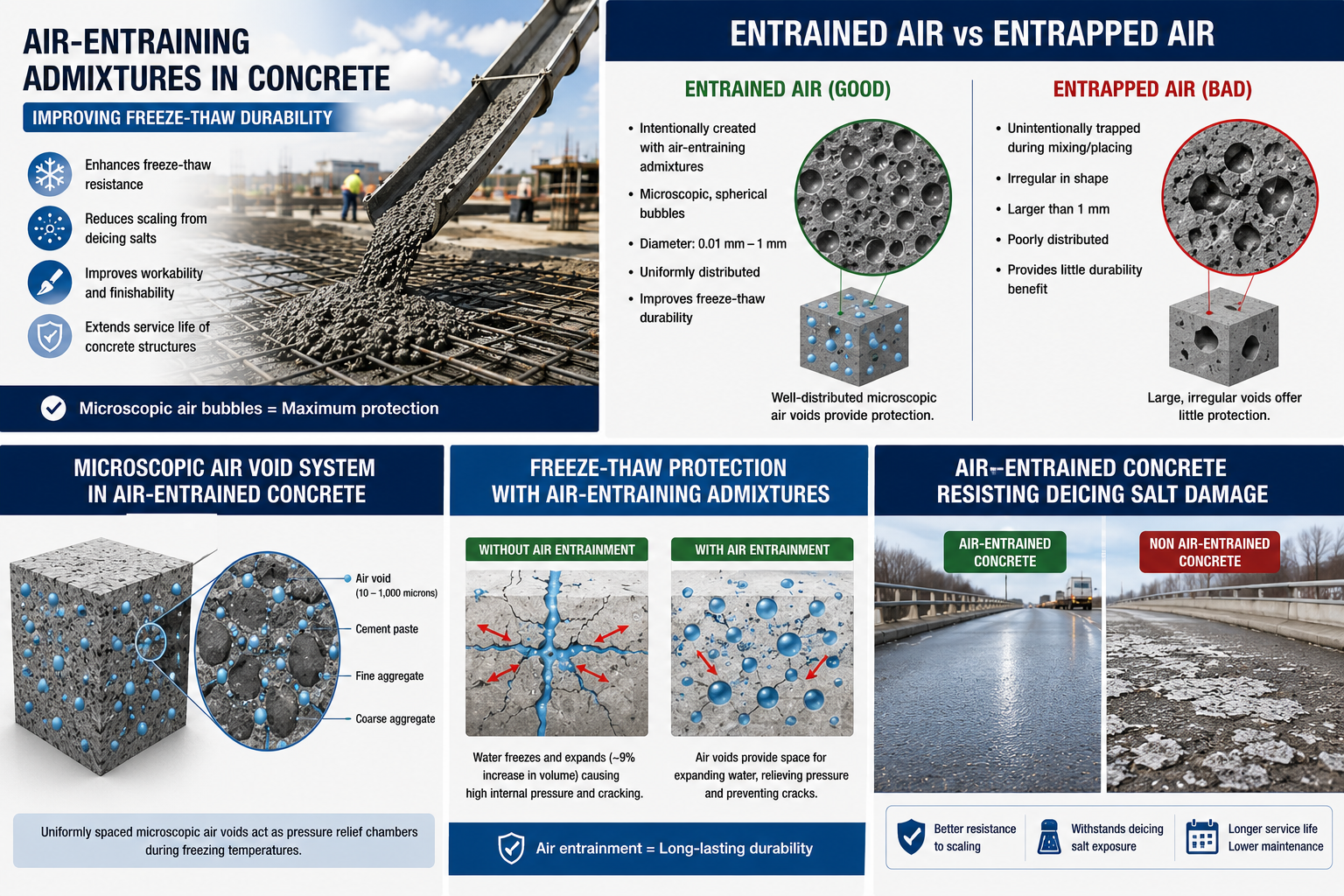
Entrained Air
Entrained air consists of intentionally created microscopic bubbles distributed throughout concrete.
Characteristics
- Spherical shape
- Diameter between 0.01 mm and 1 mm
- Uniformly distributed
- Created through air-entraining admixtures
- Improves concrete durability
These tiny bubbles provide spaces where freezing water can expand safely without damaging the concrete.
Entrapped Air
Entrapped air refers to larger, irregularly shaped voids naturally present in concrete.
Characteristics
- Irregular shape
- Typically larger than 1 mm
- Poor distribution
- Created accidentally during mixing or placement
- Provides little durability benefit
Unlike entrained air, entrapped air contributes little to freeze-thaw protection.
Why Entrained Air Works Better
Because entrained air bubbles are smaller and more evenly distributed, water traveling through concrete capillary pores only needs to move a short distance before reaching a protective air void.
This greatly reduces internal pressure caused by freezing water.
Why Do We Need Air in Concrete?
In cold-weather environments, water inside concrete pores freezes when temperatures fall below 32°F (0°C).
When water freezes, it expands approximately 9% in volume.
If the concrete is highly saturated—greater than approximately 91.7% saturation—this expansion creates significant internal pressure.
When that pressure exceeds the tensile strength of concrete, cracking occurs.
How Air Voids Prevent Damage
Entrained air voids act as pressure-relief chambers.
As water freezes and expands:
- Water migrates toward nearby air voids.
- Internal pressure is reduced.
- Concrete avoids cracking.
- Long-term durability improves.
Without air entrainment, repeated freeze-thaw cycles can rapidly deteriorate concrete structures.
How Do Air-Entraining Admixtures Work?
A common misconception is that air-entraining admixtures create air bubbles.
In reality, they do not generate bubbles.
Instead, they stabilize microscopic bubbles that naturally form during mixing.
Air-entraining admixtures work by:
1. Reducing Surface Tension
The admixture lowers the surface tension of mixing water, making it easier for tiny bubbles to form.
2. Stabilizing Air Bubbles
The admixture creates a protective shell around each bubble.
This shell:
- Repels water
- Prevents bubbles from merging
- Helps bubbles remain stable
- Promotes attachment to cement and aggregate particles
The result is a uniform network of microscopic air voids throughout the concrete.
Chemistry of Air-Entraining Admixtures
Air-entraining admixtures belong to a class of chemicals known as surfactants.
These surface-active compounds contain:
- A water-repelling hydrocarbon chain
- A water-attracting polar chain
This unique molecular structure allows them to stabilize microscopic air bubbles during mixing.
Major Classifications
Wood-Derived Acid Salts
Examples include:
- Vinsol resins
- Wood rosins
Advantages
- Excellent bubble structure
- Proven performance for over 60 years
- Effective in low water-cementitious ratio mixtures
Limitations
- Can lose air during long haul times
- Vinsol resin availability has declined
Today, wood rosins have largely replaced traditional vinsol resins.
Synthetic Resins
Examples include:
- Detergents
- Fatty acids
- Gum resins
- Tall oils
Advantages
- Available since the mid-1980s
- Produce smaller air bubbles
- Closer bubble spacing
- Superior freeze-thaw protection
Limitations
- Delayed water addition may increase air content unexpectedly
Many modern concrete producers prefer synthetic air-entraining agents because of their improved durability performance.
Benefits of Air-Entraining Admixtures
Increased Freeze-Thaw Resistance
The primary benefit of air entrainment is protection against repeated freezing and thawing cycles.
This is especially important for:
- Roads
- Bridge decks
- Sidewalks
- Parking structures
- Exterior slabs
Improved Resistance to Deicing Salts
Concrete exposed to road salts often suffers scaling and surface deterioration.
Air-entrained concrete provides significantly better resistance to:
- Salt scaling
- Surface spalling
- Moisture penetration
Improved Workability
Entrained air acts like microscopic ball bearings within fresh concrete.
Benefits include:
- Easier placement
- Better consolidation
- Reduced finishing effort
- Improved pumpability
Reduced Bleeding and Segregation
Air entrainment helps stabilize fresh concrete by:
- Reducing aggregate settlement
- Minimizing water migration
- Improving mixture uniformity
This results in higher-quality concrete surfaces.
Does Air Entrainment Affect Concrete Strength?
Yes.
While air entrainment improves durability, it generally reduces compressive strength.
General Rule
For every:
1% increase in air content
Concrete compressive strength decreases approximately:
3% to 5% at 28 days
Example
| Air Content Increase | Strength Reduction |
|---|---|
| 1% | 3–5% |
| 2% | 6–10% |
| 3% | 9–15% |
This trade-off is usually acceptable because the durability benefits far outweigh the modest strength reduction.
Factors That Affect Air Content in Concrete
Achieving the target air content requires careful control because many variables influence air entrainment.
Cement Factors
| Change | Effect on Air Content |
|---|---|
| Increased cement content | Variable |
| Increased fineness | Decreases |
| Increased alkalinity | Increases |
Supplementary Cementitious Materials
| Material | Effect |
|---|---|
| Fly Ash | Decreases |
| Silica Fume | Significantly Decreases |
| Slag Cement | Decreases |
Aggregate Factors
| Change | Effect |
|---|---|
| Larger aggregate size | Decreases |
| Higher sand content | Increases |
Chemical Admixtures
| Admixture | Effect |
|---|---|
| Water Reducers | Increase |
| Retarders | Increase |
| Accelerators | Neutral |
| High-Range Water Reducers | Increase |
Production Factors
Air content may also change due to:
- Batching procedures
- Mixer size
- Mixing speed
- Extended mixing time
Transportation and Placement
Air loss commonly occurs during:
- Long haul times
- Pumping operations
- Conveyor placement
- Excessive vibration
- Over-finishing
Proper quality control is essential to maintain target air levels throughout construction.
Choosing the Right Air Content
Typical air content recommendations vary based on exposure conditions.
Severe Freeze-Thaw Exposure
Recommended:
5%–8% entrained air
Moderate Exposure
Recommended:
4%–6% entrained air
Interior Concrete
Often requires little or no intentional air entrainment.
Always consult project specifications and applicable standards.
Best Practices for Air-Entrained Concrete
To maximize performance:
✔ Monitor air content regularly
✔ Adjust admixture dosage based on materials and weather
✔ Minimize excessive vibration
✔ Avoid unnecessary retempering
✔ Account for pumping and transportation losses
✔ Follow ASTM and ACI recommendations
✔ Perform trial batches before production
Frequently Asked Questions
What is the purpose of air-entraining admixtures?
Air-entraining admixtures create and stabilize microscopic air bubbles that improve freeze-thaw durability, workability, and resistance to deicing salts.
What is the difference between entrained and entrapped air?
Entrained air consists of intentionally created microscopic bubbles that improve durability, while entrapped air consists of larger accidental voids that provide little benefit.
Does air entrainment increase concrete durability?
Yes. Air entrainment significantly improves freeze-thaw resistance, reduces scaling, and extends service life in cold climates.
Does air entrainment reduce strength?
Yes. Every 1% increase in air content typically reduces compressive strength by approximately 3–5%.
Conclusion
Air-entraining admixtures are among the most important concrete admixtures used in modern construction. By creating a carefully distributed network of microscopic air bubbles, they protect concrete against freeze-thaw damage, improve workability, reduce scaling, and significantly enhance long-term durability.
Although air entrainment may slightly reduce compressive strength, the durability benefits far outweigh the trade-off—especially in regions exposed to freezing temperatures and deicing chemicals.
For optimal results, work closely with your concrete supplier and admixture manufacturer to determine the correct air content and dosage for your specific project conditions.