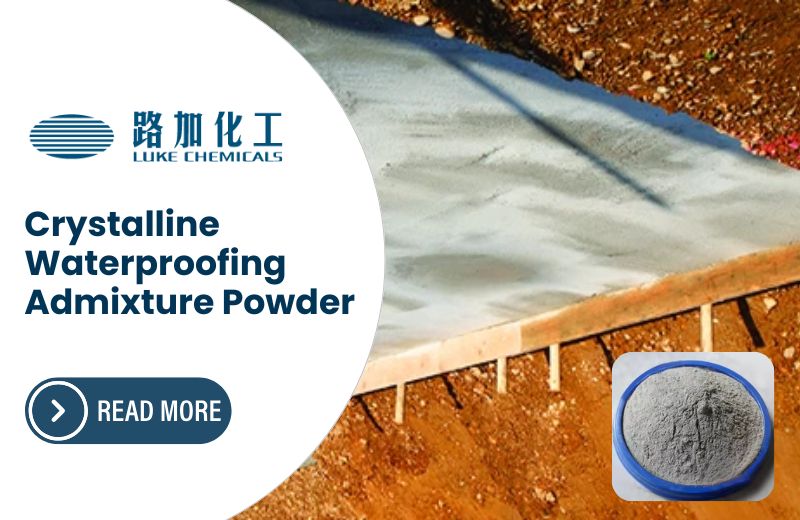
Crystalline waterproofing admixture is available in two physical forms, powder and liquid, and the choice between them affects handling, dosing accuracy, transport cost, and shelf life. Powder is the more common form for large batching plants, precast producers, and export buyers, mainly because it is lighter to ship, easier to store for long periods, and simpler to dose precisely by weight.
This guide looks specifically at the powder form, what it contains, how it is packaged and stored, how to dose it correctly, and what to check before placing a bulk order.
What Crystalline Waterproofing Admixture Powder Actually Contains
The powder is a blend of fine cementitious carriers, active chemical compounds, and proprietary catalysts that react with moisture and the calcium hydroxide released during cement hydration. Once mixed into concrete, these active compounds trigger the growth of insoluble crystals inside the pore structure, which is the same reaction mechanism explained in detail in our breakdown of how crystalline waterproofing admixture works. The dry form does not change the chemistry; it simply changes how the material is transported, stored, and dosed compared to a liquid concentrate.
Particle fineness matters more than most buyers expect. A powder that is too coarse disperses unevenly in the mix and can leave weak spots where crystal formation is incomplete. Reputable manufacturers control particle size distribution closely, since consistent fineness is directly linked to how quickly and evenly the crystalline reaction begins.
Packaging, Storage, and Shelf Life
Crystalline waterproofing admixture powder is typically supplied in moisture-resistant bags, most commonly 20 to 25 kilogram multi-wall paper or PE-lined bags, sometimes with an inner soluble film layer that allows the entire bag to be added directly to the mixer without opening it. This dust-free handling method is increasingly preferred at batching plants because it reduces worker exposure and keeps dosing consistent batch to batch.
Because the active ingredients are moisture sensitive, storage conditions matter. Bags need to stay in a dry, covered warehouse, off the ground on pallets, away from direct rainfall or high humidity. Under proper storage, most powder formulations carry a shelf life of six to twelve months from the production date. Buyers sourcing in bulk should always confirm the manufacturing date on the packaging and avoid stock that has already spent significant time in transit or port storage before reaching the job site.
Dosage and Mixing Guidelines
Dosage for crystalline waterproofing admixture powder is generally expressed as a percentage of cement weight, commonly falling between one and three percent, though the exact figure depends on the exposure condition, water-to-cement ratio, and the specific formulation being used. Below-grade structures under sustained hydrostatic pressure typically need dosages at the higher end of that range, while structures needing only dampproofing protection can often use less.
Powder is normally added directly into the mixer along with the dry cementitious materials, then blended for several minutes before water is introduced, to ensure even distribution before hydration begins. Because the powder interacts directly with cement chemistry, running a trial batch with the actual cement source and mix design is good practice before committing to full-scale production, since cement composition can vary between suppliers and affect reaction speed.
Quality Checks to Run Before a Bulk Purchase
Before ordering in volume, buyers should ask suppliers for a few specific data points rather than relying on marketing claims alone. These include documented particle size distribution, moisture content at the time of packaging, bulk density figures, and third-party test data showing water penetration resistance under pressure rather than absorption alone. A supplier who can share GB/T 31296-2014 test reports, ASTM C494 Type S compliance data, or DIN 1048 and BS EN 12390-8 penetration results is generally easier to specify with confidence on infrastructure and export projects.
It also helps to request a small sample batch for an internal trial mix before committing to a full container order, particularly when working with a new supplier or a formulation that has not yet been tested against local cement and aggregate sources.
Powder Versus Liquid: Which Form Fits Your Project
Powder generally wins on shipping economics, since it is lighter per unit of active material and has a longer stable shelf life than most liquid concentrates. It also allows more precise dosing by weight at the batching plant. Liquid crystalline admixtures can be easier to meter through automated dosing pumps at high-volume ready-mix plants, but they are heavier to ship, more sensitive to freezing during transport in cold climates, and generally have a shorter shelf life once opened.
For export buyers, importers, and precast manufacturers working across long supply chains, powder is usually the more practical choice, which is part of why it remains the dominant form referenced across current demand trends for crystalline waterproofing admixture in the market today.
Where This Form Is Used
Powder-form crystalline admixtures are used across the same core applications as the liquid version, including basements and foundation walls, water and wastewater treatment structures, underground parking, tunnels, swimming pools, and marine or coastal concrete works. It fits particularly well into precast operations and centralized batching plants, where dry material handling systems are already set up for bagged cementitious additives, similar to how bulk powder water reducing admixtures like CP1000 are typically supplied and handled in the same production environments.
Sourcing Crystalline Waterproofing Admixture Powder in Bulk
For distributors and manufacturers sourcing at scale, consistency between batches is often more important than any single spec sheet number, since variation in fineness or moisture content from one shipment to the next can create dosing headaches at the plant level. At Luke Chemicals, our VF 36 crystalline self-healing waterproofing admixture is manufactured in powder form with controlled particle fineness and dosage guidance for both plant batching and site mixing, supported by technical documentation for buyers working across ASTM, EN, and GB/T frameworks.
Final Thoughts
Crystalline waterproofing admixture powder offers a practical, cost-efficient way to build permanent, self-healing waterproofing directly into concrete, provided buyers pay attention to particle fineness, moisture-safe packaging, correct storage, and dosage guidance specific to their mix design. Requesting test data, running a trial batch, and confirming shelf life before a bulk order remain the most reliable ways to avoid performance issues once the material reaches the job site.