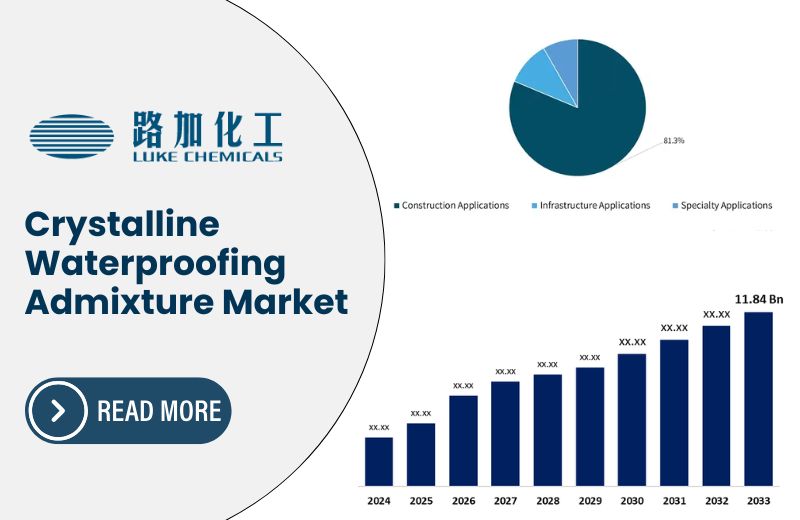
Concrete structures face a constant enemy: water. Whether it is a basement, a tunnel, a water treatment plant or a high-rise foundation, moisture finds its way through capillary pores and hairline cracks over time. This is where crystalline waterproofing admixtures have become one of the most talked-about solutions in the concrete construction industry. Unlike surface coatings that sit on top of concrete, these admixtures work from within the concrete mass itself, and that difference is reshaping how engineers and contractors approach durability.
In this post, I will break down the current state of the crystalline waterproofing admixture market, why demand is climbing, how the technology actually works, and what trends are likely to define the next several years.
About Crystalline Waterproofing Admixture
A crystalline waterproofing admixture is a chemical additive, usually supplied as a powder or liquid, that is mixed directly into concrete during batching. It contains reactive compounds, based on Portland cement combined with proprietary catalysts, that trigger a chemical reaction with the water and unhydrated cement particles present in the mix. This reaction produces insoluble crystalline formations that grow within the pore structure and microcracks of the concrete.
Once these crystals form, they physically block the pathways water would otherwise use to penetrate the structure. Because the reaction is triggered by moisture, the admixture stays chemically dormant until water reappears, which means new cracks that form later, even years after construction, can trigger fresh crystal growth and reseal themselves. This self-healing behavior is one of the biggest reasons crystalline systems are preferred over membrane-based waterproofing in below-grade and hydrostatic pressure applications.
Crystalline Waterproofing Admixture Market Size and Growth Outlook
Industry estimates place the global crystalline waterproofing admixture market at 2.4 to 2.8 billion US dollars as of 2023 and 2024, with most forecasts projecting a compound annual growth rate between 7 and 9 percent through the early 2030s. Depending on the source, the market is expected to reach between 4.2 and over 5 billion US dollars within the next six to eight years.
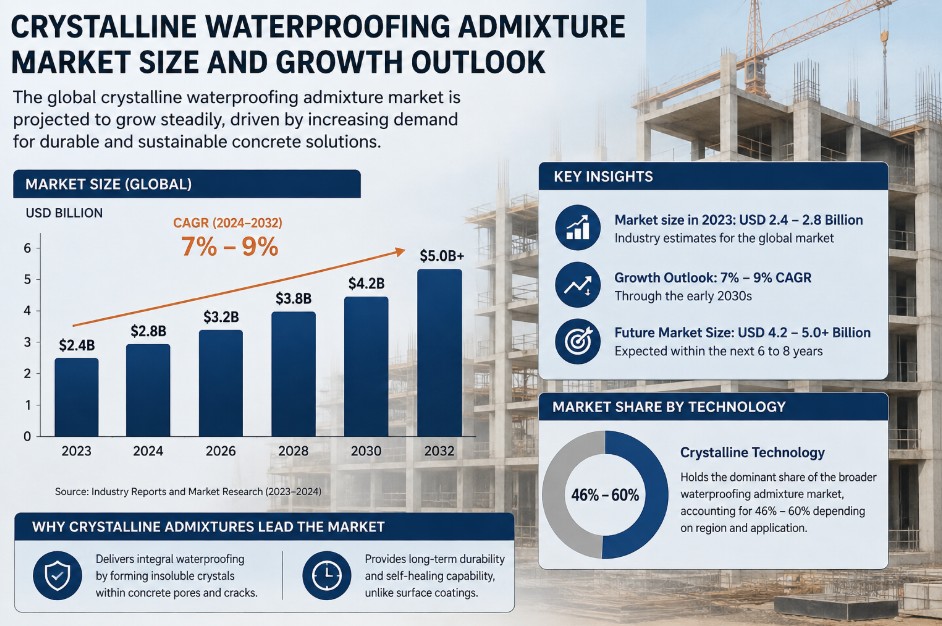
Within the broader waterproofing admixture category, which also includes pore blocking admixtures and densifiers, crystalline technology holds the dominant share, often cited between 46 and 60 percent depending on region and application. This dominance is largely attributed to the dual benefit crystalline admixtures offer: waterproofing performance combined with long-term durability, rather than a coating that can degrade or delaminate.
What are the Key Demand Drivers?
Several factors are pushing this growth forward.
Infrastructure investment is a major one. Governments across Asia, the Middle East and parts of North America are funding large-scale transportation, water management and underground transit projects, all of which require long-service-life concrete that resists water ingress for 50 to 75 years or more.
Urban housing expansion is another driver, particularly in developing economies where residential construction with basements is rising sharply. Builders are increasingly specifying integral waterproofing at the mix design stage rather than relying solely on external membranes.
Stricter building codes and durability requirements are also playing a role. Standards such as ASTM C1582, EN 934-2 and GB/T31296 push specifiers toward admixtures with proven long-term performance data, and crystalline technology has built a strong track record against these benchmarks.
Finally, sustainability expectations are shifting product selection. Crystalline admixtures typically avoid volatile organic compounds and reduce the need for repair interventions over a structure’s lifetime, which appeals to green building certification frameworks.
Regional Trends
Asia Pacific currently leads global demand, accounting for roughly a third or more of the market, driven by rapid urbanization, metro and tunnel construction, and large-scale residential development in China, India and Southeast Asia.
North America follows, supported by aging infrastructure renewal, strict building codes and a mature construction sector focused on lifecycle performance rather than upfront cost alone.
Europe holds a meaningful share as well, with demand concentrated in water-retaining structures, renovation projects in Eastern Europe, and sulfate-resistant applications tied to municipal specifications.
Applications Across Construction
Crystalline waterproofing admixtures are used across a wide range of structures, including basements and foundations, water and wastewater treatment plants, tunnels and underground metro systems, swimming pools and water-retaining structures, parking structures, and precast elements exposed to moisture.
Residential construction remains the largest single application segment globally, largely due to basement and foundation waterproofing in single-family and multi-unit housing. However, infrastructure and commercial projects are growing at a faster relative pace because of the sheer scale of concrete volumes involved and stricter durability requirements on public works.
Emerging Trends Shaping the Market
A few trends stand out as the market matures.
Self-healing concrete technology continues to gain traction, with researchers and manufacturers refining formulations that can close cracks up to half a millimeter wide through continued crystal growth when exposed to moisture.
Nanotechnology integration is being explored to improve crystal density and reduce dosage requirements, which could lower material costs while improving performance in high permeability environments.
Digital documentation and performance verification are becoming more common, as specifiers request lab-backed data on chloride resistance, hydrostatic pressure tolerance and crack sealing capability rather than relying on general marketing claims.
There is also a clear shift toward combining crystalline technology with corrosion inhibitors and expansion agents in more comprehensive concrete durability packages, especially for reinforced structures exposed to chloride- or sulfate-rich environments.
Choosing the Right Crystalline Admixture
Not all crystalline admixtures perform the same way, and dosage, curing conditions, and compatibility with other admixtures in the mix all affect outcomes. Specifiers typically look for third party test data on water penetration reduction, self-healing crack width capacity, and compliance with recognized standards before finalizing a product for a given project.
Manufacturers such as Luke Chemicals develop crystalline and integral waterproofing solutions alongside corrosion inhibitors and expansion agents, giving specifiers access to durability-focused chemistry backed by ISO and REACH compliance for export projects worldwide.
Summary
The crystalline waterproofing admixture market is growing steadily because it solves a real and expensive problem in construction, which is water damage over the life of a structure. As infrastructure spending increases and building codes demand longer service life from concrete, integral waterproofing technology is likely to keep gaining ground over traditional membrane systems. For engineers and specifiers, understanding how these admixtures work and where they perform best is becoming essential knowledge rather than a niche specialty.