Mixtures are an important part of chemistry because many materials used in laboratories, manufacturing, construction, food processing, pharmaceuticals, and everyday life contain two or more substances combined physically. Understanding the kinds of mixtures in chemistry helps explain how substances combine, how their properties differ, and which methods can separate them.
A mixture forms when two or more substances combine without producing a new chemical substance. The individual components generally retain their own chemical identities and can often be separated using physical methods. Depending on how evenly the components are distributed and the size of the particles involved, mixtures can be classified into several categories.
What Is a Mixture in Chemistry?
A mixture is a physical combination of two or more substances in which each component retains its characteristic chemical properties. The substances present in a mixture are not necessarily combined in a fixed ratio, unlike the elements in a chemical compound.
For example, salt and water can be combined in different proportions to produce salt solutions with different concentrations. Similarly, air contains several gases, including nitrogen, oxygen, argon, and carbon dioxide, in varying proportions.
Mixtures can contain elements, compounds, or both. Their composition can be changed without necessarily causing a chemical reaction.
Some common examples include:
- Air
- Salt water
- Sugar solution
- Soil
- Sand and water
- Milk
- Oil and water
- Concrete
- Cement-based mortar
What Are the Main Kinds of Mixture in Chemistry?
The two fundamental categories of mixtures are homogeneous mixtures and heterogeneous mixtures.
A homogeneous mixture has a relatively uniform composition throughout the sample, while a heterogeneous mixture has a non-uniform composition in which different components or phases can be distinguished.
Homogeneous Mixtures
A homogeneous mixture has a uniform composition throughout. Its components are distributed evenly at the scale being considered, so separate components are generally not visible.
Homogeneous mixtures are often referred to as solutions when one substance is uniformly dissolved in another.
Examples include:
- Salt dissolved in water
- Sugar dissolved in water
- Air
- Vinegar
- Brass
- Ethanol and water
The properties of a homogeneous mixture are generally consistent throughout the sample. For example, a properly prepared salt solution has approximately the same concentration in different portions of the solution. A similar principle of uniform distribution is important when considering the different types of admixtures in concrete, as each admixture must be properly dispersed throughout the concrete mix to provide consistent performance.
Heterogeneous Mixtures
A heterogeneous mixture does not have a uniform composition throughout. Its components may remain physically distinguishable, or the mixture may contain multiple phases with different properties.
Examples include:
- Oil and water
- Sand and water
- Soil
- Granite
- Cereal mixed with milk
- Concrete containing cement paste, aggregates, and other components
The composition of a heterogeneous mixture can vary from one part of the sample to another.
Homogeneous vs Heterogeneous Mixtures
Understanding the difference between these two categories is one of the simplest ways to classify mixtures.
| Property | Homogeneous Mixture | Heterogeneous Mixture |
| Composition | Relatively uniform | Non-uniform |
| Distribution of components | Evenly distributed | Unevenly distributed |
| Visible components | Usually not distinguishable | May be distinguishable |
| Phases | Usually one observable phase | Two or more phases may be present |
| Examples | Salt water, air, brass | Oil and water, soil, concrete |
The distinction is useful in chemistry because the physical behavior and separation methods can depend on whether a mixture is homogeneous or heterogeneous.
What Is a Solution in Chemistry?
A solution is a homogeneous mixture in which one or more substances are uniformly distributed at the molecular or ionic level within another substance.
A solution normally contains a solute and a solvent. The solute is the substance that is dissolved, while the solvent is the component that dissolves the solute.
For example, in a salt-water solution:
- Salt is the solute.
- Water is the solvent.
- The resulting salt water is the solution.
Solutions can occur in different physical states. Examples include gas mixtures such as air, liquid solutions such as salt water, and solid solutions such as certain metal alloys.
Properties of Solutions
Common characteristics of solutions include:
- Uniform composition
- Small dispersed particles
- Components that generally do not settle under normal conditions
- Components that cannot usually be separated by ordinary filtration
- Physical properties that depend on composition and concentration
The concentration of a solution can influence properties such as density, viscosity, conductivity, and chemical reactivity.
What Is a Colloid?
A colloid is a type of dispersed system in which particles of one substance are distributed throughout another substance. The dispersed particles are larger than those typically found in a true solution but small enough to remain dispersed under ordinary conditions.
Common examples of colloids include:
- Milk
- Fog
- Mayonnaise
- Gelatin
- Some paints
- Certain polymer dispersions
A colloidal system contains a dispersed phase and a dispersion medium.
The behavior of a colloid depends on factors such as particle size, surface chemistry, concentration, and interactions between the dispersed phase and the surrounding medium.
What Is a Suspension?
A suspension is a heterogeneous mixture containing relatively large particles dispersed throughout a fluid. The particles can often settle when the mixture is left undisturbed.
Examples include:
- Sand in water
- Muddy water
- Some pharmaceutical suspensions
- Solid particles dispersed in certain industrial liquids
Suspensions can often be separated through physical processes such as sedimentation and filtration, depending on particle size and the properties of the medium.
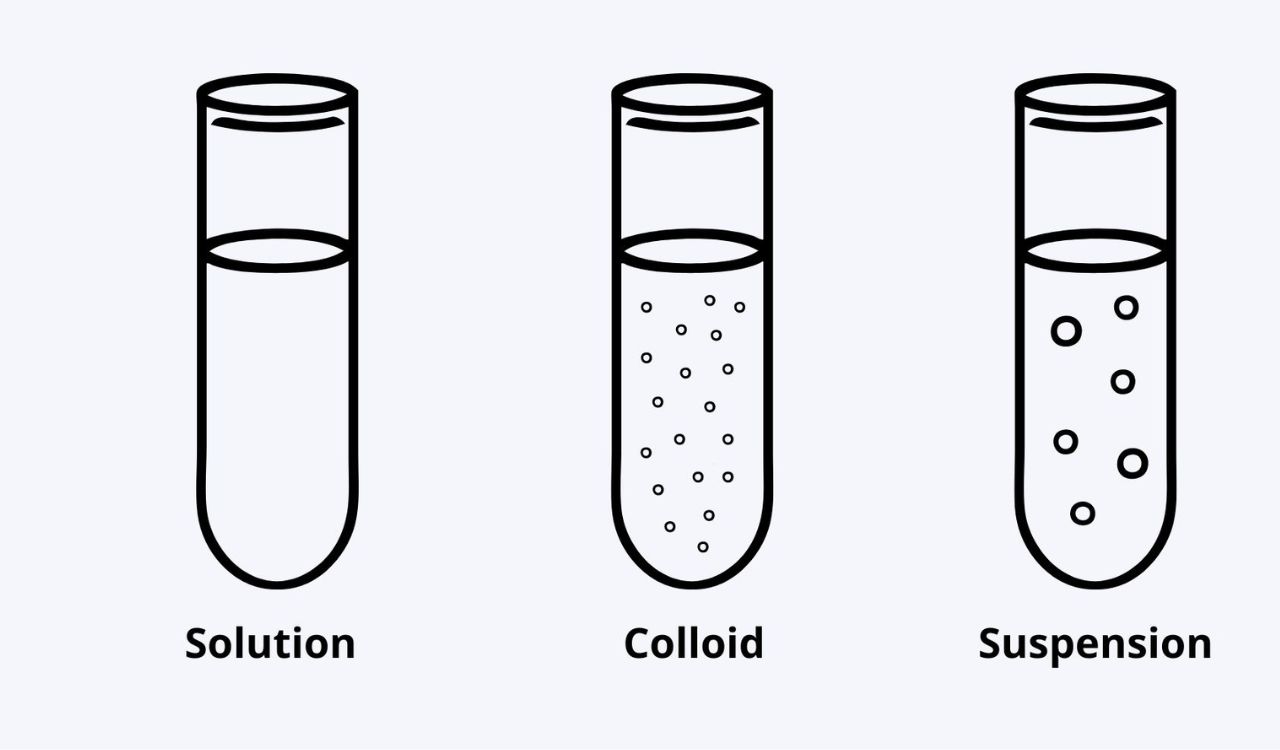
Solution vs Colloid vs Suspension
Solutions, colloids, and suspensions can be distinguished by the size and behavior of their dispersed particles.
| Characteristic | Solution | Colloid | Suspension |
| Particle size | Very small | Intermediate | Relatively large |
| Appearance | Generally uniform | May appear uniform to the eye | Often visibly heterogeneous |
| Settling | Does not normally settle | Generally remains dispersed | Particles can settle |
| Ordinary filtration | Usually not effective | Depends on system and filtration method | Often effective |
| Example | Salt water | Milk | Sand in water |
The boundaries between these categories can depend on the material and the measurement method, so particle size alone should not always be treated as the only classification factor.
Other Important Types of Mixtures
Mixtures can also be described according to their physical structure and the way one component is dispersed within another.
Emulsions
An emulsion is a system involving two liquids that do not readily mix, with one liquid dispersed as droplets within another.
Examples include:
- Oil-in-water systems
- Water-in-oil systems
- Mayonnaise
- Some creams and lotions
Emulsifiers or surfactants can help stabilize certain emulsions by reducing interfacial tension and limiting droplet coalescence.
Aerosols
An aerosol consists of fine solid or liquid particles dispersed in a gas.
Examples include:
- Smoke
- Fog
- Dust suspended in air
The behavior of an aerosol depends on factors such as particle size, density, air movement, and interactions between the particles and surrounding gas.
Foams
Foams contain gas dispersed within a liquid or solid phase.
Examples include:
- Soap foam
- Whipped cream
- Certain insulation materials
- Cellular construction materials
Foam stability depends on the properties of the liquid or solid matrix, surface-active components, gas content, and processing conditions.
Gels
A gel is a semi-solid system in which a liquid is immobilized within a three-dimensional structure.
Examples include:
- Gelatin
- Some polymer gels
- Certain chemical gels
The structure and properties of gels depend on the interactions between their components and the formation of the internal network.
Mixtures vs Chemical Compounds
Mixtures and chemical compounds are not the same.
In a mixture, substances are physically combined and generally retain their individual chemical identities. In a compound, elements are chemically bonded together in a specific ratio to form a new substance with different chemical properties.
| Feature | Mixture | Chemical Compound |
| Formation | Physical combination | Chemical combination |
| Composition | Can vary | Fixed chemical ratio |
| Components retain identity | Generally yes | No |
| Separation | Often possible by physical methods | Requires chemical or more complex processes |
| Properties | Reflect components and their interactions | Different from constituent elements |
| Example | Salt water | Sodium chloride |
For example, mixing iron filings and sulfur produces a mixture in which the components retain their individual properties. When iron and sulfur undergo a chemical reaction under appropriate conditions, iron sulfide is formed as a new compound.
How Are Mixtures Separated?
Because mixtures are physically combined, their components can often be separated using physical techniques. The appropriate method depends on properties such as particle size, boiling point, density, solubility, magnetism, and volatility.
Filtration
Filtration separates insoluble solid particles from a fluid by passing the mixture through a filter.
A common example is separating sand from water.
Evaporation
Evaporation can be used to recover a dissolved solid from a solution by removing the solvent.
For example, water can be evaporated from a salt solution, leaving salt behind.
Distillation
Distillation separates components based primarily on differences in volatility and boiling behavior.
It can be used to separate certain liquid mixtures or recover a solvent from a solution.
Decantation
Decantation involves carefully removing a liquid from a mixture after heavier solid particles have settled or after immiscible liquid phases have separated.
Centrifugation
Centrifugation uses rotational force to accelerate the separation of components with different densities or settling behavior.
Chromatography
Chromatography separates substances according to their different interactions with a stationary phase and a mobile phase. It is widely used in analytical chemistry to identify and separate components of complex mixtures.
Examples of Mixtures in Everyday Life
Mixtures are present in many ordinary materials and products.
Air
Air is a homogeneous mixture of gases. Its major components include nitrogen and oxygen, along with smaller quantities of other gases.
Salt Water
Salt water is a homogeneous mixture when the salt is completely dissolved and distributed uniformly throughout the water.
Soil
Soil is a heterogeneous mixture containing mineral particles, organic matter, water, air, and other components.
Milk
Milk is a complex colloidal system containing water, proteins, fats, minerals, and other substances.
Concrete
Concrete is a complex heterogeneous material containing cementitious components, water, fine aggregate, coarse aggregate, and, depending on the formulation, chemical admixtures or other additives.
Mixtures in Chemical Manufacturing
Understanding mixtures is important beyond basic chemistry. Industrial products are often produced by combining multiple raw materials under controlled conditions.
Manufacturers may need to control:
- Component concentration
- Particle size
- Dispersion
- Solubility
- Viscosity
- pH
- Temperature
- Mixing energy
- Stability
- Compatibility
- Moisture content
The final properties of an industrial mixture can depend not only on the individual ingredients but also on how those ingredients interact with one another.
Mixtures in Construction Chemicals
Mixture principles are also relevant to construction materials. Cementitious products, mortar formulations, concrete systems, and chemical admixtures involve combinations of different materials designed to achieve specific physical or performance characteristics.
For example, a cement-based formulation may contain cement, mineral components, water, aggregates, and chemical additives. Depending on the formulation and stage of processing, these components can form solutions, dispersions, suspensions, or more complex multiphase systems.
For manufacturers such as Luke Chemicals, understanding the chemistry of mixtures is relevant when developing and processing construction-chemical materials because dispersion, solubility, compatibility, particle distribution, and formulation stability can influence the behavior of the final product.
Why Understanding Mixtures Matters in Chemistry
The study of mixtures provides a foundation for understanding how materials behave when different substances are combined.
It is particularly important for:
- Chemical formulation
- Material development
- Laboratory analysis
- Industrial processing
- Pharmaceutical manufacturing
- Food production
- Environmental testing
- Construction materials
- Quality control
A clear understanding of mixture classification can also help determine the appropriate processing and separation method for a particular material.
Factors That Affect the Behavior of a Mixture
Several factors can influence the properties and stability of a mixture.
Composition
The proportion of each component can affect concentration, density, viscosity, strength, stability, and other properties.
Particle Size
Particle size is particularly important in suspensions and dispersions. Smaller particles can behave differently from larger particles because of changes in surface area and settling behavior.
Solubility
The ability of one substance to dissolve in another determines whether a true solution can form under specific conditions.
Temperature
Temperature can affect solubility, viscosity, reaction rates, phase behavior, and the stability of some mixtures.
Mixing Conditions
Mixing time, shear, equipment, and energy input can influence how uniformly components are distributed.
Chemical Compatibility
Components that interact undesirably can cause precipitation, phase separation, instability, or changes in performance.
Best Practices for Working With Chemical Mixtures
Proper control is important when preparing or handling mixtures in laboratory and industrial environments.
Useful practices include:
- Verify the identity and quality of raw materials.
- Measure components accurately.
- Follow the intended formulation sequence.
- Control temperature and mixing conditions.
- Monitor concentration and consistency.
- Check compatibility between components.
- Prevent contamination during preparation.
- Use appropriate storage conditions.
- Test the final mixture against defined quality requirements.
- Document formulation and processing conditions.
These practices become increasingly important when mixtures are manufactured at commercial scale, where small variations in raw materials or processing can affect batch-to-batch consistency.
Conclusion
The kinds of mixture in chemistry can be understood primarily through the distinction between homogeneous and heterogeneous mixtures. Solutions represent homogeneous mixtures, while colloids and suspensions are important dispersed systems with different particle sizes and physical behaviors. Emulsions, aerosols, foams, and gels provide additional examples of how substances can be distributed within different phases.
Understanding the composition, particle behavior, stability, and separation characteristics of mixtures is important in both basic chemistry and industrial applications. The same principles can be applied to chemical manufacturing, construction materials, cement-based formulations, mortar, concrete additives, and other engineered products.
By understanding how different substances interact and distribute within a mixture, chemists, engineers, manufacturers, and material specialists can develop formulations with more predictable properties and consistent performance.
Frequently Asked Questions
What are the kinds of mixture in chemistry?
The two main kinds of mixture in chemistry are homogeneous mixtures and heterogeneous mixtures. Solutions are common homogeneous mixtures, while suspensions and many colloidal systems are examples of heterogeneous or multiphase mixtures.
What is a homogeneous mixture?
A homogeneous mixture has a relatively uniform composition throughout the sample. Salt water, air, and many metal alloys are common examples.
What is a heterogeneous mixture?
A heterogeneous mixture has a non-uniform composition. Its components or phases may be distinguishable, as in oil and water, soil, or concrete.
What is the difference between a solution, colloid, and suspension?
A solution contains very small dissolved species and is generally uniform. A colloid contains intermediate-sized dispersed particles that can remain distributed within a medium. A suspension contains relatively large particles that can settle when the mixture is left undisturbed.
Is concrete a mixture?
Yes. Concrete is a complex heterogeneous mixture or composite material containing cementitious materials, water, aggregates, and potentially chemical admixtures and other additives. Its properties depend on the composition and interactions among these components.
Can mixtures be separated?
Many mixtures can be separated using physical methods. Depending on the properties of the components, techniques can include filtration, evaporation, distillation, decantation, centrifugation, and chromatography.
Why are mixtures important in chemical manufacturing?
Mixtures are fundamental to chemical manufacturing because many industrial products are created by combining multiple raw materials. Controlling composition, dispersion, particle size, solubility, compatibility, and processing conditions helps manufacturers achieve consistent product properties.