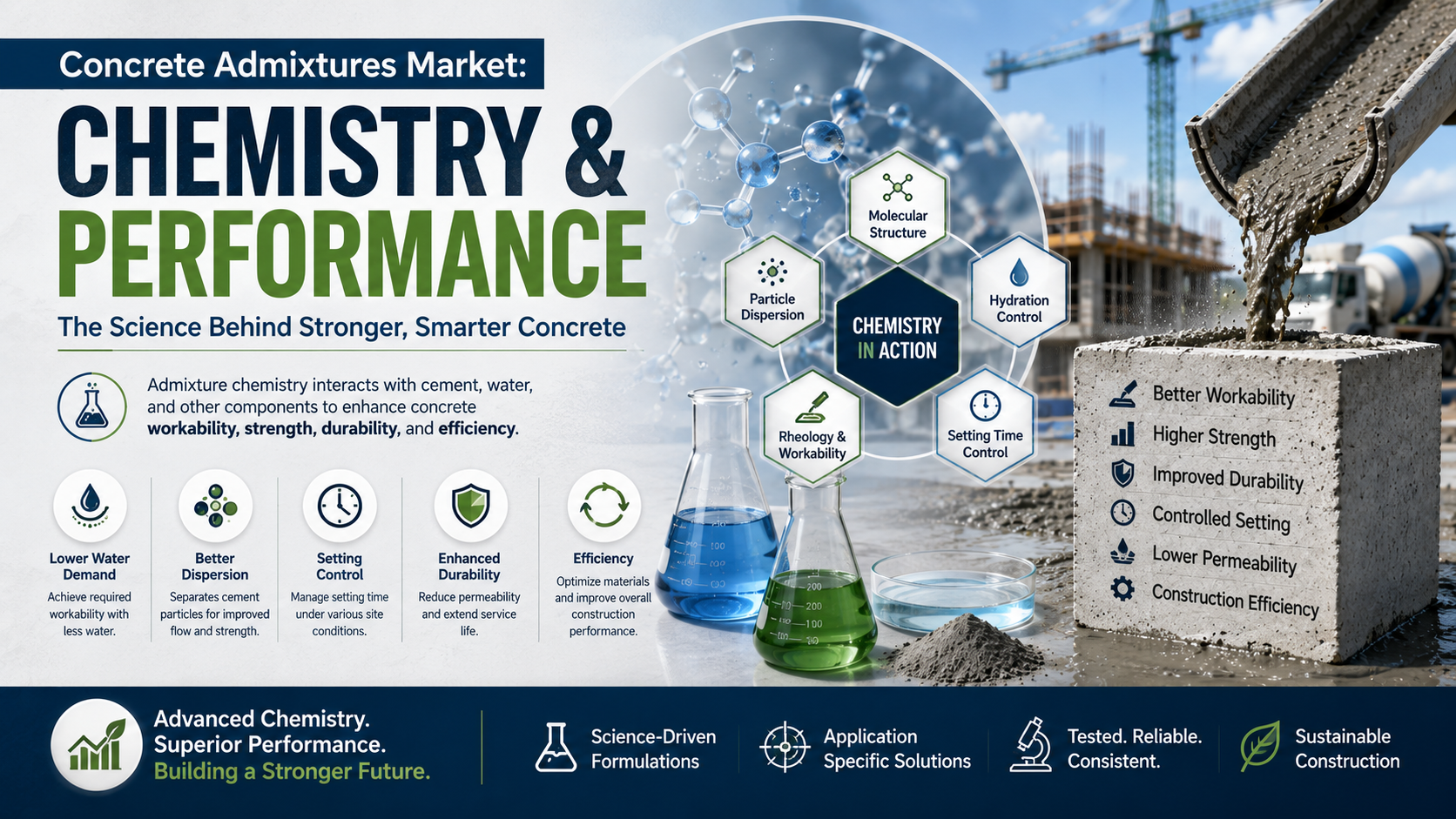
Concrete is a chemically complex material whose performance changes according to the interaction between cement, water, aggregates, supplementary cementitious materials, and chemical admixtures. As construction projects demand greater strength, durability, workability, and efficiency, understanding these interactions has become increasingly important.
This relationship is also influencing the concrete admixtures market.
What is a concrete admixture? A concrete admixture is a chemical or mineral material added to concrete before or during mixing to modify specific properties, such as workability, setting time, strength development, water reduction, durability, or resistance to harsh environmental conditions. Different admixtures are designed to perform specific functions depending on the requirements of the concrete mix.
Modern admixtures are not simply added to concrete to produce a particular effect. Their performance depends on how their chemical structure interacts with cement particles, water, hydration products, supplementary cementitious materials, and other components of the mixture.
For concrete manufacturers, engineers, contractors, and industrial buyers, understanding this chemistry can help explain why the same admixture may produce different results in different concrete formulations.
What Is the Relationship Between Admixture Chemistry and Concrete Performance?
Chemical admixtures are formulated to modify specific properties of fresh or hardened concrete.
Depending on their chemistry, they can influence:
- Water demand
- Particle dispersion
- Workability
- Rheology
- Setting time
- Hydration behavior
- Strength development
- Air content
- Permeability
- Durability
The effect does not occur independently of the concrete mixture.
When an admixture is introduced into concrete, its molecules interact with cementitious particles and the surrounding water. These interactions can change how particles disperse, how the cement hydrates, and how the fresh concrete flows.
The resulting performance is therefore determined by the combination of admixture chemistry and concrete chemistry.
Why Chemistry Matters in the Concrete Admixtures Market
The concrete admixtures industry has moved beyond basic performance modification toward increasingly specialized formulations.
Concrete producers may need an admixture that can provide high water reduction while maintaining slump, control setting under difficult temperatures, improve durability, or work effectively with modern cementitious systems.
These requirements have increased the importance of formulation chemistry.
For manufacturers, product development involves balancing factors such as:
- Molecular structure
- Dosage
- Cement compatibility
- Water reduction
- Adsorption behavior
- Slump retention
- Setting characteristics
- Temperature sensitivity
- Compatibility with supplementary cementitious materials
As concrete formulations become more complex, admixture chemistry becomes an increasingly important part of mix optimization.
How Admixtures Interact With Cement
Cement contains several mineral phases that react with water during hydration.
When water is added, cement particles begin hydrating and gradually form hydration products that bind the aggregate particles together.
Admixtures can interact with the surfaces of these cement particles and influence the physical and chemical processes occurring within the cement paste.
The exact mechanism depends on the admixture.
Some products primarily modify particle dispersion, while others influence hydration kinetics, air-void formation, pore characteristics, or water movement.
This is why two admixtures designed for a similar purpose can behave differently in the same concrete mixture.
Particle Dispersion and Workability
One of the most important chemical mechanisms associated with modern water-reducing technologies is cement-particle dispersion.
Without sufficient dispersion, cement particles can form clusters within the mixture. These clusters can trap water and reduce the amount of water available to provide flow.
Certain chemical admixtures interact with cement particle surfaces and help separate these particles.
Improved dispersion can result in:
- Better flow
- Lower water demand
- Improved workability
- More efficient cement utilization
- Improved concrete consistency
This mechanism is particularly important in high-performance concrete where maintaining flow at a relatively low water-to-cementitious-material ratio is often required.
Polycarboxylate Ether Chemistry
Polycarboxylate ether, commonly abbreviated as PCE, is an important chemistry used in modern high-performance water-reducing admixtures.
PCE-based admixtures can provide significant dispersion of cement particles through a combination of adsorption and steric effects.
Their molecular architecture can be tailored to influence characteristics such as:
- Water reduction
- Initial flow
- Slump retention
- Setting behavior
- Compatibility
- Rheological properties
The ability to modify polymer structure has contributed to the development of admixtures designed for different concrete systems and performance requirements.
This is one example of how the evolution of chemical formulation is influencing the broader concrete admixtures market.
Traditional and Modern Admixture Chemistry
Different generations of admixture technology have used different chemical approaches.
Traditional water-reducing technologies have included materials such as lignosulfonates, while more advanced high-range water reducers often use synthetic polymer technologies such as PCE.
The distinction is not simply about whether one chemistry is “better.”
The appropriate technology depends on the concrete formulation and required performance.
Factors such as cost, water reduction, slump retention, setting characteristics, cement compatibility, and application requirements all influence product selection.
How Chemistry Influences Concrete Setting
Setting occurs as cement hydration progresses and the fresh concrete gradually loses its plasticity.
Admixtures can modify this process.
Accelerating technologies are formulated to promote faster setting or early strength development, while retarding technologies can extend working time.
However, the final response depends on more than the admixture itself.
Important variables include:
- Cement composition
- Concrete temperature
- Water-to-cementitious-material ratio
- Admixture dosage
- Supplementary cementitious materials
- Other admixtures
- Concrete age
This is why admixture performance should be evaluated using the actual concrete materials intended for the project.
Chemistry and Strength Development
Concrete strength develops as cement hydrates and a hardened microstructure forms.
Admixtures can influence strength indirectly or directly depending on their function.
For example, a water-reducing admixture may allow a concrete producer to achieve the required workability using less water. A lower water-to-cementitious-material ratio can contribute to higher strength when the concrete is properly designed, placed, and cured.
The chemistry of the admixture therefore interacts with the physical design of the concrete.
Strength should not be attributed to the admixture alone.
Cementitious material characteristics, aggregate quality, curing, air content, water content, and hydration all remain important.
Admixture Chemistry and Concrete Rheology
Rheology describes how fresh concrete flows and deforms.
It has become increasingly important as concrete technology moves toward self-compacting concrete, high-performance concrete, pumped concrete, and other specialized mixtures.
Admixture chemistry can affect:
- Yield stress
- Plastic viscosity
- Flowability
- Cohesion
- Segregation resistance
- Pumpability
- Slump retention
A formulation that produces excellent initial flow may not necessarily maintain that behavior over time.
For ready-mix applications, therefore, both initial workability and workability retention may need to be considered.
The Role of Adsorption
Adsorption is an important concept in understanding how certain admixture molecules interact with cement particles.
When admixture molecules adsorb onto particle surfaces, they can modify the interaction between particles.
In water-reducing technologies, this can contribute to particle dispersion and improved flow.
However, adsorption behavior can vary according to:
- Cement chemistry
- Mineral composition
- Surface characteristics
- Admixture molecular structure
- Dosage
- Supplementary cementitious materials
This helps explain why an admixture can perform differently when the cement source changes.
Supplementary Cementitious Materials and Admixture Chemistry
Modern concrete increasingly incorporates supplementary cementitious materials such as fly ash, slag, and silica fume.
These materials can alter the chemical and physical characteristics of the binder system.
As a result, they may influence:
- Water demand
- Particle packing
- Workability
- Setting
- Strength development
- Admixture adsorption
- Slump retention
The effect varies according to the material and replacement level.
For admixture manufacturers and concrete producers, this creates a need for formulations that can perform consistently across increasingly diverse cementitious systems.
How Chemical Raw Materials Influence Admixture Formulation
The performance of a finished admixture begins with its underlying chemical raw materials.
Raw materials determine important characteristics of the final formulation, including molecular structure, purity, reactivity, stability, and functional performance.
Factors that can affect formulation include:
- Raw-material purity
- Chemical composition
- Molecular characteristics
- Consistency between batches
- Storage stability
- Manufacturing process
- Supply availability
Variations in raw materials can therefore contribute to variations in finished-product performance.
For industrial buyers, evaluating raw-material quality and supplier consistency can be as important as comparing nominal product specifications.
Chemistry and Waterproofing Performance
Waterproofing admixtures represent another area where chemistry and concrete structure interact.
An integral waterproofing system may work by modifying water movement through the concrete matrix, reducing capillary absorption, refining pore pathways, or introducing water-repellent characteristics depending on the technology.
However, chemical performance cannot compensate for fundamental concrete defects.
Water penetration can also be influenced by:
- Cracking
- Poor compaction
- Improper curing
- Construction joints
- Honeycombing
- High permeability
- Poor detailing
Consequently, waterproofing chemistry should be considered as part of a broader concrete durability strategy.
Chemistry and Corrosion Protection
Corrosion-inhibiting admixtures provide another example of specialized chemical technology.
In reinforced concrete, corrosion can occur when aggressive substances such as chlorides reach reinforcing steel and disrupt its protective passive condition.
Certain corrosion-inhibiting technologies are designed to help maintain or restore protection around reinforcing steel.
Their effectiveness depends on the concrete environment, exposure conditions, dosage, and overall durability design.
This demonstrates an important principle within the concrete admixtures market: specialized chemical formulations are increasingly being developed around specific performance problems rather than one general-purpose function.
Why Admixture Compatibility Matters
A concrete mixture may contain multiple chemical admixtures simultaneously.
For example, a formulation could combine a water reducer with an accelerating or retarding technology, air-entraining agent, or durability-focused admixture.
These products can interact with one another.
Compatibility issues may affect:
- Workability
- Slump retention
- Setting time
- Air content
- Bleeding
- Segregation
- Strength development
The interaction between cement and admixtures can also change when the cementitious system changes.
Therefore, compatibility testing is particularly important when developing or modifying a concrete formulation.
How Temperature Changes Admixture Performance
Temperature can influence both cement hydration and admixture behavior.
Higher temperatures can accelerate hydration and reduce available working time, while lower temperatures can slow setting and strength development.
The same admixture dosage may therefore produce different results under different environmental conditions.
Concrete producers should consider:
- Ambient temperature
- Concrete temperature
- Transportation duration
- Placement conditions
- Required setting time
- Curing conditions
This is particularly important for large infrastructure projects and seasonal construction operations.
From Chemical Formulation to Concrete Performance
The connection between chemistry and performance can be understood as a chain:
Chemical structure → interaction with cementitious particles → changes in dispersion or hydration → changes in fresh-concrete behavior → changes in hardened-concrete properties
For example:
PCE-based water reducer → cement-particle dispersion → lower water demand → improved flow at a lower water content → potential improvement in strength and durability when the overall mix is properly designed.
This illustrates why admixture technology should be evaluated as part of a complete concrete system.
What Is Driving Innovation in the Concrete Admixtures Market?
Several trends are encouraging continued development of admixture chemistry.
Performance-based concrete
Engineers increasingly specify concrete based on performance requirements rather than relying solely on conventional mix proportions.
This creates demand for admixtures capable of delivering specific combinations of workability, strength, setting, and durability.
Lower water demand
Reducing water while maintaining workability remains an important objective in high-performance concrete.
This supports continued development of advanced water-reducing technologies.
Slump retention
Longer transportation distances and demanding placement schedules create a need for concrete that can maintain workable characteristics over time.
Complex binder systems
The increased use of supplementary cementitious materials and blended cement systems creates new formulation challenges and opportunities.
Durability requirements
Longer service-life expectations are increasing interest in technologies that address permeability, water penetration, corrosion, shrinkage, and other durability-related concerns.
Resource efficiency
The construction industry is increasingly focused on using materials efficiently. Admixtures can contribute to optimized concrete formulations by modifying performance without relying solely on increased cement or water content.
Challenges Facing Admixture Development
Advanced admixture chemistry also presents challenges.
Variable cement chemistry
Changes in cement composition can affect adsorption, workability, and setting behavior.
Raw-material variability
Inconsistent chemical raw materials can make it difficult to maintain consistent product performance.
Complex concrete formulations
Modern concrete can contain multiple supplementary cementitious materials and chemical admixtures, increasing the number of possible interactions.
Environmental conditions
Temperature and transportation time can significantly influence concrete behavior.
Performance versus cost
An advanced formulation may provide superior technical performance but must still meet the economic requirements of the intended application.
For manufacturers, the challenge is to balance performance, consistency, formulation complexity, and commercial practicality.
How Manufacturers Can Improve Admixture Performance
Reliable admixture development requires systematic formulation and testing.
Important practices include:
- Characterizing raw materials.
- Controlling formulation consistency.
- Understanding cement-admixture interactions.
- Evaluating different dosage levels.
- Testing with representative cementitious materials.
- Checking compatibility with other admixtures.
- Evaluating temperature sensitivity.
- Measuring fresh and hardened concrete properties.
- Monitoring batch-to-batch consistency.
- Validating formulations under realistic production conditions.
This approach helps move admixture development from simple chemical formulation toward performance-based engineering.
What Should Buyers Consider When Evaluating Admixture Technology?
Industrial buyers should look beyond the headline function of an admixture.
Important questions include:
- What concrete system is the product designed for?
- What dosage range is recommended?
- How consistent is product performance between batches?
- Is the product compatible with the intended cement?
- How does it perform with supplementary cementitious materials?
- What happens under different temperatures?
- How well does it maintain workability?
- What technical documentation is available?
- Can the supplier support trial batching?
- What quality-control measures are used?
These considerations can help buyers identify products that are appropriate for their actual concrete formulation rather than simply choosing based on price.
The Future of Admixture Chemistry
The future development of concrete admixtures is likely to focus increasingly on precision and application-specific performance.
Rather than developing products around a single property, manufacturers are working toward formulations that can address several requirements simultaneously.
Potential areas of continued development include:
- Advanced polymer architectures
- Improved slump retention
- Greater compatibility with blended binders
- Lower dosage requirements
- Specialized durability technologies
- Improved performance under variable temperatures
- More resource-efficient concrete formulations
- Admixtures designed for low-carbon concrete systems
As concrete formulations become more sophisticated, the ability to understand and control chemical interactions will become increasingly important.
Conclusion
The concrete admixtures market is closely connected to advances in concrete chemistry. Admixtures influence concrete through interactions with cementitious particles, water, hydration processes, pore structure, and other components of the mixture.
Understanding these interactions helps explain why admixture performance can vary between concrete systems.
Modern water reducers, superplasticizers, accelerating technologies, retarding technologies, waterproofing systems, corrosion inhibitors, and other specialized products are increasingly designed around specific performance requirements.
For engineers, concrete producers, manufacturers, and industrial buyers, successful admixture selection therefore requires more than identifying a product category. Cement chemistry, raw-material quality, supplementary cementitious materials, dosage, temperature, compatibility, and project requirements all need to be considered.
As the construction industry moves toward higher-performance, more durable, and more resource-efficient concrete, the relationship between chemical formulation and concrete performance will remain a central factor in the development of the admixture industry.
Frequently Asked Questions
1. How does admixture chemistry affect concrete performance?
Admixture chemistry determines how a product interacts with cementitious particles, water, hydration processes, and other components. These interactions can influence workability, water demand, setting, strength development, rheology, and durability.
2. Why can the same admixture perform differently with different cement?
Cement composition, fineness, mineral phases, and surface characteristics can influence how admixture molecules interact with cement particles. Consequently, changes in cement can affect workability, setting, and dosage requirements.
3. What is PCE in concrete admixtures?
PCE stands for polycarboxylate ether. PCE-based admixtures are commonly used as high-range water reducers because their molecular structure can provide effective cement-particle dispersion and high water reduction.
4. Do chemical raw materials affect admixture quality?
Yes. Raw-material purity, chemical composition, molecular characteristics, consistency, and manufacturing controls can influence the performance and stability of the finished admixture.
5. Why is admixture compatibility important?
Different admixtures can interact with each other and with cementitious materials. Compatibility testing helps identify potential changes in workability, setting, air content, bleeding, segregation, and strength.
6. Does admixture chemistry directly determine concrete strength?
Not by itself. Admixtures can influence factors such as water demand, workability, hydration, and air content, which can affect strength. Final strength also depends on mix proportions, cementitious materials, aggregates, curing, and other factors.
7. How is admixture chemistry evolving?
Development is increasingly focused on application-specific performance, improved water reduction, longer slump retention, compatibility with complex binder systems, durability, resource efficiency, and formulations suitable for emerging low-carbon concrete technologies.