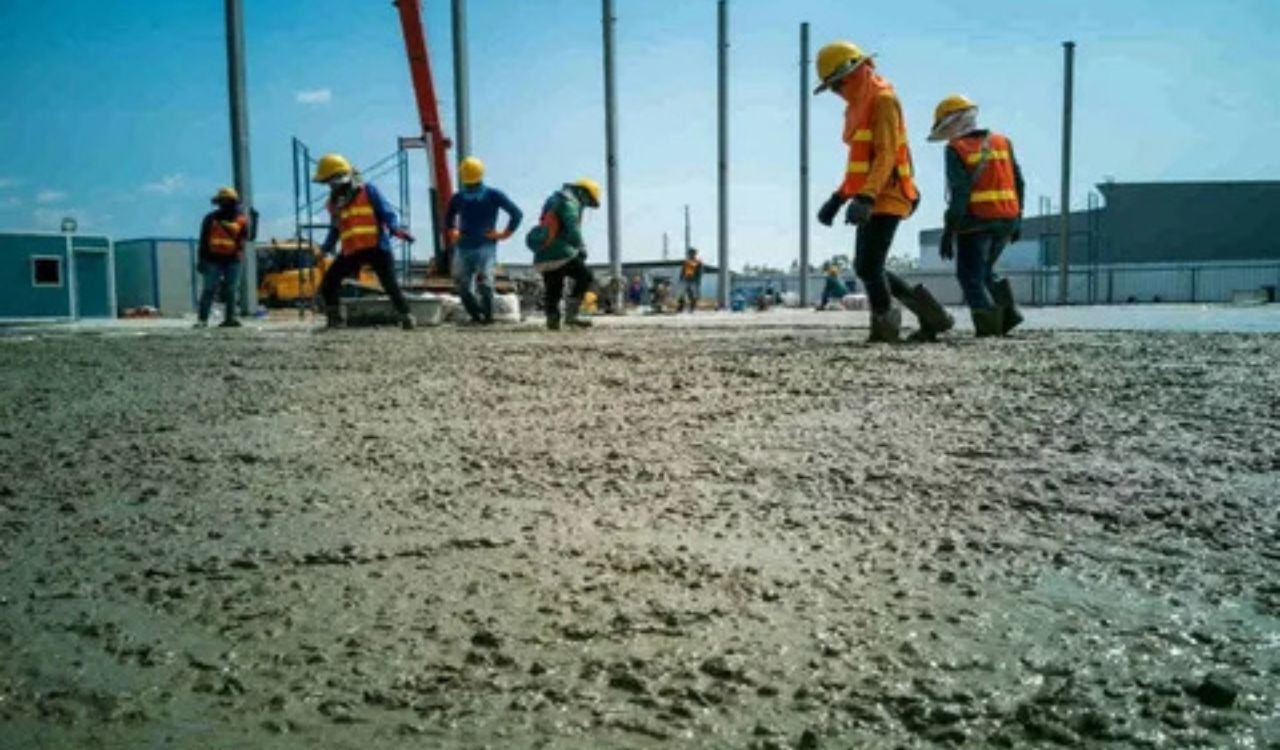
Crystalline waterproofing can significantly reduce water penetration through the concrete matrix, but waterproof concrete is not simply a matter of adding a waterproofing admixture to the mix. The locations where one concrete pour meets another require separate attention because the continuity of the concrete matrix is interrupted.
This is why construction joints in concrete can become vulnerable points in otherwise well-designed waterproof structures. A wall, slab, tank, basement, or foundation may have low-permeability concrete throughout its main body, yet water can still find a pathway through a poorly prepared or inadequately detailed joint.
A crystalline waterproofing admixture works within the concrete by promoting the formation of insoluble crystalline structures that reduce pathways through pores and fine cracks. Luke Chemicals, for example, offers crystalline self-healing waterproofing technology designed to improve impermeability and address microcracking within concrete.
The important distinction is that integral waterproofing of the concrete does not eliminate the need for proper construction-joint design.
What Is a Construction Joint in Concrete?
A construction joint is a planned interface between two concrete placements that are cast at different times.
Construction joints are normally required when a concrete pour cannot be completed continuously because of:
- Daily construction schedules
- Maximum practical pour sizes
- Concrete delivery limitations
- Formwork arrangements
- Structural sequencing
- Access restrictions
- Equipment capacity
- Planned stages of construction
A construction joint is therefore not necessarily a defect. It is a designed part of the construction sequence.
The challenge is maintaining adequate structural continuity and water resistance across the interface between the older and newer concrete.
Why Are Construction Joints Vulnerable to Water Ingress?
Fresh concrete develops a relatively continuous cementitious matrix as hydration progresses. A construction joint introduces an interface where this continuity can be interrupted.
Several factors can make the joint more permeable than the surrounding concrete.
1. Poor Surface Preparation
After the first concrete placement has hardened, the surface may contain laitance, loose particles, weak cement paste, dust, or other contaminants.
If the surface is not properly prepared before the next pour, the new concrete may not establish the required bond with the previous concrete.
2. Inadequate Consolidation
Concrete around reinforcement, embedded waterstops, corners, and joint details can be difficult to compact.
Insufficient vibration can leave:
- Voids
- Honeycombing
- Entrapped air
- Poor contact around reinforcement
- Localized permeability
These defects can create direct pathways for water.
3. Bleeding and Laitance
Excessive bleeding can concentrate water and fine cement particles near the surface of the first pour.
The resulting weak layer can reduce the quality of the interface unless it is removed or properly treated.
4. Shrinkage and Cracking
Concrete undergoes volume changes during drying and temperature variations.
A construction joint may experience localized stresses caused by:
- Drying shrinkage
- Thermal movement
- Restraint
- Differential deformation
- Structural movement
A joint that is exposed to movement requires a different approach from a relatively stable non-moving construction joint.
5. Improper Joint Detailing
Even high-performance concrete can leak if the joint lacks suitable water-control measures.
For water-retaining or below-grade structures, joint design may incorporate waterstops, joint profiles, hydrophilic materials, or compatible crystalline joint treatments depending on the project requirements.
How Does Crystalline Waterproofing Work in Concrete?
A crystalline waterproofing admixture is incorporated into the concrete mixture rather than being applied only to the finished surface.
The technology generally relies on a chemical reaction within the cementitious environment that promotes crystalline growth in capillary pores and fine discontinuities.
The objective is to reduce pathways through which water can move.
This differs from simply placing a conventional waterproof coating over the concrete surface.
Integral Waterproofing vs Joint Waterproofing
| Feature | Integral crystalline waterproofing | Construction-joint treatment |
| Main target | Concrete matrix | Interface between pours |
| Typical mechanism | Crystalline growth within pores and fine cracks | Joint-specific barrier, treatment, or waterstop |
| Main purpose | Reduce permeability | Control water movement at the joint |
| Applied to | Concrete mixture | Joint/interface area |
| Requires proper concrete placement? | Yes | Yes |
| Replaces joint detailing? | No | No |
This distinction is critical. A waterproofing admixture should be considered one part of a waterproof concrete system, not a substitute for proper construction-joint detailing.
Why Crystalline Waterproofing Does Not Automatically Waterproof Every Joint
The concrete surrounding a construction joint may have excellent permeability characteristics while the joint itself remains vulnerable.
Research on reinforced concrete walls has found that construction-joint areas can have lower impermeability than continuously cast concrete, with the joint becoming a potential source of seepage.
This happens because the performance of the joint depends on factors beyond the chemical properties of the concrete.
The joint must also account for:
- Interface preparation
- Joint geometry
- Concrete placement sequence
- Compaction
- Reinforcement congestion
- Waterstop installation
- Curing
- Crack control
- Expected movement
- Hydrostatic pressure
Therefore, waterproofing performance should be evaluated at both levels:
Concrete matrix + construction-joint detail
Types of Construction Joints Relevant to Waterproof Concrete
Not every joint behaves in the same way.
Horizontal Construction Joints
Horizontal joints commonly occur when a wall is constructed in multiple lifts or when a foundation slab is poured separately from the wall.
They can become important water-ingress locations in:
- Basements
- Underground tanks
- Water reservoirs
- Retaining walls
- Tunnels
- Treatment plants
Their waterproofing requires careful coordination between the concrete placement sequence and the joint-treatment system.
Vertical Construction Joints
Vertical joints can occur when walls or slabs are divided into separate casting sections.
The joint should be positioned and detailed according to structural requirements, reinforcement layout, concrete placement sequence, and waterproofing requirements.
Wall-to-Slab Construction Joints
The connection between a basement slab and wall is particularly important because water pressure can act against the external face of the structure.
Joint preparation and water-control detailing should therefore be incorporated into the construction method before concrete placement begins.
Construction Joint vs Expansion Joint vs Control Joint
These terms are sometimes used interchangeably, but they serve different purposes.
| Joint type | Primary purpose | Typical movement consideration |
| Construction joint | Separates concrete placement stages | Limited or project-dependent |
| Expansion joint | Accommodates intentional structural movement | Significant |
| Control joint | Controls or directs cracking | Designed cracking |
| Isolation joint | Separates adjacent elements | Allows relative movement |
A crystalline waterproofing admixture may contribute to overall concrete impermeability, but it should not be assumed to provide the same function as a flexible joint seal or movement-accommodating waterstop.
For joints expected to experience significant movement, the waterproofing system must be selected according to the expected movement and service conditions.
Key Waterproofing Measures for Construction Joints
A reliable system normally combines concrete quality with appropriate joint detailing.
Proper Joint Surface Preparation
Before placing the next concrete pour, the joint surface should be prepared according to the approved method statement and project specification.
Depending on the system, preparation may include:
- Removing laitance
- Removing loose concrete
- Cleaning dust and debris
- Exposing sound concrete
- Roughening the interface where required
- Pre-wetting when specified
- Applying a compatible bonding or crystalline treatment where required
The objective is to create a sound interface rather than simply making the surface appear clean.
Waterstops
Waterstops provide a physical barrier against water movement through joints.
Common types include:
- PVC waterstops
- Hydrophilic waterstops
- Rubber waterstops
- Swellable waterstop strips
- Specialized crystalline joint systems
The correct choice depends on whether the joint is moving or non-moving, the water pressure, chemical exposure, installation conditions, and project specifications.
Crystalline Joint Treatment
Some crystalline waterproofing systems include dedicated materials for treating construction joints.
These may be applied directly to the prepared joint or used as part of a broader joint waterproofing system.
The important point is that the treatment should be compatible with the integral waterproofing system and installed according to the manufacturer’s technical instructions.
Good Concrete Placement
Even the best joint material cannot compensate for poorly placed concrete.
Particular attention should be given to:
- Proper slump
- Appropriate water-cement ratio
- Concrete workability
- Reinforcement congestion
- Vibration
- Avoiding segregation
- Avoiding excessive bleeding
- Proper finishing
- Adequate curing
The Role of Water-Reducing Admixtures
A water reducing agent in concrete can indirectly contribute to waterproofing performance by allowing the required workability to be achieved with less mixing water.
Lower water demand can support a lower water-cement ratio when the mixture is properly proportioned.
This can result in a denser cementitious matrix and lower permeability.
Water reducing admixtures should therefore be considered part of the overall concrete mix-design strategy rather than as a standalone waterproofing solution.
For example, PCE-based high-range water reducers are widely used when concrete needs high flowability without excessive water addition.
However, compatibility must be verified through trial batching because cement chemistry, supplementary cementitious materials, admixture combinations, temperature, and dosage can all influence concrete behavior.
Can Shrinkage-Reducing Additives Help?
Shrinkage is an important consideration in watertight concrete.
A shrinkage-reducing additive or shrink reducing additive can be used in suitable mixtures to help manage drying-shrinkage-related stresses.
This is especially relevant where cracking could create pathways for water ingress.
However, shrinkage-reducing technology should not be viewed as a replacement for:
- Correct joint placement
- Reinforcement detailing
- Proper curing
- Appropriate water-cement ratio
- Temperature control
- Construction sequencing
Crack prevention is a system-level issue.
How Admixture Selection Affects Joint Performance
The performance of concrete at construction joints can be influenced by the overall admixture package.
Depending on the project, the concrete mix may contain:
- Water-reducing admixture
- High-range water reducer
- Crystalline waterproofing admixture
- Shrinkage-reducing admixture
- Set accelerator
- Set retarder
- Air-entraining admixture
- Other performance-enhancing additives
These products should not simply be combined based on their individual benefits.
Their interaction must be evaluated through laboratory testing and field trial batches.
For example, an accelerating admixture may be useful when early strength or rapid setting is required, but changes in setting behavior can also affect finishing, placement, joint preparation, and construction sequencing.
ASTM C494 and Concrete Admixture Selection
ASTM C494 provides classifications for several chemical admixture types used in concrete.
Common categories include:
- Type A – Water-reducing
- Type B – Retarding
- Type C – Accelerating
- Type D – Water-reducing and retarding
- Type E – Water-reducing and accelerating
- Type F – Water-reducing, high range
- Type G – Water-reducing, high range and retarding
- Type S – Specific performance admixtures
The appropriate classification depends on the intended performance and project specification.
Importantly, ASTM C494 classification does not by itself establish that an admixture is a complete waterproofing system. Waterproofing performance must be assessed against the requirements of the specific project.
Best Practices for Waterproof Construction Joints
A practical approach is to address the joint before concrete placement rather than waiting for leakage after construction.
During Design
Define:
- Joint locations
- Joint type
- Expected movement
- Hydrostatic pressure
- Water exposure
- Waterstop requirements
- Concrete performance requirements
- Waterproofing system
- Repair strategy
Before the First Pour
Confirm:
- Formwork is correctly installed
- Reinforcement is correctly positioned
- Waterstops are securely fixed
- Joint components are clean
- Construction sequence is understood
- Concrete mix has been trial-batched where necessary
Before the Second Pour
Inspect:
- Joint surface condition
- Removal of laitance
- Cleanliness
- Waterstop condition
- Reinforcement
- Embedded items
- Joint treatment
- Concrete delivery sequence
During Placement
Monitor:
- Concrete consistency
- Segregation
- Placement rate
- Consolidation
- Waterstop stability
- Cold-joint risk
- Concrete cover
- Curing arrangements
After Placement
Check:
- Curing
- Surface defects
- Honeycombing
- Cracking
- Leakage during testing
- Joint condition
Common Mistakes That Cause Leakage
Several construction practices can undermine an otherwise well-designed waterproof concrete system.
Treating the Admixture as a Complete Waterproofing System
Integral waterproofing improves concrete performance, but construction joints still require appropriate detailing.
Adding Extra Water on Site
Uncontrolled water addition can change the designed water-cement ratio and affect strength, permeability, shrinkage, and durability.
Poor Joint Cleaning
Dust, laitance, loose material, and contaminants can weaken the interface.
Incorrect Waterstop Installation
A damaged, displaced, poorly joined, or improperly anchored waterstop may create a leakage pathway.
Insufficient Consolidation
Voids around joint components and reinforcement can become direct water paths.
Ignoring Curing
Poor curing can increase cracking and adversely affect the development of the cementitious matrix.
Using Incompatible Admixtures
Multiple additives for concrete should be assessed for compatibility rather than selected independently.
Can Concrete Additive Storage Sensors Improve Quality Control?
For large-scale concrete and construction chemical operations, material storage conditions can affect product consistency.
Concrete additive storage sensors can be relevant where temperature, humidity, inventory conditions, or other environmental parameters need monitoring for sensitive materials.
This is particularly useful for manufacturers, concrete producers, and industrial facilities handling chemical raw materials and specialty chemical manufacturing raw material systems.
However, storage monitoring is a quality-control measure. It does not replace proper concrete mix design, joint detailing, testing, or installation practices.
Where Is This Approach Most Important?
Construction-joint waterproofing becomes particularly important in structures where water ingress can affect durability, operation, or serviceability.
Typical applications include:
- Underground basements
- Water tanks
- Reservoirs
- Swimming pools
- Wastewater facilities
- Tunnels
- Retaining walls
- Foundations
- Parking structures
- Water treatment plants
- Industrial structures
- Below-grade infrastructure
In these applications, waterproofing should be considered as a complete system involving concrete quality, reinforcement, joints, penetrations, cracks, curing, and drainage.
A Practical Waterproof Concrete Strategy
A reliable approach can be summarized in five stages:
1. Design the joint
Determine where the joint will occur and what movement and water pressure it must withstand.
2. Design the concrete
Select the required water-cement ratio, cementitious materials, workability, strength, and durability characteristics.
3. Select compatible admixtures
Choose waterproofing, water-reducing, shrinkage-reducing, accelerating, or other admixtures based on actual project requirements.
4. Detail the joint
Use the appropriate waterstop, joint treatment, sealant, or other waterproofing detail.
5. Control construction
Ensure surface preparation, placement, consolidation, curing, and inspection follow the approved method statement.
This integrated approach is more reliable than depending on any single concrete additive.
How to Specify a Crystalline Waterproofing System
Engineers and contractors should consider more than the product name when preparing a specification.
Important information includes:
- Concrete exposure conditions
- Required permeability performance
- Hydrostatic pressure
- Crack-width considerations
- Joint types
- Expected joint movement
- Waterstop requirements
- Concrete strength
- Water-cement ratio
- Admixture dosage
- Compatibility with other admixtures
- Mixing procedure
- Curing requirements
- Testing requirements
- Repair procedures
- Manufacturer technical documentation
For critical waterproof structures, trial mixes and representative joint details can provide valuable information before large-scale construction begins.
Water-reducing admixture makes concrete waterproof
A water reducing admixture can help reduce water demand while maintaining workability. When used correctly, this can support a lower water-cement ratio and lower permeability, but it is not by itself a complete waterproofing system.
Final Takeaway
Crystalline waterproofing can significantly improve the resistance of concrete to water penetration, but the construction joint remains a critical detail because it interrupts the continuity of the concrete matrix.
The most effective strategy is not to ask whether a concrete waterproof admix can waterproof the entire structure by itself. Instead, the better question is whether the concrete mix, crystalline waterproofing technology, joint detailing, waterstop system, placement procedure, curing, and quality control have been designed to work together.
For engineers and contractors, this system-based approach helps reduce leakage risks and supports more durable waterproof concrete construction.
Frequently Asked Questions
Is crystalline waterproofing enough to stop leakage at construction joints?
Not necessarily. Integral crystalline waterproofing can reduce permeability within the concrete, but construction joints require appropriate detailing and treatment based on the joint type, expected movement, and water exposure.
Why are construction joints more vulnerable than continuous concrete?
A construction joint creates an interface between concrete placed at different times. Surface preparation, laitance, inadequate consolidation, shrinkage, poor bonding, or defective joint detailing can make the interface more permeable.
Can a waterproofing admixture replace a waterstop?
Generally, no. A waterproofing admixture and a waterstop perform different functions. The appropriate system depends on the joint type, movement, water pressure, and project specification.
Are shrinkage-reducing additives useful for waterproof concrete?
They can be useful where drying shrinkage is a concern. However, they should be combined with appropriate reinforcement, curing, concrete mix design, and joint detailing.
Which construction joints need the most attention?
Joints in below-grade and water-retaining structures deserve particular attention because hydrostatic pressure can drive water through small defects. Horizontal wall joints, slab-to-wall joints, and joints around penetrations are common critical details.
How should admixtures be tested before use?
Admixtures should be evaluated through appropriate laboratory testing and, where necessary, trial batching under representative materials and environmental conditions. Compatibility with cementitious materials and other admixtures should be verified before full-scale placement.