Introduction
Concrete waterproofing admixtures help prevent one of the leading causes of concrete deterioration worldwide—water penetration. From underground foundations and parking garages to tunnels, water treatment plants, and marine structures, effective waterproofing is essential for maintaining long-term durability, structural integrity, and service life. By reducing permeability and protecting against moisture intrusion, waterproofing admixtures enhance concrete performance in even the most demanding environments.
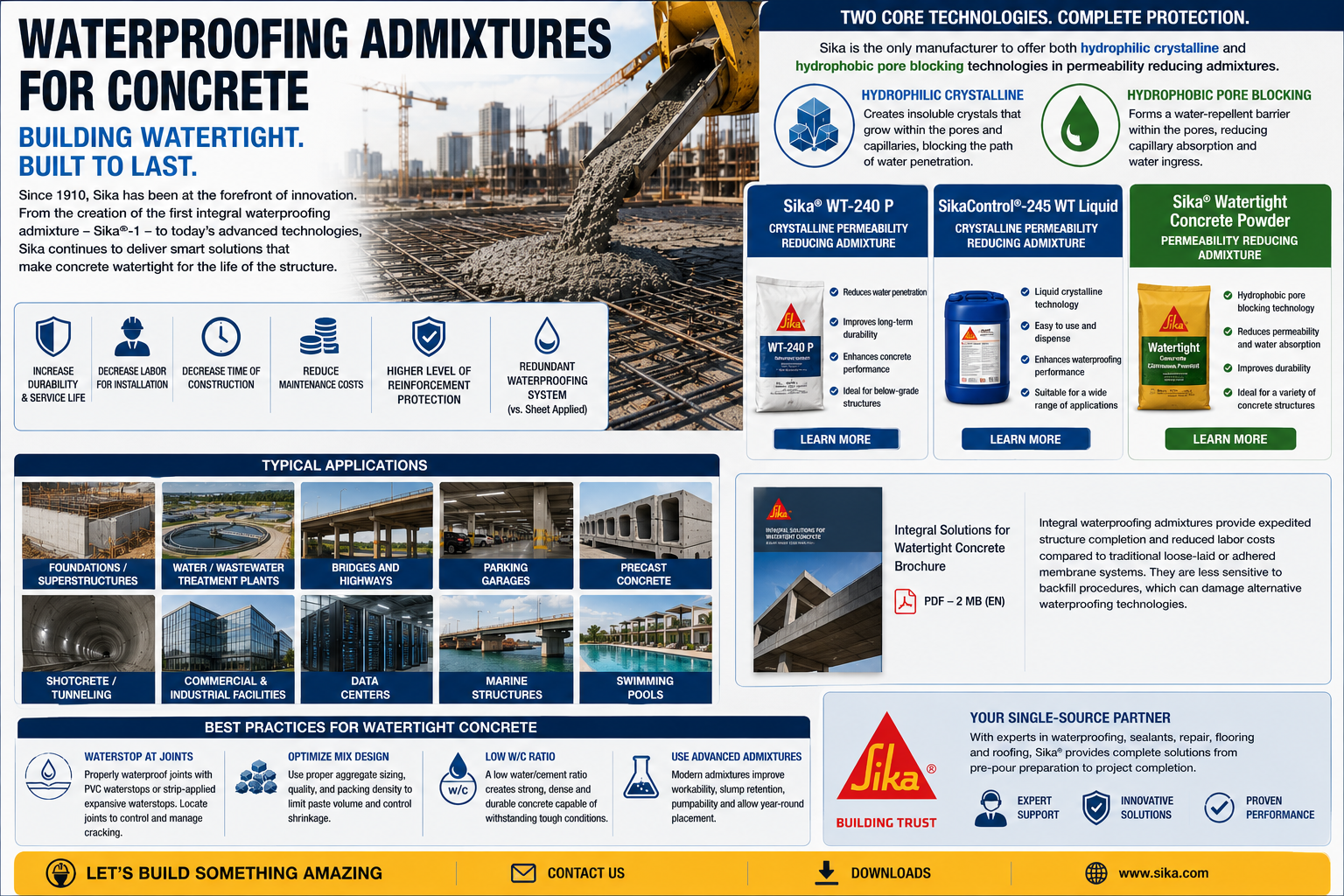
The history of modern waterproofing admixtures for concrete dates back more than a century. In 1910, Sika introduced Sika®-1, one of the industry’s first integral waterproofing admixtures. Since then, waterproofing technology has evolved significantly, providing engineers and contractors with advanced solutions that improve concrete durability, reduce permeability, and extend service life.
Today, Sika offers both hydrophilic crystalline permeability reducing admixtures and hydrophobic pore-blocking admixtures, making it one of the few manufacturers capable of addressing diverse waterproofing requirements with multiple technologies.
This guide explores how waterproofing admixtures work, the different technologies available, their advantages over traditional membrane systems, and why integral waterproofing solutions are transforming modern construction.
What Are Waterproofing Admixtures?
Waterproofing admixtures are specialized concrete additives introduced during the mixing process to reduce water penetration through hardened concrete.
Unlike surface-applied waterproofing systems, these admixtures become an integral part of the concrete matrix, providing long-term protection throughout the structure’s lifespan.
Why Concrete Waterproofing Matters
Although concrete appears solid, it naturally contains microscopic pores and capillaries that allow water and moisture to migrate through the structure.
Over time, water infiltration can cause:
- Reinforcement corrosion
- Freeze-thaw damage
- Efflorescence
- Chemical attack
- Mold growth
- Structural deterioration
Waterproofing admixtures address these challenges by reducing permeability and improving the concrete’s resistance to water ingress.
Benefits of Waterproof Concrete
Enhanced Structural Durability
Water-resistant concrete maintains its integrity longer under aggressive environmental conditions.
Lower Maintenance Costs
Reducing moisture penetration minimizes repair requirements throughout the structure’s service life.
Improved Reinforcement Protection
By limiting water and chloride ingress, waterproofing admixtures help protect embedded steel reinforcement from corrosion.
Extended Service Life
Structures remain functional and durable for decades with reduced risk of premature deterioration.
Understanding Permeability Reducing Admixture Technologies
| Feature | Hydrophilic Crystalline | Hydrophobic Pore-Blocking |
|---|---|---|
| How it works | Reacts with water and cement byproducts to form insoluble crystals in pores | Lines pores and capillaries to repel water and cut capillary suction |
| ACI 212.3R category | PRAH (hydrostatic conditions) | PRAN (non-hydrostatic conditions) |
| Best under | Constant water pressure (basements, tanks, tunnels) | Damp soil, splash zones, capillary moisture |
| Response to moisture | Keeps reacting when water re-enters, which can help seal fine cracks | Works immediately, but does not react to later water exposure |
| Typical forms | Powder or liquid | Powder, liquid, or emulsion |
| Example products | Sika® WT-240 P, SikaControl®-245 WT | Sika® Watertight Concrete Powder |
| Typical uses | Foundations, water-retaining structures, tunnels, pools | Precast, parking structures, above-grade slabs, walls |
Modern waterproofing admixtures generally utilize two primary technologies:
Hydrophilic Crystalline Technology
Hydrophilic crystalline admixtures react with water and cement byproducts to create insoluble crystals within the concrete’s pore structure.
These crystals continue developing whenever moisture is present, helping seal micro-pores and capillary pathways.
How Crystalline Waterproofing Works
When water enters concrete:
- Active chemicals react with free lime and moisture.
- Crystal formations develop within pores.
- Water pathways become blocked.
- Permeability is significantly reduced.
Key Crystalline Admixture Solutions
Sika® WT-240 P
A crystalline permeability reducing admixture designed to enhance watertight concrete performance.
Features
- Reduces water penetration
- Improves durability
- Enhances long-term waterproofing performance
- Suitable for below-grade applications
SikaControl®-245 WT Liquid
A liquid crystalline waterproofing admixture developed for projects requiring integral moisture protection.
Benefits
- Easy incorporation into concrete production
- Enhanced waterproofing performance
- Long-term durability improvements
- Reduced permeability
Hydrophobic Pore-Blocking Technology
Hydrophobic waterproofing admixtures work differently by creating water-repellent characteristics within the concrete matrix.
Rather than forming crystals, these admixtures coat pore structures and reduce water absorption.
How Hydrophobic Admixtures Work
Hydrophobic agents:
- Reduce capillary suction
- Limit moisture absorption
- Increase water repellency
- Improve resistance to water ingress
Sika® Watertight Concrete Powder
Sika® Watertight Concrete Powder is a permeability-reducing admixture that utilizes hydrophobic pore-blocking technology.
Advantages
- Integral waterproofing protection
- Reduced permeability
- Enhanced durability
- Long-term moisture resistance
Why Integral Waterproofing Outperforms Traditional Membranes
Traditional waterproofing often relies on sheet membranes, coatings, or adhered waterproofing systems.
While effective in certain applications, these systems can be vulnerable to installation errors and physical damage.
Advantages of Integral Waterproofing Admixtures
Faster Construction Schedules
Integral waterproofing eliminates many installation steps associated with external membrane systems.
Reduced Labor Costs
Since waterproofing becomes part of the concrete itself, contractors spend less time installing separate waterproofing layers.
Improved Protection During Backfilling
Below-grade membrane systems can be damaged during backfill operations.
Integral waterproofing admixtures remain protected within the concrete matrix.
Redundant Waterproofing Performance
Unlike single-layer membrane systems, waterproofing admixtures provide protection throughout the entire concrete section.
Key Benefits of Waterproofing Admixtures
Increased Durability and Service Life
Waterproofing admixtures significantly reduce permeability, helping structures resist environmental deterioration.
Long-Term Benefits
- Reduced cracking
- Improved chemical resistance
- Better freeze-thaw performance
- Lower maintenance requirements
Increased Safety
Moisture-related structural deterioration can compromise safety over time.
Reducing water penetration helps preserve structural integrity and occupant safety.
Reduced Construction Time
Contractors can accelerate project completion by minimizing separate waterproofing installation processes.
Time-Saving Advantages
- Fewer construction stages
- Reduced labor requirements
- Faster project turnover
Enhanced Reinforcement Protection
Waterproof concrete helps protect embedded steel from corrosion, one of the primary causes of concrete deterioration worldwide.
Common Applications for Waterproofing Admixtures
Integral waterproofing solutions are used across numerous construction sectors.
Foundations and Basements
Below-grade structures are highly susceptible to groundwater infiltration.
Waterproofing admixtures provide long-term moisture protection.
Water and Wastewater Treatment Plants
Water-retaining structures require reliable waterproofing to prevent leakage and maintain operational efficiency.
Bridges and Highways
Transportation infrastructure faces constant exposure to water, chlorides, and environmental stress.
Waterproof concrete improves long-term durability.
Parking Garages
Parking structures benefit from enhanced resistance to water penetration and deicing chemicals.
Precast Concrete
Precast manufacturers often incorporate waterproofing admixtures to improve product quality and service life.
Shotcrete and Tunneling
Underground construction projects frequently rely on waterproof concrete to control groundwater infiltration.
Commercial and Industrial Facilities
Warehouses, factories, and industrial complexes require durable waterproofing solutions to protect valuable assets.
Data Centers
Data centers demand exceptional moisture protection to safeguard sensitive equipment and maintain operational continuity.
Marine Structures
Marine environments expose concrete to aggressive saltwater conditions.
Waterproofing admixtures help improve resistance to chloride penetration and corrosion.
Swimming Pools
Swimming pools require watertight concrete capable of retaining water while resisting long-term deterioration.
Best Practices for Designing Watertight Concrete Structures
Even the most advanced waterproofing admixtures must be combined with proper design and construction practices.
Joint Waterproofing Is Critical
Construction joints remain one of the most vulnerable areas for water infiltration.
Recommended Solutions
PVC Waterstops
Provide physical barriers against water migration.
Expansive Waterstops
Expand upon water contact to seal joints effectively.
Optimize Concrete Mix Design
Concrete mix design plays a major role in waterproofing performance.
Key Considerations
Low Water-Cement Ratio
Lower water content produces denser, stronger concrete.
Proper Aggregate Selection
Well-graded aggregates improve packing density and reduce shrinkage.
Quality Materials
Consistent raw materials improve overall concrete performance.
Utilize Modern Admixture Technologies
Advanced admixtures can address challenges such as:
- Slump retention
- Pumpability
- Workability
- Year-round placement
- Waterproofing performance
Why Waterproofing Admixtures Are Essential for Modern Construction
As structures become larger, more complex, and more demanding, traditional waterproofing methods alone may not provide sufficient long-term protection.
Waterproofing admixtures offer:
- Integral moisture protection
- Faster construction
- Lower lifecycle costs
- Improved durability
- Enhanced structural performance
By incorporating waterproofing directly into the concrete mix, contractors and engineers can create structures capable of performing reliably throughout their intended service life.
Frequently Asked Questions
What is a waterproofing admixture?
A waterproofing admixture is a concrete additive designed to reduce water penetration and improve the durability of concrete structures.
How do crystalline waterproofing admixtures work?
Crystalline admixtures react with moisture and cement byproducts to form insoluble crystals that block water pathways within concrete.
What is the difference between crystalline and hydrophobic waterproofing admixtures?
Crystalline admixtures create crystals that block pores, while hydrophobic admixtures make pores water-repellent and reduce absorption.
Are waterproofing admixtures better than membranes?
Waterproofing admixtures provide integral protection throughout the concrete structure and are less vulnerable to installation damage, although many projects use both systems together for maximum protection.
Where are waterproofing admixtures commonly used?
They are widely used in foundations, tunnels, water treatment plants, parking structures, marine facilities, swimming pools, and data centers.
Conclusion
For more than a century, waterproofing admixtures have helped engineers create stronger, more durable, and longer-lasting concrete structures. From hydrophilic crystalline technology to hydrophobic pore-blocking systems, modern waterproofing admixtures provide effective protection against water infiltration while simplifying construction processes.
Whether you’re designing foundations, tunnels, water treatment facilities, marine structures, or commercial developments, selecting the right permeability reducing admixture can significantly improve durability, reduce maintenance costs, and extend service life.
As waterproofing requirements continue to evolve, integral waterproofing solutions remain one of the most effective ways to build resilient, watertight concrete structures capable of performing for generations.