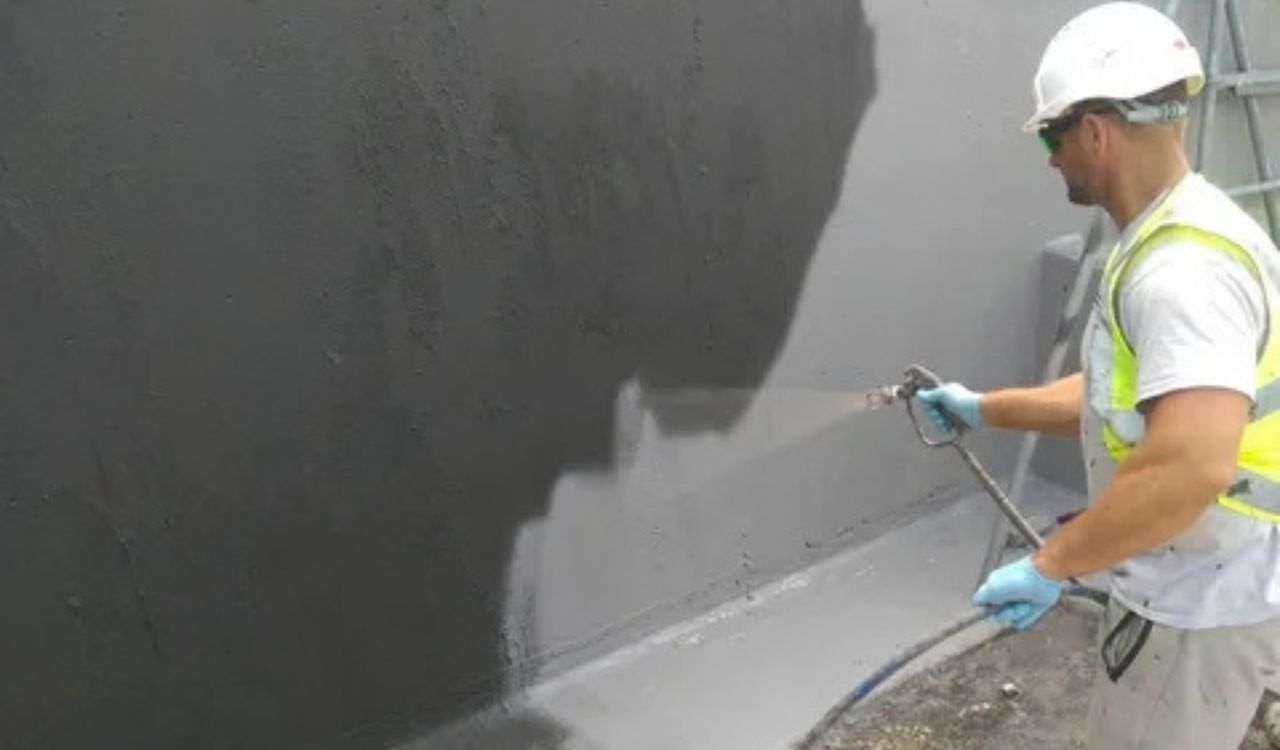
Concrete looks solid, but it is porous. Water moves through its capillary pores under pressure, by suction, or as vapor, and it carries chlorides, sulfates, and carbon dioxide with it. That is why basements seep, tanks leak at joints, and rebar corrodes long before the structure reaches its design life.
A waterproof concrete additive tackles this inside the mix rather than on the surface. This guide covers the main applications of waterproof concrete additive, how the technology works, which type suits which job, and how to use it correctly on site and at the batching plant.
What Is a Waterproof Concrete Additive?
A waterproof concrete additive, also called a waterproofing admixture for concrete, is a chemical added to concrete or mortar during mixing to reduce water absorption and permeability. It can also be used as a waterproofing additive to plaster, helping improve the plaster’s resistance to moisture when properly formulated and applied. Because it becomes part of the material, the whole section resists water, not just the outer skin.
It belongs to the wider family of concrete admixtures, which also includes water reducers, retarders, accelerators, and air-entraining agents. Standards treat these families differently. Water-resisting admixtures are classified under EN 934-2; IS 2645 covers integral waterproofing compounds for cement mortar and concrete.
Additive or admixture? In practice, “concrete additives” and “admixtures for concrete” are used interchangeably. Strictly, admixtures are added at the mixer, while additives are often mixed into cement at the factory. Most site conversations treat the terms as the same thing.
How Waterproofing Admixtures Work
Waterproofing admixture technology works through three main mechanisms. Many commercial products combine more than one.
- Pore blocking: Fine particles or reactive compounds fill capillary pores, reducing the connected pore network that carries water.
- Hydrophobic lining: Water-repellent molecules such as fatty-acid derivatives coat the pore walls. Water cannot wick in, though the concrete still lets vapor pass.
- Crystalline growth: Active chemicals react with moisture and unhydrated cement to form insoluble crystals in the pores and micro-cracks.
Lowering the water-cement ratio has the same effect on permeability. This is why water-reducing admixtures, including multi-range water reducers and superplasticizers, are often paired with a waterproofing admixture. Less mixing water leaves fewer capillary pores behind after hydration.
Types of Waterproofing Admixtures
Here is how the common concrete admixture types used for waterproofing compare.
| Type | Main mechanism | Best suited for | Points to note |
| Crystalline | Forms insoluble crystals in pores and cracks | Basements, tanks, tunnels, structures under hydrostatic pressure | Can help seal fine cracks; needs moisture to keep reacting |
| Hydrophobic / water-repellent | Lines pores, reducing capillary suction | Damp-proofing, plaster, blocks, precast | Less effective against sustained water pressure |
| Pore-blocking (fine fillers, e.g. silica-based) | Physically fills pores | General concrete and mortar | Performance depends on dispersion and dosage |
| Polymer / latex-based | Forms a flexible film in the matrix | Repair mortars, screeds, plaster | Improves bond and flexibility |
| Combined systems | Water reduction plus pore blocking | Ready-mix and high-performance concrete | Requires compatibility checks |
Always confirm the mechanism and claims against the product’s technical data sheet and test results, not the label alone.
Key Applications of Waterproof Concrete Additive
Basements, Foundations and Raft Slabs
Below-grade concrete faces constant groundwater contact and hydrostatic pressure. Adding a crystalline or combined waterproofing admixture gives protection through the full thickness of the raft, walls and retaining structures. This is a strong option where external membranes are hard to install, such as tight urban sites with adjacent structures.
Water Tanks, Reservoirs and Swimming Pools
Water-retaining structures need low permeability from the inside and the outside. Integral waterproofing reduces seepage through the concrete body. Joints, however, remain the weak point and still need waterstops or sealants alongside the admixture.
Tunnels, Metro Structures and Underpasses
Underground infrastructure sits in contact with groundwater for its entire service life. Waterproofing admixtures are used in cast-in-place linings and precast segments to cut water ingress and slow chloride and sulfate attack.
Sewage and Wastewater Treatment Plants
Aggressive liquids attack unprotected concrete. A denser, less permeable matrix slows the ingress of sulfates and chlorides that cause deterioration. Depending on exposure, sulfate-resisting cement and protective coatings may also be specified.
Roofs, Terraces and Podium Slabs
Roof slabs suffer from cracking, ponding and thermal movement. Integral waterproofing is used in the structural slab and the screed above it, often combined with a membrane for full protection.
Marine and Coastal Structures
Chloride-laden water drives reinforcement corrosion. Lower permeability slows chloride penetration, which helps protect steel. It should be part of a durability design that also covers cover depth, cement type and supplementary cementitious materials.
Precast Products and Blocks
Manufacturers use water-repellent admixtures in pavers, hollow blocks, pipes and manholes to reduce absorption and surface staining, and to limit efflorescence.
Plaster Waterproofing and Plastering Chemicals
Plaster waterproofing is one of the most common uses in residential and commercial construction. A waterproof chemical for plaster is added to cement-sand plaster on external walls, bathrooms, kitchens, parapets and sunken areas. It cuts water absorption and dampness, and reduces the salts that cause white efflorescence on finished walls.
Quality still depends on workmanship. Correct proportions, proper curing and a well-bonded substrate matter as much as the plaster waterproofing chemical itself. The same logic applies to mortar for masonry and tile bedding.
Benefits of Using a Waterproofing Admixture
- Reduces water absorption and permeability through the full section
- Improves durability against chlorides, sulfates and carbonation
- Reduces efflorescence and damp patches
- Protects reinforcement by slowing water and chloride ingress
- Works where external membranes are hard to apply or get damaged
- Adds waterproofing at the mixing stage, with no separate application step
- Can be dosed and controlled at a batching plant for consistent results
Limitations to Understand
A waterproof concrete additive is not a cure-all, and being honest about its limits avoids costly disputes on site.
- It does not seal poorly designed or unsealed construction joints.
- It will not bridge large structural cracks caused by settlement or overload.
- Poor compaction, honeycombing and inadequate curing defeat its purpose.
- Performance depends on dosage, mix design and compatibility with other admixtures.
- For severe hydrostatic conditions, a combined system, such as an admixture plus a membrane and waterstops, is usually safer.
Selecting the Right Additive for Your Project
| Factor | What to check |
| Exposure condition | Damp-proofing, splash zone or sustained hydrostatic head |
| Structure type | Water-retaining, below-grade, roof, precast or plaster |
| Cement and SCMs | Compatibility with OPC, PPC, fly ash, slag or silica fume |
| Other admixtures | Interaction with superplasticizers, retarders or accelerators |
| Standards | Compliance with IS 2645, IS 9103, EN 934-2, ASTM C494 or project specs |
| Performance data | Water penetration depth, sorptivity (ASTM C1585) or permeability tests |
| Form and handling | Powder or liquid, shelf life, and storage requirements |
Dosage and Mixing Best Practices
Dosage varies widely by chemistry, so follow the manufacturer’s data sheet and confirm through trial mixes. As a general practice:
- Run trial mixes with your actual cement, aggregates and other admixtures.
- Add the admixture as directed, either with the mixing water or with the dry mix, and mix thoroughly for uniform distribution.
- Adjust the water-cement ratio downward where possible and use a water reducer to keep workability.
- Compact properly with vibration to avoid voids.
- Cure for the specified period. Crystalline systems in particular need moisture.
- Treat joints, penetrations and cold joints with the correct details.
- Verify results with a water penetration test such as EN 12390-8, or with a permeability test to IS 3085.
Storage, Dosing and Quality Control
Consistency matters as much as chemistry. Liquid admixtures should be stored in sealed containers, protected from frost and direct heat, and used within their shelf life. At ready-mix plants, automated dosing lines and concrete additive storage sensors, meaning tank level sensors, help track stock and prevent under-dosing or run-outs. Regular calibration of dosing equipment keeps performance repeatable batch to batch.
Market Context: Why Demand Is Growing
Interest in these products follows wider growth in the concrete mortar and construction chemicals market. Infrastructure programs, urban housing and durability-focused specifications are driving the APAC concrete admixtures market. The India cement admixtures market and the China concrete superplasticizer market are both closely watched, as superplasticizers and multi-range water reducers are often specified alongside waterproofing admixtures.
Segments such as the accelerating admixtures market also reflect demand for faster construction cycles. For buyers, this means more product choice, and a stronger need to verify technical data and quality.
Working with a Reliable Supplier
Luke Chemicals supplies construction chemicals, including concrete admixtures and waterproofing solutions for concrete and plaster. Whichever supplier you choose, ask for technical data sheets, test reports against relevant standards, batch traceability and technical support for trial mixes.
Frequently Asked Questions
1. What are the main applications of waterproof concrete additive?
The main uses are basements and foundations, water tanks and pools, tunnels, wastewater plants, roofs and terraces, marine structures, precast products, and plaster and mortar waterproofing.
2. Can waterproofing admixture replace external waterproofing membranes?
In moderate conditions it can be enough, but for severe hydrostatic pressure, movement joints or critical structures, engineers commonly combine the admixture with membranes, waterstops and sealants.
3. What is the difference between crystalline and hydrophobic waterproofing admixtures?
Crystalline products form insoluble crystals that block pores and can help seal fine cracks. Hydrophobic products repel water by lining the pores and work best against capillary absorption rather than sustained pressure.
4. Can a waterproof chemical for plaster be used on bathroom and external walls?
Yes. Plaster waterproofing chemicals are widely used for bathrooms, kitchens, external walls and parapets. Correct mixing, thickness and curing are essential for good results.
5. Is a waterproofing admixture compatible with superplasticizers?
Often yes, and the combination is common because water reduction lowers permeability. Compatibility should still be checked through trial mixes, since some combinations can affect workability or setting time.
6. How much waterproofing admixture should I use?
The dosage depends on the product type and the cement content, so follow the manufacturer’s data sheet and confirm with a trial mix. Overdosing does not guarantee better results and can affect setting or strength.
7. Does it affect concrete strength?
Effects vary by product. Some have little impact, and others can slightly change setting time or strength. Testing in your mix design is the reliable way to confirm.