A concrete slab can pass its compressive strength test and still fail where it matters most: the top few millimetres. Dust on the surface, a web of fine cracks, or small hollow bumps under a trowel pass are all signs that the surface layer did not form properly. These three problems account for a large share of floor complaints in warehouses, factories, parking decks and commercial buildings.
Dusting, crazing and blistering in concrete floors look different, but they usually start from the same place: how water moves in fresh concrete, and when and how the surface is finished and cured. Even the accelerating admixtures market reflects this, since faster-setting mixes are only an advantage when finishing is timed to match. This guide explains what each defect is, what causes it, how to tell them apart, how to prevent them, and how to repair them if they have already appeared.
Why the Concrete Surface Is So Vulnerable
Freshly placed concrete bleeds. Heavier solids settle, and water rises to the surface. If that bleed water is worked back in, sealed under a closed surface, or lost too fast to the air, the top layer ends up different from the concrete below it. It can have a higher water-cement ratio, more fines, less cement hydration, or trapped air.
That difference in the top 2 to 5 mm is what shows up later as one of three defects:
- Dusting: the surface is weak and powdery.
- Crazing: the surface shrinks faster than the concrete beneath it and cracks into a fine network.
- Blistering: the surface is sealed too early and traps air or bleed water underneath.
Understanding this shared mechanism makes diagnosis and prevention much easier than treating each as a separate problem.
Dusting, Crazing and Blistering: Quick Comparison
| Feature | Dusting | Crazing | Blistering |
| What you see | Fine powder that rubs off on hands, shoes, or forklift tires | Network of fine, shallow, hexagon-like cracks | Small, hollow, raised domes that sound hollow when tapped |
| Typical size | Whole surface or large patches | Cells a few centimetres or less across; cracks very shallow | Roughly 5 mm to 100 mm across |
| When it appears | At finishing or soon after, and worsens under traffic | Within hours to the first few weeks | During finishing, or shortly after, as the surface dries |
| Core mechanism | Weak, over-watered or carbonated surface paste | Differential shrinkage between surface and body | Air or bleed water trapped beneath a sealed surface |
| Structural effect | None to the slab body, but surface wear and abrasion increase | Usually cosmetic | Surface breakout can expose a weak layer beneath |
| Typical fix | Densifier, grinding, or protective coating | Often cosmetic treatment, polishing or sealing | Remove loose tops, patch, and re-finish or overlay |
What Is Dusting in Concrete Floors?
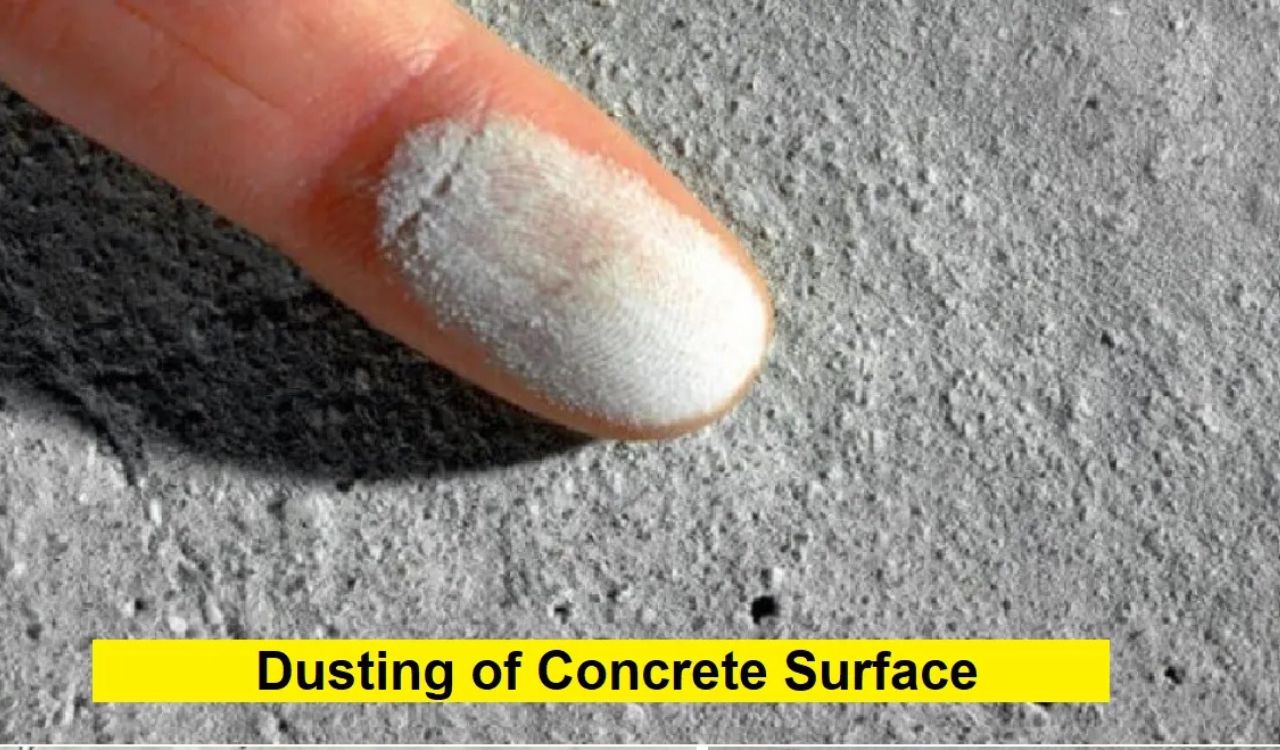
Dusting is the continuous release of fine, chalky powder from a hardened concrete floor. Rub a dark cloth across the surface, and it comes away white. In industrial settings, the dust gets into machinery, contaminates products, and wears floor coatings.
Main Causes of Dusting
- Water added at the surface. Spraying water to ease troweling or “refresh” a drying slab raises the water-cement ratio of the top layer and leaves a weak paste.
- Finishing in the presence of bleed water. Troweling bleed water back in creates a fragile layer of laitance.
- Dry cement used as a blotter. Sprinkling cement to soak up bleed water concentrates fines on the surface.
- Premature finishing. Starting before bleeding has finished seals water under a thin skin.
- Carbonation from unvented heaters. Propane or kerosene heaters release carbon dioxide. On a fresh slab it reacts with the surface paste before it hydrates properly, leaving a soft, dusty layer. This is common on winter pours in enclosed buildings.
- Excess entrained air. For hard-troweled interior floors, ACI 302.1R recommends keeping air content to about 3% or less. Higher levels increase the chance of a fragile surface.
- Poor curing. Rapid drying stops hydration at the surface before it gains strength.
- Freezing at early age. Surface paste that freezes before it sets loses strength permanently.
- Contamination. Clay, silt or organic matter in aggregate or on the subgrade can end up in the paste.
- Low cement content or very high slump. Both make a weak surface more likely.
How to Test for Dusting
- Rub a dark cloth or a gloved hand across the slab and check for powder.
- Scratch the surface with a screwdriver or nail. A surface that scratches easily is weak.
- Use abrasion testing (ASTM C779) or pull-off testing (ASTM C1583) on larger or critical projects to measure surface strength.
What Is Crazing in Concrete Floors?
Crazing is a network of very fine, shallow cracks that form a pattern of irregular cells, often compared to a spider web or map. The cracks are normally only a few millimetres deep, and they are most visible on steel-troweled surfaces and when the floor is damp.
Crazing is mostly a cosmetic issue. It does not normally affect load capacity. It can collect dirt, show through thin coatings and look poor on polished or decorative floors, which is why it generates so many complaints.
Main Causes of Crazing
- Rapid drying of the surface. Wind, sun, low humidity and high concrete or air temperature all increase evaporation. ACI 305R includes an evaporation-rate chart. Many specifications call for protection when the rate approaches about 1 kg/m² per hour, and a lower threshold for mixes with silica fume or other supplementary cementitious materials.
- Missing or late curing. Without moisture or a curing compound, the surface shrinks while the concrete below stays stable.
- Excess water in the mix or at the surface. A higher water-cement ratio at the top means greater shrinkage.
- Overworking the surface. Repeated troweling brings paste and water to the top.
- Intermittent wetting and drying during curing. Cycles of wetting and drying stress the surface layer.
- Carbonation. Fresh surfaces exposed to carbon dioxide from heaters can shrink and craze.
- Rich finishing mixes or dry-shake overuse. A layer with a very different composition from the base shrinks differently.
Crazing vs Other Cracks
| Crack type | Typical appearance | Depth | Cause |
| Crazing | Fine web or hexagonal pattern | Very shallow | Surface shrinkage and early drying |
| Plastic shrinkage cracks | Longer, wider, often roughly parallel | Deeper, can go through the slab | Rapid water loss while concrete is still plastic |
| Drying shrinkage or restraint cracks | Straight or diagonal, often at corners or columns | Full depth | Restrained shrinkage, missing or late joints |
| Alkali-silica reaction cracking | Map pattern, wider, often with staining | Deeper and progressive | Reactive aggregate, moisture and alkalis |
If a pattern looks like crazing but the cracks are wide, deep, stained or still growing, investigate for other causes before treating it as cosmetic.
What Is Blistering in Concrete Floors?
Blistering is the formation of small, hollow, dome-shaped bumps on the surface during or soon after finishing. They typically range from about 5 mm to 100 mm in diameter. Tap one and it sounds hollow. Under traffic, the thin cap breaks away and leaves a pit with a weak surface below.
When blisters merge into larger zones that sound hollow over a wider area, the problem is called delamination. It is more serious and often needs structural-surface repair rather than patching.
Main Causes of Blistering
- Premature troweling. Closing the surface with a steel trowel while the concrete is still bleeding traps air and water below a dense skin.
- Rapid surface drying. Sun and wind can stiffen the top while the interior is still bleeding.
- Excessive air entrainment. Extra air gives bubbles more to trap.
- Sticky or low-bleed mixes. High fines content, silica fume or low water content can reduce bleed water to the point where the surface tightens early.
- Temperature mismatch. A cold subgrade or slab bottom with a warm, sunny top slows bleeding at the bottom and speeds setting at the top.
- Vapor retarder placed directly under the slab. This slows downward water movement and prolongs bleeding. If finishing is not delayed accordingly, blisters form.
- Retarded or delayed set without adjusted timing. Long bleeding periods need patient finishing.
- Early sealing. Applying a curing compound, sealer or densifier too soon can trap moisture.
How to Check for Blisters and Delamination
- Tap with a hammer or drag a chain across the surface and listen for hollow sounds.
- Use ASTM D4580 sounding methods for larger areas.
- Mark affected zones before repair so the extent is clear.
The Finishing Window: Where Most Defects Begin
Many of these defects come down to timing. A simple site routine prevents most of them.
- Wait for bleed water to leave the surface. The sheen should disappear on its own. Do not blot it with dry cement or work it back in.
- Check with a foot test. The surface should be firm enough that a footprint leaves only a shallow impression, roughly 6 mm.
- Use the bull float once, early and gently, and avoid overworking it.
- Start power troweling only when the surface can take it. Use flat blades first, and increase pitch gradually.
- Slow evaporation without adding water. Use fog misting for the air, windbreaks, sunshades or an evaporation retarder film during finishing.
- Start curing immediately after final troweling. Use wet curing, or a compliant curing compound (ASTM C309).
- Control the building. Close openings to reduce wind and use indirect-fired or vented heaters in cold weather.
How Mix Design and Admixtures Influence Floor Surface Quality
Good finishing cannot fully rescue a poorly proportioned mix. The right mix design and the right concrete admixtures make the finishing window wider and more predictable. A quick look at the types of chemical admixtures for concrete shows which ones matter most for floors.
| Admixture type | Relevance to dusting, crazing and blistering | Watch out for |
| Water-reducing and high-range water-reducing | Lower water-cement ratio at the same workability, which reduces bleeding and weak surface paste | Overdosing can cause segregation or very sticky mixes |
| Admixture type G (high-range water-reducing and retarding) | Delivers low water content with extended workability in hot weather and long hauls | Retardation extends bleeding, so finishing must be delayed to match, or blistering and dusting can follow |
| Accelerating admixtures | Bring set time forward in cold weather so finishing is not delayed into evening or into freezing conditions | In hot weather, faster surface set raises crazing and blister risk. Use non-chloride types where reinforcement is present |
| Air-entraining agents | Needed for freeze-thaw exposure | Keep air content low (about 3% or less) for hard-troweled interior floors |
| Retarders | Help in hot weather | Can lengthen the finishing window past the available working time |
| Shrinkage-reducing admixtures and expansion agents | Reduce drying shrinkage stress and curling | They do not replace curing or correct finishing mistakes |
A concrete expansion agent deserves a specific note. It can reduce shrinkage cracking in slabs and help with shrinkage-compensating designs, but it needs proper moist curing to work. If the surface dries early, the expansion benefit is lost and crazing can still occur. Treat it as one part of a floor design alongside joints, reinforcement and curing, and not as a cure for poor surface practice.
Mix choices also matter beyond admixtures:
- Keep the water-cement ratio as low as workability allows.
- Use enough cement paste and well-graded aggregate, with clean, low-clay sand.
- Account for fly ash or slag, which usually extend set times and bleeding periods.
- Run trial placements for floors with unusual mixes, especially when combining retarders, silica fume and vapor retarders.
Moisture, Waterproofing and Subgrade Conditions
Floor performance also depends on what happens beneath the slab. A vapor retarder or waterproofing layer under the slab protects against moisture rising into flooring, but it also affects bleeding and drying behavior. On slabs placed directly on a vapor retarder, bleed water has nowhere to go, so finishing needs to be later and more cautious. Basements, tanks, and wet industrial areas use integral crystalline or other cementitious waterproofing systems and admixtures. They should be considered at the design stage so that mix and finishing decisions fit together.
Prevention Checklist
Before the pour
- Review the mix design with the supplier: water-cement ratio, air content, SCM content, admixtures and expected set time.
- Check weather forecasts, evaporation rate and subgrade temperature.
- Plan curing materials, windbreaks and heaters in advance.
During placement and finishing
- Never add water at the surface.
- Never use dry cement to soak up bleed water.
- Time each finishing step to the actual surface condition, not the clock.
- Keep personnel and equipment trained and consistent.
After finishing
- Start curing as soon as possible and keep it continuous.
- Avoid wet-dry cycles.
- Protect against freezing and rapid drying for the first days.
- Delay sealers or densifiers until the surface is ready.
Repair Options for Each Defect
| Defect | Repair approach | Notes |
| Light dusting | Apply a lithium, sodium or potassium silicate densifier | Reacts with calcium hydroxide to form additional calcium silicate hydrate in the surface pores. Works best when the weak layer is thin |
| Severe dusting | Grind off the weak layer, then densify, polish or coat | Surface strength should be rechecked after grinding |
| Crazing | Often left as is, polished, sealed or covered with a coating or overlay | Fine cracks may reflect through thin coatings, so assess finish requirements first |
| Blisters | Remove loose tops, clean, and fill with a polymer-modified repair mortar or compatible patching material | Find the cause first, or blisters will return |
| Delamination | Cut out or grind the delaminated area, or inject with epoxy if bond remains | Test the substrate afterward with pull-off tests |
Do not seal in moisture. Wait until the slab has dried enough for the product being applied, and always follow the manufacturer’s data sheet for cure time and moisture limits.
Market Context: Why Floor Quality Is Driving Admixture Demand
Warehousing, logistics, manufacturing and infrastructure projects all demand flatter, more wear-resistant slabs, and that has pushed attention to both surface quality and mix design. Market reports tracking the concrete admixtures market, the cement and concrete additives market and the concrete admixtures additive market consistently link demand growth to higher-performance concrete and construction chemicals. Growth in the APAC concrete admixtures market is closely tied to urbanization, industrial parks and infrastructure spending. Related segments, including the accelerating admixtures market and the cementitious waterproofing market, reflect the same trend toward engineered solutions for hot, cold and moisture-challenged conditions. For contractors and buyers, a broader product range makes it more important to check technical data sheets, compatibility and batch consistency instead of choosing on price alone.
Working With a Supplier
Preventing floor defects works best when the contractor, ready-mix producer and chemical supplier plan together. Luke Chemicals supplies construction chemicals and concrete admixtures, and can help match admixture selection, dosage and curing products to the climate and finishing method on your project.
Frequently Asked Questions
What causes dusting in concrete floors?
Dusting is caused by a weak surface layer of paste or laitance. The most common triggers are water added during finishing, troweling while bleed water is present, dry cement used to blot the surface, carbonation from unvented heaters, excess air entrainment and poor curing.
Is crazing in concrete structurally harmful?
In most cases, no. Crazing is shallow and mostly cosmetic. It becomes a concern when the cracks are wide, deep or progressive, which points to a different problem such as plastic shrinkage, restraint cracking or alkali-silica reaction.
Why do blisters form on a concrete slab?
Blisters form when the surface is closed by troweling before bleed water and air have escaped. The trapped bubble pushes up the thin skin. Hot, windy conditions, a vapor retarder under the slab, high air content and cold subgrades make it more likely.
Can dusting be fixed without replacing the floor?
Often yes. Light dusting can be treated with a silicate densifier. Severe dusting may need grinding to sound concrete first, followed by densifying, polishing or coating. Test the surface strength before choosing the repair.
Can concrete admixtures prevent these defects?
They can reduce the risk but cannot replace good practice. Water reducers lower the water-cement ratio, Type G admixtures help with hot-weather workability, and accelerators help in cold weather. Retarders and extra air can make blistering or dusting worse if finishing is not adjusted. Proper curing and finishing timing are still essential.
Does a concrete expansion agent stop crazing?
Not by itself. An expansion agent compensates for drying shrinkage in the body of the slab, but crazing is a surface issue driven by early drying and finishing. It still needs prompt, continuous moist curing.
How long should I cure a concrete floor to avoid surface defects?
Moist curing for at least seven days is the common recommendation in ACI 308R for typical mixes. Mixes with fly ash, slag or other supplementary cementitious materials may need longer. Start curing as soon as finishing is complete.
Conclusion
Dusting, crazing and blistering in concrete floors are different symptoms of the same underlying issue: a surface layer that was over-watered, dried too fast, or closed too early. The most reliable prevention is a sound mix design with a controlled water-cement ratio, finishing that follows the actual condition of the surface and not the clock, and curing that begins immediately and continues without interruption. When defects do appear, identify which one it is, test the extent, and choose a repair that fits the cause, so the problem does not return.