Introduction
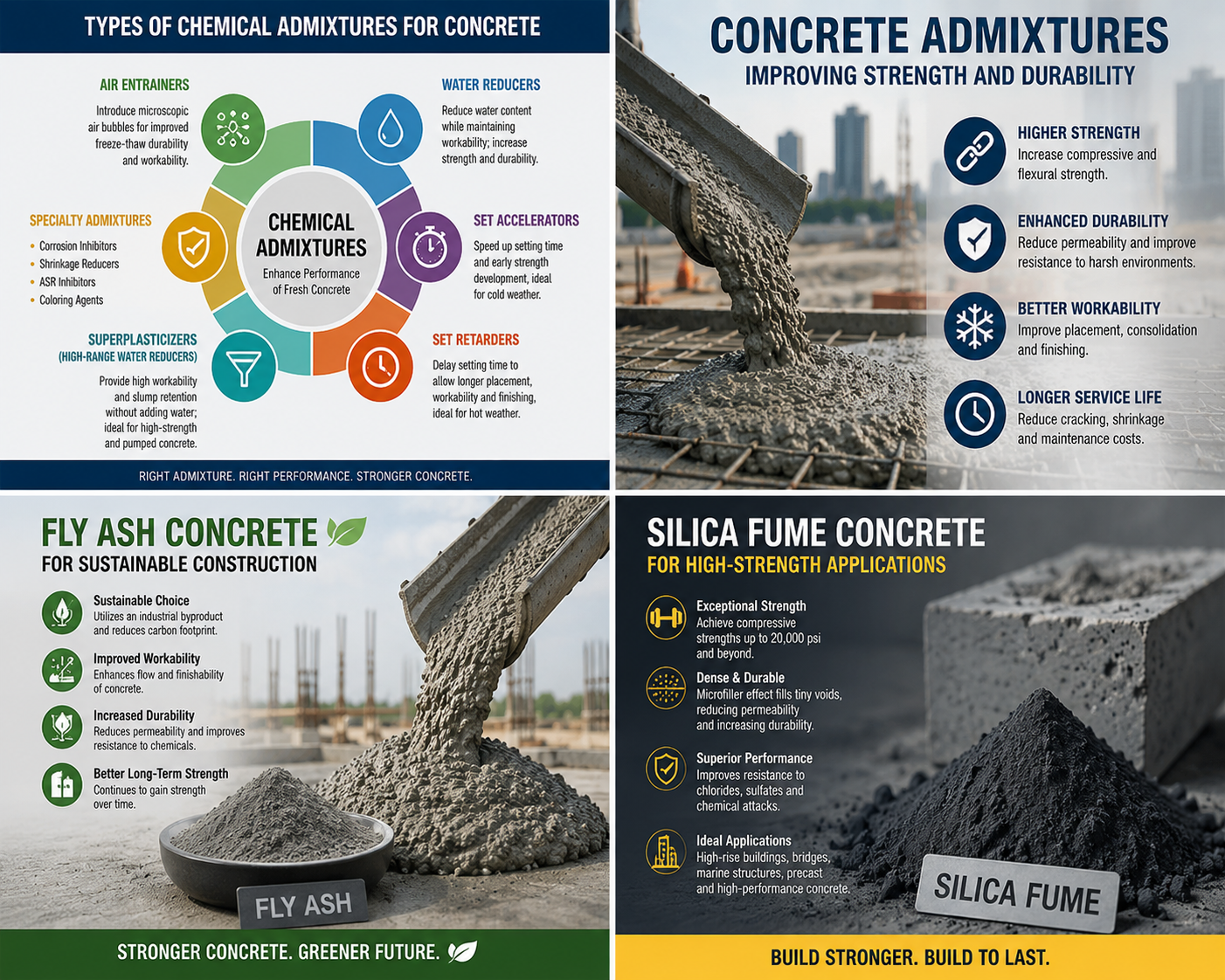
Most people assume concrete is simply a mixture of cement, water, and aggregate. However, modern concrete is rarely that simple. In fact, nearly every high-performance concrete mix used today contains concrete admixtures that dramatically improve strength, durability, workability, and long-term performance.
Concrete admixtures have become essential tools for contractors, engineers, architects, and ready-mix producers. Whether the goal is achieving higher compressive strength, extending placement time in hot weather, accelerating curing during winter, or improving resistance to harsh environmental conditions, the right admixture can make all the difference.
In this guide, we’ll explore the two primary categories of concrete admixtures—chemical admixtures and mineral admixtures—along with their applications, benefits, and how to select the right solution for your project.
What Are Concrete Admixtures?
Concrete admixtures are materials added before or during the mixing process to modify the properties of fresh or hardened concrete.
These additives allow engineers and contractors to tailor concrete performance for specific construction requirements, environmental conditions, and durability goals.
Concrete admixtures generally fall into two categories:
Chemical Admixtures
Chemical admixtures improve concrete during:
- Mixing
- Transporting
- Placement
- Consolidation
- Finishing
- Curing
These products influence setting time, workability, air content, and water demand.
Mineral Admixtures
Mineral admixtures affect hardened concrete through hydraulic or pozzolanic activity.
They improve:
- Strength
- Durability
- Permeability
- Long-term performance
Many mineral admixtures are also sustainable because they utilize industrial byproducts.
ASTM C494 Classification
To ensure consistency and quality, ASTM C494 classifies chemical admixtures into seven categories:
| ASTM Type | Function |
|---|---|
| Type A | Water Reducing |
| Type B | Retarding |
| Type C | Accelerating |
| Type D | Water Reducing & Retarding |
| Type E | Water Reducing & Accelerating |
| Type F | High-Range Water Reducing |
| Type G | High-Range Water Reducing & Retarding |
Understanding these classifications helps specifiers choose admixtures that meet performance requirements.
Chemical Admixtures: A Closer Look
Chemical admixtures are among the most important concrete additives used in modern construction.
Let’s examine the major categories.
Air Entrainers
Air-entraining admixtures create millions of microscopic air bubbles throughout the concrete matrix.
These tiny voids provide space for freezing water to expand, reducing internal stresses that can damage concrete.
Benefits of Air Entrainment
- Improved freeze-thaw durability
- Better workability
- Increased resistance to wetting and drying cycles
- Reduced scaling
According to ASTM C260, typical air entrainment levels range between 5% and 8% of concrete volume.
Best Applications
Air entrainment is especially important in:
- Cold climates
- Bridge decks
- Sidewalks
- Driveways
- Exterior slabs exposed to winter conditions
Water Reducers
Water reducers are often called the fifth ingredient of concrete because of their widespread importance.
They reduce the amount of water required while maintaining or improving workability.
Lower water content generally means:
- Higher strength
- Reduced permeability
- Better durability
- Improved abrasion resistance
Types of Water Reducers
Low-Range Water Reducers
- Basic water reduction
- Standard concrete applications
- Cost-effective option
Mid-Range Water Reducers
- Moderate water reduction
- Excellent slump retention
- Ideal for 4–5 inch slump concrete
These admixtures are particularly useful during hot weather because they help offset rapid slump loss caused by elevated temperatures.
High-Range Water Reducers (Superplasticizers)
- Reduce water demand by up to 40%
- Produce highly flowable concrete
- Suitable for 8–11 inch slumps
Ideal for:
- High-rise construction
- Dense reinforcement
- Pumped concrete
- Architectural concrete
Set Accelerators
Set accelerators speed up cement hydration.
They are commonly used when concrete needs to gain strength more quickly.
Benefits
- Faster setting
- Improved early strength
- Better cold-weather performance
- Reduced finishing delays
A useful rule of thumb:
A temperature drop of approximately 20°F can double concrete setting time.
Accelerators help offset this effect.
Modern Alternatives
The industry has largely shifted away from calcium chloride due to corrosion concerns.
Today, chloride-free accelerators provide similar performance without increasing reinforcement corrosion risks.
Set Retarders
Set retarders slow the hydration process and extend working time.
They are particularly valuable when concrete placement takes longer than normal.
Best Uses
- Large concrete pours
- Long transport distances
- Decorative stamping projects
- Warm-weather placements
- Slow placement rates
- Undermanned crews
When Retarders May Not Be Necessary
- Short delivery distances
- Fast placement operations
- Cool indoor environments
- Small pours
Superplasticizers (High-Range Water Reducers)
Superplasticizers deserve special attention because they can dramatically transform concrete behavior.
These admixtures can convert a relatively stiff mix into highly flowable concrete without adding extra water.
ASTM Types
Type F
- Short-term flowability
- Typically added at the job site
- Ideal when temporary workability increases are needed
Type G
- Extended flowability
- Added during batching
- Longer slump retention
Common Applications
- Narrow formwork
- Congested reinforcement
- High-rise pumping
- Precast concrete
- Self-consolidating concrete (SCC)
Specialty Concrete Admixtures
Corrosion Inhibitors
Corrosion inhibitors protect reinforcing steel from deterioration.
Most beneficial in:
- Marine environments
- Parking structures
- Coastal projects
- Areas using deicing salts
Shrinkage-Reducing Admixtures (SRAs)
SRAs reduce drying shrinkage by lowering surface tension within concrete pores.
Benefits include:
- Reduced cracking
- Improved dimensional stability
- Better long-term durability
Alkali-Silica Reactivity (ASR) Inhibitors
ASR inhibitors prevent damaging chemical reactions between:
- Alkalis in cement
- Reactive silica in aggregates
This protection helps preserve structural integrity over time.
Coloring Agents
Coloring admixtures provide decorative effects without compromising concrete performance.
Popular for:
- Decorative concrete
- Stamped concrete
- Architectural finishes
- Colored pavements
Mineral Admixtures: Building Stronger, More Durable Concrete
Unlike chemical admixtures, mineral admixtures primarily influence hardened concrete through hydraulic and pozzolanic reactions.
Fly Ash
Fly ash is a byproduct generated during coal combustion.
When incorporated into concrete, it improves both fresh and hardened properties.
Benefits of Fly Ash Concrete
- Improved workability
- Reduced bleeding
- Increased long-term strength
- Lower permeability
- Enhanced durability
- Reduced heat of hydration
Class F Fly Ash
Class F fly ash:
- Reduces bleeding
- Improves ultimate strength
- Decreases permeability
- Enhances sulfate resistance
Class C Fly Ash
Class C fly ash possesses self-cementing properties.
Ideal for:
- High early strength applications
- Precast concrete
- Prestressed concrete
Sustainability Benefits
Fly ash is considered environmentally friendly because it repurposes an industrial byproduct that would otherwise be disposed of in landfills.
Silica Fume (Microsilica)
Silica fume is one of the most effective mineral admixtures available.
It improves concrete through two mechanisms:
1. Pozzolanic Reaction
Silica fume reacts with calcium hydroxide produced during hydration, creating additional calcium silicate hydrate (C-S-H), the primary strength-giving compound in concrete.
2. Microfiller Effect
Its extremely fine particles fill microscopic voids between cement grains, creating a denser concrete matrix.
Performance Advantages
Silica fume can help concrete achieve compressive strengths approaching:
20,000 psi
while dramatically reducing permeability.
Recommended Dosage Rates
| Application | Dosage |
|---|---|
| Bridge Decks & Low Permeability Concrete | 8–10% |
| High-Strength Columns | 10–15% |
| Flatwork | Maximum 10% |
Pro Tip
Higher silica fume contents often require larger doses of superplasticizers.
Many producers replace approximately one-third of the required superplasticizer dosage with a mid-range water reducer to improve workability and finishing characteristics.
How to Choose the Right Concrete Admixture
Choosing the correct admixture starts with identifying project requirements.
Cold Weather Concreting
Recommended:
- Air entrainers
- Set accelerators
Hot Weather Concreting
Recommended:
- Mid-range water reducers
- Set retarders
High Strength Requirements
Recommended:
- Silica fume
- Superplasticizers
Corrosion-Prone Environments
Recommended:
- Corrosion inhibitors
- Silica fume
Decorative Concrete
Recommended:
- Coloring agents
- Finishing enhancers
Best Practice
Always:
- Follow manufacturer recommendations
- Conduct trial batches
- Test local materials
- Verify compliance with ASTM C494 requirements
Frequently Asked Questions
What admixture is best for cold weather concreting?
Air-entraining admixtures and set accelerators are typically the most effective choices for cold-weather concrete placement because they improve freeze-thaw durability and reduce setting times.
How does silica fume improve concrete strength?
Silica fume improves strength through a pozzolanic reaction and by filling microscopic voids within the concrete matrix, resulting in denser and stronger concrete.
What is the difference between chemical and mineral admixtures?
Chemical admixtures primarily affect fresh concrete properties such as workability and setting time, while mineral admixtures improve hardened concrete performance through hydraulic and pozzolanic reactions.
Are superplasticizers the same as water reducers?
Superplasticizers are a specialized type of high-range water reducer capable of reducing water content by up to 40% while maintaining excellent workability.
Conclusion:Build Smarter with Concrete Admixtures
Concrete admixtures have transformed modern construction by enabling engineers and contractors to customize concrete performance for virtually any application.
Chemical admixtures improve workability, setting characteristics, and placement efficiency, while mineral admixtures enhance strength, durability, and long-term performance.
Choosing the right admixture isn’t just about achieving better concrete. It also affects project schedules, labor costs, maintenance requirements, and overall lifecycle value.
Before selecting an admixture, consult with an experienced admixture supplier or concrete specialist to ensure the product matches your project’s unique performance requirements.
Explore our product directory to connect with trusted concrete admixture suppliers and discover solutions for your next construction project.