Introduction
Cold weather can create significant challenges for concrete contractors and construction teams. As temperatures drop, concrete takes longer to set, finishing operations are delayed, and freshly placed concrete becomes vulnerable to frost damage. These issues can increase project costs, disrupt schedules, and compromise the long-term durability of concrete structures.
This is where accelerating admixtures play an important role. These specialized concrete admixtures help speed up the hydration process, allowing concrete to set and gain strength faster even in challenging winter conditions.
Understanding how accelerating admixtures work is essential for anyone involved in cold weather concreting. Choosing the right admixture can improve productivity, reduce delays, and help ensure durable concrete performance throughout the structure’s lifespan.
In this guide, you’ll learn:
- What accelerating admixtures are
- How accelerating admixtures work
- Types of accelerating admixtures
- Common applications in construction
- How to select the right accelerator
- Important safety and performance considerations
What Are Accelerating Admixtures?
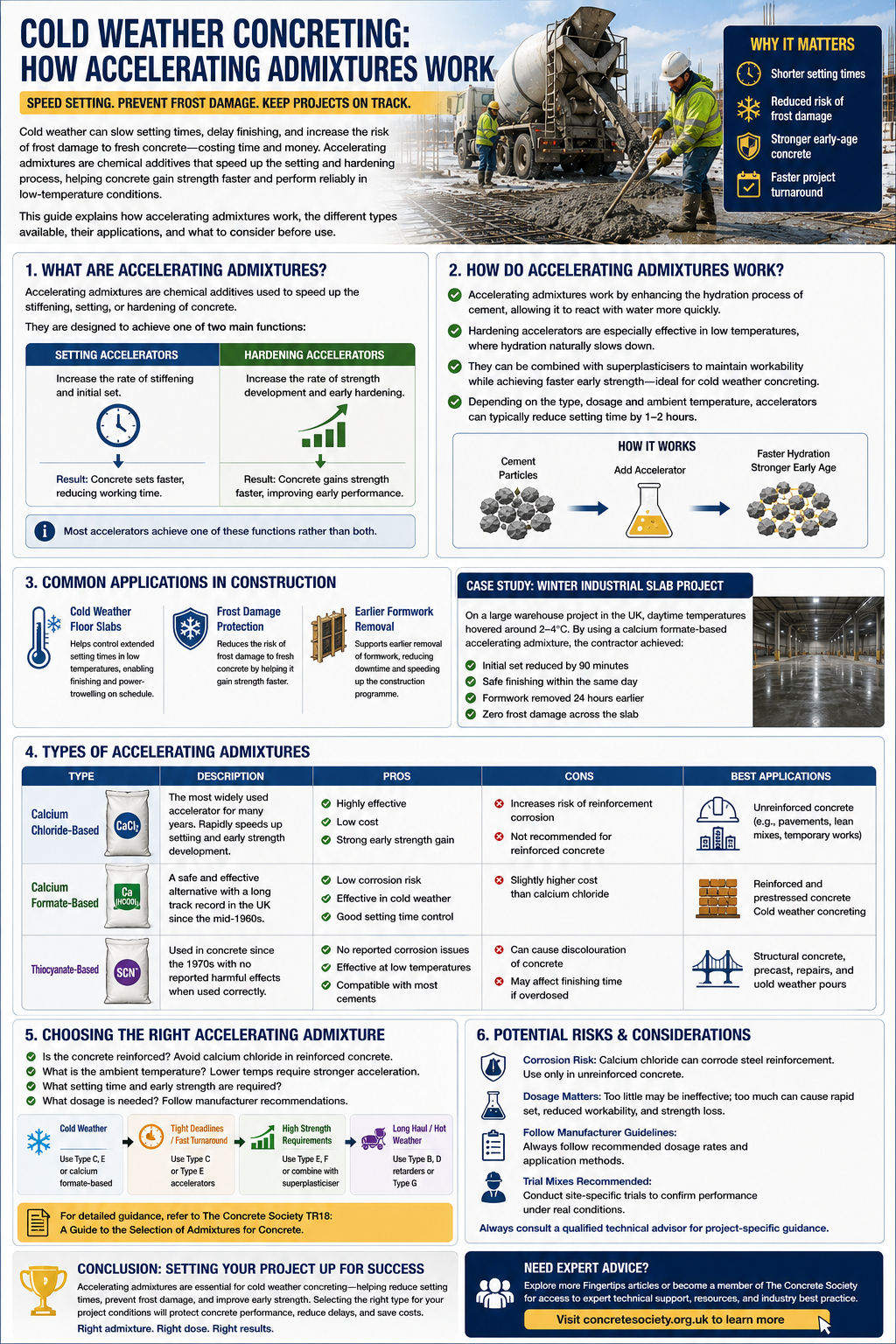
Accelerating admixtures are chemical additives designed to speed up the stiffening, setting, or hardening process of concrete.
These concrete admixtures are particularly valuable during cold weather because low temperatures slow the chemical reactions responsible for concrete strength development.
Two Main Functions of Accelerating Admixtures
Accelerators generally perform one of two functions:
| Type | Function | Primary Benefit |
|---|---|---|
| Setting Accelerators | Speed up initial and final setting times | Faster finishing and reduced waiting time |
| Hardening Accelerators | Increase early-age strength development | Faster formwork removal and earlier loading |
While some products provide both benefits, most accelerating admixtures are designed primarily for one purpose.
Key Benefits
- Faster setting times
- Improved early strength gain
- Reduced risk of frost damage
- Earlier finishing operations
- Faster project completion
- Reduced downtime during winter construction
How Do Accelerating Admixtures Work?
To understand how accelerating admixtures work, it’s helpful to understand the basics of cement hydration.
When water is added to cement, a chemical reaction begins that forms strong bonds between cement particles. This reaction generates heat and gradually transforms the mixture from a plastic state into hardened concrete.
Accelerating admixtures increase the speed of these chemical reactions.
The Science Behind Accelerators
Accelerators work by:
- Increasing the rate of cement hydration
- Promoting faster formation of hydration products
- Enhancing early heat generation
- Speeding up strength development
This allows concrete to reach critical strength levels more quickly, especially during cold weather when hydration naturally slows down.
Why They Are Effective in Cold Weather
At temperatures below 40°F (4°C), concrete hydration slows significantly.
Without protection, freshly placed concrete may:
- Set extremely slowly
- Fail to gain sufficient strength
- Become damaged by freezing water within the concrete matrix
Accelerating admixtures help overcome these issues by boosting hydration even in lower temperatures.
Combining Accelerators with Superplasticizers
Many modern concrete mixes combine accelerating admixtures with high-range water reducers (superplasticizers).
This combination provides:
- Excellent workability
- Lower water-cement ratios
- Faster early strength development
- Improved durability
Typical Setting Time Reduction
Depending on:
- Ambient temperature
- Cement type
- Accelerator dosage
- Concrete mix design
Accelerating admixtures can reduce setting times by approximately 1–2 hours, and in some cases even more.
Common Applications of Accelerating Admixtures in Construction
Accelerating admixtures are widely used across numerous construction sectors.
1. Cold Weather Floor Slabs
Floor slab installations often require precise finishing schedules.
In cold weather:
- Concrete remains plastic longer
- Power troweling is delayed
- Labor costs increase
Accelerators shorten setting times and allow contractors to complete finishing operations on schedule.
2. Frost Protection
Fresh concrete is especially vulnerable during the first 24 hours after placement.
Accelerating admixtures help concrete gain sufficient strength before freezing temperatures can cause damage.
Benefits include:
- Reduced frost risk
- Improved freeze-thaw resistance
- Better long-term durability
3. Earlier Formwork Removal
Construction schedules often depend on how quickly concrete reaches required strength levels.
Accelerators help achieve:
- Faster stripping of forms
- Earlier loading
- Reduced project delays
4. Emergency Repairs
Roadways, bridges, and industrial facilities often require rapid repairs.
Accelerating admixtures enable:
- Faster reopening times
- Reduced downtime
- Improved traffic management
Example: Winter Warehouse Construction
A contractor placing a large warehouse slab during winter experienced daytime temperatures between 2°C and 5°C.
By incorporating a calcium formate-based accelerating admixture, the project team achieved:
- Faster setting times
- Same-day finishing operations
- Earlier formwork removal
- No frost-related defects
The project remained on schedule despite challenging weather conditions.
Types of Accelerating Admixtures
Several types of accelerating admixtures are commonly used in construction.
Calcium Chloride-Based Accelerators
Calcium chloride is one of the oldest and most effective concrete accelerators.
Advantages
- Highly effective
- Low cost
- Rapid strength gain
- Widely available
Limitations
- Can cause steel reinforcement corrosion
- Not recommended for reinforced concrete
- Restricted in many structural applications
Best Uses
- Unreinforced slabs
- Sidewalks
- Temporary concrete structures
Calcium Formate-Based Accelerators
Calcium formate has become a popular non-chloride alternative.
Advantages
- Safe for reinforced concrete
- Excellent cold weather performance
- Reliable early strength gain
Limitations
- Higher cost than calcium chloride
Best Uses
- Reinforced concrete
- Commercial projects
- Structural applications
Thiocyanate-Based Accelerators
Thiocyanate accelerators have been used successfully since the 1970s.
Advantages
- Effective at low temperatures
- Compatible with most cement systems
- Suitable for reinforced concrete
Limitations
- May affect finishing characteristics if overdosed
Best Uses
- Structural concrete
- Precast applications
- Cold weather placements
Accelerating Admixture Comparison Table
| Type | Pros | Cons | Best Applications |
|---|---|---|---|
| Calcium Chloride | Fast and economical | Corrosion risk | Unreinforced concrete |
| Calcium Formate | Safe for reinforcement | Higher cost | Structural concrete |
| Thiocyanate | Effective in cold weather | Requires dosage control | Precast and reinforced concrete |
Choosing the Right Accelerating Admixture
Selecting the correct accelerating admixture depends on several project-specific factors.
Is the Concrete Reinforced?
If reinforcement is present:
✓ Choose non-chloride accelerators
Avoid:
✗ Calcium chloride
What Is the Ambient Temperature?
Lower temperatures generally require:
- Higher dosages
- More aggressive acceleration
- Additional curing protection
What Early Strength Is Required?
Determine:
- Formwork removal schedule
- Traffic opening requirements
- Structural loading needs
Follow Recommended Dosages
Always follow manufacturer recommendations.
Excessive dosage may:
- Reduce workability
- Cause rapid setting
- Affect long-term performance
Practical Resource
The Concrete Society’s TR18: A Guide to the Selection of Admixtures for Concrete provides valuable guidance for selecting admixtures based on project requirements.
Potential Risks and Considerations
While accelerating admixtures provide significant benefits, they must be used correctly.
Corrosion Risk
Calcium chloride accelerators can increase reinforcement corrosion risk.
For reinforced structures:
- Use non-chloride alternatives
- Verify compliance with project specifications
Workability Issues
Overdosing accelerators can lead to:
- Reduced slump
- Difficult placement
- Poor finishing characteristics
Impact on Final Strength
Improper admixture use may affect:
- Long-term strength
- Durability
- Shrinkage behavior
Conduct Trial Mixes
Before large-scale placement:
- Test admixture compatibility
- Evaluate setting times
- Confirm strength development
Professional trial batching can prevent costly field problems.
Accelerating Admixtures vs Antifreeze Admixtures
A common misconception is that accelerating admixtures prevent concrete from freezing.
They do not.
Accelerating Admixtures
- Speed up hydration
- Increase early strength
- Reduce setting time
Antifreeze Admixtures
- Lower water freezing point
- Allow placement in sub-freezing conditions
In extreme winter conditions, both may be used together.
Frequently Asked Questions
Can accelerating admixtures be used in reinforced concrete?
Yes. Non-chloride accelerators such as calcium formate and thiocyanate-based products are commonly used in reinforced concrete applications.
How much do accelerating admixtures reduce setting time?
Most accelerating admixtures reduce setting time by approximately 1–2 hours, depending on temperature, dosage, and concrete mix design.
Do accelerating admixtures increase concrete strength?
They primarily increase early-age strength. Long-term strength generally remains similar when proper dosage rates are used.
Are accelerating admixtures necessary in cold weather?
While not always required, they significantly improve concrete performance, reduce frost risk, and help maintain construction schedules during cold weather.
Can accelerators replace proper curing?
No. Accelerating admixtures complement proper curing practices but do not eliminate the need for temperature protection, insulation blankets, or other curing measures.
Conclusion: Setting Your Project Up for Success
Cold weather concreting presents unique challenges, but accelerating admixtures offer an effective solution for maintaining productivity and concrete quality during winter construction.
By increasing hydration rates and promoting faster strength development, these admixtures help contractors:
- Reduce setting times
- Minimize frost damage risks
- Remove formwork earlier
- Improve project efficiency
- Maintain construction schedules
The key to success lies in selecting the appropriate accelerating admixture for your specific project conditions, environmental exposure, and structural requirements.
For more detailed technical guidance, consult the Concrete Society’s TR18: A Guide to the Selection of Admixtures for Concrete and seek advice from qualified admixture specialists before finalizing your concrete mix design.
Explore our additional concrete admixture resources and cold weather concreting guides to ensure your next winter project achieves maximum durability, strength, and performance.