Introduction
Did you know that up to 90% of modern concrete mixes contain some form of water reducer, yet most people outside the concrete industry have never heard of them?
Water reducers are among the most widely used concrete admixtures in construction today. Td concrete performance.
In this guide, you’ll learn what water reducers in concrete are, how they work, the different types available, their advantages and limitations, and how to select the right admixture for your project.
What Are Water Reducers?
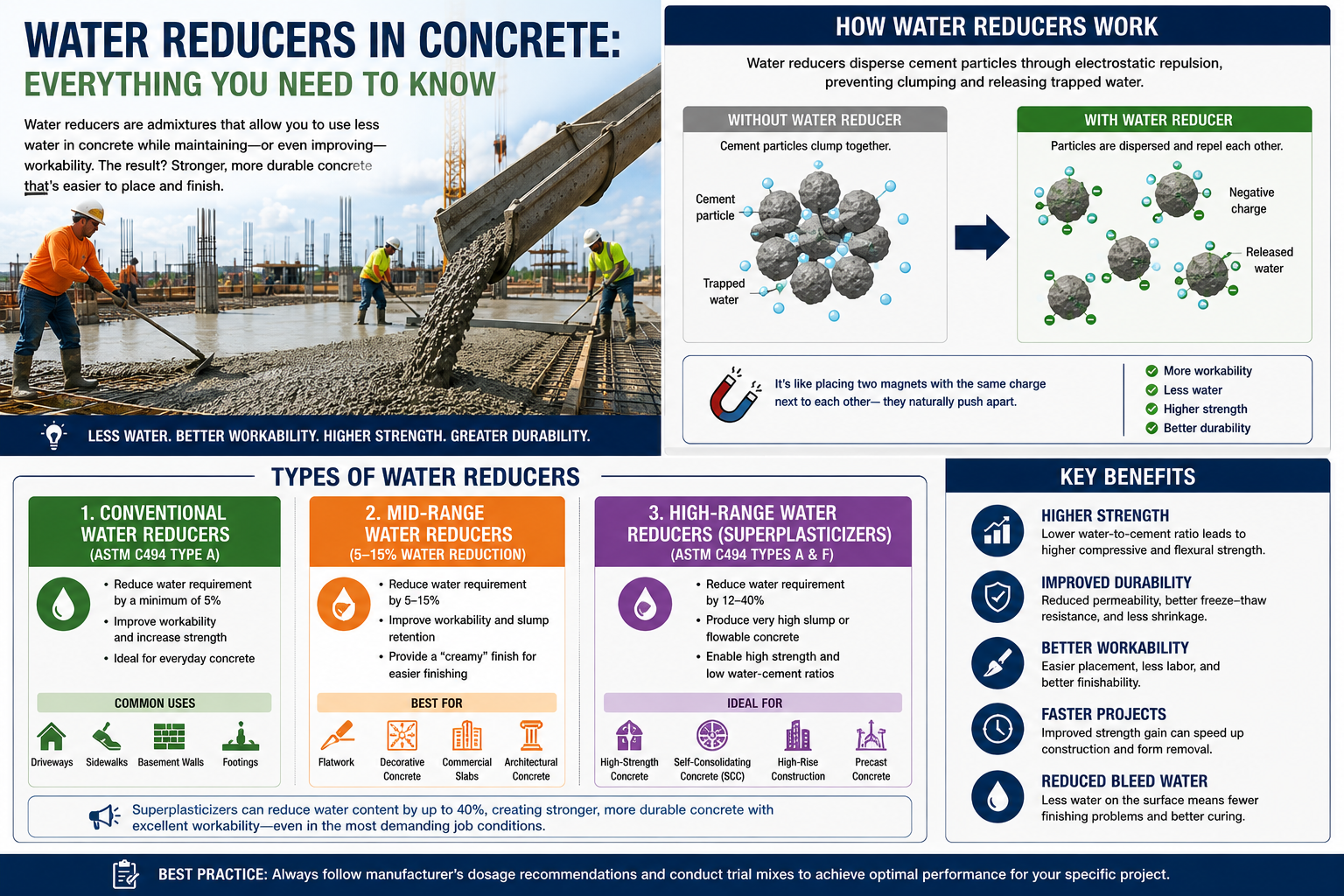
Water reducers are chemical admixtures that allow concrete to be mixed with less water while maintaining—or even improving—its workability.
To understand why this matters, it’s important to understand the water-to-cement ratio (w/c ratio).
The water-to-cement ratio represents the amount of water compared to the amount of cement in a concrete mix. Research shows that approximately 0.22–0.25 pounds of water per pound of cement is required for complete cement hydration. However, most concrete mixes contain water-to-cement ratios between 0.40 and 0.60 because additional water makes the concrete easier to place, consolidate, and finish.
While adding extra water improves workability, it also creates several problems:
- Reduced compressive strength
- Lower abrasion resistance
- Increased permeability
- Greater drying shrinkage
- Higher risk of cracking
- Reduced long-term durability
Water reducers solve this challenge by allowing concrete to remain workable without requiring excess water.
Water-to-Cement Ratio and Concrete Strength
A lower water-to-cement ratio generally results in:
| Water-Cement Ratio | Concrete Strength |
|---|---|
| 0.60 | Lower Strength |
| 0.50 | Moderate Strength |
| 0.40 | High Strength |
| 0.30 | Very High Strength |
| 0.25 | Maximum Potential Strength |
Suggested Infographic: Water-to-Cement Ratio vs. Concrete Strength showing increasing strength as the ratio decreases.
How Do Water Reducers Work?
The science behind water reducers is surprisingly simple.
Cement particles naturally carry electrical charges that cause them to attract one another and form clusters. When these particles clump together, a significant portion of the mixing water becomes trapped inside the clusters, reducing efficiency.
Water reducers work through a process called electrostatic repulsion.
They coat cement particles with negative charges, causing the particles to repel each other and disperse evenly throughout the mix.
Think of it like placing two magnets with the same charge next to each other—they naturally push apart.
As the cement particles separate:
- Water trapped inside clumps is released.
- The concrete becomes more fluid.
- Workability improves.
- Less water is needed.
- Placement becomes easier.
Modern polycarboxylate-based superplasticizers are so effective that their fluidity is often measured by spread rather than traditional slump tests.
The result is concrete that is easier to place while maintaining superior strength and durability.
The Three Types of Water Reducers
Conventional Water Reducers (ASTM C494 Type A)
Conventional water reducers are the most commonly used water-reducing admixtures.
Key Characteristics
- Reduce water demand by at least 5%
- Improve workability
- Enhance strength development
- Cost-effective solution
- Suitable for most standard concrete applications
Common Applications
- Residential driveways
- Sidewalks
- Basement walls
- Footings
- General construction projects
Most manufacturers offer products with similar performance characteristics in this category, making conventional water reducers a reliable option for everyday concrete work.
Mid-Range Water Reducers
Mid-range water reducers bridge the gap between conventional products and superplasticizers.
Key Characteristics
- Reduce water requirements by approximately 5–15%
- Improve slump retention
- Produce a smooth, creamy finish
- Enhance placement and finishing
Although there is currently no official ASTM designation for mid-range water reducers, they are widely recognized and used throughout the construction industry.
Why Contractors Prefer Them
Many finishers appreciate the creamy consistency these admixtures create. This improved finishability can significantly reduce labor effort during concrete finishing operations.
Best Applications
- Decorative concrete
- Commercial slabs
- Flatwork projects
- Architectural concrete
- Projects requiring improved finish quality
High-Range Water Reducers (Superplasticizers) (ASTM C494 Types A and F)
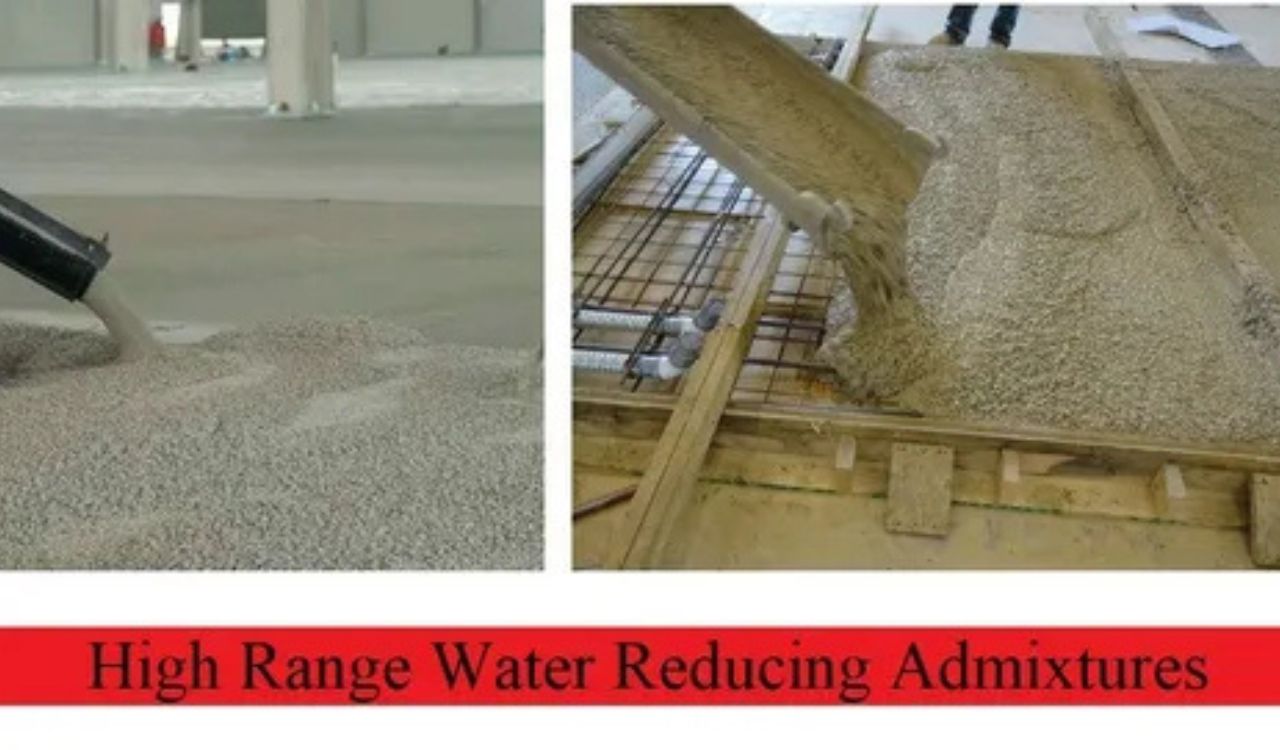
High-range water reducers, commonly known as superplasticizers, represent the most powerful category of water-reducing admixtures.
Key Characteristics
- Reduce water demand by 12–40%
- Produce very low water-cement ratios
- Create highly flowable concrete
- Increase compressive strength dramatically
- Improve pumpability
Modern superplasticizers are typically added at the batch plant, ensuring concrete arrives on-site at the desired slump and ready for placement.
Industry Perspective
Sean Fallon of Euclid Chemical summarized their importance perfectly:
“A concrete manufacturer that does not use a high-range water reducer these days is like a secretary not using a computer.”
Common Applications
- High-rise buildings
- Bridge construction
- Precast concrete
- Self-consolidating concrete (SCC)
- High-performance concrete
- Industrial flooring
Benefits of Using Water Reducers
Water reducers provide numerous performance and economic benefits.
Improved Strength
Lower water content generally translates into higher compressive and flexural strengths.
Some water reducers may initially slow strength development due to mild retardation effects, but many mixes demonstrate substantial strength gains at the 28-day mark.
Greater Durability
Reducing water content creates denser concrete with:
- Better abrasion resistance
- Lower permeability
- Improved freeze-thaw resistance
- Reduced shrinkage
- Lower cracking potential
Reduced Bleed Water
Because less excess water exists within the mix, there is less bleed water rising to the surface.
Benefits include:
- Easier finishing
- Better surface quality
- Reduced scaling potential
- Improved curing effectiveness
Increased Workability
Water reducers significantly improve concrete workability without sacrificing strength.
This allows crews to:
- Place concrete faster
- Consolidate more effectively
- Reduce labor costs
- Improve productivity
Faster Project Timelines
Accelerated strength development can allow:
- Earlier form removal
- Faster construction sequencing
- Earlier occupancy
- Improved project cash flow
Water Reducer Comparison Table
| Benefit | Conventional | Mid-Range | High-Range |
|---|---|---|---|
| Water Reduction | 5%+ | 5–15% | 12–40% |
| Improved Workability | Good | Very Good | Excellent |
| Strength Gain | Moderate | High | Very High |
| Surface Finish | Good | Excellent | Excellent |
| Flowability | Moderate | High | Very High |
| Cost | Low | Medium | Higher |
Potential Drawbacks and How to Avoid Them
While water reducers offer significant advantages, improper use can create challenges.
Excessive Retardation
Using too much retarding admixture can leave concrete in a plastic state for an extended period.
In windy conditions, this may increase susceptibility to plastic shrinkage cracking.
Solution
Maintain open communication between:
- Contractors
- Concrete producers
- Admixture suppliers
Proper mix design coordination minimizes these risks.
Delayed Finishing Operations
Overdosing water reducers can delay:
- Finishing schedules
- Troweling operations
- Form stripping
Solution
Follow manufacturer dosage recommendations and conduct trial batches when necessary.
Segregation
Excessive water reduction can cause aggregates to fall out of suspension.
This leads to:
- Non-uniform concrete
- Poor surface quality
- Reduced structural performance
Solution
Ensure proper dosing and quality control procedures throughout production.
The Expert Consensus
Most concrete professionals agree on one key point:
When used correctly, water reducers have virtually no significant disadvantages.
The Cost-Benefit Equation
One concern some contractors have is cost.
In reality, conventional water reducers are often already included in the ready-mix price per cubic yard, meaning many contractors never notice the additional expense.
Mid-range and high-range water reducers do cost more, but they often deliver substantial returns through:
- Higher strength
- Reduced labor requirements
- Better finishing characteristics
- Improved durability
- Faster project completion
The key concept is understanding that the true cost of concrete is not the purchase price per cubic yard—it is the in-place cost.
A slightly higher material cost can produce significantly lower overall project costs when labor savings, performance improvements, and schedule reductions are considered.
As Scott Thome of L.M. Scofield Co. emphasizes, evaluating concrete based solely on material cost often overlooks the much greater value created through improved placement and long-term performance.
Frequently Asked Questions
How Do Water Reducers Work in Concrete?
Water reducers disperse cement particles through electrostatic repulsion, preventing clumping and releasing trapped water. This improves workability while reducing water requirements.
When Should You Use a Superplasticizer?
Superplasticizers are ideal when very high workability or high-strength concrete is required, such as in high-rise construction, precast applications, and self-consolidating concrete.
Do Water Reducers Increase Concrete Strength?
Yes. By lowering the water-to-cement ratio, water reducers typically improve compressive strength, flexural strength, and overall durability.
Are Water Reducers and Superplasticizers the Same?
Superplasticizers are a specific category of water reducers known as high-range water reducers. They provide significantly greater water reduction than conventional products.
Conclusion
Water reducers have become one of the most important concrete admixtures used in modern construction. From residential driveways to high-performance commercial structures, they improve workability, enhance durability, increase strength, and deliver better overall value.
Whether you’re using a conventional water reducer, a mid-range product, or a high-range superplasticizer, the key to success lies in selecting the correct admixture and dosage for your specific project requirements.
Before your next pour, consult with your ready-mix supplier, concrete producer, or admixture specialist to determine the best water reducer for your application.
For more expert insights, explore our related guides on ready-mix concrete suppliers, cold-weather concrete placement, decorative concrete techniques, and advanced concrete admixtures.
Stay ahead of industry trends by subscribing to our newsletter and receiving the latest concrete technology updates directly in your inbox.