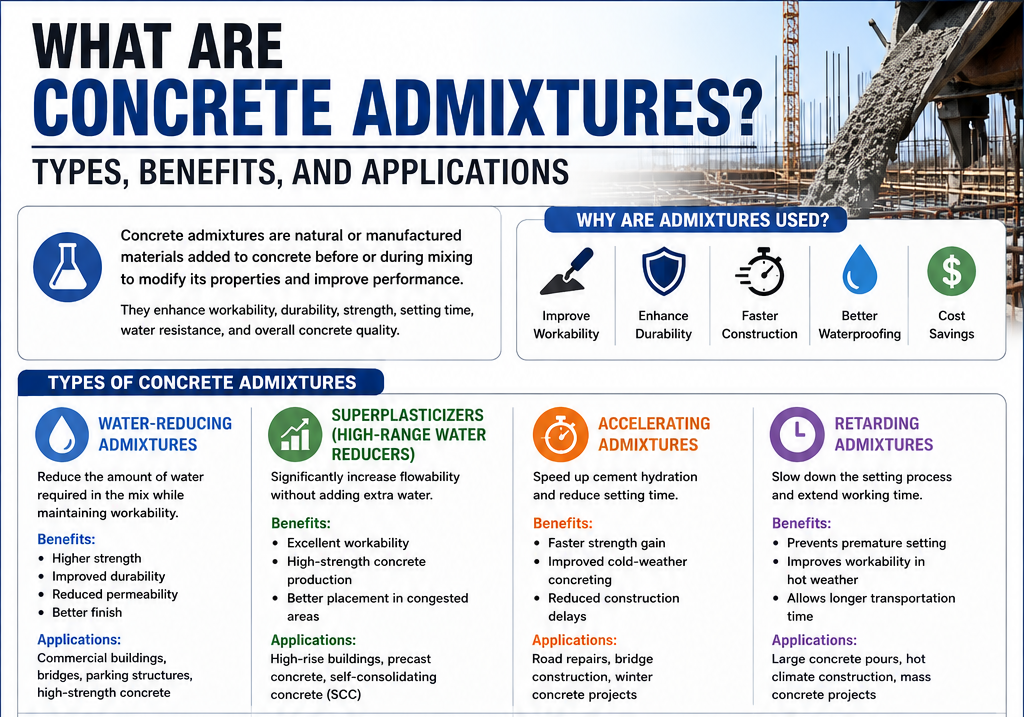
What are concrete admixtures? Concrete admixtures are natural or manufactured materials added to concrete before or during mixing to modify its properties and improve performance. These additives enhance workability, durability, strength, setting time, water resistance, and overall concrete quality.
Modern construction projects rely heavily on concrete admixtures to meet demanding performance requirements in residential, commercial, industrial, and infrastructure applications. From skyscrapers and bridges to tunnels and water treatment facilities, admixtures help engineers create concrete that performs better under specific environmental and structural conditions.
What Are Concrete Admixtures?
Concrete admixtures are ingredients added to a concrete mix in addition to cement, water, and aggregates. T
Concrete is made from cement, water, and aggregates. An admixture is an extra ingredient, added in a small quantity, that changes how fresh concrete behaves, how hardened concrete performs, or both. Dosage is small compared with the cement, from a fraction of a percent up to a few percent of the cementitious material, depending on the product.
Depending on the project, admixtures can:
- Increase workability without adding water
- Reduce the water content of the mix
- Speed up or slow down setting
- Improve strength development
- Reduce permeability and improve waterproofing
- Control shrinkage and cracking
- Protect reinforcing steel from corrosion
- Improve resistance to freeze-thaw cycles, chemicals, and harsh environments
Chemical vs mineral admixtures
The word admixture covers two different groups. Chemical admixtures (water reducers, superplasticizers, accelerators, retarders, and the others covered below) are used in small doses and work through chemistry. Mineral admixtures, also called supplementary cementitious materials, such as fly ash, slag, silica fume, and calcined clay, are used in larger quantities and partly replace cement. This guide focuses on chemical admixtures. In everyday use, the terms admixture and additive are often used interchangeably.
Why Are Concrete Admixtures Used?
Construction professionals use concrete admixtures for several reasons:
Improved Workability
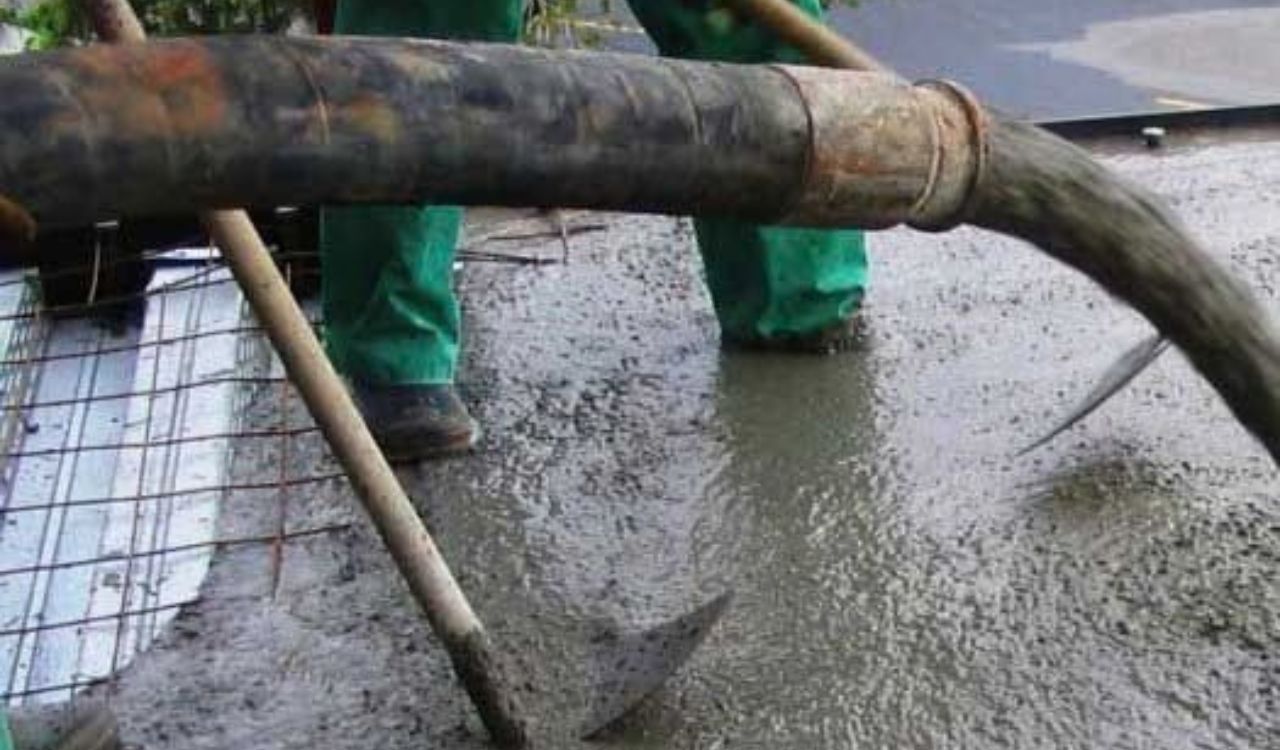
Admixtures make concrete easier to mix, place, pump, and finish without increasing water content.
Enhanced Durability
Specialized admixtures improve resistance to freeze-thaw cycles, chemical attack, corrosion, and environmental exposure.
Faster Construction
Accelerating admixtures help concrete gain strength more quickly, reducing project timelines.
Better Waterproofing
Waterproofing admixtures reduce water penetration and improve long-term durability.
Cost Savings
Reducing cement content while maintaining performance can lower construction costs.
How Admixtures Work
Cement particles tend to clump together and trap water between them. Water-reducing admixtures attach to the particle surfaces and disperse them, either by electrostatic repulsion (older types such as lignosulfonate and naphthalene) or by steric hindrance (polycarboxylate). The released water makes the mix more fluid, so a producer can either gain flow at the same water content or keep the same flow with less water. A lower water-cement ratio gives denser, stronger, less permeable concrete.
Other admixtures work differently. Accelerators and retarders change the speed of cement hydration. Air-entraining agents create microscopic air bubbles. Crystalline admixtures form crystals inside pores and microcracks. Corrosion inhibitors support the protective layer around reinforcing steel.
Superplasticizers: PCE and Naphthalene
Superplasticizers sharply increase flowability without adding water, which makes them essential for high-strength concrete, self-compacting concrete (SCC), precast elements, and congested reinforcement.
- Polycarboxylate ether (PCE) is the high-performance option. Its molecular structure can be designed for high water reduction and long workability retention, so it is widely used in ready-mix, precast, UHPC, and dry-mix mortar. PCE is available as liquid, powder, and flakes.
- Naphthalene (SNF) superplasticizers are an established, cost-effective option for high-range water reduction, for example in precast and steam-cured concrete. A naphthalene powder is typically dosed at roughly 0.5 to 1.5% of cementitious material, and the exact rate depends on the product and strength grade.
Powder forms are popular with dry-mix mortar manufacturers and exporters because they are easy to store and ship. Whichever you choose, confirm the dosage on the product data sheet and test with your own cement.
Slump-Retaining Agents
Concrete loses workability over time, especially during long transport or in hot weather. Slump-retaining admixtures release their dispersing effect gradually so the mix stays workable until placement, without delaying setting as a retarder would.
Accelerating Admixtures
Accelerators speed up cement hydration, giving faster setting and early strength gain. They are used in cold-weather concreting, road repairs, and fast-track work. For reinforced concrete, choose chloride-free accelerators, because chloride can promote corrosion of steel.
Retarding Admixtures
Retarders slow the set and extend working time. They are used for large pours, long haul times, hot-weather concreting, and mass concrete.
Air-Entraining Admixtures
These admixtures create microscopic, evenly spaced air bubbles that give water room to expand when it freezes, which improves freeze-thaw and de-icing salt resistance in pavements, bridge decks, and exterior concrete. Because added air can reduce compressive strength, the air content must be controlled carefully.
Waterproofing and Crystalline Admixtures
Waterproofing admixtures reduce water absorption and permeability from inside the concrete. Crystalline waterproofing admixtures react with moisture and unhydrated cement to form insoluble crystals inside capillary pores and microcracks. Because the reaction restarts when water enters, they can seal new fine cracks, for example cracks up to about 0.3 mm, over the life of the structure. They suit basements, tunnels, tanks, reservoirs, and underground structures. Typical crystalline dosage is higher than for superplasticizers, commonly in the range of 2 to 4% of cementitious material.
An admixture cannot fix poor compaction, excess water, or badly detailed joints, so good mix design, curing, and joint waterproofing remain essential.
Expansion Agents and Shrinkage Control
Concrete shrinks as it dries, and restrained shrinkage causes cracks. Two different approaches exist. Shrinkage-reducing admixtures lower the drying shrinkage itself. Expansion agents, such as sulfoaluminate-calcium types, create a controlled expansion during early hardening that compensates for later shrinkage. Dosage is much higher than for water reducers, commonly 6 to 12% of cementitious material depending on the application, and proper curing is essential. They are used in basements, long slabs, water-retaining structures, and mass concrete.
Corrosion Inhibitors
Chlorides from seawater or de-icing salts can break down the passive layer that protects steel reinforcement, leading to rust, cracking, and spalling. Corrosion-inhibiting admixtures slow this process and extend service life in marine structures, bridges, and parking decks. Some products are designed mainly for chloride attack, and others for combined chloride and sulfate exposure.
Other Specialty Admixtures
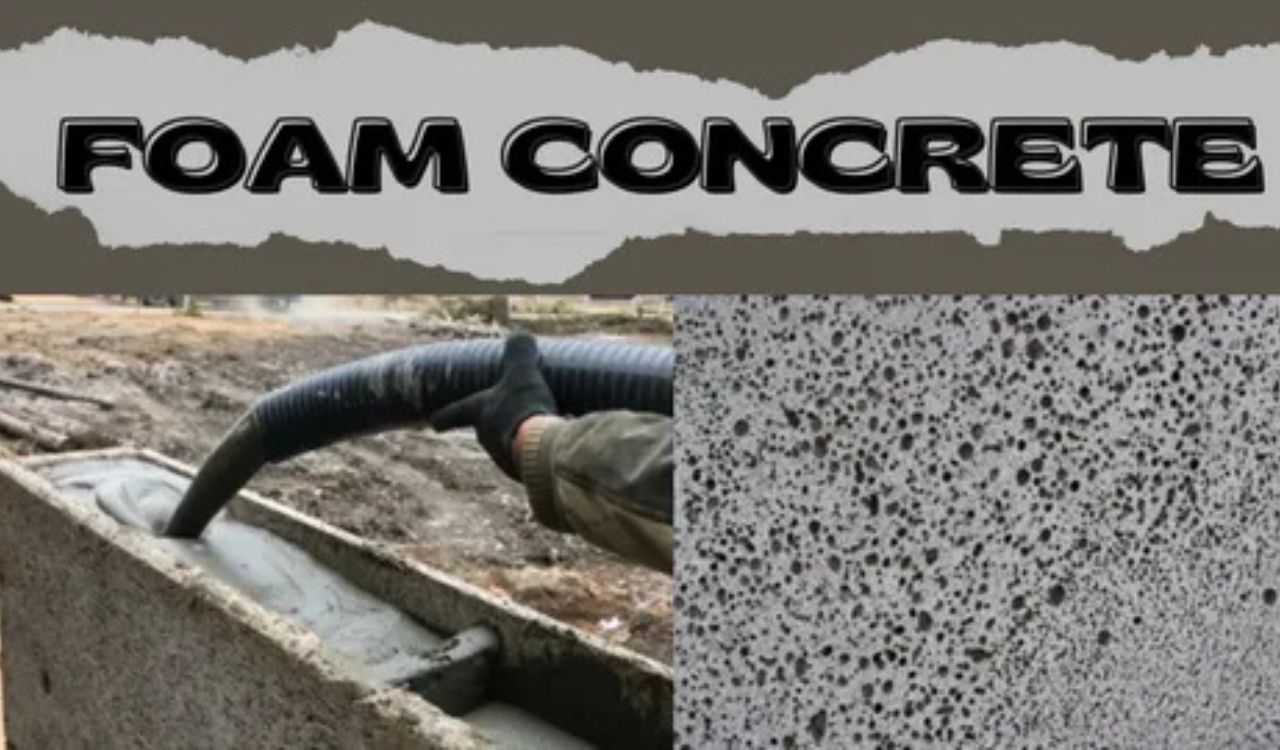
Other admixtures serve narrower needs, including viscosity modifying admixtures for stability and self-compacting mixes, foaming agents for lightweight concrete, and antifreeze admixtures for very cold conditions.
Types of Concrete Admixtures
Water-Reducing Admixtures
Water reducers decrease the amount of water required in a concrete mix while maintaining workability.
Benefits:
- Higher strength
- Improved durability
- Reduced permeability
- Better finishing characteristics
Common Applications:
- Commercial buildings
- Bridges
- Parking structures
- High-strength concrete
Superplasticizers (High-Range Water Reducers)
Superplasticizers significantly increase concrete flowability without adding extra water.
Benefits:
- Excellent workability
- High-strength concrete production
- Improved placement in congested reinforcement areas
Applications:
- High-rise buildings
- Precast concrete
- Self-consolidating concrete (SCC)
Accelerating Admixtures
Accelerators speed up cement hydration and reduce setting time.
Benefits:
- Faster strength gain
- Improved cold-weather concreting
- Reduced construction delays
Applications:
- Road repairs
- Bridge construction
- Winter concrete projects
Retarding Admixtures
Retarders slow down the setting process and extend working time.
Benefits:
- Prevents premature setting
- Improves workability in hot weather
- Allows longer transportation times
Applications:
- Large concrete pours
- Hot climate construction
- Mass concrete projects
Air-Entraining Admixtures
These admixtures introduce microscopic air bubbles into the concrete mix.
Benefits:
- Improved freeze-thaw resistance
- Reduced scaling
- Enhanced durability
Applications:
- Pavements
- Bridges
- Exterior concrete structures
Waterproofing Admixtures
Waterproofing admixtures reduce water absorption and permeability.
Benefits:
- Improved water resistance
- Reduced leakage
- Increased service life
Applications:
- Basements
- Water tanks
- Foundations
- Tunnels
- Swimming pools
Corrosion Inhibitors
Corrosion inhibitors protect embedded steel reinforcement from rust and deterioration.
Benefits:
- Extended structural life
- Reduced maintenance costs
- Improved durability
Applications:
- Marine structures
- Parking garages
- Bridges
- Coastal construction
Shrinkage-Reducing Admixtures
These admixtures minimize drying shrinkage and cracking.
Benefits:
- Reduced cracking
- Improved dimensional stability
- Better long-term performance
Applications:
- Industrial floors
- Large slabs
- Water-retaining structures
Crystalline Waterproofing Admixtures
Crystalline admixtures are advanced waterproofing additives that react with moisture and unhydrated cement particles to form insoluble crystals within the concrete.
Benefits:
- Permanent waterproofing
- Self-sealing of small cracks
- Reduced permeability
- Improved durability
Applications:
- Basements
- Foundations
- Water treatment plants
- Reservoirs
- Underground structures
Advantages of Concrete Admixtures
Improved Concrete Performance
Admixtures enhance both fresh and hardened concrete properties.
Increased Durability
Structures become more resistant to weathering, chemicals, and environmental stress.
Reduced Construction Time
Accelerating and workability-enhancing admixtures improve project efficiency.
Lower Maintenance Costs
Durable concrete requires fewer repairs over its service life.
Sustainability Benefits
Reduced cement consumption can lower the environmental impact of construction projects.
Applications of Concrete Admixtures
Concrete admixtures are widely used in:
- Residential buildings
- Commercial construction
- Bridges and highways
- Dams and reservoirs
- Tunnels
- Airports
- Marine structures
- Industrial facilities
- Water treatment plants
- Underground infrastructure
How to Choose the Right Concrete Admixture
When selecting a concrete admixture, consider:
Project Requirements
Determine whether you need improved workability, waterproofing, durability, or strength.
Environmental Conditions
Climate, temperature, and exposure conditions influence admixture selection.
Structural Performance
Different structures require different performance characteristics.
Compatibility
Ensure the admixture is compatible with cement, aggregates, and other mix components.
Frequently Asked Questions
What are concrete admixtures?
Concrete admixtures are materials added to concrete before or during mixing to improve workability, durability, strength, setting time, and other performance characteristics.
Why are admixtures added to concrete?
Admixtures enhance concrete performance, improve construction efficiency, and help meet specific project requirements.
What is the most common concrete admixture?
Water-reducing admixtures are among the most commonly used admixtures in modern concrete construction.
Are waterproofing admixtures effective?
Yes. Waterproofing admixtures significantly reduce water penetration and improve concrete durability.
Can admixtures increase concrete strength?
Yes. Many admixtures improve strength development by reducing water content and enhancing cement hydration.
What are crystalline waterproofing admixtures?
Crystalline admixtures create insoluble crystals within concrete that block water pathways and improve waterproofing performance.
Conclusion
Understanding what concrete admixtures are is essential for designing durable, high-performance concrete structures. These specialized additives improve workability, strength, waterproofing, durability, and construction efficiency across a wide range of applications. Whether you’re building a residential foundation, a commercial structure, or critical infrastructure, the right concrete admixture can significantly enhance the quality and longevity of your concrete.