Concrete admixtures can significantly change the behavior of fresh and hardened concrete, but their performance depends heavily on dosage.
Adding too little admixture may fail to produce the required water reduction, setting control, workability, early strength, waterproofing performance, or other desired effect. Adding too much does not necessarily improve performance and may introduce problems such as excessive slump, rapid setting, delayed setting, segregation, bleeding, air-content changes, or inconsistent strength development.
For this reason, concrete admixture dosage should not be treated as a fixed number that applies to every concrete mixture.
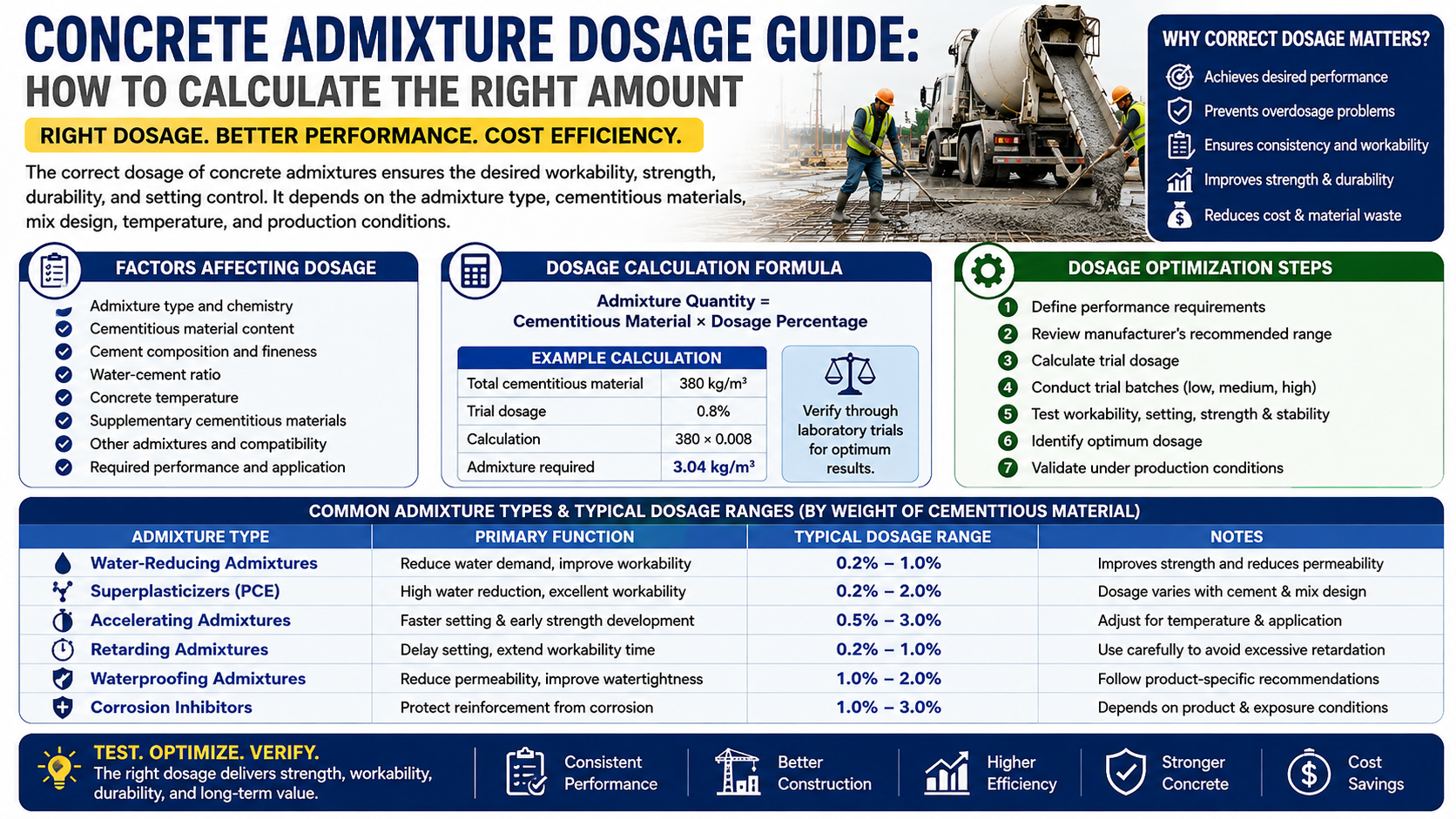
The correct dosage depends on the admixture type, cementitious material content, cement chemistry, water-cement ratio, concrete temperature, supplementary cementitious materials, other admixtures, required performance, and actual production conditions.
For concrete producers, contractors, engineers, precast manufacturers, and industrial buyers, the most reliable approach is to begin with the manufacturer’s recommended dosage range and then confirm the appropriate amount through laboratory trials and production testing.
Why Concrete Admixture Dosage Matters
Chemical admixtures are normally added in relatively small quantities compared with cement, aggregates, and water, but even these small quantities can have a substantial influence on concrete behavior.
Depending on the product, admixtures may be used to:
- Reduce water demand
- Increase workability
- Improve slump retention
- Accelerate setting
- Retard setting
- Develop earlier strength
- Improve pumping performance
- Control air content
- Reduce permeability
- Improve durability
- Protect reinforcement
- Modify shrinkage
- Support specialized concrete applications
The effectiveness of these functions depends partly on using an appropriate dosage.
Dosage optimization therefore has two objectives:
- Achieve the required concrete performance.
- Avoid unnecessary admixture consumption or undesirable side effects.
The highest possible dosage is rarely the objective. Instead, the goal is to identify a practical dosage that consistently achieves the required performance under actual production conditions.
Basic Concrete Admixture Dosage Formula
When dosage is specified as a percentage of cementitious material, a basic calculation can be made using:
Admixture quantity = Cementitious material × Dosage percentage
The percentage must first be converted into decimal form.
For example:
0.5% = 0.005
If a concrete mixture contains 400 kg of cementitious material per cubic meter and the selected trial dosage is 0.5%, the calculation becomes:
400 kg × 0.005 = 2.0 kg
The theoretical admixture requirement would therefore be:
2.0 kg of admixture per cubic meter of concrete
This calculation provides the batching quantity for that particular trial dosage. It does not prove that 0.5% is the optimum dosage for the concrete.
Performance still needs to be verified through testing.
Example Dosage Calculation
Consider a hypothetical concrete mixture containing:
| Item | Quantity |
| Cement | 320 kg/m³ |
| Fly ash | 60 kg/m³ |
| Total cementitious material | 380 kg/m³ |
| Trial admixture dosage | 0.8% |
| Calculated admixture | 3.04 kg/m³ |
The calculation is:
380 × 0.008 = 3.04 kg/m³
If the manufacturer’s dosage is based on total cementitious material, approximately 3.04 kg of admixture per cubic meter would be used for that trial.
However, if the manufacturer’s instructions define dosage based only on cement, the calculation would be different.
This is why the product technical data sheet should always be checked before determining the batching quantity.
Step 1: Identify the Type of Admixture
Different admixture categories perform different functions and therefore should not be dosed using the same assumptions.
Common categories include:
Water-Reducing Admixtures
Water reducers are used to decrease water demand while maintaining required workability or to improve workability at a given water content.
Dosage can influence:
- Water reduction
- Slump
- Strength
- Setting behavior
- Finishing characteristics
Superplasticizers
High-range water reducers, including polycarboxylate-based systems, can produce substantial changes in concrete flow and water demand.
Their performance can be particularly sensitive to cement chemistry, dosage, temperature, and supplementary cementitious materials.
Accelerating Admixtures
Accelerators are used to shorten setting time and/or promote early-strength development.
Dosage needs to balance acceleration with adequate transportation, placement, consolidation, and finishing time.
Retarding Admixtures
Retarders delay setting and can be useful in hot weather, long-distance transportation, mass concrete, or construction requiring extended working time.
Excessive dosage may extend setting beyond the intended construction schedule.
Waterproofing Admixtures
Integral waterproofing products are incorporated into concrete to support reduced water penetration or other waterproofing mechanisms.
These products should be dosed according to their specific technical requirements rather than general water-reducer practices.
Corrosion Inhibitors
Corrosion-inhibiting admixtures are selected to help protect embedded reinforcement under specified exposure conditions.
Dosage can depend on product chemistry, chloride exposure, structural requirements, and manufacturer recommendations.
The first rule of dosage calculation is therefore simple:
Identify exactly which admixture is being used and follow the dosage basis specified for that product.
Step 2: Determine the Cementitious Material Content
Once the admixture type is identified, determine which material quantity should be used as the basis for dosage.
A modern concrete mixture may contain:
- Portland cement
- Fly ash
- Ground granulated blast-furnace slag
- Silica fume
- Limestone materials
- Other supplementary cementitious materials
If the product dosage is based on total cementitious material, these components may need to be included in the calculation according to the manufacturer’s instructions.
For example:
Cement = 330 kg/m³
Fly ash = 70 kg/m³
Total cementitious material = 400 kg/m³
At a hypothetical trial dosage of 0.6%:
400 × 0.006 = 2.4 kg/m³
Again, this represents a calculated trial quantity rather than a universal recommended dosage.
Step 3: Start With the Manufacturer’s Recommended Range
A technical data sheet should normally be the starting point for dosage selection.
Manufacturers develop recommended ranges based on product formulation and testing.
The technical information may provide:
- Typical dosage range
- Recommended applications
- Physical form
- Density
- Solid content
- Compatibility information
- Storage requirements
- Limitations
- Performance characteristics
Do not assume that two products belonging to the same admixture category require the same dosage.
Two polycarboxylate superplasticizers, for example, may have different active concentrations, molecular structures, intended applications, and recommended dosage ranges.
Product-specific documentation should therefore take priority over generic dosage assumptions.
Step 4: Define the Required Concrete Performance
The correct dosage cannot be selected without defining what the concrete needs to achieve.
Ask:
What performance problem is the admixture expected to solve?
Possible objectives include:
- Increasing initial slump
- Maintaining slump during transportation
- Reducing mixing water
- Increasing compressive strength
- Achieving earlier strength
- Accelerating setting
- Extending setting time
- Improving pumping
- Reducing permeability
- Improving durability
- Protecting reinforcement
- Supporting precast production
The dosage should be optimized around measurable performance requirements.
For a water reducer, for example, simply obtaining the highest slump may not be the objective. The actual target may be to achieve a specified slump while reducing water content and maintaining stability.
Step 5: Consider the Water-Cement Ratio
Water-cement or water-binder ratio is one of the most important variables in concrete mix design.
Changing water content affects:
- Workability
- Strength
- Permeability
- Durability
- Bleeding
- Segregation
- Admixture response
When a water-reducing admixture is introduced, the mix should not automatically be evaluated only by how much the slump increases.
If the purpose is water reduction, the water content may need to be adjusted while maintaining the required workability.
Dosage optimization therefore needs to be performed together with the overall mix design.
Step 6: Consider Cement Type and Chemistry
Admixtures interact directly with cement particles and hydration processes.
Different cement sources may respond differently to the same admixture.
Important variables can include:
- Cement composition
- C₃A content
- Sulfate balance
- Cement fineness
- Alkali content
- Mineral additions
- Cement age and storage conditions
This is especially important with modern high-performance admixtures.
A dosage that performs successfully with one cement source should not automatically be transferred to another cement without testing.
Step 7: Consider Supplementary Cementitious Materials
Fly ash, slag, silica fume, and other supplementary materials can influence admixture demand.
They may change:
- Particle packing
- Surface area
- Water demand
- Adsorption behavior
- Slump
- Slump retention
- Setting
- Strength development
Silica fume, for example, has a very high specific surface area and can significantly affect water demand and rheology.
Concrete containing supplementary cementitious materials should therefore be tested as a complete system.
Step 8: Check Concrete Temperature
Temperature can significantly affect concrete behavior and admixture performance.
Higher temperatures generally increase the rate of hydration and may accelerate slump loss and setting.
Lower temperatures generally slow hydration and strength development.
Therefore, a dosage established under laboratory conditions at one temperature may not produce identical results during summer or winter production.
When seasonal temperature changes are significant, trial programs may need to evaluate more than one temperature condition.
Step 9: Check Compatibility With Other Admixtures
Modern concrete frequently contains multiple chemical admixtures.
A mixture may include combinations of:
- Water reducers
- Superplasticizers
- Accelerators
- Retarders
- Air-entraining agents
- Corrosion inhibitors
- Waterproofing admixtures
- Shrinkage-control products
These admixtures should not be evaluated independently when they will ultimately be used together.
Potential interactions may influence:
- Slump
- Slump retention
- Setting time
- Air content
- Bleeding
- Segregation
- Strength
- Surface finish
The complete admixture system should therefore be evaluated during trial batching.
Step 10: Conduct Trial Batches at Different Dosages
Trial batching is one of the most reliable methods for establishing an appropriate admixture dosage.
Instead of testing only one dosage, evaluate several points within the manufacturer’s permitted or recommended range.
A simple program may include:
| Trial | Admixture Level | Purpose |
| Control | No admixture | Establish baseline |
| Trial A | Lower dosage | Evaluate minimum effective response |
| Trial B | Intermediate dosage | Evaluate target performance |
| Trial C | Higher dosage | Check additional benefit and side effects |
The actual dosage values should come from the product’s technical guidance.
Each trial should use the same materials and controlled batching procedures so that the effect of dosage can be evaluated properly.
What Should Be Measured During Trial Batching?
The tests depend on the admixture and project requirements, but a typical program may examine:
| Property | Why It Matters |
| Initial slump | Measures initial workability |
| Slump retention | Shows workability over time |
| Setting time | Identifies acceleration or retardation |
| Air content | Detects unwanted air changes |
| Bleeding | Helps assess stability |
| Segregation | Indicates mixture cohesion |
| Density | Supports consistency checks |
| Early strength | Evaluates early-age performance |
| 7-day strength | Shows intermediate development |
| 28-day strength | Evaluates later performance |
Specialized applications may require additional testing.
What Happens If Admixture Dosage Is Too Low?
Underdosing generally means the product cannot deliver its intended performance effectively.
Depending on the admixture, possible results include:
- Insufficient water reduction
- Low workability
- Poor slump retention
- Inadequate acceleration
- Insufficient retardation
- Reduced pumping performance
- Failure to achieve the desired early strength
- Inadequate specialized performance
However, increasing dosage should only be done within appropriate technical limits and after determining whether dosage is actually the cause of the problem.
Poor concrete performance may also result from incorrect water content, aggregate grading, cement variation, temperature, batching errors, or incompatibility.
Powder vs Liquid Admixture Dosage
Physical form also affects batching.
Powder Admixtures
Powder products are typically measured by mass.
Accurate weighing and uniform dispersion are important.
Liquid Admixtures
Liquid products may be dosed by mass or volume depending on the batching equipment and manufacturer instructions.
When converting between mass and volume, product density becomes important.
A simple relationship is:
Volume = Mass ÷ Density
For accurate production, use the actual product density supplied by the manufacturer rather than assuming that every liquid admixture has the same density as water.
Common Mistakes in Concrete Admixture Dosage
Using One Dosage for Every Concrete Mix
Different cement contents, materials, temperatures, and performance targets may require different dosage levels.
Assuming Higher Dosage Means Better Performance
Increasing dosage beyond the useful range can increase cost and potentially create undesirable concrete behavior.
Ignoring Cement Source Changes
A new cement source can change admixture response even if the concrete mix proportions remain similar.
Ignoring Aggregate Moisture
Incorrect moisture corrections can change the actual water content and make an admixture appear to perform differently.
Mixing Admixtures Without Compatibility Testing
Two admixtures that work individually may interact when used together.
Using Laboratory Dosage Without Field Validation
Laboratory trials are important, but production conditions can introduce additional variables.
Adding Extra Water Instead of Correcting the Mix
Uncontrolled water addition can change the water-cement ratio and affect strength and durability.
Dosage Should Be Rechecked When Materials Change
Once an admixture dosage has been established, it should not necessarily be considered permanent.
Reevaluation may be appropriate when there are significant changes in:
- Cement supplier
- Cement composition
- Supplementary cementitious materials
- Aggregate source
- Aggregate moisture
- Mix proportions
- Water-cement ratio
- Admixture supplier
- Concrete temperature
- Production process
- Required performance
Concrete is a multi-component system, and changes in one component can affect the behavior of the others.
Where Luke Chemicals Fits Into Admixture Selection
For concrete producers, contractors, manufacturers, and industrial buyers, admixture selection should consider both product chemistry and the actual concrete system in which the product will be used.
Luke Chemicals provides concrete admixture solutions across multiple performance categories, including water-reducing admixtures, accelerating systems, waterproofing solutions, corrosion-control products, and other chemical materials used in concrete production.
When evaluating an admixture, buyers should consider technical specifications, recommended dosage, compatibility, application conditions, required concrete performance, and production requirements.
The final dosage should then be confirmed through project-specific trial batches using the actual cementitious materials, aggregates, water content, temperature, and other admixtures intended for production.
Conclusion
Calculating concrete admixture dosage begins with a simple mathematical formula, but determining the right dosage requires much more than arithmetic.
The basic calculation is:
Admixture quantity = Cementitious material × Dosage percentage
However, the percentage itself must be selected according to the specific product and concrete system.
Cement chemistry, cementitious material content, water-cement ratio, supplementary materials, temperature, other admixtures, transportation time, placement requirements, and performance targets can all influence the optimum dosage.
The most reliable process is:
Define the performance target → review manufacturer guidance → calculate trial dosage → conduct trial batches → measure concrete performance → optimize dosage → validate under production conditions.
This approach helps concrete producers achieve the required performance while reducing the risk of underdosing, overdosing, unnecessary chemical consumption, and inconsistent concrete quality.
Frequently Asked Questions
How do you calculate admixture dosage in concrete?
When dosage is specified as a percentage of cementitious material, multiply the cementitious material content by the dosage expressed as a decimal. For example, 400 kg/m³ × 0.005 for a 0.5% dosage equals 2.0 kg/m³. Always confirm whether the manufacturer bases dosage on cement alone or total cementitious material.
Should admixture dosage change in hot weather?
It may need adjustment because temperature can affect hydration, slump loss, setting, and admixture response. Hot-weather dosage should be established through testing using conditions representative of actual production.