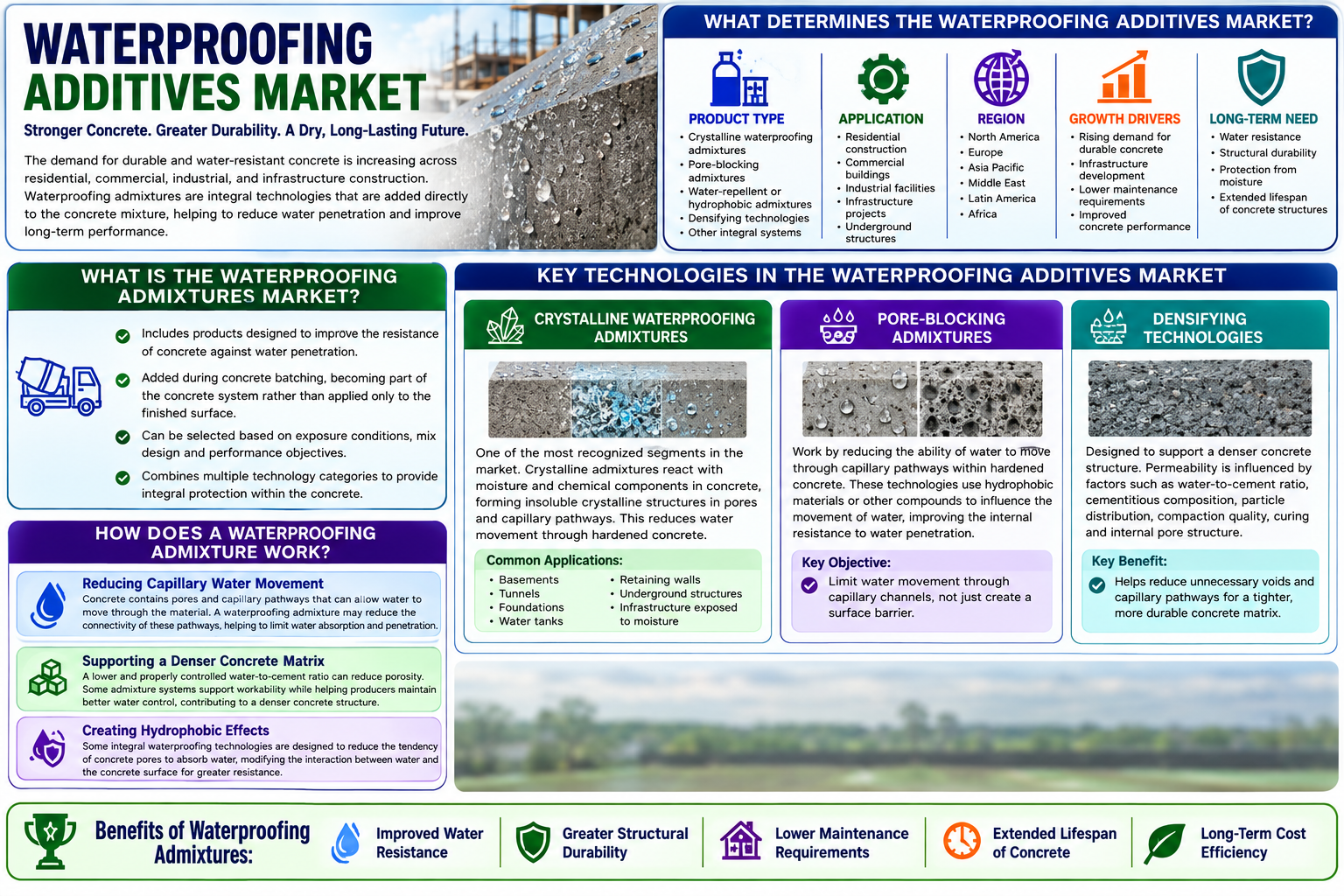
The demand for durable and water-resistant concrete is increasing across residential, commercial, industrial, and infrastructure construction. Structures such as basements, tunnels, bridges, foundations, reservoirs, parking structures, and underground facilities are regularly exposed to moisture or water pressure.
Traditional waterproofing systems often rely on external membranes or coatings. However, modern construction increasingly uses integral technologies that are incorporated directly into the concrete mixture.
This shift has contributed to the development of the waterproofing admixtures market, a specialized segment of the broader construction chemicals industry focused on reducing water penetration and improving concrete durability.
A waterproofing admixture can modify the internal structure or water-transport characteristics of concrete. Depending on the technology used, it may reduce capillary absorption, block pores, increase density, or support crystalline growth within the concrete matrix.
The growing emphasis on long-term durability, infrastructure development, lower maintenance requirements, and improved concrete performance continues to influence demand for these technologies.
What Is the Waterproofing Admixtures Market?
The waterproofing admixtures market includes products designed to improve the resistance of concrete against water penetration.
These products are generally added during concrete batching and become part of the concrete system rather than being applied only to the finished surface.
A concrete waterproofing admixture can be selected according to the required exposure conditions, concrete mix design, and performance objectives.
The market includes several major technology categories, including:
- Crystalline waterproofing admixtures
- Pore-blocking admixtures
- Water-repellent or hydrophobic admixtures
- Densifying technologies
- Other integral waterproofing systems
Market research firms commonly segment the industry by product type, application, and region. Crystalline admixtures, pore-blocking admixtures, and densifiers are among the major categories used in market analysis.
Key Technologies in the Waterproofing Admixtures Market
Crystalline Waterproofing Admixtures
Crystalline technology is one of the most recognized segments within the waterproofing admixtures market.
These admixtures are designed to react with moisture and chemical components present within the concrete system, forming insoluble crystalline structures in pores and capillary pathways.
The objective is to reduce pathways through which water can move through hardened concrete.
Crystalline waterproofing technology is commonly considered for applications involving:
- Basements
- Tunnels
- Foundations
- Water tanks
- Retaining walls
- Underground structures
- Infrastructure exposed to moisture
Industry market analyses identify crystalline admixtures as an important and growing product segment because of their ability to provide integral protection within the concrete structure.
Pore-Blocking Admixtures
Pore-blocking technologies work by reducing the ability of water to move through capillary pathways within hardened concrete.
Depending on the formulation, these systems may use hydrophobic materials or other compounds that influence the movement of water through the concrete.
The goal is not simply to create a surface barrier. Instead, the technology is incorporated into the concrete mix to improve internal resistance to water penetration.
Densifying Technologies
Densifying admixtures are designed to support a denser concrete structure.
Concrete permeability is influenced by several factors, including:
- Water-to-cement ratio
- Cementitious material composition
- Particle distribution
- Compaction quality
- Curing
- Internal pore structure
A properly designed mix with controlled water content and suitable admixture technology can help reduce unnecessary voids and capillary pathways.
How Does a Waterproofing Admixture Work?
The performance of a waterproofing admixture depends on its chemistry and the overall concrete mix.
Different technologies use different mechanisms.
Reducing Capillary Water Movement
Concrete contains pores and capillary pathways that can allow water to move through the material.
A waterproofing admixture may reduce the connectivity or effectiveness of these pathways.
This can help reduce water absorption and penetration.
Supporting a Denser Concrete Matrix
A lower and properly controlled water-to-cement ratio can contribute to reduced porosity.
Some admixture systems support workability while helping producers maintain better water control.
This can contribute to a denser concrete structure when combined with appropriate mix design, placement, consolidation, and curing.
Creating Hydrophobic Effects
Some integral waterproofing technologies are designed to reduce the tendency of concrete pores to absorb water.
These products can modify the interaction between water and the internal surfaces of the concrete.
Supporting Crystalline Growth
Crystalline systems use chemical reactions that can generate insoluble structures within pores and capillaries when suitable moisture conditions are present.
This mechanism is one reason crystalline waterproofing technologies are frequently discussed in applications involving long-term exposure to moisture.
Major Applications Driving Demand
The waterproofing admixtures market is connected closely to construction activity.
Different applications have different waterproofing requirements.
Residential Construction
Residential buildings can use waterproofing technologies in foundations, basements, retaining walls, bathrooms, and other structures exposed to moisture.
Growing urbanization and housing development have supported demand for durable concrete and moisture-control solutions.
Commercial Buildings
Commercial structures may include:
- Underground parking
- Foundations
- Basements
- Podiums
- Roof structures
- Water-management systems
Water intrusion can create expensive maintenance and repair requirements, making long-term waterproofing performance an important consideration.
Infrastructure Projects
Infrastructure is a major application area for waterproofing admixture technologies.
Projects can include:
- Bridges
- Tunnels
- Metro systems
- Dams
- Water-treatment facilities
- Ports
- Roads
- Underground structures
These structures may face repeated exposure to moisture, groundwater, chemicals, or environmental stress.
Industrial Facilities
Industrial projects may require concrete with specific resistance to moisture and demanding operating environments.
The selection of a concrete waterproofing admixture should consider the complete exposure conditions rather than focusing only on general water resistance.
Waterproofing Admixtures Market by Technology
| Technology | Main Function | Typical Applications |
| Crystalline admixtures | Support crystal formation within pores and capillaries | Basements, tunnels, foundations, water structures |
| Pore-blocking admixtures | Reduce water movement through concrete pores | Residential, commercial and infrastructure concrete |
| Hydrophobic admixtures | Reduce water absorption characteristics | Structures exposed to moisture |
| Densifying technologies | Support reduced porosity and a denser structure | Industrial and high-performance concrete |
The appropriate technology depends on the required concrete performance and project exposure conditions.
What Is Driving the Waterproofing Admixtures Market?
Several major factors are contributing to continued interest in integral concrete waterproofing technologies.
Infrastructure Development
Large infrastructure projects require materials designed for long service life and reliable performance.
Tunnels, transportation systems, bridges, water facilities, and underground structures can experience significant exposure to water.
This creates demand for concrete systems designed to reduce water penetration and support durability.
Market research identifies infrastructure expansion and urban development as important factors supporting industry demand.
Increasing Focus on Concrete Durability
Construction professionals are increasingly considering the total service life of structures.
Water penetration can contribute to problems such as:
- Reinforcement corrosion
- Freeze-thaw damage
- Chemical transport
- Moisture-related deterioration
- Increased maintenance requirements
Reducing the movement of water and aggressive substances through concrete can therefore be an important part of durability-focused design.
Growth of Integral Waterproofing Systems
Integral waterproofing is incorporated directly into the concrete rather than relying entirely on an external system.
This approach can be particularly useful where access for future repairs may be difficult.
However, integral systems do not eliminate the need for proper design and construction practices.
Construction joints, cracks, penetrations, and other potential leakage points must still be addressed appropriately.
Sustainable Construction and Longer Service Life
Longer-lasting structures can potentially reduce the frequency of repair and replacement.
This has increased interest in concrete technologies that support durability and extended service life.
Market analyses also identify sustainability and durable construction practices as factors influencing demand for waterproofing admixtures.
Regional Trends in the Waterproofing Admixtures Market
Demand varies according to construction activity, infrastructure investment, climate, regulations, and local manufacturing capacity.
Asia-Pacific
Asia-Pacific is an important region for the waterproofing admixtures market because of large-scale urban development and infrastructure investment.
China, India, South Korea, Indonesia, and other regional markets continue to represent significant construction activity.
MarketsandMarkets identifies Asia-Pacific as a leading region in its market analysis, while Future Market Insights also highlights strong projected growth in major Asian markets.
Europe
European construction markets place significant emphasis on durability, quality standards, infrastructure maintenance, and sustainable building practices.
Demand includes both new construction and renovation or rehabilitation projects.
North America
North America represents an important market for infrastructure, commercial construction, water-management structures, and high-performance concrete technologies.
Durability requirements and maintenance considerations can influence the selection of integral waterproofing solutions.
Middle East and Other Developing Construction Markets
Regions with rapid urban development and major infrastructure investment may present additional opportunities for waterproofing admixture manufacturers.
However, product selection must consider local climate conditions, concrete materials, project specifications, and technical requirements.
Important Factors When Selecting a Concrete Waterproofing Admixture
Selecting the right product involves more than choosing a technology category.
Concrete Mix Compatibility
The admixture must be compatible with:
- Cement type
- Supplementary cementitious materials
- Aggregates
- Water-reducing admixtures
- Other chemical admixtures
Trial testing is important because different combinations can produce different results.
Exposure Conditions
The project should identify the type of water exposure.
Important considerations include:
- Damp conditions
- Groundwater
- Hydrostatic pressure
- Repeated wetting and drying
- Freeze-thaw exposure
- Chemical exposure
A product suitable for one environment may not provide the required performance in another.
Crack and Joint Management
A waterproofing admixture should not be viewed as a solution for every potential leakage path.
Construction joints, expansion joints, penetrations, and significant cracking require appropriate design and detailing.
Dosage and Quality Control
Correct dosage is essential.
The selected admixture should be added according to technical recommendations and verified through testing.
Concrete batching, water control, mixing time, placement, consolidation, and curing also influence the final result.
Limitations of Waterproofing Admixtures
Waterproofing admixtures can improve concrete performance, but they are not a replacement for good engineering and construction practices.
Potential limitations include:
Poor Mix Design
An admixture cannot completely compensate for excessive water, poor aggregate grading, inadequate cementitious materials, or incorrect mix proportions.
Improper Placement
Poor consolidation can create voids and honeycombing that increase the risk of water penetration.
Inadequate Curing
Concrete requires suitable curing to support hydration and the development of its intended properties.
Uncontrolled Cracking
Large structural cracks and improperly treated joints may still allow water penetration.
A complete waterproofing strategy should therefore consider:
- Mix design
- Admixture selection
- Structural design
- Crack control
- Joint detailing
- Placement quality
- Curing
- Exposure conditions
Best Practices for Using Waterproofing Admixtures
For reliable performance, construction professionals should follow a systematic process.
Start With Performance Requirements
Define the expected exposure conditions and required level of water resistance before selecting an admixture.
Test the Complete Mix
A laboratory or production trial should evaluate the actual combination of cement, aggregates, water, and admixtures.
Control Water Addition
Uncontrolled water addition can increase porosity and affect the final concrete structure.
Follow Recommended Dosage
Use the product within the appropriate dosage range and adjust based on technical testing where necessary.
Maintain Quality During Placement
Proper mixing, transportation, consolidation, finishing, and curing remain essential.
Consider the Entire Waterproofing System
An integral waterproofing admixture should be coordinated with joint systems, waterstops, crack-control measures, and other project-specific waterproofing requirements.
For projects requiring integral concrete waterproofing technologies, manufacturers such as Luke Chemicals can provide specialized admixture solutions that should be selected according to mix compatibility and application requirements.
Conclusion
The waterproofing admixtures market is developing alongside growing demand for durable, lower-maintenance, and high-performance concrete.
Crystalline technologies, pore-blocking systems, densifying solutions, and other integral waterproofing approaches give concrete producers additional options for reducing water penetration and improving durability.
The best waterproofing admixture is not determined only by product category. Successful performance depends on selecting technology that matches the concrete mix, exposure conditions, structural design, and construction requirements.
As infrastructure investment, urban development, and durability-focused construction continue to expand, demand for reliable concrete waterproofing admixture technologies is likely to remain an important part of the broader construction chemicals industry.
Frequently Asked Questions
What is a waterproofing admixture?
A waterproofing admixture is a material added to a concrete mix to reduce water penetration or modify the internal characteristics of concrete that influence water movement.
What is the difference between waterproofing admixtures and waterproofing membranes?
A waterproofing admixture is incorporated into the concrete mix, while a membrane is generally applied as a separate barrier on the surface of a structure. Depending on the project, they may be used independently or as part of a combined waterproofing strategy.
What are the main types of waterproofing admixtures?
Major categories include crystalline admixtures, pore-blocking admixtures, hydrophobic technologies, and densifying systems.
Can a concrete waterproofing admixture stop all leaks?
No. Performance depends on the complete concrete system. Construction joints, penetrations, significant cracks, and design issues may require additional waterproofing measures.
Are crystalline waterproofing admixtures suitable for underground structures?
Crystalline technologies are commonly considered for basements, foundations, tunnels, and other structures exposed to moisture. Product selection should still be based on project requirements and technical testing.
How do I choose the right waterproofing admixture?
Consider the concrete mix, exposure conditions, water pressure, application type, compatibility with other admixtures, required performance, dosage, and relevant project specifications.
Does waterproof concrete eliminate the need for proper curing?
No. Proper curing remains essential for concrete quality, hydration, strength development, and durability.