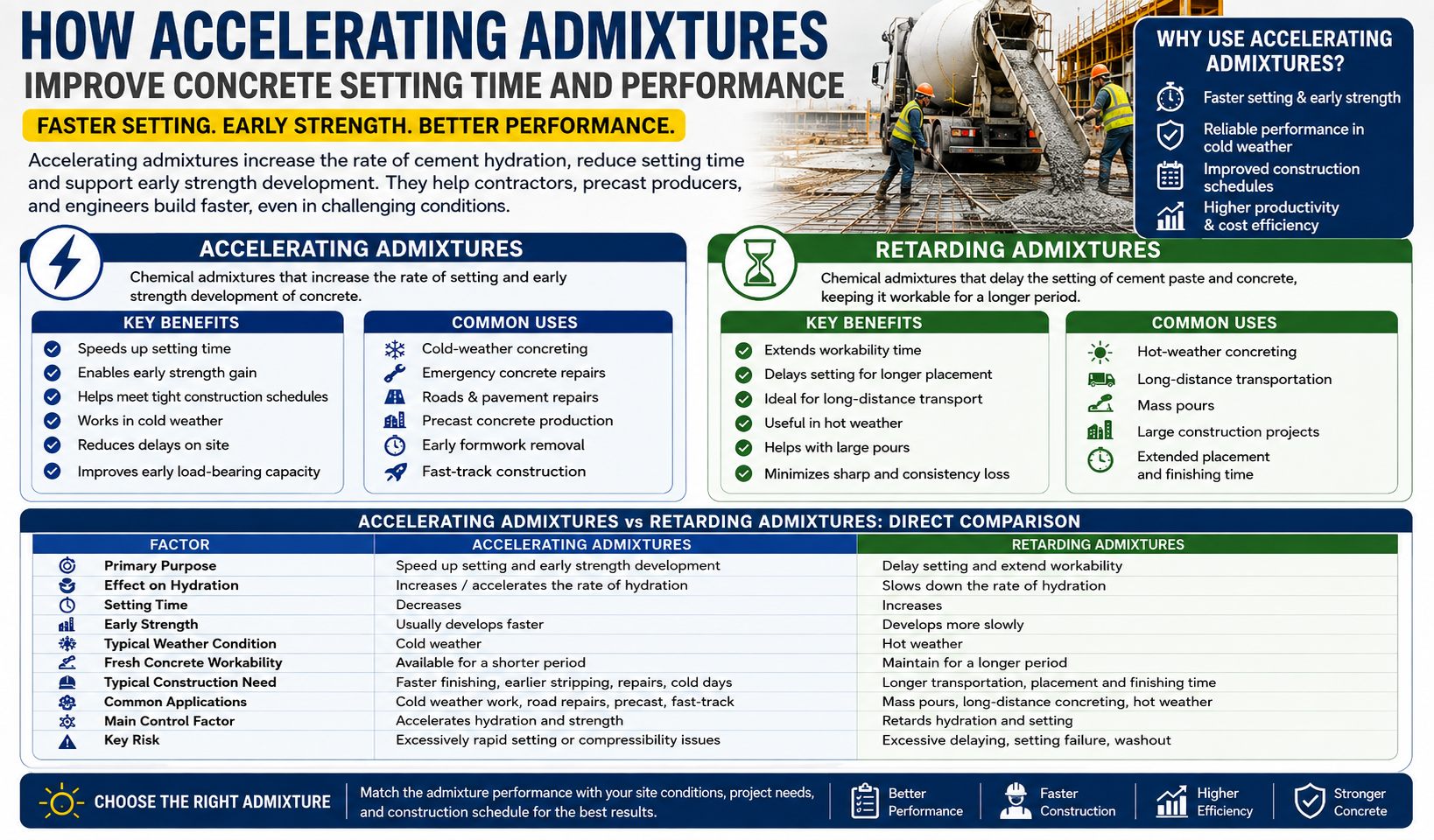
Modern concrete construction increasingly requires more than simply achieving a specified compressive strength. Contractors and engineers must often balance setting time, early-age strength, workability, durability, weather conditions, production schedules, and construction efficiency within the same mix.
Accelerating admixtures provide one way to control these requirements. These chemical admixtures are formulated to increase the rate at which cementitious systems stiffen, set, or develop early strength. They are particularly valuable when concrete needs to reach a usable strength level sooner than it would under normal conditions.
This makes accelerating admixtures relevant to cold-weather construction, precast production, emergency repairs, shotcrete, fast-track infrastructure, and other applications where waiting for conventional strength development can affect productivity.
As demand grows for faster and higher-performing construction materials, accelerating products are becoming an important segment of the wider accelerating admixtures market and the broader concrete chemical additives industry.
What Are Accelerating Admixtures?
Accelerating admixtures are chemical additives incorporated into concrete to increase the rate of cement hydration and accelerate either setting, early-age hardening, or both.
Their primary purpose is not simply to make concrete “dry faster.” Instead, a properly selected accelerator changes the kinetics of the cement-water reaction so that the concrete can progress more rapidly from its plastic state toward setting and strength development.
During hydration, cement compounds react with water and form hydration products, including calcium silicate hydrate (C-S-H), which is a major contributor to the strength and structure of hardened cement paste.
Accelerating admixtures can influence this hydration process, helping concrete achieve earlier stiffening and strength development. The exact response depends on the cement chemistry, admixture formulation, dosage, temperature, water-cement ratio, and interaction with other materials.
ASTM C494 categorizes accelerating admixtures within the chemical admixture classification system, including Type C accelerating admixtures and Type E water-reducing and accelerating admixtures.
How Do Accelerating Admixtures Work?
The effectiveness of an accelerator begins at the cement hydration stage.
When cement comes into contact with water, a series of chemical reactions occur. The rate of these reactions changes according to temperature, cement composition, water availability, particle characteristics, and the presence of other chemical admixtures.
An accelerating admixture modifies this reaction environment to promote faster early-age development.
1. Accelerating Cement Hydration
The principal mechanism is an increase in the rate of hydration reactions.
Faster hydration promotes earlier formation and development of hydration products within the cement paste. This can reduce the time required for concrete to transition from a plastic mixture to a stiffened and hardened material.
2. Reducing Setting Time
For construction teams, one of the most visible effects is a shorter initial or final setting period.
This can allow:
- Earlier finishing operations
- Faster progression between construction stages
- Reduced waiting time
- Earlier formwork-related operations where strength requirements are satisfied
- Faster repair work
- Better schedule control
However, setting time and strength gain are not identical. A concrete mix can set faster without necessarily developing the required structural strength at the same rate. Product selection should therefore consider both parameters.
3. Supporting Early Strength Development
Some accelerating admixtures are formulated primarily to promote early strength.
This is especially important where concrete needs to reach a specified strength before:
- Removing forms
- Applying loads
- Opening repaired pavement to traffic
- Moving precast elements
- Advancing construction to the next stage
The performance target should therefore be defined in terms of measurable strength requirements rather than simply choosing the fastest-setting product.
Setting Time vs. Strength Gain: Why the Difference Matters
One of the most important considerations when selecting an accelerator is understanding the difference between setting and hardening.
| Property | What It Means | Why It Matters |
| Initial setting time | Point at which concrete begins losing plasticity | Determines available placement and finishing time |
| Final setting time | Point at which concrete has substantially stiffened | Indicates transition toward hardened behavior |
| Early strength | Strength developed during the first hours or days | Determines formwork removal and early loading |
| Later-age strength | Strength developed over longer curing periods | Important for structural performance |
| Workability | Ease of mixing, placing and finishing | Controls construction efficiency |
A suitable accelerating admixture should provide the required setting and early-strength behavior without creating unacceptable side effects.
This is why trial mixes and performance testing are essential before large-scale application.
Key Benefits of Accelerating Admixtures
The benefits extend beyond simply reducing concrete setting time.
Faster Construction Cycles
Shorter setting periods can help construction teams move more quickly between placement, finishing, formwork operations, and subsequent activities.
This is particularly useful in projects where delays can significantly increase labor, equipment, or site-management costs.
Improved Cold-Weather Construction
Low temperatures slow cement hydration and can substantially delay setting and strength development.
Accelerating admixtures can help offset some of this slowdown, making them useful in winter construction when combined with appropriate temperature control, curing, and protection measures.
An accelerator should not be viewed as a replacement for proper cold-weather concrete practices. Temperature management remains essential.
Earlier Formwork Removal
Where project specifications permit, faster early strength development can allow forms to be removed earlier.
This can improve the utilization rate of reusable formwork, especially in precast plants and repetitive structural construction.
Faster Precast Production
Precast manufacturers often work with tightly controlled production cycles.
Accelerating admixtures can help shorten the time between casting and subsequent handling operations when the concrete reaches the required strength.
Rapid Repair Applications
Roads, bridges, industrial floors, airports, and other infrastructure may require rapid repair solutions.
Accelerated strength development can reduce the period during which an area must remain closed or unavailable.
Improved Productivity
When correctly selected and dosed, accelerators can help align concrete performance with project schedules, reducing unnecessary waiting periods.
The economic benefit comes not simply from the price of the admixture but from its effect on labor, equipment utilization, formwork cycles, downtime, and project completion.
Applications of Accelerating Admixtures
Accelerating admixtures are used across several areas of modern construction.
Cold-Weather Concrete
Cold environments slow hydration and can delay both setting and strength development.
Accelerators can support earlier strength gain, but concrete temperature, insulation, curing, and protection against freezing must also be controlled.
Precast Concrete Manufacturing
Precast plants benefit from predictable early-age performance because production efficiency depends on consistent demolding and handling cycles.
Shotcrete and Tunneling
Accelerators are important in sprayed concrete systems used for tunnels, underground structures, mining, and slope stabilization.
In these applications, rapid setting helps sprayed concrete adhere to surfaces and build thickness efficiently.
Emergency Concrete Repairs
Accelerated systems are useful when roads, bridges, industrial facilities, or other structures need to return to service quickly.
Fast-Track Infrastructure
Large infrastructure projects often operate under demanding schedules. Accelerators can support faster construction sequences when their use is compatible with the structural and durability requirements.
How Accelerating Admixtures Affect Concrete Performance
An accelerator should not be evaluated only by how quickly concrete sets.
Engineers should assess the complete performance profile.
Early Compressive Strength
Early-age compressive strength is one of the most important performance indicators.
Testing at appropriate intervals, such as 1 day, 3 days, and 7 days, can show whether the accelerator delivers the required strength development.
Long-Term Strength
Rapid early hydration does not automatically mean superior long-term performance.
Mix design, cement type, curing, water-cement ratio, and admixture compatibility all influence later-age strength.
Therefore, both early and later-age strength should be evaluated.
Durability
Concrete durability depends on factors such as permeability, pore structure, cracking, curing, and exposure conditions.
An accelerating admixture should support the project requirements without creating unacceptable effects on shrinkage, cracking, permeability, or long-term durability.
This is particularly important for reinforced concrete exposed to chloride, sulfate, moisture, freeze-thaw cycles, or other aggressive environments.
Accelerating Admixtures vs. Other Concrete Admixtures
Accelerators are only one category within the wider concrete admixtures market.
| Admixture | Primary Function | Typical Application |
| Accelerating admixture | Speeds setting or early strength | Cold weather, precast, repairs |
| Retarding admixture | Delays setting | Hot weather, mass pours |
| Water reducer | Reduces water demand | General structural concrete |
| Superplasticizer | Provides high water reduction and flow | High-performance and SCC |
| Air-entraining admixture | Introduces stable air voids | Freeze-thaw environments |
| Waterproofing admixture | Reduces water penetration | Basements, tanks, tunnels |
| Shrinkage-control admixture | Limits shrinkage-related cracking | Large slabs and specialized concrete |
| Corrosion inhibitor | Protects reinforcement | Marine and chloride-exposed structures |
This distinction is important because the correct admixture depends on the performance problem being solved.
For example, a waterproofing admixture for concrete addresses permeability and water ingress rather than primarily accelerating cement hydration.
Luke Chemicals’ existing range includes products addressing different performance requirements, such as expansion control, waterproofing-related applications, slump retention, and corrosion protection.
Factors That Affect Accelerator Performance
The same accelerating admixture may behave differently in two concrete mixtures.
Cement Type and Chemistry
Different cement compositions can respond differently to accelerator chemistry.
The interaction between cement mineral phases and admixture components should therefore be evaluated through laboratory testing.
Temperature
Temperature strongly affects hydration.
A formulation that performs well under warm conditions may behave differently during winter placement.
Water-Cement Ratio
The water-cement ratio affects hydration, porosity, strength, and overall concrete performance.
Accelerating admixtures should be evaluated within the actual mix design rather than independently.
Admixture Dosage
Dosage has a major influence on performance.
Insufficient dosage may provide little acceleration, while excessive dosage can cause excessively rapid setting or other undesirable changes.
Compatibility With Other Admixtures
Modern concrete frequently contains multiple chemical admixtures.
Superplasticizers, water reducers, retarders, slump-retaining agents, corrosion inhibitors, and accelerators can interact with one another.
Compatibility testing is therefore essential before commercial production. Luke Chemicals similarly recommends trial mixing to verify compatibility between its admixture products, cement, water reducers, and other mix components.
Aggregate Characteristics
Aggregate mineralogy, moisture content, grading, and surface characteristics can affect concrete behavior.
Consistent aggregate conditions are particularly important in ready-mix and precast production.
Best Practices for Using Accelerating Admixtures
Proper application is as important as product selection.
Conduct Laboratory Trial Mixes
Before full-scale application, test the accelerator with:
- The actual cement
- Local aggregates
- Mixing water
- Other admixtures
- Intended dosage
- Expected temperature range
Measure setting time, slump, air content, compressive strength, and other project-specific parameters.
Follow the Technical Data Sheet
Do not assume that a dosage used successfully in one concrete formulation will work in another.
Manufacturer recommendations should be treated as a starting point and verified through testing.
Monitor Setting Time
Field teams should monitor concrete behavior under actual placement conditions.
Unexpectedly rapid setting can create finishing problems, cold joints, poor consolidation, or surface defects.
Maintain Proper Curing
Acceleration does not eliminate the need for proper curing.
Adequate moisture and temperature control remain essential for strength development and durability.
Avoid Uncontrolled Overdosing
More accelerator does not necessarily mean better concrete.
Overdosing can produce excessively rapid setting or negatively affect workability and finishing time.
Common Limitations and Risks
Accelerating admixtures can provide major benefits, but they are not suitable for every concrete situation.
Excessively Rapid Setting
If the setting time becomes too short, workers may struggle to place, compact, vibrate, or finish the concrete properly.
Compatibility Problems
An accelerator may interact unexpectedly with cement, supplementary cementitious materials, water reducers, or other admixtures.
Potential Durability Concerns
Certain accelerator chemistries may create durability concerns if they are inappropriate for the exposure environment.
Chloride-containing products, for example, require particular caution in reinforced or prestressed concrete.
Increased Shrinkage or Cracking Risk
Rapid hydration and early stiffening can change early-age behavior. Mix design, temperature control, curing, and dosage must therefore be managed carefully.
Cost Considerations
The purchase price of an accelerator should be evaluated against the total project benefit.
A higher-cost product may still be economically attractive if it reduces downtime, shortens formwork cycles, or enables earlier reopening of repaired infrastructure.
How the Accelerating Admixtures Market Is Evolving
The wider cement and concrete additives market is being shaped by demand for faster construction, higher durability, improved resource efficiency, and increasingly specialized concrete technologies.
Accelerating admixtures are particularly relevant to applications where early strength and schedule efficiency have measurable economic value.
The broader China concrete admixtures market is also significant because China has a large construction-material manufacturing base and extensive demand for chemical admixtures used in infrastructure, precast, ready-mix, and industrial construction.
At the same time, the APAC concrete admixtures market encompasses diverse construction environments ranging from high-density urban development to transportation infrastructure and industrial projects.
For buyers, the market is therefore moving beyond a simple “fast-setting” requirement. Important purchasing criteria increasingly include:
- Consistent formulation
- Compatibility with modern cement systems
- Chloride and alkali considerations
- Early-strength performance
- Long-term durability
- Technical documentation
- Batch-to-batch consistency
- Supply reliability
- Application support
- Regulatory compliance
These factors are particularly important for contractors, ready-mix producers, precast manufacturers, distributors, and international buyers evaluating concrete chemical suppliers.
The Role of Accelerators in High-Performance Concrete
High-performance concrete increasingly combines multiple technologies rather than relying on one additive.
For example, an accelerator may be combined with a water-reducing admixture or superplasticizer to achieve both workable fresh concrete and rapid early strength development.
This type of combination can be valuable in precast production, fast-track construction, and specialized infrastructure.
However, every combination must be evaluated through trial batching because admixture interactions can change setting, slump retention, air content, and strength development.
Modern concrete admixture technologies increasingly focus on achieving multiple performance objectives within one engineered mix rather than maximizing a single characteristic.
Frequently Asked Questions
What are accelerating admixtures used for in concrete?
Accelerating admixtures are used to shorten setting time and/or increase early-age strength development. They are commonly used in cold-weather construction, precast concrete, shotcrete, emergency repairs, and projects requiring faster construction cycles.
Do accelerating admixtures increase concrete strength?
They can increase the rate of early strength development, allowing concrete to reach specified early-strength targets sooner. However, the effect on later-age strength depends on the complete mix design, cement chemistry, curing conditions, dosage, and admixture compatibility.
How do accelerating admixtures reduce concrete setting time?
They modify the rate of cement hydration, accelerating the chemical reactions that produce hydration products within the cement paste. This can cause concrete to lose plasticity and reach initial and final set sooner.
Are accelerating admixtures suitable for reinforced concrete?
They can be, but the chemistry must be carefully selected. Chloride-containing accelerators can create corrosion concerns for embedded steel, so non-chloride or other approved formulations may be preferred where reinforcement protection is critical.
Can accelerating admixtures be used with superplasticizers?
Yes, accelerators can be combined with superplasticizers in appropriately designed concrete mixes. However, compatibility should always be verified through trial batching because the combination can affect setting time, slump, air content, and strength development.
Are accelerating admixtures only used in cold weather?
No. Although cold-weather concreting is an important application, accelerators are also used in precast manufacturing, shotcrete, emergency repairs, fast-track infrastructure, and applications where early strength or rapid construction is required.