Concrete is often expected to provide high strength, long service life and resistance to demanding environmental conditions. However, these properties do not depend on cement content alone. The relationship between water, cement, aggregates, mix proportions, placement and curing can significantly influence the final performance of hardened concrete.
This is where concrete additives for strength can play an important role. The right materials can help improve workability while reducing unnecessary water, support early strength development, refine the internal structure of concrete or improve resistance to cracking and environmental exposure.
The term concrete additives is often used broadly. In technical concrete practice, materials added to a concrete mixture to modify its fresh or hardened properties are commonly referred to as admixtures. VF860P – Polycarboxylate covers several categories of chemical admixtures, including water-reducing, accelerating and high-range water-reducing admixtures.
Understanding how these materials work is more useful than simply asking which product will make concrete stronger. Different additives influence different parts of the concrete system, and the best choice depends on the mix design and required performance.
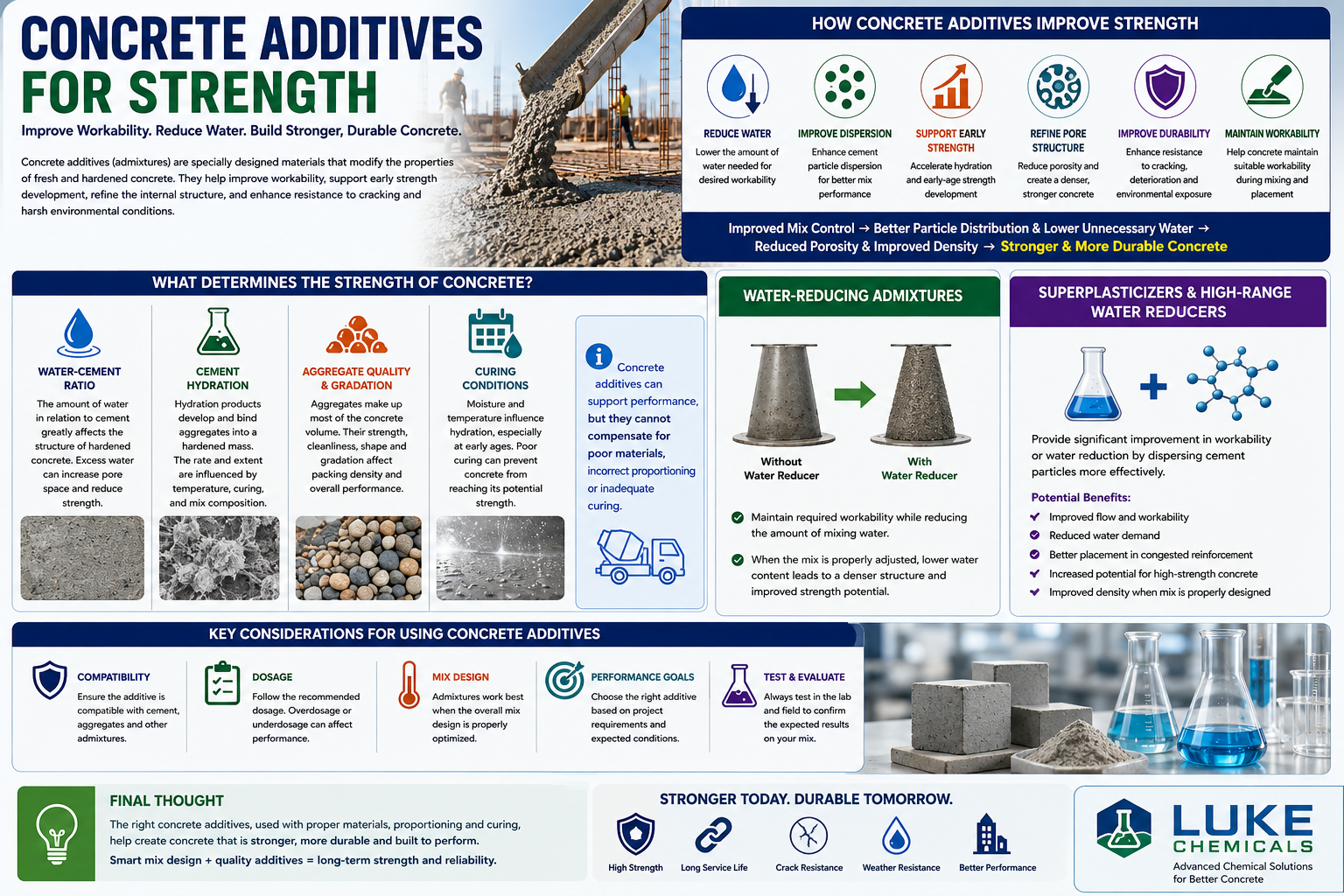
What Determines the Strength of Concrete?
Concrete strength develops through a combination of material quality, proportioning and curing conditions. Several factors are particularly important.
Water-Cement Ratio
The amount of water in relation to cement has a major influence on the structure of hardened concrete. Water is necessary for hydration and workability, but excessive water can leave additional pore space after the concrete hardens.
For this reason, improving workability by simply adding more water may negatively affect the potential density and compressive strength of the mixture.
Cement Hydration
When cement reacts with water, hydration products gradually develop and bind the aggregates into a hardened mass. The rate and extent of hydration are influenced by factors such as temperature, curing conditions, cement characteristics and the composition of the concrete mixture.
Aggregate Quality and Gradation
Aggregates occupy a large proportion of the concrete volume. Their strength, cleanliness, shape and particle-size distribution can affect packing density and the overall performance of the hardened material.
Curing Conditions
Even a well-designed concrete mix may fail to achieve its expected performance if curing conditions are poor. Moisture and temperature influence hydration, particularly during the early stages of concrete hardening.
Concrete additives can support performance, but they cannot compensate for every problem caused by poor materials, incorrect proportioning or inadequate curing.
How Do Concrete Additives Improve Strength?
The answer depends on the type of additive and the property it is designed to influence. Rather than directly adding “strength” to concrete, many admixtures improve the conditions that allow the mixture to develop a denser and more effective internal structure.
The main mechanisms include:
- Reducing the amount of water needed for a given level of workability
- Improving cement particle dispersion
- Supporting early-age strength development
- Refining the pore structure of hardened concrete
- Improving resistance to cracking or deterioration
- Helping the concrete maintain suitable workability during placement
The relationship can be simplified as:
Improved mix control → better particle distribution and lower unnecessary water → reduced porosity and improved density → stronger and potentially more durable concrete
The exact result depends on the materials and proportions used in the project.
Water-Reducing Admixtures
Water-reducing admixtures are among the most important additives to make concrete stronger when the goal is to improve strength without unnecessarily sacrificing workability.
Fresh concrete requires sufficient workability for mixing, pumping, placement and consolidation. Without an appropriate admixture, increasing workability may sometimes require additional mixing water.
A water reducer can help maintain a required consistency while reducing the amount of water needed in the mixture. When the overall mix design is properly adjusted, reducing unnecessary water can contribute to a denser hardened concrete structure and improved strength potential.
Superplasticizers and High-Range Water Reducers
Superplasticizers, commonly referred to as high-range water reducers, are used when a substantial improvement in workability or water reduction is required.
These materials help disperse cement particles more effectively. This can allow concrete producers to achieve a workable or highly flowable mixture without relying on a proportional increase in mixing water.
Their potential benefits include:
- Improved flow and workability
- Reduced water demand
- Better placement in congested reinforcement
- Increased potential for high-strength concrete
- Improved density when the overall mix is properly designed
However, dosage and compatibility are important. A high-range water reducer should be evaluated with the actual cement, supplementary materials, aggregates and production conditions planned for the project.
Accelerating Admixtures and Early Strength Development
Accelerating admixtures are primarily used to influence the rate at which concrete sets or develops strength.
They can be particularly useful when a project requires faster strength development, such as:
- Precast concrete production
- Cold-weather concreting
- Rapid construction schedules
- Earlier formwork removal
- Repair applications where shorter downtime is important
It is important to distinguish between early-age strength and ultimate long-term strength. An additive that supports faster strength development does not automatically guarantee the highest final compressive strength.
Supplementary Cementitious Materials and Concrete Density
Some mineral materials can influence the microstructure and long-term properties of concrete when incorporated into an appropriate mix design.
Depending on the application and material used, supplementary cementitious materials may contribute to:
- Improved particle packing
- Reduced permeability
- A denser microstructure
- Improved long-term strength potential
- Improved resistance to certain environmental exposures
Examples can include materials such as silica fume, fly ash and ground granulated blast-furnace slag.
These materials should not be viewed as universal strength boosters. Their effects depend on factors including replacement levels, cement chemistry, curing conditions, particle characteristics and the required age at which concrete performance is evaluated.
Fibers and Crack Control
Fibers are another category often associated with stronger concrete, but their role should be understood correctly.
Different fiber systems can help control cracking and may improve properties such as tensile or flexural behavior, depending on the material and design. Their primary contribution is not necessarily the same as increasing compressive strength.
By limiting crack development in appropriate applications, fibers may contribute to improved structural performance and durability.
This distinction is important because concrete strength is not a single property.
Concrete Additives and Different Types of Strength
| Concrete Property | How Additives May Contribute |
| Compressive strength | Water reduction, improved density and optimized hydration |
| Early-age strength | Accelerated hydration and improved curing conditions |
| Tensile performance | Crack-control systems and appropriate fiber reinforcement |
| Flexural performance | Fibers and optimized matrix design |
| Long-term durability | Reduced permeability, improved density and crack control |
The most suitable additive therefore depends on which performance property the project is trying to improve.
How Density Affects Concrete Performance
Concrete density is influenced by the packing and distribution of solid materials as well as the volume and connectivity of pores within the hardened structure.
A well-designed concrete mixture can benefit from:
- Appropriate aggregate gradation
- Controlled water content
- Effective cement particle dispersion
- Good consolidation
- Suitable curing
- Compatible admixtures
When unnecessary voids and excessive porosity are reduced, concrete may develop improved mechanical performance and resistance to the movement of water and potentially harmful substances.
This creates an important connection between strength, density and durability. A denser concrete structure may be less permeable, although density alone should not be treated as a complete measure of durability.
How Concrete Additives Support Durability
Durability describes the ability of concrete to maintain its intended performance over time under environmental and service conditions.
Depending on the exposure environment, durability may involve resistance to:
- Water penetration
- Chloride ingress
- Freeze-thaw cycles
- Sulfate exposure
- Cracking
- Abrasion
- Reinforcement corrosion
Concrete additives can support durability by improving specific properties. For example, water-reducing admixtures may help lower water demand, while other technologies may be selected specifically to address permeability, cracking or particular exposure conditions.
The most appropriate solution depends on the actual service environment.
For projects requiring improved protection against water penetration or related durability concerns, the concrete mix should be evaluated as a complete system rather than relying on a single additive.
Choosing the Right Additives to Make Concrete Stronger
Selecting a concrete additive should begin with the required performance rather than the product category.
Consider the following factors.
Define the Strength Requirement
Determine whether the goal is:
- Higher compressive strength
- Faster early strength
- Improved tensile or flexural performance
- Better long-term structural performance
Each objective may require a different approach.
Evaluate the Existing Mix Design
Before adding an admixture, examine:
- Cement type
- Water content
- Aggregate quality
- Aggregate gradation
- Supplementary cementitious materials
- Existing admixtures
- Required slump or workability
An additive works within the overall concrete system.
Consider Environmental Conditions
Temperature, humidity and exposure conditions can influence both fresh and hardened concrete performance.
A mixture designed for hot-weather placement may have different requirements from one used for precast production or cold-weather construction.
Test Material Compatibility
The performance of chemical admixtures can vary depending on the cement and other materials used.
For this reason, trial batches using the intended project materials are an important part of mix evaluation. ASTM guidance also emphasizes testing admixtures with suitable concreting materials and notes that their effects can vary with the properties and proportions of the other ingredients.
Common Mistakes When Trying to Increase Concrete Strength
Adding More Water for Workability
Additional water may make fresh concrete easier to place, but uncontrolled increases in water content can negatively affect the hardened structure.
Assuming More Additive Means More Strength
Admixtures should be used according to the appropriate dosage and mix design. Increasing dosage beyond the intended range does not automatically improve performance.
Ignoring Material Compatibility
Different cements, supplementary materials and admixtures can interact differently. A product should be tested with the actual materials used in production.
Focusing Only on Compressive Strength
A project may also require low permeability, crack resistance, early strength or improved durability.
The highest compressive strength is not always the same as the best overall concrete performance.
Neglecting Curing
Even an optimized concrete mixture needs appropriate curing to support continued hydration and property development.
Finding the Right Balance Between Strength and Workability
One of the central challenges in concrete mix design is achieving sufficient workability without unnecessarily increasing water content.
This is where chemical admixtures can provide significant value.
A properly selected water reducer or high-range water reducer may help concrete remain workable while allowing the mixture to maintain a lower water demand. The result can be better control over the balance between placement requirements and hardened concrete performance.
However, the final outcome still depends on the complete mix design, batching accuracy, mixing procedures, consolidation and curing.
For manufacturers and construction professionals evaluating concrete performance technologies, Luke Chemicals provides solutions related to concrete admixtures and durability-focused applications that can be considered as part of a broader mix design and project performance strategy.
Conclusion
Concrete additives can improve strength, density and durability by influencing the way concrete is mixed, placed and developed into a hardened material. Water reducers and superplasticizers can help control water demand while maintaining workability, accelerators can support early strength development, and selected mineral materials or fiber systems can improve specific aspects of the concrete structure and performance.
The key is to avoid treating additives as a simple shortcut to stronger concrete. The best results come from selecting the right material for a clearly defined objective and evaluating it as part of the complete concrete mix design.
By combining appropriate admixture technology with quality materials, accurate batching, proper placement and effective curing, concrete producers and construction professionals can better control the balance between strength, density, workability and long-term durability.
Frequently Asked Questions
What are the best concrete additives for strength?
The best option depends on the performance goal and mix design. Water-reducing admixtures and high-range water reducers can support higher strength potential by reducing unnecessary water while maintaining workability. Accelerators may support faster early-age strength development, while supplementary cementitious materials can influence long-term strength and microstructure.
What additives make concrete stronger?
Common options include water-reducing admixtures, superplasticizers, accelerating admixtures and selected supplementary cementitious materials. The right choice depends on whether the objective is higher compressive strength, faster strength development or improved overall performance.
Do superplasticizers increase concrete strength?
Superplasticizers can contribute to increased strength potential when they allow water content to be reduced while maintaining the required workability. The final strength depends on the complete mix design and production conditions.
Does adding more cement always make concrete stronger?
Not necessarily. Strength is affected by the water-cement ratio, aggregate quality, mix proportioning, consolidation and curing. Simply increasing cement content without properly controlling the rest of the mixture may not produce the desired result.
Can concrete additives improve durability?
Yes, certain admixtures and mineral materials can support durability by helping reduce water demand, refine the concrete structure, control cracking or address specific exposure conditions. The correct solution depends on the environment and performance requirements.
Can additives replace proper curing?
No. Concrete additives can modify specific properties, but they do not eliminate the need for appropriate curing. Curing remains important for hydration and the development of hardened concrete properties.
How should an additive be selected for a concrete mix?
Start with the required performance, then evaluate the existing mix design, materials, environmental conditions, compatibility and application method. Trial batches using the intended project materials are recommended before full-scale use.