Modern construction projects often require concrete to reach a specified level of stiffness or strength within a limited time. Cold temperatures, demanding construction schedules, early formwork removal, rapid pavement repairs, and precast production can all make normal concrete setting and strength development too slow.
Accelerating admixtures are chemical admixtures designed to increase the rate at which cement-based concrete sets, hardens, or develops early-age strength. However, not every accelerator works in the same way. Different formulations are selected according to the required setting behavior, reinforcement conditions, temperature, concrete composition, and application.
ASTM C494/C494M identifies Type C as accelerating admixtures and Type E as water-reducing and accelerating admixtures. The standard also emphasizes that admixture performance can vary depending on the cement, pozzolans, aggregates, air-entraining admixture, mixture proportions, and batching conditions used in a particular project.
Understanding the types of accelerating admixtures therefore helps engineers, contractors, concrete producers, and industrial buyers select an accelerator based on actual performance requirements rather than simply choosing the fastest-setting product.
What Are Accelerating Admixtures?
Accelerating admixtures are materials added to concrete during mixing to increase the rate of cement hydration and consequently accelerate setting, early hardening, or both.
Their main purpose is to shorten the time required for concrete to transition from a plastic material to a stiff or hardened material. Depending on the formulation, an accelerator may primarily influence setting time or may have a stronger effect on early-age strength development.
European terminology makes an important distinction between set-accelerating admixtures and hardening-accelerating admixtures. A set accelerator reduces the time required for concrete to become rigid, while a hardening accelerator increases the rate of early strength development. Some products can influence both properties.
This distinction matters because faster setting does not automatically mean that concrete has achieved the required structural strength.
How Do Accelerating Admixtures Work?
Concrete hardens through the hydration reactions between cement and water. When water is added to cement, compounds within the cement begin reacting and form hydration products, including calcium silicate hydrate (C-S-H), which is primarily responsible for the development of concrete’s strength and structure.
Accelerating admixtures modify this hydration process so that the required reactions occur more rapidly.
Depending on their chemistry, accelerators may:
- Increase the rate of cement hydration
- Promote earlier formation of hydration products
- Increase early heat evolution
- Shorten initial or final setting time
- Increase early-age compressive strength
- Reduce the period during which fresh concrete is vulnerable to freezing
- Allow earlier finishing or formwork removal
The effect is particularly valuable in cold conditions because low temperatures slow cement hydration. However, an accelerator is not a substitute for appropriate temperature control and curing. Proper curing and protection remain essential to concrete quality.
Main Ways to Classify Accelerating Admixtures
There is no single classification system that describes every accelerator. For practical concrete selection, accelerators can be grouped according to their standard classification, chemical composition, and primary performance function.
The most useful categories are:
- Type C accelerating admixtures
- Type E water-reducing and accelerating admixtures
- Chloride-based accelerators
- Non-chloride accelerators
- Set accelerators
- Hardening accelerators
- Shotcrete and specialized rapid-setting accelerators
These categories can overlap. For example, a non-chloride product may also be a Type C admixture and may primarily function as a hardening accelerator.
Type C Accelerating Admixtures
Under ASTM C494/C494M, Type C refers to accelerating admixtures. Their primary purpose is to accelerate concrete setting and early strength development.
Type C products are selected when a concrete mixture needs faster reaction and earlier performance without necessarily requiring the water-reduction function associated with Type E admixtures.
Common Applications of Type C Accelerators
Type C accelerating admixtures may be used for:
- Cold-weather concreting
- Precast concrete
- Fast-track construction
- Emergency concrete repairs
- Pavement and road repairs
- Industrial floors
- Concrete requiring earlier finishing
- Projects where earlier formwork removal is beneficial
The actual response depends on cement chemistry, temperature, dosage, water-cement ratio, and other admixtures in the mix.
Type E Water-Reducing and Accelerating Admixtures
Type E admixtures combine two functions: water reduction and acceleration. ASTM C494/C494M classifies these as water-reducing and accelerating admixtures.
This combination can be valuable when a project requires both improved workability or reduced water demand and faster early-age strength development.
Reducing the water content while maintaining required workability can lower the water-cement ratio. A lower water-cement ratio can contribute to higher strength and lower permeability when the overall mix is properly designed.
Where Type E Admixtures Are Useful
They may be considered for:
- Precast production
- Structural concrete
- Cold-weather construction
- Industrial construction
- Fast-track projects
- Concrete requiring early loading
- Applications where both strength development and workability are important
Type E should not automatically be considered better than Type C. The appropriate choice depends on whether water reduction is also required.
Chloride-Based Accelerating Admixtures
Calcium chloride is one of the best-known traditional concrete accelerators. It can provide strong acceleration and has historically been used for cold-weather concrete and other applications requiring rapid early performance.
However, chloride-containing accelerators have an important limitation: chloride ions can increase the risk of corrosion of embedded steel reinforcement.
ASTM’s specification notes that admixtures containing relatively large amounts of chloride may accelerate corrosion of prestressing steel, and compliance with the admixture standard alone does not establish acceptability for prestressed concrete.
Advantages of Calcium Chloride Accelerators
- Strong accelerating effect
- Rapid early-age strength development
- Generally economical
- Long history of use
- Useful in certain unreinforced concrete applications
Limitations
- Chloride-related reinforcement corrosion risk
- Restrictions in reinforced and prestressed concrete
- Potential limitations imposed by project specifications
- Unsuitable for some durability-critical structures
For reinforced or prestressed concrete, engineers generally need to evaluate chloride limits carefully and consider non-chloride alternatives where required.
Non-Chloride Accelerating Admixtures
Non-chloride accelerating admixtures were developed to provide acceleration without deliberately introducing calcium chloride as the primary accelerator.
Common chemistries used in non-chloride systems can include compounds based on calcium salts and other inorganic or organic accelerating components. Examples encountered in accelerator technology include calcium formate, calcium nitrate, and sodium thiocyanate, although actual commercial formulations vary considerably.
Why Non-Chloride Accelerators Are Important
They are particularly useful where reinforcement corrosion is a concern.
Typical applications include:
- Reinforced concrete
- Prestressed concrete, subject to project requirements
- Precast concrete
- Bridges
- Commercial buildings
- Industrial structures
- Cold-weather structural concrete
Non-chloride does not mean that every product will behave identically. Dosage, cement compatibility, temperature, and other mix variables still need to be evaluated through testing.
Calcium Formate-Based Accelerators
Calcium formate is used in some non-chloride accelerating formulations and is particularly associated with early strength development in cement-based systems.
Its value comes from providing acceleration without relying on chloride ions as the principal accelerating component.
Potential Advantages
- Suitable for many reinforced-concrete applications
- Useful for early strength development
- Can perform effectively in lower-temperature conditions
- Avoids the chloride-related corrosion mechanism associated with calcium chloride
The exact performance of a calcium formate-based product depends on its formulation and the concrete materials with which it is combined.
Calcium Nitrate-Based Accelerators
Calcium nitrate is another chemical used in non-chloride accelerator formulations.
It can promote earlier hydration and strength development while avoiding the introduction of chloride ions from calcium chloride.
Calcium nitrate-based systems may be considered where early strength is required but chloride restrictions apply. However, the complete formulation matters more than the name of one active ingredient, so engineers should evaluate the manufacturer’s technical data and test results rather than selecting a product based solely on chemistry.
Thiocyanate-Based Accelerators
Thiocyanate compounds can also be incorporated into non-chloride accelerator formulations.
These systems can provide acceleration under conditions where early strength or reduced setting time is important. They are found in some commercial accelerating admixture formulations for structural and precast concrete.
As with other accelerators, dosage control is important because excessive acceleration can reduce available working time and may negatively affect finishing or placement operations.
Set-Accelerating vs. Hardening-Accelerating Admixtures
One of the most important distinctions when selecting an accelerator is whether the project needs faster setting, faster strength development, or both.
| Accelerator function | Main effect | Typical project need |
| Set accelerator | Shortens setting time | Faster finishing and reduced waiting time |
| Hardening accelerator | Increases early-age strength development | Earlier formwork removal or loading |
| Combined accelerator | Influences setting and early strength | Fast-track construction |
| Water-reducing accelerator | Reduces water demand while accelerating | Higher efficiency and early strength |
EN 934-2 distinguishes hardening accelerators as admixtures that increase the rate of early strength development, with or without changing setting time.
This distinction prevents a common specification mistake: selecting a product solely because it produces a rapid set when the real project requirement is a specific early compressive strength.
Shotcrete Accelerators
Shotcrete often requires a specialized accelerator because concrete or mortar is pneumatically projected onto a surface rather than conventionally placed into formwork.
For sprayed concrete, the accelerator may need to provide rapid stiffening after projection so the material can build thickness and remain on vertical or overhead surfaces.
Common Benefits in Shotcrete
- Faster initial set
- Reduced rebound potential
- Faster layer buildup
- Improved overhead application
- Earlier strength development
- Better productivity in tunneling and underground construction
Shotcrete accelerator chemistry can differ substantially from conventional concrete accelerators. Alkali-free accelerating systems are commonly used where rapid setting is required while controlling alkali-related concerns and improving suitability for modern sprayed-concrete systems.
Because shotcrete performance is highly sensitive to cement, silica fume, supplementary cementitious materials, temperature, spraying equipment, and accelerator dosage, field trials are especially important.
Benefits of Accelerating Admixtures in Modern Concrete
The main advantages depend on the product and project, but properly selected accelerators can provide several practical benefits.
Faster Setting
Shorter setting time can allow finishing and subsequent construction activities to begin earlier.
Earlier Strength Development
Accelerators can increase early-age strength, which may support earlier formwork removal or opening of repaired surfaces when the specified strength has been reached.
Improved Cold-Weather Productivity
Low temperatures slow hydration. Accelerating admixtures can help compensate for this slowdown and reduce the time concrete remains vulnerable to early freezing.
Faster Construction Cycles
Precast plants and fast-track construction projects can benefit from shorter production cycles and earlier handling of concrete elements.
Rapid Repairs
For roads, industrial floors, bridges, and other infrastructure, earlier strength development can help reduce downtime when the required opening strength is achieved.
Better Production Efficiency
In controlled precast environments, faster strength development can improve mold utilization and production scheduling.
Where Are Accelerating Admixtures Used?
Accelerating admixtures are selected for many applications where early setting or strength is important.
Cold-Weather Concrete
Winter construction is one of the most established applications. Accelerators help offset slower hydration caused by low temperatures.
Precast Concrete
Precast manufacturers may use accelerators to shorten production cycles and achieve handling strength sooner.
Road and Pavement Repairs
Rapid-setting and early-strength concrete can help return roads, floors, and other surfaces to service sooner.
Structural Concrete
Non-chloride accelerators may be used where reinforcement is present and early strength development is required.
Shotcrete
Specialized accelerators help sprayed concrete stiffen rapidly on tunnels, slopes, underground structures, and other surfaces.
Industrial Flooring
Accelerated setting can help coordinate finishing operations and reduce construction downtime.
Emergency Construction
Where infrastructure needs to be repaired quickly, acceleration can be part of a broader rapid-repair concrete strategy.
Factors That Affect Accelerator Performance
An accelerating admixture does not operate independently. Its effect depends on the complete concrete system.
Important factors include:
Cement Type and Chemistry
Different cement compositions can respond differently to the same accelerator.
Temperature
Lower temperatures generally slow hydration, while higher temperatures can already accelerate setting. The required accelerator dosage may therefore change with ambient and concrete temperatures.
Water-Cement Ratio
The water-cement ratio influences hydration, setting, strength development, and overall concrete behavior.
Supplementary Cementitious Materials
Fly ash, slag, silica fume, and other supplementary cementitious materials can change hydration kinetics and admixture response.
Dosage
Increasing dosage does not necessarily produce proportionally better performance. Excessive dosage can cause excessively rapid setting, workability loss, or other undesirable effects.
Other Admixtures
Accelerators may interact with water reducers, superplasticizers, retarders, air-entraining agents, and other chemical admixtures.
ASTM specifically recommends testing admixtures with the actual cementitious materials, aggregates, admixtures, mixture proportions, and batching conditions proposed for the project because performance can vary between concrete systems.
How to Choose the Right Accelerating Admixture
Selecting an accelerator should begin with the project’s required outcome.
Ask the following questions:
- Is the concrete reinforced or unreinforced?
- Is chloride-free performance required?
- Is faster setting or higher early strength the main objective?
- What temperature will the concrete experience during placement and curing?
- How quickly must the concrete reach its required strength?
- Are other admixtures already present in the mix?
- What cement and supplementary cementitious materials are being used?
- What dosage range has been validated by testing?
- Are there project-specific ASTM, EN, ACI, DOT, or owner requirements?
- Will the concrete be conventionally placed, pumped, precast, or sprayed?
For example, a reinforced structural slab in winter may require a non-chloride accelerator, while an unreinforced repair application may have different material constraints.
Best Practices for Using Accelerating Admixtures
Correct application is as important as choosing the right chemistry.
Conduct Trial Mixes
Test the accelerator with the actual cement, aggregates, supplementary cementitious materials, water, and other admixtures proposed for the project.
Measure:
- Slump
- Air content
- Initial setting time
- Final setting time
- Early compressive strength
- 28-day strength
- Temperature
- Workability retention
Follow the Product’s Recommended Dosage
Use the manufacturer’s technical data sheet and approved project specifications. Do not assume that increasing the dosage will always improve performance.
Control Concrete Temperature
Accelerators can help in cold weather, but they do not eliminate the need for proper temperature management, insulation, and curing.
Check Admixture Compatibility
Particular attention should be paid when accelerators are combined with polycarboxylate ether superplasticizers, retarders, air-entraining admixtures, or other specialty products.
Protect Fresh Concrete From Freezing
Early-age concrete can still be damaged by freezing if it has not developed adequate strength. An accelerator should be treated as one part of a complete cold-weather concreting strategy.
Monitor Early Strength Rather Than Assuming It
The concrete should be tested to confirm that the required strength has actually been achieved before removing formwork, opening a pavement, or applying structural loads.
Limitations and Potential Problems
Accelerating admixtures are useful, but they are not a universal solution.
Excessively Rapid Setting
Too much acceleration can reduce the available time for transportation, placement, vibration, and finishing.
Workability Loss
Some accelerating systems can increase the rate of slump loss or make finishing more difficult.
Reinforcement Corrosion Risk
Chloride-containing accelerators require particular caution in reinforced and prestressed concrete.
Inconsistent Field Performance
Changes in cement chemistry, temperature, moisture, aggregate properties, and admixture dosage can alter performance.
Higher Heat Evolution
Faster hydration can increase early heat generation. This should be considered in temperature-sensitive concrete applications, particularly where thermal gradients or cracking are concerns.
Accelerators Cannot Replace Good Curing
An accelerator can speed hydration, but it does not replace adequate moisture retention, temperature control, curing, or sound placement practices.
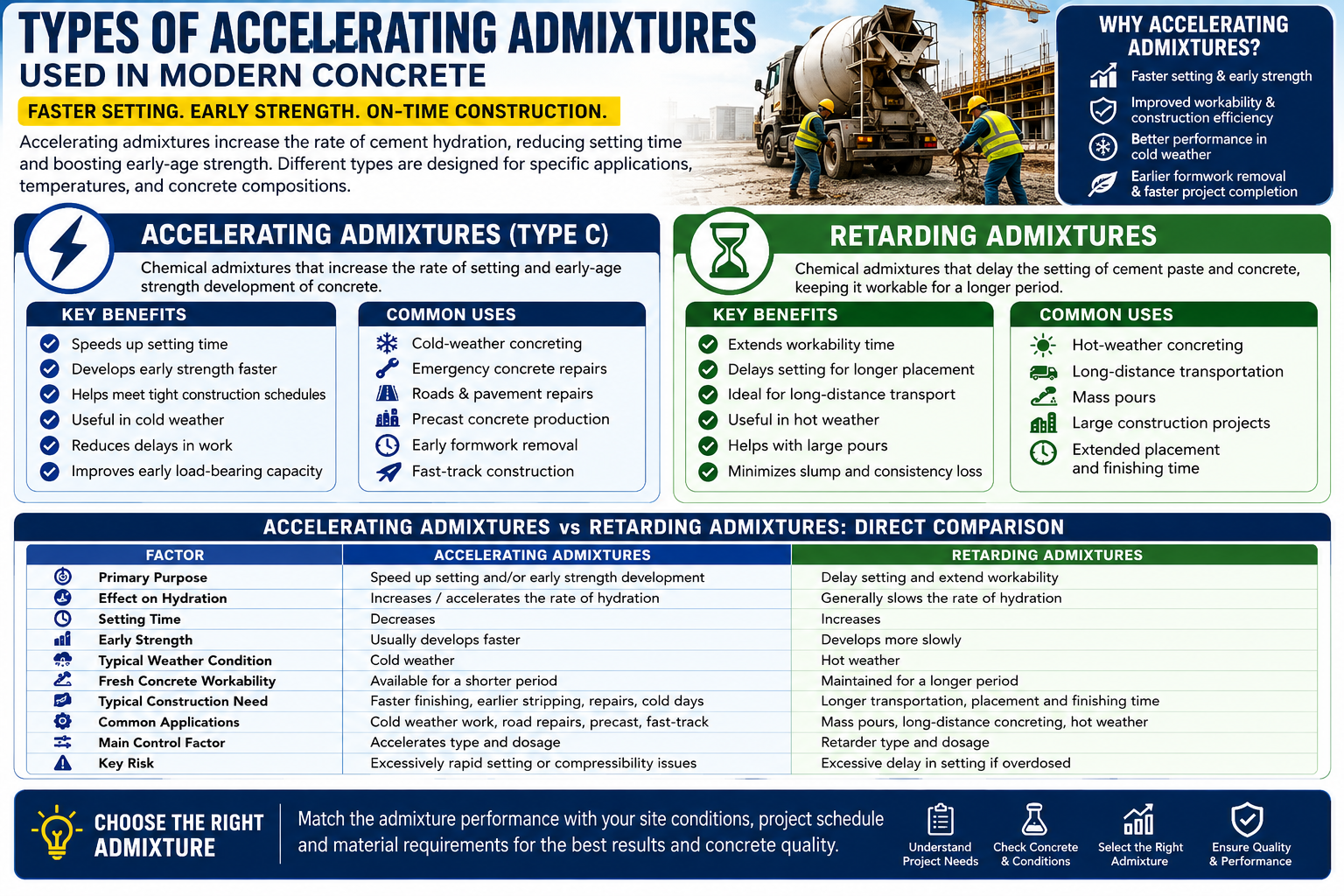
Accelerating Admixtures vs. Retarding Admixtures
Accelerators and retarders solve opposite setting-time problems.
| Property | Accelerating admixture | Retarding admixture |
| Main purpose | Speed setting or early strength | Delay setting |
| Typical environment | Cold weather or fast-track work | Hot weather or long placement periods |
| Effect on hydration | Increases reaction rate | Delays reaction |
| Common applications | Precast, repairs, winter construction | Mass pours, hot-weather concrete |
| Main scheduling benefit | Earlier finishing, stripping, or opening | Longer working time |
The correct choice depends on the conditions at the time of placement rather than simply on the desired construction speed.
Accelerating Admixtures and Superplasticizers
Modern concrete mixes frequently use more than one admixture.
A superplasticizer can improve workability and reduce water demand, while an accelerator can promote faster setting or early strength development. This combination can be useful when a project needs both high workability and rapid strength development.
However, the products should not simply be combined without testing. Compatibility can depend on molecular chemistry, cement composition, dosage, mixing sequence, temperature, and water quality.
For projects using high-performance concrete, products such as polycarboxylate water-reducing admixtures from Luke Chemicals can be evaluated as part of the overall admixture system, subject to project-specific compatibility testing.
Conclusion
The types of accelerating admixtures used in modern concrete range from traditional chloride-based accelerators to non-chloride systems, Type C and Type E admixtures, hardening accelerators, set accelerators, and specialized products for shotcrete and rapid construction.
The best accelerator is not necessarily the one that produces the fastest set. Selection should be based on the required early strength, setting window, temperature, reinforcement, cement chemistry, other admixtures, construction method, and applicable specifications.
For manufacturers, contractors, engineers, and industrial buyers, the most reliable approach is to evaluate accelerator performance using the actual concrete materials and job conditions. Trial batching, compatibility testing, controlled dosage, proper curing, and early-strength verification help ensure that acceleration improves construction efficiency without compromising concrete quality or long-term durability.
For technical information and concrete admixture solutions, Luke Chemicals provides construction chemical products and technical support for concrete and cement-based applications.
Frequently Asked Questions
What are the main types of accelerating admixtures?
The main categories include Type C accelerating admixtures, Type E water-reducing and accelerating admixtures, chloride-based accelerators, non-chloride accelerators, set accelerators, hardening accelerators, and specialized shotcrete accelerators. These classifications can overlap because one product may fit several categories.
What is the difference between Type C and Type E accelerating admixtures?
Type C admixtures are classified as accelerating admixtures, while Type E combines water reduction with acceleration. Type E is useful when the concrete mix requires both lower water demand and faster setting or early strength development.
Are calcium chloride accelerators suitable for reinforced concrete?
Calcium chloride requires caution in reinforced and prestressed concrete because chloride ions can contribute to reinforcement corrosion. Project specifications and applicable standards should be checked before using chloride-containing accelerators.
What are non-chloride accelerating admixtures?
Non-chloride accelerators are formulations that provide acceleration without relying on calcium chloride as the primary accelerating component. Calcium formate, calcium nitrate, and sodium thiocyanate are examples of chemicals used in some non-chloride accelerator systems.
Do accelerating admixtures increase concrete strength?
They primarily improve early-age strength development. The effect on later-age strength depends on the complete concrete mixture, curing conditions, cement chemistry, and dosage. Faster early strength should not automatically be interpreted as higher ultimate strength.
Can accelerating admixtures be used in cold weather?
Yes. Cold-weather concreting is one of their important applications because low temperatures slow cement hydration. However, accelerators should be combined with appropriate temperature protection and curing practices rather than used as a replacement for them.