Tremie concrete flows underwater by displacement. Fresh concrete is fed down a water-tight pipe whose outlet stays buried in concrete already placed. The heavy concrete column pushes new material into the base of the existing mass, the mass swells like a slow bulge, and water is pushed upward and outward without ever mixing into the core. Only the outer skin of the concrete touches water.
Anti-washout admixtures (AWAs) are needed when that protection is not enough: open-water placement, currents, free fall through water, thin repair sections, or strict turbidity and pH limits. On a deep, still, well-controlled tremie pour, a cohesive mix design and good execution often do the job without one.
AWAs are also a good example of why the concrete admixtures market is more than water reducers and retarders: specialty products like these solve problems that standard admixtures cannot. This guide explains how the flow works, where washout still happens, how AWAs change the mix, and how to decide.
This guide explains how the flow works, where washout still happens, how AWAs change the mix, and how to decide.
Quick Answer: Do You Need an Anti-Washout Admixture?
| Situation | AWA needed? | Why |
| Deep, still water or slurry-filled bored pile or diaphragm wall, tremie seal well maintained | Usually no | Embedded pipe keeps concrete away from water; a cohesive, retarded, high-slump mix is the priority |
| Large foundation slab in a cofferdam, calm water | Often no | Good tremie practice limits exposure; AWA is a risk-reduction option |
| Flowing water, tidal or river conditions | Often yes | Currents strip cement paste from the exposed surface |
| Placement by pump hose, bucket or short free fall through water | Yes | Concrete contacts water before it reaches its final position |
| Thin sections, underwater repairs, congested steel | Yes | High surface-to-volume ratio and difficult access |
| Limits on turbidity or water alkalinity near the work | Yes | Reduces cement and fines released into the water |
| Doubtful pipe seal, uncertain supply, or inexperienced crew | Consider yes | Gives margin when the seal may be disturbed |
What Is Tremie Concrete?
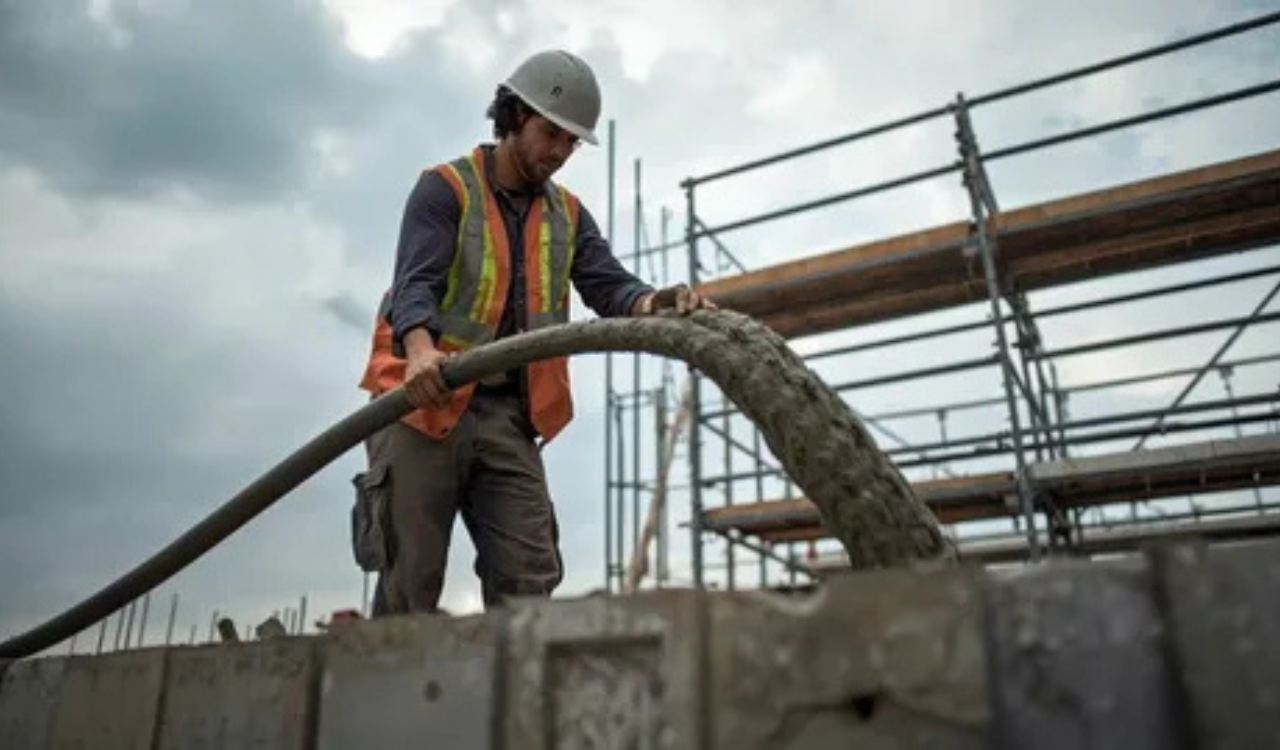
Tremie concrete is concrete, usually modified with concrete admixtures such as water reducers and retarders, placed under water or support fluid through a vertical pipe called a tremie. The pipe has a hopper at the top and a discharge end at the bottom, and it is lifted in sections as the concrete level rises. The method is used for bored piles, diaphragm walls, caissons, bridge pier foundations, cofferdam seals, seawalls and other submerged structures.
The reason for the method is simple. Cement paste is the glue of concrete, and moving water can wash it away from the aggregate. What remains is weak, porous and segregated. Tremie placement, backed by the right concrete admixtures, is designed to keep fresh concrete away from water until it has reached its final position.
How Tremie Concrete Flows Underwater
Starting the Pour
The pipe is lowered to the base of the placement area and fitted with a plug, often foam or rubber, or an equivalent method of keeping water out of the first load. Concrete is fed into the hopper and pushes the plug down the pipe, which expels the water ahead of it. The first concrete emerges at the bottom and forms an initial mound. From this point the pipe outlet must stay buried.
The Steady-State Flow
Once the outlet is embedded, the flow works like this:
- The pipe is full of concrete. The concrete column inside is much denser than the water outside, so there is a net driving pressure at the outlet.
- New concrete leaves the pipe and enters the base of the existing mound, not the water.
- The mound swells from within, pushing older concrete outward and upward. The surface of the mass advances slowly.
- Water above the mass is displaced upward and outward, not mixed in.
- The pipe is raised only as the level rises, keeping an adequate embedment in fresh concrete. Many specifications require around 1 m or more, so follow the project requirement.
Because new concrete is always injected into the interior, the concrete that was in contact with water earlier stays on the outside as a skin, and fresh material keeps pushing it away from the core.
Why the Pipe Must Stay Full and Sealed
If the outlet is lifted clear of the concrete, water rushes into the pipe and the seal is lost. The concrete column is diluted, flow becomes uncontrolled, and the mix can be washed and segregated. Recovery means stopping, cleaning the pipe, replugging and restarting, and the interface left behind is a weak zone. This is the single most common serious defect in tremie work.
Where Washout Still Happens
Even a good tremie pour exposes some concrete:
- The advancing surface. The outer skin of the mound is in contact with water throughout the pour. Cement fines are lost from this layer, and the weak material that forms on top is called laitance.
- Long horizontal flow. Concrete forced to travel a long way across a form can segregate. Multiple tremies placed at a sensible spacing keep the flow distance short.
- Currents. Moving water strips paste from the surface faster than still water does. A water velocity of about 0.5 m/s is a commonly cited upper limit, and silt curtains or cofferdams are used to calm the area.
- Interruptions and seal loss. Any pause lets the surface stiffen and any loss of embedment lets water in.
For this reason the top layer of an underwater placement is usually overfilled and removed after hardening. The depth removed is set by the specification and is commonly in the range of 150 to 200 mm.
Underwater Concrete Placement Methods Compared
| Method | How it works | Washout risk | AWA role |
| Tremie | Gravity-fed pipe with outlet embedded in fresh concrete | Low if embedment is kept | Optional; mainly for currents, thin sections or added margin |
| Pump | Pressurized pipe or hose with embedded outlet | Low if the outlet is embedded | Often used, especially with hose placement |
| Bottom-dump bucket | Bucket lowered to the surface and opened | Medium to high | Strongly recommended |
| Free fall through water | Concrete dropped through the water column | High | Required in practice |
| Preplaced aggregate (two-stage) | Aggregate placed first, grout injected from below | Low | Grout is designed for flow and cohesion |
What Are Anti-Washout Admixtures?
An anti-washout admixture is a water-soluble polymer added to concrete to raise its cohesion and viscosity so that cement paste stays bound to the aggregate when the concrete contacts water. It is sometimes grouped with, or called, a viscosity-modifying admixture (VMA), and the two terms overlap in practice.
How They Work
The polymer chains thicken the water phase of the paste and bind to cement particles. This increases yield stress and plastic viscosity, so the mix resists being pulled apart by water, and it also reduces bleeding and segregation. Many AWA mixes are shear-thinning: they flow when pushed by pump or tremie pressure, then stiffen quickly once movement stops. That is what lets them hold together when they meet water.
Common Types
- Cellulose ethers (such as HPMC and HEC), the most widely used family.
- Polysaccharide gums, including welan and diutan types.
- Acrylic and other synthetic polymers, used in some formulations.
They are supplied as powders or liquids. The right choice depends on the product data, the cement, the mix design and the placement method.
What They Deliver
- Lower loss of cement fines to the water, so higher strength and surface quality.
- Less turbidity and less increase in water alkalinity around the pour, which matters in environmentally controlled areas.
- Greater tolerance of short free fall, currents and imperfect seals.
- Better stability of high-slump or self-leveling mixes, with less segregation.
When Are Anti-Washout Admixtures Needed?
The decision comes down to how much water contact the concrete will see, and how much margin the project needs.
Use an AWA when:
- Concrete will be placed by pump hose, bucket or any method where it passes through water before reaching its position.
- Water is flowing, tidal or subject to waves and the area cannot be fully isolated.
- The section is thin, congested with reinforcement, or part of an underwater repair.
- Specifications set limits on washout mass loss, turbidity or pH of the surrounding water.
- The pour is critical and a disturbed seal would be very costly.
An AWA may not be needed when:
- The pour is a large tremie or pumped placement in still water or support slurry, with a proven crew, continuous supply and constant embedment.
- The mix is already designed for cohesion, with a low water-cement ratio, adequate cementitious content, supplementary cementitious materials and a retarder.
Be cautious when:
- The pour relies on long horizontal flow, since high-viscosity AWA mixes spread less and may need closer tremie spacing.
- Support fluid, such as bentonite or polymer slurry, is present. Test the combined system, because the priorities differ from open-water work.
Difference between an anti-washout admixture and a viscosity-modifying admixture
The terms overlap. Both are polymers that raise viscosity and cohesion. AWAs are formulated specifically to resist washout in water, while VMAs are used more widely to control segregation and bleeding in self-compacting and other flowable mixes.
How Anti-Washout Admixtures Change the Way Tremie Concrete Flows
AWAs protect the concrete but they also change its rheology, and the flow behaviour must be planned for:
- Higher viscosity and stickiness. The mix moves more slowly in the pipe and spreads less in the form. Slump alone becomes a weak indicator, so slump flow and VSI are used as well.
- Superplasticizer demand. More water reducer, usually a PCE, is needed to keep the mix flowable at a low water-cement ratio.
- Compatibility. Some AWA and superplasticizer combinations lead to excess air, high viscosity or delayed set. Confirm the pair with the project cement in trials.
- Set time. AWAs can slow setting, which helps long pours but must be checked against the schedule.
- Tremie spacing and pipe size. Plan tremie positions for the reduced flow distance of an AWA mix.
Mix Design Guidelines for Tremie and Underwater Concrete
The ranges below are typical starting points drawn from common practice. Use them to frame trials, and defer to the project specification and local standards such as ACI 304R and EN 1536.
| Parameter | Typical direction | Reason |
| Cementitious content | At least about 350 to 400 kg/m3 | Paste volume improves cohesion and flow |
| Water-cement ratio | Around 0.40 to 0.45, rarely above 0.50 | Density and washout resistance |
| Supplementary materials | Silica fume, fly ash or slag | Better cohesion, less bleeding |
| Aggregate | Rounded, well graded, typically 20 mm maximum | Reduces pipe blockage and segregation |
| Pipe diameter | Commonly 6 to 8 times maximum aggregate size | Prevents blockage |
| Workability | Slump of about 175 to 225 mm, or slump flow for self-compacting mixes | Flows through the pipe and around steel |
| Superplasticizer | PCE type | Flow without extra water |
| Retarder | Dosed for the full pour duration plus margin | Prevents stiffening in the pipe or at the surface |
| AWA | Per product data and trials | Cohesion and washout control |
| Stability | VSI at or near 0 to 1, and washout test results within limits | Confirms resistance to segregation |
Limitations and Risks of Anti-Washout Admixtures
- Reduced flow and spread that can leave voids if tremie spacing is not adjusted.
- Pumping and pipe pressure rise with very viscous mixes.
- Entrained air that may lower strength if not controlled.
- Delayed setting that must be accounted for in strength gain and formwork.
- Incompatibility with some superplasticizers or cements.
- Overdosing can make the mix unworkable, and underdosing leaves it vulnerable.
- They do not replace good practice. AWAs cannot fix a lost seal, an interrupted supply or a dirty base.
Testing and Quality Control
Before the pour:
- Test slump or slump flow, VSI, setting time and density on the trial mix.
- Run a washout test such as CRD-C 61 to compare mass loss with and without the AWA.
- Confirm compatibility of cement, superplasticizer, retarder and AWA at the expected water temperature.
During the pour:
- Record concrete volume, time and level rise, and confirm pipe embedment continuously.
- Check each load for consistency, and reject loads outside the approved range.
- Divers, ROVs or sounding lines verify the level where visibility is poor.
After the pour:
- Remove laitance and the weak top layer to the specified depth.
- For piles and walls, use cores, ultrasonic tests or crosshole sonic logging to check integrity.
Best Practices for Tremie Placement with or without AWA
- Clean the base of silt and debris before starting, and check slurry quality in bored piles.
- Use a proper plug or seal and fill the pipe before lowering it fully.
- Keep the outlet embedded at all times and raise the pipe only in controlled steps.
- Plan continuous supply with backup batching and pumping, so no pause lets the surface stiffen.
- Match set time to pour duration with a retarder, and allow for warm water or long hauls.
- Place several tremies for large areas and keep the concrete rise even.
- Keep water velocity low with silt curtains, cofferdams or sealed forms.
- Seal the formwork so paste cannot leak out through joints.
- Run trial mixes with the actual cement, admixtures and water temperature before the job.
- Keep a pour log and verify results by testing the hardened concrete.
Common Problems and Fixes
| Problem | Likely cause | Fix |
| Loss of tremie seal | Pipe lifted too high or supply interruption | Stop, clean, replug, restart; maintain embedment |
| Segregated or porous concrete | Water contact, low cohesion, long flow | Raise cohesion, add AWA or SCMs, space tremies closer |
| Pipe blockage | Large aggregate, stiff mix, pipe too small | Resize pipe, adjust grading, increase flowability |
| Early stiffening in the pipe | Insufficient retardation | Increase retarder or adjust for temperature |
| Excess laitance | Cement loss at the advancing surface | Use cohesive mix or AWA, overfill and remove |
| Sticky, slow-moving mix | AWA overdose or too little water reducer | Reduce AWA, raise superplasticizer, retest |
Choosing a Supplier
For underwater concrete, ask the admixture supplier for data sheets, washout test results, compatibility advice for the cement and superplasticizer in use, and trial support. Luke Chemicals can help you compare anti-washout and related admixtures against your mix design and placement method before a full-scale pour.
Frequently Asked Questions
How does tremie concrete flow underwater?
The tremie pipe is kept full and its outlet is kept buried in fresh concrete. The heavy concrete column drives new material into the base of the existing mass, which swells and pushes water upward. Fresh concrete rarely touches water directly, which limits washout.
Is an anti-washout admixture always required for tremie concrete?
No. A well-controlled tremie pour in still water or slurry, with a cohesive mix, a retarder and constant pipe embedment, often does not need one. AWAs become important with currents, free fall, pump hose placement, thin sections, repairs or environmental limits on turbidity.
What slump should tremie concrete have?
Tremie and pump placements commonly target a slump of about 175 to 225 mm, or a suitable slump flow for self-compacting mixes. The right value depends on pipe size, reinforcement and the project specification, and should be confirmed in trials.
Can anti-washout admixtures be used with superplasticizers?
Yes, and they usually are, since the added viscosity needs extra water reduction to keep the mix flowable. Some combinations cause excess air, high viscosity or delayed set, so test the exact products with the project cement.
What is laitance and why is it removed?
Laitance is the weak, fine-rich layer that forms where fresh concrete meets water. It has low strength and poor bond, so the top of an underwater placement is overfilled and the layer is removed after hardening.
How do you test whether concrete resists washout?
Common checks include the CRD-C 61 washout test, slump flow and VSI, along with setting time and compatibility trials. After placement, cores, ultrasonic tests or crosshole sonic logging verify the hardened concrete.
Conclusion
Tremie concrete works because the pipe outlet stays buried, so new concrete pushes into the existing mass instead of falling through water. Anti-washout admixtures add a second layer of protection by making the paste hold together when it meets water. They are most valuable for currents, hose or bucket placement, thin or repair sections and strict environmental limits, and less essential for deep, still, well-run pours. Whichever route you choose, a cohesive mix, a retarder matched to the pour, a compatible superplasticizer, continuous supply and constant embedment are what deliver sound underwater concrete.