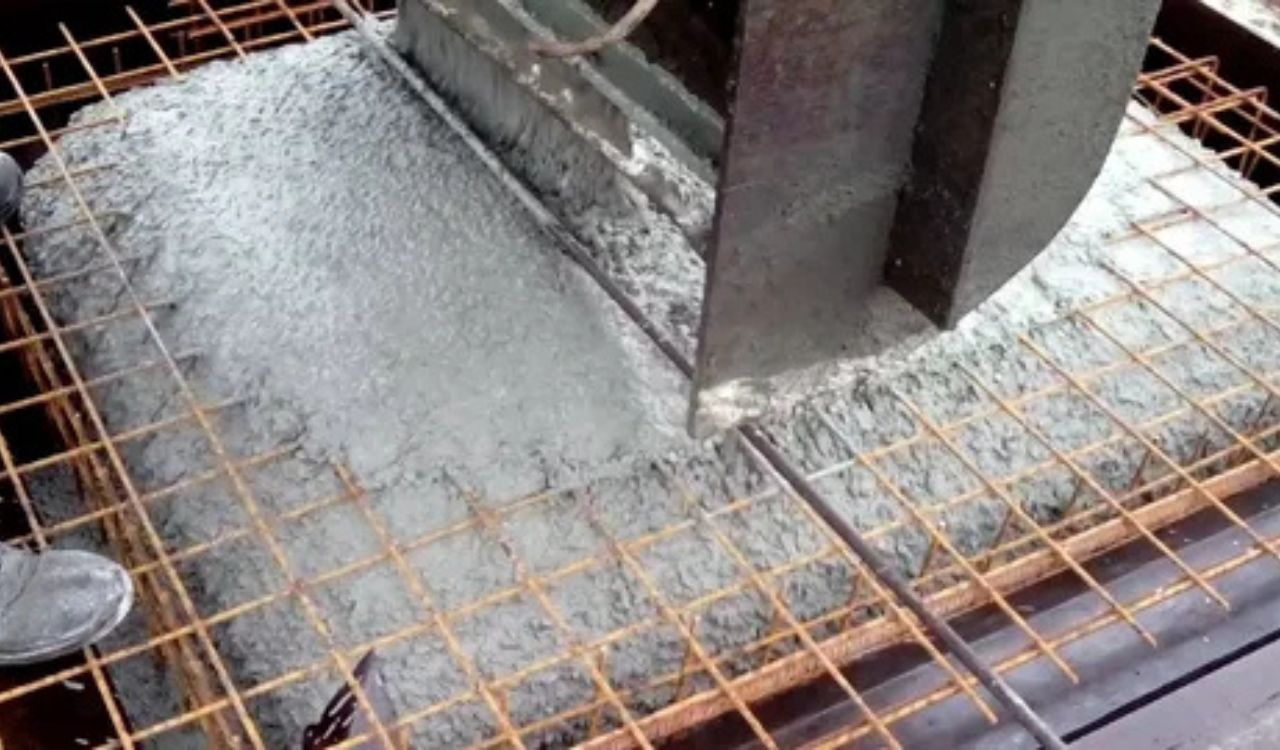
Self-compacting concrete (SCC) is designed to flow under its own weight, fill complex formwork, pass through congested reinforcement, and achieve adequate consolidation without mechanical vibration. Unlike conventional concrete, SCC must balance several fresh-state properties at the same time: filling ability, passing ability, flowability, and resistance to segregation and bleeding.
This performance depends on more than simply adding a high dosage of a concrete water reducer. The aggregate grading, paste volume, powder content, water-to-binder ratio, cement chemistry, mineral additions, and admixture system all interact to determine how the concrete behaves. Consistent material handling and sensors that monitor concrete additive storage can also improve control of storage conditions, particularly where temperature or environmental exposure may affect admixture quality.
Modern self-compacting concrete admixtures are therefore selected as part of the complete mix design rather than treated as an isolated additive. Superplasticizers, particularly polycarboxylate ether (PCE) technologies, provide the high fluidity required for SCC, while viscosity modifying admixtures (VMAs) can improve cohesion and segregation resistance when the mix requires additional rheological control.
What Is Self-Compacting Concrete?
Self-compacting concrete is a highly flowable concrete that consolidates under its own weight without vibration. It was developed to address construction situations where conventional vibration is difficult, particularly where reinforcement is congested, or formwork contains complicated geometries.
A successful SCC mix needs to accomplish three fundamental tasks:
- Fill the formwork: The concrete must flow into corners and around embedded components.
- Pass through reinforcement: The mix must move through narrow reinforcement gaps without blocking.
- Remain stable: Cement paste and aggregates must remain uniformly distributed without excessive bleeding or segregation.
This makes SCC fundamentally a rheology-controlled concrete system. The mix needs sufficiently low yield stress to begin flowing easily, while its plastic viscosity and cohesion must remain high enough to control aggregate settlement and segregation. These performance requirements also contribute to ongoing development of the concrete admixtures additive market, particularly for high-performance water reducers and admixture systems designed to improve concrete flow, stability, and workability retention.
How Does Self-Compacting Concrete Work?
The behavior of SCC results from the interaction between the cementitious paste, aggregates, water, and chemical admixtures.
A conventional approach to increasing concrete flowability is to add more water. In SCC, this is generally not the preferred solution because excessive water can increase the water-to-binder ratio and negatively affect strength, permeability, and durability.
Instead, SCC uses a carefully proportioned paste phase and high-range water-reducing admixture.
A PCE-based superplasticizer disperses cement particles and reduces the amount of water required to achieve a particular level of flow. This allows the concrete to remain highly fluid without simply increasing its water content.
At the same time, sufficient fines and paste volume help keep the aggregate skeleton stable. Where the mix does not have enough natural cohesion, a VMA can increase viscosity and reduce the tendency toward segregation.
The result is a controlled balance:
Low yield stress → easy flow
Adequate plastic viscosity → stability
Optimized aggregate structure → passing ability
Controlled water content → strength and durability
Key Admixtures Required for SCC
Not every SCC mixture requires the same admixture package. The appropriate system depends on the cement, aggregates, supplementary cementitious materials, required slump retention, temperature, transport time, placement conditions, and performance requirements.
1. Polycarboxylate Ether Superplasticizers
The most important chemical admixture in many modern SCC systems is the high-range water-reducing admixture, commonly based on polycarboxylate ether (PCE) technology.
PCE molecules adsorb onto cement particles and promote particle dispersion. Their molecular structure can be designed to provide different combinations of:
- High water reduction
- Rapid flow development
- Slump retention
- Cement compatibility
- Improved dispersion
- Controlled setting behavior
- Better workability retention
For SCC, the objective is not simply maximum water reduction. The selected PCE needs to produce the required flow while maintaining adequate cohesion and stability.
2. Viscosity Modifying Admixtures
A viscosity-modifying admixture (VMA) can be used when the SCC mix requires additional stability.
VMAs increase the cohesion or viscosity of the fresh concrete without being used primarily to create flow. This can help reduce:
- Aggregate settlement
- Bleeding
- Segregation
- Sensitivity to small changes in aggregate moisture
- Variations caused by changes in fines content
However, VMA should not be used to compensate for fundamentally poor mix proportions. European SCC guidance specifically emphasizes that VMA is not a substitute for proper constituent selection and mix design.
Too much VMA can also make the concrete excessively viscous. This may increase flow time and reduce passing ability. Research has shown that increasing VMA can improve segregation resistance while simultaneously reducing fluidity, demonstrating why dosage must be established through trials rather than applied as a fixed universal percentage.
3. Mineral Additions and Supplementary Cementitious Materials
Mineral additions can play an important role in SCC because the powder phase contributes to the rheology and stability of the mixture.
Depending on availability and performance requirements, SCC may incorporate materials such as:
- Limestone powder
- Fly ash
- Ground granulated blast-furnace slag
- Silica fume
- Other suitable mineral fillers
These materials can alter water demand, paste viscosity, setting behavior, strength development, durability, and admixture demand.
The important point is that changing the powder system can change the entire rheological balance of the SCC. A PCE dosage that works with one cement and filler combination may not provide the same result with another.
Three Common SCC Mix Approaches
SCC formulations are often discussed according to how segregation resistance and viscosity are achieved.
| SCC approach | Typical powder concept | Main stability mechanism |
| Powder-type SCC | Higher powder content | Fines and paste provide viscosity |
| VMA-type SCC | Lower powder content | VMA provides additional cohesion |
| Combination-type SCC | Intermediate powder content | Powder and VMA work together |
EFNARC/EFCA technical guidance describes these three approaches and gives indicative powder ranges, while emphasizing that actual proportions must be established for the particular materials and application.
This classification is useful because it demonstrates that there is no single universal SCC recipe.
Basic Self-Compacting Concrete Mix Design
SCC mix design should start with the required performance rather than a fixed admixture dosage.
The main variables include:
- Required compressive strength
- Durability requirements
- Water-to-binder ratio
- Cementitious material composition
- Powder content
- Fine aggregate grading
- Coarse aggregate size and volume
- Paste volume
- Superplasticizer type and dosage
- VMA requirement
- Required slump-flow retention
- Placement and reinforcement conditions
Step 1: Define the Performance Requirements
Before proportioning the mix, determine:
- Strength class
- Exposure conditions
- Required durability
- Placement method
- Reinforcement congestion
- Required flowability
- Transport time
- Temperature conditions
- Required finishing characteristics
For example, a highly congested precast component may require stronger passing ability than a large, relatively open structural element.
Step 2: Select the Aggregate System
Aggregate grading is critical to SCC.
An excessive amount of coarse aggregate can increase the risk of blocking and segregation, particularly when reinforcement is congested. A well-graded aggregate skeleton can reduce voids and help create a more stable paste-aggregate system.
Aggregate shape and surface texture also influence water demand and admixture demand.
Therefore, the same nominal concrete grade can require different SCC proportions when the aggregate source changes.
Step 3: Establish the Powder and Paste System
The powder fraction provides much of the cohesion and rheological control in powder-rich SCC.
Cement may be combined with suitable supplementary cementitious materials or mineral fillers to achieve the required paste characteristics.
Published SCC mix-design guidance gives broad initial ranges rather than a single recipe. One commonly referenced EFNARC framework considers total powder contents around 400–600 kg/m³ as an initial design range, with further adjustment based on the actual materials and required properties.
These figures should be treated as starting points for laboratory development, not universal production specifications.
Step 4: Control Water Content
Water has a major influence on both flow and stability.
Adding water may initially increase slump flow, but excessive water can reduce viscosity and increase the risk of:
- Segregation
- Bleeding
- Lower strength
- Higher permeability
- Reduced durability
The preferred approach is to control the water-to-binder ratio and obtain the required flow through aggregate optimization, paste design, and an appropriate high-range water reducer.
Step 5: Select the PCE Superplasticizer
The superplasticizer should be selected according to the cementitious system and required fresh-concrete behavior.
Important factors include:
- Water-reduction efficiency
- Initial flow
- Slump retention
- Cement compatibility
- Setting behavior
- Temperature sensitivity
- Interaction with mineral additions
- Interaction with other admixtures
Different PCE structures can produce significantly different concrete behavior. Consequently, an admixture should not be selected solely from its general product category.
Step 6: Determine Whether VMA Is Necessary
If the mix has adequate powder and paste characteristics, a separate VMA may not be necessary.
If the concrete remains prone to segregation or becomes excessively sensitive to aggregate moisture and fines variations, VMA may provide additional stability.
The objective is to use enough VMA to improve cohesion without making the concrete too viscous.
Step 7: Conduct Laboratory Trial Mixes
This is one of the most important stages of SCC development.
The trial should evaluate both fresh and hardened concrete properties. A typical development process is:
Initial formulation → admixture dosage adjustment → fresh-property testing → strength testing → durability evaluation → robustness testing → final mix optimization
Small dosage changes can significantly affect SCC rheology, so laboratory trials are more reliable than simply adopting a standard dosage.
Important SCC Fresh-Concrete Tests
SCC cannot be adequately evaluated using only the conventional slump test.
Several specialized tests are used to assess its behavior.
| Property | Common test | What it evaluates |
| Filling ability | Slump-flow test | Overall flowability |
| Viscosity | T500 or V-funnel | Flow resistance |
| Passing ability | L-box or J-ring | Ability to pass reinforcement |
| Segregation resistance | Sieve segregation or stability testing | Resistance to aggregate separation |
| Flow retention | Repeated slump-flow measurements | Workability over time |
Slump-Flow Test
The slump-flow test measures how far the SCC spreads after the cone is lifted.
Unlike conventional slump testing, the objective is not simply to measure vertical settlement. The resulting spread diameter provides an indication of the concrete’s filling ability.
The T500 value, when measured, provides additional information about the rate at which the concrete reaches a 500 mm spread.
V-Funnel Test
The V-funnel measures the time required for SCC to flow through a narrow opening.
A longer flow time generally indicates higher resistance to flow, although the result must be interpreted alongside other SCC tests.
L-Box Test
The L-box test evaluates passing ability.
Concrete must flow from the vertical section into the horizontal section through reinforcing bars. This provides an indication of whether the mixture can pass through congested reinforcement without blocking.
J-Ring Test
The J-ring test similarly evaluates the interaction between flowability and reinforcement obstruction.
A concrete mixture that has a high slump flow but poor passing ability is not necessarily a successful SCC mixture.
What Makes a Good SCC Mix?
A successful SCC mix is not simply the one with the highest flow.
The goal is a controlled balance between:
Filling ability + passing ability + stability + required strength + durability
For example, increasing PCE dosage may increase flowability, but if the mix becomes too unstable, aggregate segregation can occur.
Likewise, adding too much VMA can improve stability while making the mixture too viscous to pass easily through reinforcement.
This balance is why SCC is often more sensitive to changes in raw materials and production conditions than conventional vibrated concrete. Research on SCC robustness identifies the delicate balance between filling ability and segregation resistance as a central mix-design challenge
Benefits of Self-Compacting Concrete
When properly designed and controlled, SCC can provide several construction benefits.
Reduced or Eliminated Vibration
Because SCC consolidates under its own weight, mechanical vibration can be greatly reduced or eliminated depending on the application.
This can simplify placement and reduce vibration-related noise.
Better Filling of Complex Formwork
SCC can flow around complicated geometries and reinforcement arrangements when the mixture has adequate passing ability.
Improved Surface Finish
Reduced dependence on mechanical vibration can contribute to more consistent consolidation and surface quality when the formwork and mix are properly controlled.
Faster Placement
Highly flowable concrete can improve placement efficiency, particularly in suitable precast and heavily reinforced applications.
Reduced Risk of Incomplete Consolidation
Where conventional concrete is difficult to vibrate properly, SCC can reduce the risk associated with inadequate consolidation.
Common Applications of SCC
Self-compacting concrete is particularly useful where conventional consolidation is difficult.
Common applications include:
- Heavily reinforced structural elements
- Precast concrete components
- Columns and walls
- Complex architectural concrete
- Bridge components
- Tunnel and infrastructure structures
- High-strength concrete
- Thin or difficult-to-access sections
- Structures requiring consistent surface appearance
The suitability of SCC should always be evaluated according to the actual geometry, reinforcement density, placement method, and project specifications.
The Importance of Cement-Admixture Compatibility
One of the most overlooked parts of SCC development is compatibility between the cementitious system and the admixture.
Two concrete mixes can contain similar quantities of cement, water, aggregates, and PCE but behave differently because the cement chemistry, mineral additions, or admixture structure differs.
Testing should therefore consider:
- Cement source
- Cement fineness
- Sulfate balance
- Supplementary cementitious materials
- Aggregate moisture
- Aggregate grading
- PCE type
- VMA type
- Mixing sequence
- Temperature
- Required retention time
Admixture products should not be assumed to be interchangeable simply because they belong to the same chemical family.
How Luke Chemicals Fits Into SCC Admixture Selection
For manufacturers and concrete producers developing SCC systems, Luke Chemicals offers several polycarboxylate-based admixture products intended for high-performance cementitious applications. For example, its PCE products include water-reducing and slump-retaining technologies that can be evaluated through project-specific laboratory trials rather than selected solely by nominal dosage. Relevant product options include VF530 Polycarboxylate Superplasticizer Powder, VF560 Polycarboxylate Superplasticizer Powder, and VF570 Polycarboxylate Superplasticizer Powder, depending on the required flow, water reduction, cementitious system, and application.
The important principle is that the final SCC admixture dosage should be established through trial mixes using the actual cement, aggregates, mineral additions, water quality, mixing process, and target fresh-concrete properties.
Best Practices for SCC Production
Consistent SCC performance requires more than a good laboratory formulation.
Control Aggregate Moisture
Small changes in aggregate moisture can change the effective water content and therefore alter SCC flow and stability.
Maintain Consistent Materials
Changes in cement, sand grading, filler, or supplementary cementitious materials can change admixture demand.
Control Admixture Dosage
Automated and accurately calibrated dosing systems can help maintain consistent performance.
Follow the Correct Mixing Sequence
The mixing sequence should be established during laboratory development and then maintained during production.
Monitor Fresh Properties
Regular slump-flow and stability testing helps identify changes before they become production problems.
Test Workability Retention
If concrete is transported over long distances, initial flow alone is not enough. Flow retention should be evaluated at realistic intervals.
Store Admixtures Correctly
Powder and liquid admixtures should be stored according to the manufacturer’s product data sheet. Moisture exposure, excessive temperature, contamination, and poor handling can affect product consistency.
Limitations of Self-Compacting Concrete
SCC offers significant advantages, but it is not automatically better for every application.
Potential limitations include:
- More complex mix design
- Higher sensitivity to material variations
- Greater dependence on admixture compatibility
- Potentially higher material cost
- Need for additional fresh-concrete testing
- Risk of segregation if poorly proportioned
- Sensitivity to aggregate moisture
- Need for careful production control
The more complex the SCC formulation becomes, the more important robustness testing becomes.
SCC vs Conventional Concrete
| Characteristic | Self-Compacting Concrete | Conventional Concrete |
| Vibration | Usually unnecessary | Normally required |
| Flowability | Very high | Moderate to high |
| Reinforcement congestion | Highly suitable when properly designed | Can be challenging |
| Mix design complexity | Higher | Generally lower |
| Admixture dependence | High | Variable |
| Segregation control | Critical | Important |
| Fresh-concrete testing | More extensive | Generally simpler |
| Production sensitivity | Higher | Generally lower |
Frequently Asked Questions
What admixtures are used in self-compacting concrete?
The main admixture is usually a high-range water-reducing admixture, commonly a polycarboxylate ether (PCE) superplasticizer. A viscosity modifying admixture may also be used when additional segregation resistance and rheological control are required.
Is PCE necessary for self-compacting concrete?
A high-performance superplasticizer is normally central to modern SCC because the concrete needs very high flowability without excessive water. PCE-based admixtures are widely used because they can provide high dispersion and workability retention.
What is the role of VMA in SCC?
VMA increases cohesion and plastic viscosity, helping reduce bleeding and segregation. It is particularly useful when the mix has relatively low powder content or needs greater robustness against variations in aggregate moisture and fines. However, VMA cannot replace proper mix proportioning.
What is the ideal slump flow for self-compacting concrete?
There is no single slump-flow value that is ideal for every SCC application. The required range depends on the structural element, reinforcement congestion, placement conditions, and project specification. Slump flow should therefore be specified together with passing ability and viscosity requirements.
How is SCC different from conventional concrete?
SCC is formulated to flow, pass reinforcement, and consolidate under its own weight without conventional mechanical vibration. It generally requires tighter control of paste volume, aggregate grading, admixture dosage, and fresh-concrete rheology.
Can too much superplasticizer cause segregation in SCC?
Yes. Increasing superplasticizer dosage can reduce yield stress and produce very high flow, but if the mixture does not have sufficient cohesion and viscosity, the aggregate and paste can separate. The correct dosage must therefore be determined through trial testing.
Why is aggregate grading important in SCC?
Aggregate grading affects packing, paste demand, flowability, passing ability, and segregation resistance. A poorly graded aggregate system can make it difficult to achieve stable SCC even when a high-performance superplasticizer is used.
What is the best way to determine SCC admixture dosage?
The dosage should be established through laboratory trials using the actual cement, aggregates, supplementary cementitious materials, water, and production conditions. Initial flow, flow retention, passing ability, segregation resistance, setting, air content, and hardened properties should be considered before finalizing the formulation.