The best corrosion inhibitor for reinforced concrete depends on the structure’s exposure conditions, construction stage, and durability requirements. Calcium nitrite is typically preferred for new concrete exposed to chlorides; migrating corrosion inhibitors are commonly used to protect existing reinforced concrete during rehabilitation; and organic or amine-based inhibitors provide broad protection against chloride-induced corrosion and carbonation in a wide range of applications.
Reinforced concrete gains its strength from embedded steel reinforcement, but that steel can corrode when chloride ions or carbonation destroy its natural passive protective layer. As corrosion progresses, the steel expands, causing concrete cracking, spalling, reduced structural capacity, and costly repairs. For this reason, corrosion inhibitor concrete admixtures are widely used to extend service life in bridges, marine structures, parking garages, tunnels, ports, and highways exposed to deicing salts.
Selecting the right corrosion inhibitor requires evaluating several factors, including the expected exposure environment, chloride concentration, concrete mix design, construction method, service-life targets, and maintenance strategy. The following guide explains the main types of corrosion inhibitors, how each works, and the key criteria engineers and contractors should consider before specifying one for a project.
Why Corrosion Inhibitors Matter in Reinforced Concrete
Concrete is naturally alkaline, which forms a protective passive film around embedded rebar. This film breaks down when chloride ions penetrate the concrete, commonly from seawater, deicing salts, or chloride-contaminated aggregates. Carbonation from atmospheric CO2 also lowers the pH and destroys this protection over time.

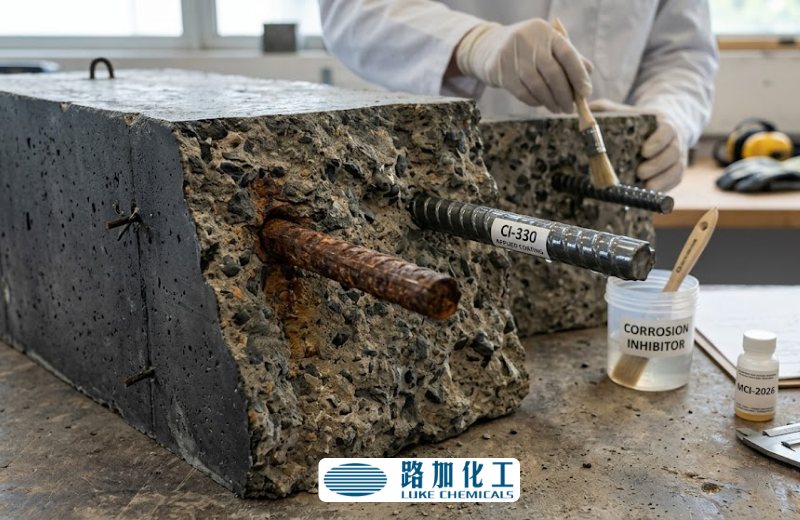
Once the passive layer is gone, steel starts to corrode, and corrosion byproducts occupy more volume than the original steel. This creates internal pressure that cracks and spalls the concrete, a problem seen constantly in coastal structures, bridge decks, and industrial facilities. Corrosion inhibitors delay or stop this process by protecting the steel surface directly or by raising the chloride threshold needed to trigger corrosion.
Main Types of Corrosion Inhibitors for Concrete
There are three broad categories most specifiers compare when selecting a corrosion inhibitor.
- Calcium nitrite-based inhibitors: Calcium nitrite is the most widely used and studied corrosion inhibitor for reinforced concrete. It works by strengthening the passive oxide layer on steel and raising the chloride threshold before corrosion initiates. It is added directly into the concrete mix as an admixture and is well suited for ready mix and precast concrete producers targeting long design life, such as 75 to 100-year bridge structures. ASTM C1582 covers admixtures for corrosion protection of embedded steel in concrete; while comparing calcium nitrite vs other inhibitors, the dosage is typically tied to the expected chloride exposure level.
- Migrating corrosion inhibitors (MCI): Migrating corrosion inhibitors, often amine or amine-carboxylate-based, are designed to move through the concrete pore structure toward the reinforcing steel. These can be added to fresh concrete or applied topically to existing structures, making them useful for rehabilitation projects where the concrete is already in service. Their effectiveness depends on concrete permeability and concrete cover depth, since the inhibitor needs time to reach the steel surface.
- Organic and amine-based inhibitors: Organic corrosion inhibitors, including amine- and ester-based compounds, work by forming a protective molecular film on the steel surface through adsorption. Many newer formulations target both chloride and carbonation-induced corrosion, and some also reduce water absorption in the concrete matrix, adding a secondary protective effect against future chloride ingress.
How to Choose the Best Corrosion Inhibitor for Your Project
When comparing corrosion inhibitors, evaluate them against these factors rather than price alone.
Exposure condition: Marine and coastal projects need higher chloride resistance than inland structures exposed mainly to carbonation. Match the inhibitor type and dosage to the expected chloride load.
New construction vs repair: For new concrete, admixture-type inhibitors like calcium nitrite are added directly during batching. For existing structures already showing early corrosion signs, migrating or surface applied inhibitors are usually more practical since they do not require re-pouring.
Compatibility with mix design: Some inhibitors interact with other admixtures such as water reducers, superplasticizers, or air entraining agents. Always check compatibility data before combining products, and request lab testing if the inhibitor will be used with a specific cement type or supplementary cementitious material.
Dosage and chloride threshold: Underdosing a corrosion inhibitor is one of the most common specification mistakes. The dosage should be calculated against expected chloride exposure over the structure’s design life, not just a standard rate.
Application method: Confirm whether the product is meant for mix-in use, surface application, or both. Using the wrong method reduces protection significantly, even if the chemistry itself is effective.
Third party testing and certification: Look for inhibitors backed by independent lab data, ASTM or equivalent international standards, and documented performance in similar climate and exposure conditions.
Let’s Compare Common Corrosion Inhibitor Types
| Corrosion Inhibitor Type | Best For | Application | Mechanism |
|---|---|---|---|
| Calcium Nitrite | New construction, marine structures, bridges | Mixed into concrete during batching | Strengthens the steel’s passive layer and raises the chloride threshold before corrosion begins |
| Migrating Corrosion Inhibitor (MCI) | Existing structures, rehabilitation and repair projects | Surface-applied or mixed into concrete | Diffuses through concrete pores to reach reinforcing steel and forms a protective barrier |
| Organic & Amine-Based Inhibitor | General-purpose protection, chloride and carbonation exposure | Added as a concrete admixture during mixing | Forms a protective film on the steel surface through adsorption, reducing corrosion reactions |
Common Mistakes When Selecting a Corrosion Inhibitor
Choosing based on price instead of chloride exposure data. Ignoring compatibility with existing mix design. Underdosing relative to design life requirements. Assuming all corrosion inhibitors work the same way regardless of application method
Conclusion
The best corrosion inhibitor for reinforced concrete depends entirely on your project’s exposure environment, whether you’re working with new construction or repairing an existing structure, and how the inhibitor is meant to be applied. Calcium nitrite remains the standard for high chloride environments, while migrating and organic inhibitors offer flexibility for rehabilitation and general-use projects.
Luke Chemicals manufactures corrosion inhibitor admixtures, including calcium nitrite-based BY-1005 corrosion inhibitor and VF-24 Concrete Anticorrosion Inhibitor, engineered for reinforced concrete durability in marine and infrastructure applications. If you’re specifying a corrosion inhibitor for an upcoming project, our technical team can help match the right product to your exposure conditions and mix design.