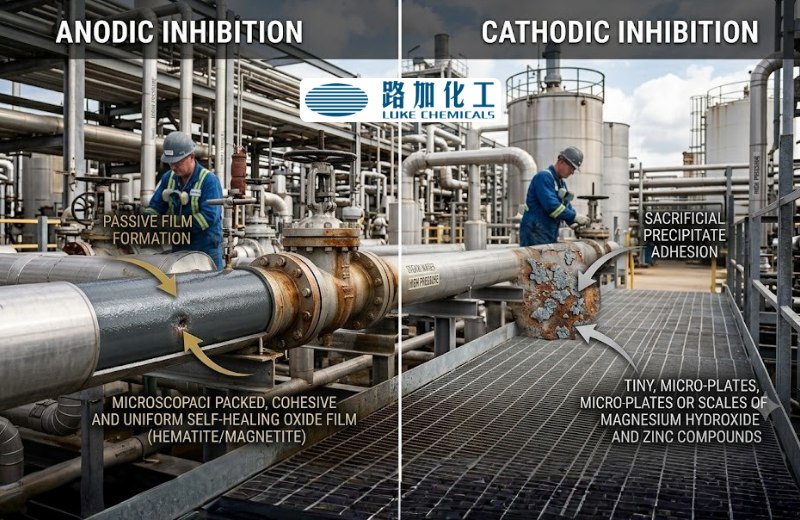
Corrosion is an electrochemical process. It needs an anodic reaction, where metal atoms oxidize and lose electrons, and a cathodic reaction, where those electrons are consumed by oxygen or hydrogen ions. Corrosion inhibitors work by interrupting one or both of these reactions. The classification anodic, cathodic, or organic simply describes where and how an inhibitor breaks that electrochemical cycle.
Inhibitor Type | Mechanism | Common Examples |
| Anodic Inhibitor | Forms a passive oxide film at anodic sites, blocking metal oxidation | Calcium nitrite, sodium nitrite, chromates, molybdates |
| Cathodic Inhibitor | Slows the reduction reaction by blocking cathodic sites or precipitating a barrier layer | Zinc salts, polyphosphates, calcium bicarbonate |
| Organic Inhibitor | Adsorbs onto the metal surface to form a molecular barrier film | Imidazolines, amines, benzotriazole, fatty acid derivatives |
Quick Comparison Table
How Anodic Corrosion Inhibitors Work
Anodic inhibitors target the oxidation half of the corrosion reaction. They form a protective passive film over the anodic sites of the metal, with common examples including chromates, nitrites, and molybdates. This passive layer stops metal ions from dissolving into the surrounding environment.
The concentration threshold matters more here than with other inhibitor types. If the concentration is too low, an anodic inhibitor can be more dangerous than using none at all, because an insufficient dose only covers part of the metal surface and leaves small anodic areas exposed. The remaining corrosion current then concentrates on those uncovered spots, causing severe localized pitting instead of even, predictable surface wear.
This is why anodic inhibitors like calcium nitrite are dosed precisely in reinforced concrete applications. Underdosing does not just reduce protection; it can actively worsen pitting corrosion on steel rebar.
Cathodic Corrosion Inhibitors
Cathodic inhibitors take the opposite approach. Instead of blocking metal dissolution, they interrupt the reduction reaction that consumes electrons at the cathode.
They typically work through one of these routes:
- Blocking cathodic reaction sites directly on the metal surface
- Precipitating an insoluble barrier layer over cathodic zones
- Competing with oxygen or hydrogen ions for available electrons
Cathodic reactions involve the reduction of oxidants, while anodic reactions involve the oxidation of the metal, and inhibitors reduce the cathodic reaction rate by blocking reduction sites, lowering the driving force for reduction, or competing with the oxidant for electrons.
Cathodic inhibitors are generally considered safer at lower doses than anodic types, since underdosing reduces overall protection uniformly rather than creating concentrated pitting zones.
How Organic Corrosion Inhibitors Work
Organic inhibitors do not rely on a chemical oxidation state at all. They are compounds used to reduce or prevent corrosion by forming a protective film on the metal surface, functioning through adsorption rather than a specific anodic or cathodic redox reaction.
The adsorption strength depends on the inhibitor’s molecular structure. This adsorption is governed by the physical characteristics of the molecule, including its functional group, molecular weight, steric factor, structure, aromaticity, and the electron density of the donor atoms.
Organic inhibitors are classified by which reaction they suppress:
- Anodic-type organic inhibitors, which slow metal oxidation
- Cathodic-type organic inhibitors, which slow the reduction reaction
- Mixed-type organic inhibitors, which act on both simultaneously
Organic inhibitors can function as cathodic, anodic, or cathodic-anodic types, either separately or in combination, and can also form a protective film through surface adsorption. Most commercial organic inhibitors used in industrial water treatment, oilfield systems, and concrete admixtures fall into the mixed-type category because they offer broader protection across varying pH and chloride conditions.
Water Soluble Corrosion Inhibitors
Water soluble corrosion inhibitors dissolve directly into an aqueous system, whether that is concrete pore water, a cooling loop, or a pipeline carrying produced water. Solubility determines how evenly the inhibitor distributes and how consistently it reaches metal surfaces.
Key characteristics of water-soluble inhibitors:
| Property | Why It Matters |
| Full miscibility in water | Ensures even distribution through the system without separation |
| Stable across pH range | Maintains inhibition efficiency in both acidic and alkaline conditions |
| Compatibility with other admixtures | Prevents interference in formulated systems like concrete or cooling water treatment |
| Low volatility | Keeps inhibitor concentration stable over the system’s service life |
Calcium nitrite-based inhibitors are a common water-soluble anodic type used in reinforced concrete, since the liquid form disperses through the concrete mix and stays in the pore solution around the steel reinforcement to maintain a passive protective layer.
Benzotriazole Corrosion Inhibitor
Benzotriazole (BTA) is one of the most studied organic corrosion inhibitors, developed specifically for copper and copper alloy protection.
Benzotriazole has been known for more than sixty years as a very effective inhibitor of corrosion for copper and its alloys. It has been used across multiple industrial applications since the 1950s, most commonly as a corrosion inhibitor for copper.
Its mechanism differs from bulk adsorption inhibitors. On the copper metal surface, monovalent copper ions and benzotriazole form an insoluble composite film through adsorption and reaction, which hinders further corrosion of the copper metal. Benzotriazole can also form covalent and coordination bonds with surface copper ions, producing a polymeric protective film that halts the progress of the corrosion redox reaction
Common benzotriazole applications:
- Cooling water systems containing copper piping or heat exchangers
- Electroplating processes, where it prevents oxidative discoloration of copper and silver
- Multi-metal systems combined with scale inhibitors and biocides
- Volatile corrosion inhibitor (VCI) packaging films for metal storage and transport
Benzotriazole is technically classified as a mixed-type organic inhibitor. Research on benzotriazole based volatile corrosion inhibitor films confirms they mainly inhibit the cathodic process while also affecting anodic sites, placing them in the mixed inhibitor categ ory rather than purely anodic or cathodic
Anodic vs Cathodic vs Organic: Key Differences
| Question | Anodic Inhibitor | Cathodic Inhibitor | Organic Inhibitor |
| Reaction targeted | Metal oxidation | Reduction reaction | Either, or both (mixed type) |
| Protection mechanism | Passive oxide film | Barrier precipitation or site blocking | Molecular adsorption film |
| Underdosing risk | High, can cause localized pitting | Lower, protection scales more evenly | Moderate, depends on film coverage |
| Typical use case | Steel reinforcement, closed systems | Cooling water, oxygenated systems | Multi-metal, acidic, or variable environments |
| Example | Calcium nitrite | Zinc phosphate | Benzotriazole |
Frequently Asked Questions
Is benzotriazole an anodic or cathodic inhibitor?
Benzotriazole is a mixed-type organic inhibitor. It forms a protective film that affects both the anodic and cathodic reactions on copper surfaces, rather than acting on one exclusively.
What is the main risk of using an anodic inhibitor at low concentration?
Underdosing an anodic inhibitor leaves parts of the metal surface unprotected, concentrating corrosion current into small exposed areas and causing severe localized pitting instead of general, predictable corrosion.
Are organic corrosion inhibitors water soluble?
Many are. Our BY 1005 Corrosion Inhibitor depends on the specific molecule and its functional groups. Imidazoline and amine derivatives are often formulated as water soluble or water dispersible for use in aqueous systems like concrete, cooling water, and produced water.
Which inhibitor type is used in reinforced concrete?
Anodic inhibitors, particularly calcium nitrite-based liquid admixtures, are the standard choice for protecting steel reinforcement from chloride-induced corrosion in concrete structures.