Reinforcing steel corrodes when chloride ions or carbonation break down the protective oxide layer around it. Once that layer fails, rust forms, expands, and cracks the surrounding concrete. Corrosion inhibitors are added to slow or delay this process, and choosing the right type matters for long-term durability in marine structures, bridges, parking garages, and other reinforced concrete projects exposed to chlorides or sulfates.
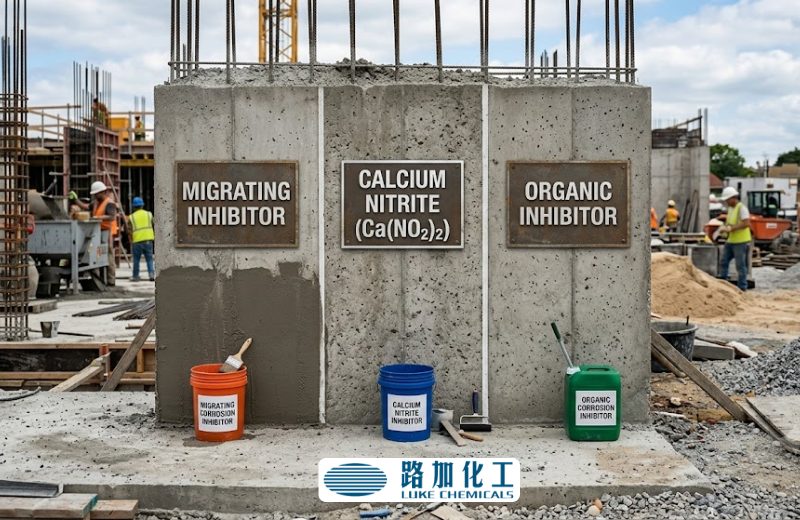
I will compare the main categories of corrosion inhibitors in concrete: calcium nitrite, migrating corrosion inhibitors (MCI), and organic amine-ester inhibitors. How corrosion inhibitors work, how they perform over time, and which situations favor one type over another.
How Calcium Nitrite Works
Calcium nitrite is classified as an anodic corrosion inhibitor. It forms a dense passivation film by oxidizing the iron atoms on the surface of the steel bar, which inhibits the anodic reaction at the steel surface. This passivation film is what keeps chloride ions from reaching bare steel and starting the corrosion cycle.
Calcium nitrite has a long track record. It has been used as a corrosion inhibitor against chloride attack and as a set accelerator in concrete for more than 20 years, with data available on corrosion inhibition, setting times, freeze-thaw resistance, and strength. In China, the Technical Standard for the Use of Reinforced Concrete Corrosion Preventers is also based on calcium nitrite, and nitrite-based corrosion inhibitors remain the dominant type used in reinforced concrete projects worldwide
Performance data backs this up. Calcium nitrite-based inhibitors have been shown to significantly reduce corrosion rate in chloride-contaminated mortar and raise the chloride threshold level, compared to nitrite-free specimens. A higher chloride threshold means more chloride can accumulate near the rebar before corrosion actually starts, which extends the service life of the structure.
Calcium nitrite does have tradeoffs. Dosage needs to increase as expected chloride exposure increases, and calcium nitrite also tends to accelerate set time and reduce workability compared to some organic alternatives. This makes correct dosing important, especially in structures designed for decades of chloride exposure such as coastal bridges or marine platforms.
Migrating Corrosion Inhibitors (MCI)
Migrating corrosion inhibitors are typically based on amine carboxylate salts. Unlike calcium nitrite, they are not always mixed directly into fresh concrete. Migrating corrosion inhibitors were developed for penetrating hardened concrete and are commonly proposed for rehabilitation of existing structures, in contrast to mixed-in inhibitors like nitrites that have been used in new concrete since the 1970s.
MCIs offer a different dosing logic. Migrating corrosion inhibitors rely on a fixed dose rate regardless of expected chloride loading, and they meet or often exceed ASTM C1582 requirements for strength, durability, and corrosion protection. This can simplify specification on projects where chloride exposure levels vary or are hard to predict.
Independent lab comparisons show MCIs can outperform admixed inhibitors in certain conditions. In one macro cell corrosion study, a migrating inhibitor system enhanced the passive condition of embedded steel by three times, compared to two times for an admixed inhibitor system, with the migrating system also showing a greater reduction in macrocell current.
How well an MCI works also depends on the concrete itself. The effectiveness of migrating corrosion inhibitors is tied to their ability to move through the capillary structure of concrete, which depends on cover depth, porosity, water content, and the solubility and volatility of the inhibitor. Low cover or a high water-to-cement ratio can help the inhibitor penetrate, but it can also let chlorides in faster, so this tradeoff needs to be considered during mix design.
Organic Amine-Ester Inhibitors
A third category combines amines with fatty acid esters. These are sometimes grouped separately from MCIs because they work through a different mechanism. In amine and ester-based admixed inhibitors, the amine compound acts as the corrosion inhibitor while the carboxylate ester compound acts as a pore-blocking agent that reduces chloride ingress into the concrete. Organic corrosion inhibitors generally work by adsorbing onto the metal surface and forming a protective organic layer that can inhibit both anodic and cathodic corrosion reactions, making them mixed inhibitors rather than purely anodic ones like nitrite.
Organic inhibitors also bring secondary benefits beyond corrosion protection. An amine-ester-based organic corrosion inhibitor has shown effectiveness in reducing deterioration from sulfate attack and sulfuric acid exposure, in addition to reducing chloride ingress across concrete of varying quality. This dual protection is useful for structures exposed to both chloride and sulfate environments, such as wastewater infrastructure or soil in contact with sulfate-rich groundwater.
Side-by-side, results have been mixed depending on test conditions. In one comparison, calcium nitrite delayed corrosion onset until chloride concentrations reached 1 to 1.4 percent, while the tested organic compound inhibitors showed different corrosion onset behavior under the same conditions. Nitrite-based inhibitors have also been shown to increase concrete transport coefficients (gas and water permeability, and chloride migration) more than amine-ester-based organic inhibitors do.
Which One Delivers Better Long-Term Corrosion Protection
There is no single winner across every condition. Calcium nitrite has the longest performance history and a well-understood passivation mechanism, which is why it remains the default choice in many national standards, including GB/T31296-2014 in China. Migrating inhibitors are better suited to existing structures where mixing an admixture into fresh concrete is not an option. Organic amine-ester inhibitors are worth considering when a project needs protection against sulfate attack alongside chloride-induced corrosion, not just corrosion resistance alone.
| Inhibitor Type | How It Works | Best Applications |
|---|---|---|
| 🧪 Calcium Nitrite | Anodic inhibitor that forms a protective passive film on reinforcing steel, reducing corrosion initiation. | New construction, marine structures, bridges, highways, parking garages, and projects requiring a proven long-term solution. |
| 🌊 Migrating Corrosion Inhibitor (MCI) | Penetrates hardened concrete and migrates to the steel surface to form a protective molecular layer. | Concrete repair and rehabilitation, existing structures, and projects with uncertain or changing chloride exposure. |
| 🛡️ Organic Amine-Ester | Mixed-mode inhibitor that combines steel surface adsorption with pore-blocking action to reduce moisture and chloride ingress. | New construction requiring corrosion protection along with improved resistance to sulfates and aggressive environments. |
The choice of choosing the right corrosion inhibitor depends on the exposure conditions, whether the concrete is new or existing, the target service life, and the applicable regional standard. Luke Chemicals manufactures both calcium-nitrite-style and dual-protection corrosion inhibitors, including BY-1005 corrosion inhibitor and VF-24, for concrete producers and infrastructure projects working across these different exposure conditions.
Frequently Asked Questions
What is the chloride threshold, and why does it matter for corrosion inhibitor selection?
The chloride threshold is the chloride concentration at which corrosion of embedded steel begins. Inhibitors that raise this threshold extend the time before corrosion starts, which is why threshold data is a key comparison point between inhibitor types.
Can calcium nitrite and organic inhibitors be used together?
Some projects combine inhibitor types to get both anodic passivation and pore-blocking or mixed-mode protection, though compatibility and dosage should be verified against the applicable standard and the concrete mix design.
Do migrating corrosion inhibitors work on new concrete, or only repairs?
MCIs are most associated with rehabilitation because they can penetrate hardened concrete, but amine carboxylate-based products are also available as admixtures for new construction, meeting ASTM C1582 requirements.