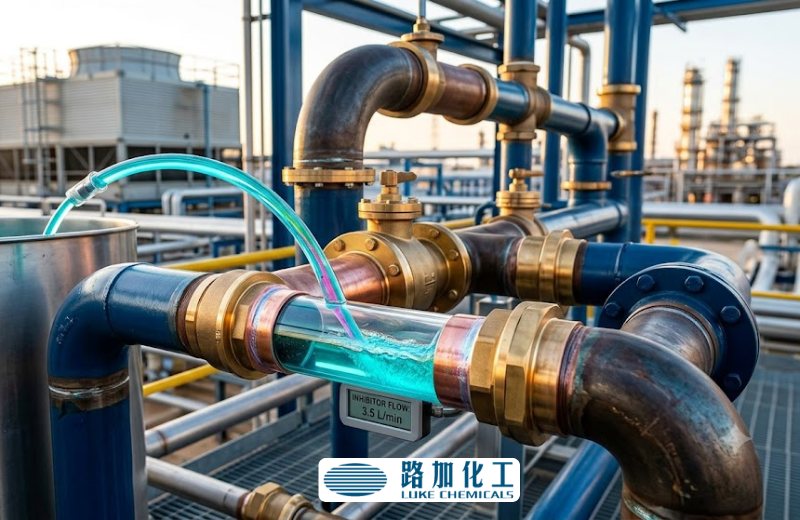
Corrosion is one of the most expensive and persistent problems facing industrial systems today. It affects pipelines, cooling towers, potable water networks, and process equipment made from steel, brass, and copper. Corrosion inhibitors are chemical solutions designed to slow or stop this deterioration, protecting metal surfaces without requiring costly replacement or downtime. This guide breaks down how corrosion inhibitors work across two major sectors, oil and gas and water treatment, and looks closely at how copper corrosion inhibitors fit into the picture.
A corrosion inhibitor is a chemical compound that, when added in small concentrations to a corrosive environment, reduces the rate at which metal degrades. Inhibitors typically work through one of a few mechanisms. Some form a protective film on the metal surface that blocks corrosive agents from making contact. Others work through adsorption, where inhibitor molecules attach themselves to the metal and create a barrier layer. A third group works by passivation, encouraging the formation of a stable oxide layer that resists further attack.
Inhibitors are generally split into two broad categories. Anodic inhibitors slow the oxidation reaction at the metal surface and often support passive film formation. While comparing Anodic inhibitors vs Cathodic inhibitors, they act more like catalysts, reducing the rate of the reduction reaction that drives corrosion forward. Many commercial formulations combine both types for broader protection across different water chemistries and metal substrates.
Applications of Corrosion Inhibitor for Oil and Gas
The oil and gas industry deals with some of the harshest corrosion conditions in any sector. Produced water, brine, dissolved gases, and organic acids create an aggressive environment for the carbon and low-alloy steel used in wells, flowlines, and processing equipment. Corrosive agents such as brines, organic acids, carbon dioxide, hydrogen sulfide, and solids like sand are commonly present in production and downstream systems, and can cause surface pitting, embrittlement, and general loss of metal.
Two corrosion types dominate this industry. Sweet corrosion is driven by dissolved carbon dioxide, while sour corrosion is caused by hydrogen sulfide and is considered far more severe. Corrosion in the oil and gas industry is mainly divided into sweet and sour types, commonly found in environments with high partial pressures of H2S and CO2, and sweet corrosion typically produces metal carbonates while sour corrosion produces various metal sulfides. Both processes accelerate when temperature, pressure, and pH conditions shift, which is why inhibitor selection has to account for the full range of downhole and surface conditions.
Historically, corrosion inhibitors used in oilfields fell into several mechanistic classes. These include passivating, vapor phase, cathodic, anodic, film forming, neutralizing, and reactive inhibitors. Early treatments relied on inorganic compounds, but these gave way to organic film-forming chemistries that offered better and more consistent protection. Inorganic inhibitors such as sodium arsenite and sodium ferrocyanide were used in the early days to inhibit CO2 corrosion in oil wells, but treatment frequency and effectiveness were not satisfactory, which led to the development of organic formulations incorporating film-forming amines and their salts.
Today, imidazolines and quaternary ammonium compounds are among the most widely referenced chemistries for sweet and sour service. Imidazoline-based compounds are considered among the most effective corrosion inhibitors for H2S and CO2 corrosion. These molecules adsorb onto steel surfaces and form a hydrophobic film that limits contact between the metal and corrosive fluids passing through it.
Corrosion Inhibitor for Gas Pipelines
Gas pipelines face a related but distinct set of challenges compared to oil production systems. Internal corrosion in gas pipelines is driven largely by the same CO2 and H2S mechanisms, but flow regime, condensation, and methanol injection practices also play a role. Top-of-line corrosion is a known failure mode in gas systems, where water vapor condenses on the upper interior surface of the pipe and creates a localized corrosive environment separate from the bulk liquid phase at the bottom.
Pipeline operators typically manage this risk through a combination of continuous or batch inhibitor injection, corrosion monitoring, and periodic pigging to remove deposits that can shield corrosion cells from treatment. Because gas pipelines often run for long distances with variable temperature and flow conditions, inhibitor films need to remain stable and adherent across a wide range of operating states. Selecting the right chemistry for a specific pipeline network usually depends on gas composition, water cut, and the ratio of CO2 to H2S present in the system.
Corrosion Inhibitor for Water Systems
Water treatment applications, including cooling towers, boilers, and potable water networks, call for a different inhibitor toolkit than oilfield service, largely because the metals involved and the regulatory constraints differ.
Phosphate and silicate-based chemistries are among the most established options for water systems. Sodium silicate and phosphate both serve as effective anodic inhibitors for mild steel, and their inhibition efficiency is significantly influenced by chloride ions, which can damage the protective films that phosphate forms. In cooling water treatment, orthophosphate acts mainly as an anodic inhibitor and works synergistically with zinc as a cathodic inhibitor, while polyphosphates are predominantly cathodic inhibitors that work well alongside orthophosphate.
Molybdate is another chemistry used where chromate and excess phosphate are restricted for environmental reasons. Chromate has traditionally been an effective and widely used corrosion inhibitor, but its use has come under increasing scrutiny due to environmental concerns, prompting the development of chromate-free alternatives. Molybdate salts, particularly sodium molybdate, are commonly used as localized corrosion inhibitors in these newer formulations.
Potable water systems require a narrower and more carefully regulated set of chemistries. Phosphate and silicate blends are used in potable water treatment to prevent corrosion, scale, and deposit formation in drinking water systems. Dosing in these systems tends to be lower and more tightly controlled than in industrial cooling loops, given the direct human contact involved.
The Chemistry of Copper Corrosion Inhibitor
Copper and copper alloys, often referred to as yellow metals in water treatment contexts, require their own class of inhibitors because the mechanisms that protect steel do not translate directly to copper surfaces.
Azole compounds are the standard choice for copper protection. Azole derivatives are common inhibitors of copper corrosion due to the chemical adsorption that occurs on the metal surface, which gives rise to a protective film. Benzotriazole, often abbreviated BTA, is the most established compound in this family. Benzotriazole, mercaptobenzothiazole, and tolyltriazole are well-known copper corrosion inhibitors that have been used in commercial formulations for decades
The way these compounds work is fairly specific to copper chemistry. Azoles have long been used in industry to protect yellow metal surfaces and are believed to form a metal-organic polymer on the surface. This layer physically separates copper from oxygen and chloride in the surrounding water, slowing the oxidation reactions that would otherwise lead to pitting and general metal loss. In mixed metal systems, such as cooling loops with both steel and copper components, azole-based copper inhibitors are typically blended with phosphate or phosphonate chemistries so that both metals receive appropriate protection at once.
Choosing the Right Corrosion Inhibitor
There is no single inhibitor that works across every application. Oilfield and pipeline environments call for film-forming organic chemistries capable of handling CO2, H2S, brine, and high-pressure conditions. Cooling and potable water systems lean on phosphate, silicate, and molybdate-based formulations tuned for lower temperatures and regulatory limits. Copper components need azole chemistry regardless of which sector they sit in, since steel inhibitors generally offer little protection to yellow metals.
Water chemistry, metal composition, temperature, flow conditions, and environmental regulations all factor into inhibitor selection. While these principles apply across industries, choosing the right corrosion inhibitor for reinforced concrete requires additional consideration of chloride exposure, carbonation, service life, and construction methods. Getting this match right is often the difference between a system that runs for decades and one that requires early, costly intervention.
Luke Chemicals develops corrosion inhibitors and admixture chemistries for industrial and construction applications, and this background across metal protection informs how we think about corrosion challenges more broadly.
Frequently Asked Questions
What is the difference between anodic and cathodic corrosion inhibitors
Anodic inhibitors slow the oxidation reaction at the metal surface, often by supporting a passive oxide layer. Cathodic inhibitors slow the reduction reaction, acting more like a brake on the overall corrosion cycle. Many formulations combine both for wider protection.
Why does copper need a different inhibitor than steel
Copper forms different surface chemistry than steel when exposed to water and oxygen. Azole compounds such as benzotriazole are specifically effective at adsorbing onto copper and forming a protective organic film, while typical steel inhibitors like phosphates do not offer the same level of protection on copper surfaces.
What causes internal corrosion in gas pipelines
Internal corrosion in gas pipelines is mainly driven by dissolved CO2 and H2S reacting with water condensed inside the pipe. Flow conditions, temperature swings, and top-of-line condensation all influence where and how quickly this corrosion develops.