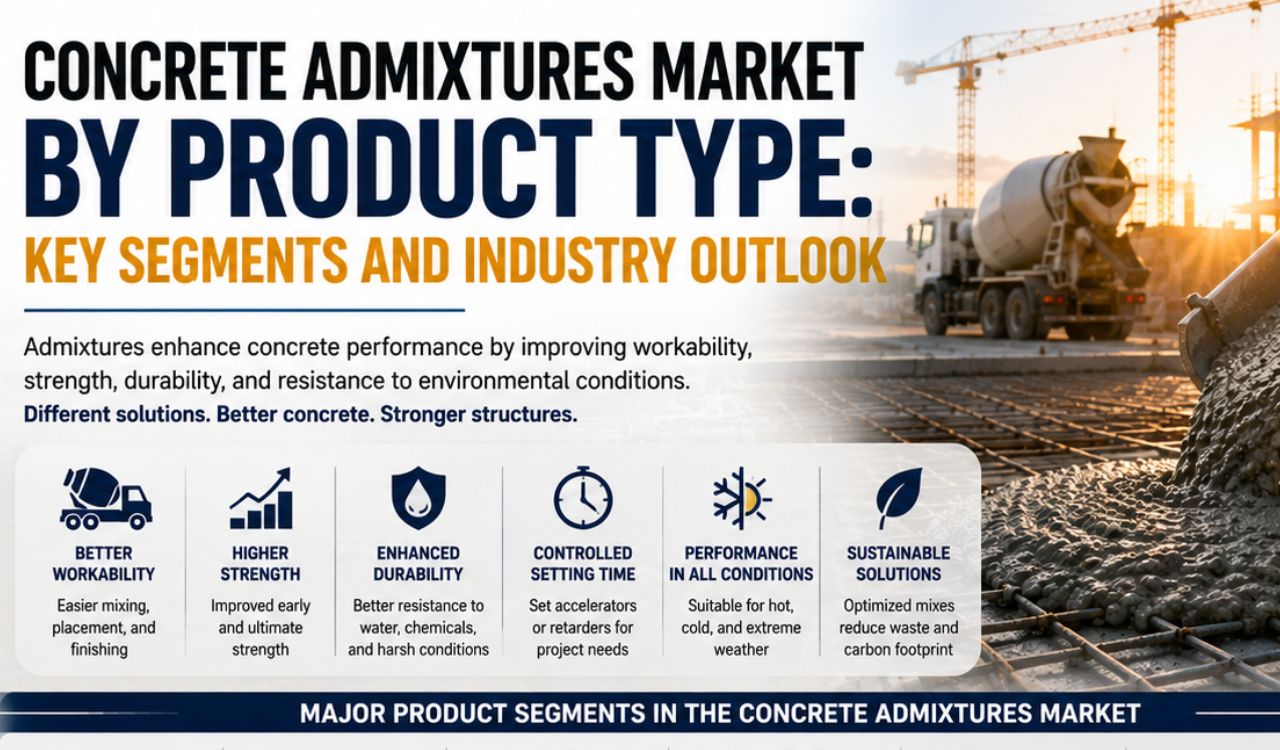
Concrete Admixtures Market by Product Type: Key Segments and Industry Outlook

Concrete Admixtures Market by Product Type

Concrete is no longer designed only around cement, aggregates, and water. Modern construction projects increasingly require concrete that can maintain workability during transportation, achieve strength within specified timeframes, resist water and aggressive environments, and remain durable over a long service life. This is where the concrete admixtures market plays an important role. Admixtures are formulated to modify specific properties of fresh or hardened concrete and help producers meet performance requirements that may be difficult to achieve through conventional mix adjustments alone.

The market includes several major product categories, including water-reducing admixtures, superplasticizers, accelerating admixtures, retarding admixtures, air-entraining agents, waterproofing admixtures, and other specialty formulations. Industry segmentation varies between market research providers, but these product groups consistently appear in assessments of global concrete admixture demand. 

Understanding these segments is useful for ready-mix producers, precast manufacturers, contractors, engineers, distributors, and industrial buyers because the performance objective of the concrete determines which admixture technology is appropriate.

What Is the Concrete Admixtures Market?

The concrete admixtures market covers the production, supply, distribution, and use of chemical products that are added to concrete during batching or mixing to modify selected properties.

Depending on the formulation, an admixture may influence:

  • Water demand
  • Workability
  • Slump retention
  • Setting time
  • Early-age strength
  • Ultimate strength
  • Air content
  • Water penetration
  • Freeze-thaw resistance
  • Durability
  • Shrinkage
  • Corrosion protection
  • Pumpability
  • Rheological behavior

The purpose is not simply to make concrete “stronger.” An admixture is selected according to the specific performance requirement of the mix and the conditions under which the concrete will be produced, transported, placed, cured, and exposed. Understanding concrete admixtures chemistry and performance helps explain why different admixtures are used to control properties such as workability, setting time, water demand, durability, and resistance to environmental conditions.

Market reports currently identify water-reducing products, waterproofing products, accelerating agents, air-entraining agents, and retarding products as major product categories. Some classifications further divide water reducers into conventional plasticizers and high-range water reducers, or superplasticizers, depending on their effect on workability and water reduction..

Major Product Segments in the Concrete Admixtures Market

Although manufacturers may use different commercial classifications, the main categories can be understood through the property they are designed to modify.

Product typePrimary purposeCommon applications
Water-reducing admixturesReduce mixing water while maintaining workabilityReady-mix, precast, structural concrete
SuperplasticizersProvide high water reduction and flowHigh-performance and high-strength concrete
Accelerating admixturesSpeed setting or early strength developmentCold-weather work, repairs, fast-track construction
Retarding admixturesDelay setting and extend workable timeHot weather, long transportation, large pours
Air-entraining admixturesIntroduce controlled microscopic air voidsFreeze-thaw exposed concrete
Waterproofing admixturesReduce water penetration or improve water resistanceBasements, tanks, foundations, tunnels
Specialty admixturesAddress specific performance requirementsCorrosion control, shrinkage reduction, rheology control

The relative importance of each segment depends on regional construction practices, climate, infrastructure investment, concrete technology, raw-material availability, and project specifications.

Water-Reducing Admixtures

Water-reducing admixtures are among the most important products in the market because water demand has a direct relationship with concrete performance.

A conventional concrete mix may require a certain amount of water to achieve the desired workability. Adding an appropriate water reducer can allow the producer to achieve comparable or improved workability with less mixing water. Reducing unnecessary water can help control the water-to-cementitious-material ratio and support strength and durability objectives when the complete mix is properly designed.

However, water reduction is only one aspect of concrete performance. When the primary requirement is to limit water penetration and improve resistance to moisture, a crystalline waterproofing admixture for concrete may be considered. These admixtures are designed to become part of the concrete matrix and help reduce the movement of water through capillary pores and small cracks. Their use can be particularly relevant in structures where moisture resistance is an important design consideration, such as basements, water tanks, foundations, tunnels, and other below-grade or water-exposed concrete applications.

Plasticizers

Conventional plasticizers, sometimes called normal-range water reducers, are generally used to improve workability or reduce water demand within moderate performance requirements.

They are commonly relevant to:

  • General structural concrete
  • Ready-mix production
  • Precast components
  • Commercial construction
  • Residential construction

Superplasticizers

Superplasticizers are high-range water reducers designed to provide substantially greater flow or water reduction than conventional plasticizers.

Modern formulations include polycarboxylate ether (PCE) technologies, which are widely associated with high-performance concrete because they can provide strong dispersing action and useful workability retention when properly formulated.

Superplasticizers are particularly important for:

  • High-strength concrete
  • High-performance concrete
  • Self-consolidating concrete
  • Precast concrete
  • Pumped concrete
  • Complex reinforced structures
  • Large infrastructure projects

Current market research identifies water-reducing products as a major market segment, while other industry analyses specifically identify superplasticizers as a leading product category

Accelerating Admixtures

The accelerating admixtures market is associated with products that accelerate cement hydration, setting, early strength development, or a combination of these effects.

They can be valuable when construction schedules require concrete to reach a specified early-age performance level quickly.

Typical applications include:

  • Cold-weather concrete
  • Emergency repairs
  • Road and bridge repairs
  • Precast production
  • Shotcrete
  • Fast-track construction
  • Projects requiring early formwork removal

Accelerators must be selected carefully because faster setting is not automatically better. Excessive acceleration can reduce placing time, affect finishing, increase temperature-related risks, or create compatibility problems with other mix components.

For reinforced concrete, the chemistry of the accelerator is particularly important. Chloride-containing formulations can create corrosion concerns for embedded steel, so non-chloride technologies are often preferred where reinforcement protection is a critical requirement.

Retarding Admixtures

Retarding admixtures work in the opposite direction by delaying setting and extending the time available for transporting, placing, consolidating, and finishing concrete.

They can be particularly useful when:

  • Ambient temperatures are high
  • Concrete must travel long distances
  • Large pours require extended placement periods
  • Construction schedules involve delays between batching and placement
  • Concrete needs improved workability retention

The correct dosage depends on cement chemistry, temperature, mix composition, required setting time, and the particular admixture formulation.

A retarder should therefore be treated as part of the overall mix design rather than as a simple solution for every hot-weather concreting problem.

Air-Entraining Admixtures

Air-entraining admixtures introduce a controlled system of small, stable air bubbles into concrete.

These microscopic voids can provide additional space for water to expand when concrete is exposed to freezing and thawing cycles. As a result, properly air-entrained concrete can have improved resistance to freeze-thaw damage.

Air entrainment can also affect:

  • Workability
  • Cohesion
  • Density
  • Bleeding
  • Finishing characteristics

However, air content must be controlled. Excessive air can reduce strength, while insufficient or poorly distributed air may not provide the intended durability benefits.

This makes air-entraining admixtures particularly relevant in regions where concrete structures experience repeated freeze-thaw exposure. Current market analysis identifies air-entraining products as an important product category with growing demand linked to durability requirements. 

Waterproofing Admixtures

The waterproofing admixtures market addresses concrete applications where limiting water penetration is an important performance objective.

Waterproofing admixtures can be formulated using different mechanisms, including pore-blocking, hydrophobic, crystalline, or other technologies.

They can be considered for structures such as:

  • Foundations
  • Basements
  • Water-retaining structures
  • Tunnels
  • Underground structures
  • Swimming pools
  • Concrete tanks
  • Parking structures
  • Marine and infrastructure components

An important distinction is that waterproofing admixture performance depends on the complete concrete system. Mix proportioning, compaction, curing, cracking, joint design, and construction quality all influence water resistance.

For this reason, an admixture should not be considered a replacement for good concrete practice or appropriate structural and joint detailing.

Specialty Concrete Admixtures

Beyond the major categories, the concrete admixtures market includes specialized products designed for particular performance requirements.

Examples include:

Corrosion inhibitors

Corrosion-inhibiting admixtures can help protect reinforcing steel in environments where chloride exposure or other corrosion mechanisms are a concern.

They may be considered for:

  • Bridges
  • Parking structures
  • Marine structures
  • Roads
  • Industrial facilities
  • Coastal infrastructure

Shrinkage-reducing admixtures

These products are designed to reduce drying-shrinkage-related deformation and can be useful where crack-control requirements are demanding.

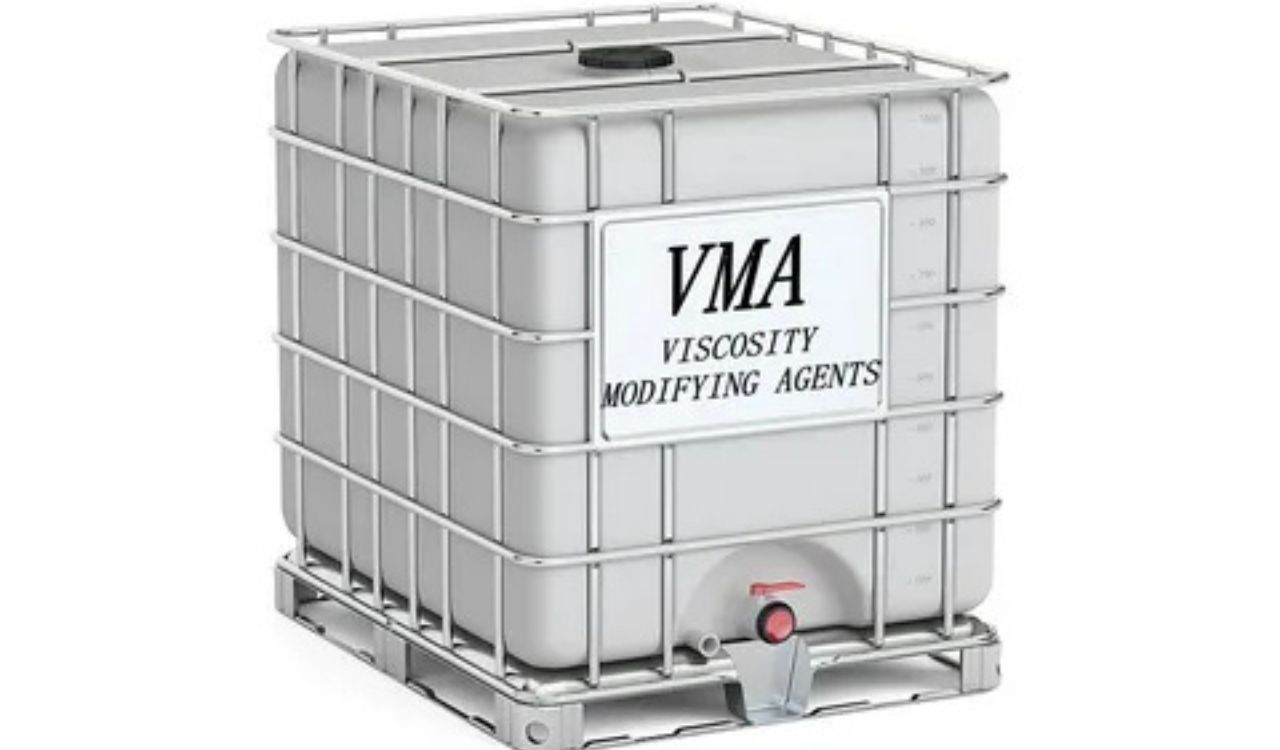
Viscosity-modifying admixtures

Viscosity-modifying technologies can improve cohesion and reduce segregation or bleeding in selected concrete formulations, including mixes requiring specialized rheological control.

Other specialty technologies

Depending on the supplier and market classification, other products may include corrosion-control systems, pumping aids, hydration-control products, shrinkage compensation technologies, and admixtures for specialized precast or self-consolidating concrete.

What Drives Demand for Different Admixture Types?

Demand is not uniform across all product categories. Different construction requirements create demand for different technologies.

1. Growth of infrastructure construction

Roads, bridges, rail systems, airports, tunnels, utilities, energy facilities, and other infrastructure require concrete with predictable performance and long-term durability.

This creates opportunities for water reducers, superplasticizers, waterproofing technologies, accelerators, corrosion inhibitors, and other specialty products.

Infrastructure is also identified as an important application segment in current market research. 

2. Demand for high-performance concrete

High-performance concrete often requires precise control over water demand, flow, strength development, and durability.

This supports demand for advanced water-reducing technologies, particularly superplasticizers.

3. Ready-mix concrete expansion

Ready-mix concrete may need to remain workable while traveling from the batching plant to the construction site.

The combination of transportation time, temperature, traffic, pumping, and placement requirements can make admixture technology an important part of mix design.

4. Precast concrete production

Precast manufacturers often prioritize predictable setting, rapid strength development, surface quality, dimensional consistency, and efficient production cycles.

These requirements can increase the use of superplasticizers, accelerators, and other performance-oriented admixtures.

5. Climate-related construction requirements

Climate affects admixture selection.

Hot conditions may increase the need for setting-control and slump-retention technologies, while cold environments can increase demand for accelerating solutions and freeze-thaw-resistant concrete systems.

How Chemical Raw Materials Influence the Market

The performance and availability of admixtures depend heavily on their underlying chemical raw materials.

The formulation may involve polymers, organic compounds, inorganic salts, surfactants, mineral components, and other specialty chemicals depending on the product category.

For manufacturers, important raw-material considerations include:

  • Purity
  • Consistency
  • Chemical composition
  • Batch-to-batch stability
  • Compatibility
  • Supply reliability
  • Storage stability
  • Cost
  • Regulatory requirements

Changes in raw-material availability can therefore affect product formulation, manufacturing costs, lead times, and supply planning.

For industrial buyers, evaluating the supplier’s ability to maintain consistent raw-material quality can be just as important as comparing the nominal price of the finished admixture.

Factors to Consider When Selecting Concrete Admixtures

Selecting an admixture should begin with the concrete’s required performance rather than the product name alone.

Cement and binder compatibility

Different cement types and supplementary cementitious materials can respond differently to admixture chemistry.

Compatibility testing should therefore be performed when introducing a new admixture, cement source, or significant change in the concrete formulation.

Target water-to-cementitious-material ratio

For water-reducing technologies, the target water-to-cementitious-material ratio is an important consideration.

The objective is to achieve the required workability without unnecessarily increasing water content.

Required workability

The desired slump or slump flow should be defined before selecting the admixture.

This is particularly important for pumped, self-consolidating, precast, and heavily reinforced concrete.

Temperature

Temperature affects hydration and admixture performance.

The same dosage may behave differently in hot and cold conditions, so trial batching under representative conditions can provide more reliable results.

Setting requirements

Determine whether the project needs:

  • Faster setting
  • Normal setting
  • Extended workability
  • Controlled strength development

This helps narrow the appropriate admixture category.

Reinforcement requirements

For reinforced or prestressed concrete, the admixture chemistry should be evaluated for its effect on embedded steel and overall durability.

Dosage

More admixture does not necessarily mean better concrete.

Dosage should be established through technical data, laboratory testing, and trial mixes under project-specific conditions.

Challenges in the Concrete Admixtures Market

Despite continued adoption, manufacturers and users face several challenges.

Raw-material price fluctuations

Changes in chemical raw-material costs can influence production economics and finished-product pricing.

Compatibility problems

An admixture may perform differently with another cement, supplementary cementitious material, aggregate, or chemical admixture.

Variable field conditions

Temperature, mixing sequence, transportation time, moisture content, and batching accuracy can affect performance.

Quality consistency

For commercial and infrastructure projects, consistent performance from batch to batch is essential.

Increasing technical requirements

As concrete specifications become more demanding, admixture manufacturers must develop products capable of balancing workability, strength, durability, setting behavior, and sustainability objectives.

Sustainability and the Future Industry Outlook

Sustainability is increasingly influencing concrete formulation.

One important opportunity is the ability of admixtures to support concrete mixes that use resources more efficiently. For example, water-reducing technologies can help producers achieve required workability with lower water demand, while advanced admixtures can facilitate high-performance concrete designs.

The industry is also moving toward more specialized formulations for:

  • Low-carbon concrete
  • High-performance concrete
  • Durable infrastructure
  • Precast manufacturing
  • Self-consolidating concrete
  • Longer service-life structures
  • Reduced material consumption

Current market research identifies sustainable construction, infrastructure investment, high-performance concrete, and technological development among the factors supporting continued demand for admixture technologies.

For manufacturers such as Luke Chemicals, this evolving market creates a need for consistent chemical formulations and raw-material quality that can support different concrete performance requirements without compromising production reliability.

How the Main Product Segments Compare

SegmentMain performance objectiveParticularly useful for
Water reducersLower water demand and improve workabilityGeneral and structural concrete
SuperplasticizersHigh water reduction and high flowHigh-performance, precast and pumped concrete
AcceleratorsFaster setting or early strengthCold weather and fast-track construction
RetardersExtended setting and workabilityHot weather and long placement periods
Air entrainersControlled air system and freeze-thaw durabilityCold climates
Waterproofing admixturesReduce water penetrationUnderground and water-exposed structures
Corrosion inhibitorsHelp protect reinforcementChloride and aggressive environments
Shrinkage reducersReduce shrinkage-related deformationCrack-sensitive applications
Viscosity modifiersImprove cohesion and rheological controlSpecialized concrete mixes

Best Practices for Using Concrete Admixtures

For consistent results, concrete producers and contractors should follow several basic principles:

  1. Define the performance requirement first.
    Identify the target workability, strength, setting time, durability, and environmental exposure.
  2. Check cement-admixture compatibility.
    Do not assume an admixture will perform identically with every cement or binder system.
  3. Use trial mixes.
    Laboratory and field trials can identify dosage and performance differences before full-scale production.
  4. Control dosage accurately.
    Automated or calibrated dispensing systems can improve batching consistency.
  5. Consider temperature and transportation time.
    These factors can significantly influence setting and slump retention.
  6. Monitor the complete concrete system.
    Admixture performance is affected by cement, aggregates, water, supplementary cementitious materials, mixing sequence, and curing.
  7. Follow technical documentation.
    Product data, safety information, recommended dosage ranges, and relevant standards should be reviewed before use.

Conclusion

The concrete admixtures market is increasingly shaped by the need for concrete that can meet specific performance requirements rather than simply achieve basic strength. Water reducers and superplasticizers support workability and water-efficiency objectives, accelerating and retarding admixtures help control construction schedules and environmental conditions, while air-entraining and waterproofing technologies address durability challenges.

At the same time, specialty products such as corrosion inhibitors, shrinkage-reducing admixtures, and viscosity-modifying technologies are expanding the range of performance characteristics that can be engineered into concrete. Continued infrastructure development, ready-mix and precast production, high-performance concrete, and sustainability requirements are likely to keep product innovation important across the industry. 

For manufacturers, suppliers, engineers, and construction professionals, the key is not simply choosing the most advanced admixture, but selecting a formulation that is compatible with the concrete system, supported by appropriate testing, and matched to the project’s actual performance requirements.

Frequently Asked Questions

What are the main product types in the concrete admixtures market?

The major categories include water-reducing admixtures, superplasticizers, accelerating admixtures, retarding admixtures, air-entraining admixtures, waterproofing admixtures, and various specialty products such as corrosion inhibitors and shrinkage-reducing admixtures.

Which concrete admixture segment is most widely used?

Water-reducing admixtures are one of the largest product segments in current market analyses. Superplasticizers are particularly important in high-performance, precast, ready-mix, and infrastructure applications. 

What is the difference between a water reducer and a superplasticizer?

Both reduce water demand or improve workability, but superplasticizers are high-range water reducers designed to provide substantially greater dispersion and flow or water-reduction capability than conventional plasticizers.

When are accelerating admixtures used?

Accelerating admixtures are commonly used when faster setting or early strength development is required, including cold-weather construction, repair work, precast production, shotcrete, and projects with demanding construction schedules.

What is the purpose of a waterproofing admixture for concrete?

A waterproofing admixture is formulated to reduce water penetration or improve concrete’s resistance to moisture. Its effectiveness also depends on proper mix design, compaction, curing, crack control, and structural detailing.

Why are chemical raw materials important for concrete admixtures?

The quality and consistency of chemical raw materials can directly affect admixture formulation, performance, stability, and manufacturing consistency. Reliable raw-material sourcing is therefore important for maintaining finished-product quality.

How should a concrete admixture be selected?

Selection should be based on the required concrete performance, cement and binder chemistry, temperature, workability, setting requirements, exposure conditions, reinforcement, dosage, and compatibility with other mix components. Trial testing is recommended before large-scale use.

Picture of Luke Chemicals
Luke Chemicals

Sichuan Lujia Sitong Technology Development is a professional chemical company with strong technical and economic strength, focusing on the development, production, and operation of high-tech new building materials.

Skilled Team member

Our experienced professionals are dedicated to delivering high-quality results with precision, creativity, and attention to detail.

Available 24 hours

We are available around the clock to provide reliable support and assistance whenever you need it, day or night.

Related Post

Table of Contents

Do you need any services?