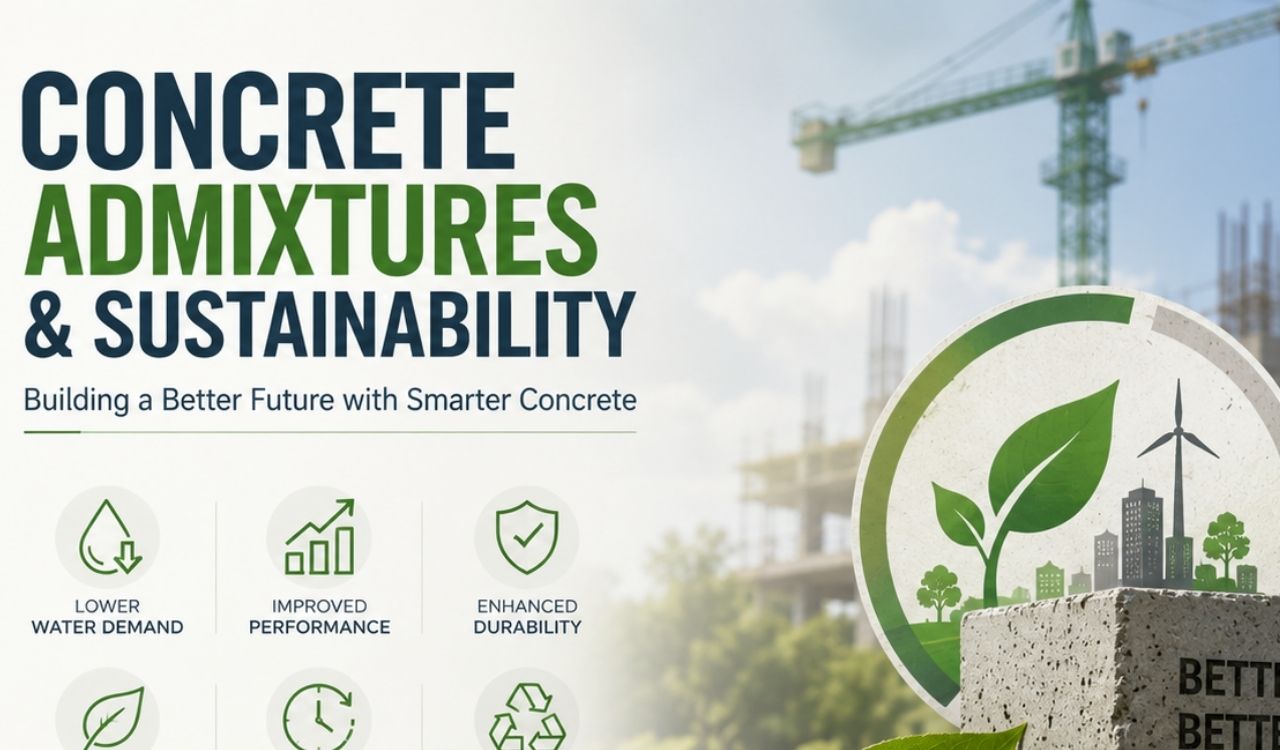
The construction industry is under increasing pressure to improve material efficiency, reduce environmental impacts, and extend the service life of infrastructure. Concrete is central to this challenge because it is one of the most widely used construction materials, while cement production is associated with significant carbon emissions.
These pressures are influencing how concrete is formulated and how chemical admixtures are developed.
The concrete admixtures market is increasingly moving toward technologies that support efficient mix designs, improved durability, lower water demand, longer service life, and compatibility with alternative cementitious materials.
Sustainability does not mean simply using a “green” admixture. Instead, the environmental performance of concrete depends on the entire system, including cementitious materials, aggregates, water, admixtures, production, transportation, construction, maintenance, and eventual replacement.
Within this system, admixtures can provide tools for achieving required concrete performance while optimizing the use of other materials.
Why Sustainability Matters in Concrete Construction
Concrete structures can remain in service for decades, but their environmental impact begins well before the material reaches the construction site.
The production of cementitious materials, transportation of raw materials, concrete production, construction activities, maintenance, and eventual demolition all contribute to the overall lifecycle impact of a structure.
As a result, sustainable concrete development increasingly focuses on several objectives:
- Reducing unnecessary material consumption
- Lowering water demand
- Optimizing cementitious material use
- Increasing concrete durability
- Extending service life
- Incorporating suitable supplementary cementitious materials
- Reducing construction waste
- Improving production efficiency
Admixture technology can support several of these objectives, although its contribution must be evaluated as part of the complete concrete system.
How the Concrete Admixtures Market Is Responding
Sustainability is changing the performance requirements placed on admixtures.
Traditional admixture selection often focused on a specific property such as water reduction, setting control, or air entrainment.
Modern formulations increasingly need to work with complex concrete systems that may contain lower clinker contents, supplementary cementitious materials, recycled materials, or specialized binders.
This creates new technical requirements for admixture manufacturers.
Products may need to provide:
- Efficient water reduction
- Reliable workability
- Slump retention
- Compatibility with blended binders
- Controlled setting
- Consistent strength development
- Durability support
- Performance under variable production conditions
The market is therefore moving toward more specialized and adaptable admixture technologies.
Can Admixtures Make Concrete More Sustainable?
Admixtures can contribute to sustainable concrete, but they are not independently responsible for making concrete sustainable.
Their potential contribution comes from improving the efficiency and performance of the overall mix.
For example, a water-reducing admixture may allow a producer to achieve the required workability with less mixing water.
If the mix is properly optimized, this can help support a lower water-to-cementitious-material ratio and potentially improve strength or durability.
Similarly, an admixture that improves durability may help extend the useful service life of a structure.
The sustainability benefit therefore depends on the actual formulation, performance requirements, material quantities, and lifecycle conditions.
Water Reduction and Material Efficiency
Water reduction is one of the clearest ways admixture technology can influence concrete efficiency.
Water-reducing admixtures and superplasticizers can improve the flow characteristics of concrete while allowing the producer to reduce mixing-water demand.
A lower water-to-cementitious-material ratio can support:
- Higher strength
- Lower permeability
- Improved durability
- Reduced capillary porosity
However, the relationship is not automatic.
Concrete must still be properly proportioned, mixed, placed, compacted, and cured.
The goal is not simply to use less water but to achieve the required performance with an efficient overall material balance.
The Importance of Supplementary Cementitious Materials
One of the major developments in sustainable concrete is the increased use of supplementary cementitious materials.
Examples include:
- Fly ash
- Ground granulated blast-furnace slag
- Silica fume
- Calcined clay
- Other suitable supplementary materials
These materials can partially replace Portland cement in appropriate formulations.
Their use can change the behavior of the concrete, including:
- Workability
- Setting time
- Early-age strength
- Later-age strength
- Water demand
- Rheology
- Admixture response
This creates an important challenge for admixture development.
An admixture that performs well in a conventional cement system may require adjustment when used with a blended binder.
Admixture Compatibility With Low-Carbon Binder Systems
As concrete producers explore lower-carbon binder systems, compatibility becomes increasingly important.
Reducing clinker content or incorporating alternative cementitious materials can change the chemical and physical characteristics of the binder.
These changes may affect the interaction between cement particles and admixture molecules.
Potential consequences include changes in:
- Adsorption
- Dispersion
- Slump
- Slump retention
- Setting
- Strength development
Admixture manufacturers therefore need to develop formulations that remain effective across a wider range of binder systems.
Polycarboxylate Ether and Sustainable Mix Design
Polycarboxylate ether, commonly known as PCE, is an important chemistry in modern high-range water-reducing admixtures.
PCE-based technologies can provide strong cement-particle dispersion and high water reduction.
This can be useful when designing concrete with:
- Lower water content
- High flowability
- High strength
- Low permeability
- Complex binder systems
The potential sustainability benefit comes from the ability to optimize concrete performance rather than from the chemical itself.
A properly formulated PCE system can help producers achieve required workability while maintaining an efficient water-to-cementitious-material ratio.
Durability as a Sustainability Strategy
Sustainability is not only about reducing emissions during production.
The service life of a concrete structure is also important.
A structure that deteriorates prematurely may require:
- Repairs
- Additional materials
- Traffic disruption
- Energy-intensive rehabilitation
- Partial replacement
- Complete reconstruction
Improving durability can therefore reduce the need for repeated interventions.
Admixtures can contribute to durability through functions such as:
- Reduced permeability
- Water penetration control
- Corrosion protection
- Shrinkage management
- Controlled air entrainment
- Improved workability at lower water content
The specific benefit depends on the admixture technology and concrete exposure conditions.
Waterproofing and Sustainable Concrete
Water-related deterioration can reduce the service life of concrete structures.
Integral waterproofing technologies can be used in appropriate concrete formulations to reduce water penetration or modify moisture movement through the concrete matrix.
This can be relevant for:
- Foundations
- Basements
- Tunnels
- Water-retaining structures
- Underground infrastructure
- Parking structures
- Marine construction
However, waterproofing admixtures should not be viewed as a replacement for proper structural detailing, crack control, curing, joints, and construction quality.
A durable waterproofing strategy requires the entire system to work together.
Corrosion Protection and Service Life
Reinforcement corrosion is another major durability challenge.
When aggressive agents such as chlorides reach embedded steel, corrosion can eventually result in cracking, delamination, and loss of concrete section.
Corrosion-inhibiting admixtures can form part of a broader corrosion-management strategy.
Their potential sustainability contribution comes from supporting longer service life and reducing the need for premature repair or replacement.
Again, the actual result depends on the exposure environment, concrete quality, reinforcement protection, and overall durability design.
Reducing Cement Demand Through Better Concrete Performance
Cement is one of the most important contributors to the environmental footprint of conventional concrete.
One approach to improving concrete efficiency is to achieve the required performance without simply increasing cement content.
Admixtures can help by improving workability and water reduction.
For example, if a concrete producer can obtain the required flow and strength from an optimized formulation, increasing cement solely to compensate for poor workability may not be necessary.
The objective is therefore performance with efficient material use.
This requires careful mix design rather than simply reducing cement content.
Admixtures and Low-Carbon Concrete
Low-carbon concrete can involve several strategies, including:
- Reduced clinker content
- Supplementary cementitious materials
- Alternative binders
- Optimized mix proportions
- Improved durability
- Efficient production
- Longer service life
Admixtures can support some of these approaches by helping maintain workability and performance as binder systems change.
This is particularly important because reducing one material can create new performance challenges.
For example, replacing part of the cement may affect early-age strength or setting. An appropriate admixture formulation may help manage these changes.
Sustainability and Ready-Mix Concrete
Ready-mix concrete production provides another opportunity for admixture optimization.
Ready-mix producers need to maintain consistent concrete quality while managing:
- Material variability
- Transportation time
- Temperature
- Workability
- Setting
- Production efficiency
Admixtures can help control these properties.
Slump-retaining technologies, water reducers, and other specialized formulations can support consistent performance between batching and placement.
Improved consistency can also help reduce rejected batches and unnecessary material waste.
Sustainability in Precast Concrete
Precast manufacturing has different requirements.
Production facilities often operate under controlled conditions and may prioritize:
- Rapid demolding
- Early-age strength
- Production efficiency
- Consistent surface quality
- Reduced cycle times
Accelerating technologies and high-performance water reducers can support these requirements when properly selected.
Shorter production cycles can improve manufacturing efficiency, although the overall environmental benefit needs to be evaluated alongside energy consumption, material use, curing methods, and product lifecycle.
The Role of Admixtures in Construction Efficiency
Sustainability also includes efficient use of labor, equipment, time, and materials.
An admixture that improves flowability can make concrete easier to place.
A product that provides controlled setting can help contractors manage transportation and placement schedules.
An admixture that supports early strength may allow a formwork cycle or repair operation to proceed more quickly.
These improvements can contribute to construction efficiency, but their environmental significance depends on the complete project.
Raw Materials and Sustainable Admixture Development
The sustainability discussion also extends to the raw materials used to manufacture admixtures.
Chemical formulations depend on raw materials with defined purity, composition, molecular characteristics, and consistency.
Manufacturers may need to consider:
- Raw-material availability
- Supply-chain reliability
- Production efficiency
- Material waste
- Manufacturing energy requirements
- Product concentration
- Storage stability
- Batch consistency
The quality of the finished admixture depends strongly on the quality and consistency of its inputs.
For this reason, sustainable product development involves both formulation performance and responsible manufacturing practices.
How Manufacturers Are Adapting Admixture Formulations
The move toward more sustainable concrete creates several formulation challenges.
Manufacturers need to understand how their products interact with:
- Lower-clinker cement systems
- Supplementary cementitious materials
- Alternative binders
- Recycled materials
- Different aggregate systems
- Other chemical admixtures
This is encouraging more application-specific development.
Instead of designing an admixture around one universal concrete formulation, manufacturers increasingly need to understand the performance requirements of different binder and construction systems.
Sustainability Requires Performance Testing
An admixture cannot be considered suitable for sustainable concrete based solely on its formulation.
The actual concrete needs to be tested.
Important evaluation parameters may include:
- Water reduction
- Slump
- Slump retention
- Setting time
- Air content
- Compressive strength
- Permeability
- Durability indicators
- Compatibility
- Temperature response
Testing with the actual cementitious materials is especially important when the concrete contains unconventional or blended binder systems.
Lifecycle Thinking in Concrete Admixture Selection
A sustainable decision should consider more than the initial material cost.
A lifecycle perspective can consider:
Raw materials → manufacturing → transportation → concrete production → construction → service life → maintenance → repair → end of life
An admixture may provide value at several points within this chain.
For example, improved durability may reduce maintenance requirements, while improved workability may reduce construction difficulties.
However, these potential benefits need to be evaluated against the actual project conditions.
Challenges in Developing Sustainable Admixtures
The transition toward more sustainable concrete does not eliminate technical challenges.
Variable binder chemistry
Lower-carbon and blended binders can vary considerably in composition and behavior.
Performance consistency
Admixtures need to maintain reliable performance despite changes in raw materials.
Cost considerations
Advanced formulations may involve more complex chemistry or manufacturing processes.
Limited availability of some supplementary materials
The availability of certain supplementary cementitious materials varies by region and industry.
Balancing multiple performance requirements
A sustainable mix still needs to meet structural, durability, workability, and construction requirements.
Sustainability cannot come at the expense of required engineering performance.
What Should Concrete Producers Consider?
Concrete producers evaluating sustainable admixture technologies should consider:
- Required concrete performance.
- Cement and binder composition.
- Supplementary cementitious material content.
- Aggregate characteristics.
- Water demand.
- Admixture compatibility.
- Dosage efficiency.
- Slump retention.
- Setting requirements.
- Strength development.
- Durability requirements.
- Production and transportation conditions.
Trial batching should be used to confirm performance before introducing a new formulation into regular production.
The Future of the Concrete Admixtures Market
Sustainability is likely to remain an important influence on the development of the concrete admixtures market.
Future innovation is likely to focus on technologies that can operate effectively within increasingly complex concrete systems.
Important areas include:
- High-efficiency water reduction
- Compatibility with blended binders
- Improved slump retention
- Low-carbon concrete formulations
- Durability-focused admixtures
- Lower dosage technologies
- Specialized PCE formulations
- Improved resource efficiency
- Longer service-life strategies
- Application-specific admixture systems
The future will likely involve greater integration between cement chemistry, admixture chemistry, concrete mix design, and lifecycle performance.
Conclusion
Sustainability is changing the role of admixtures in modern concrete construction. Instead of being considered only as materials that modify individual concrete properties, admixtures are increasingly viewed as tools for optimizing complete concrete systems.
Water reducers and superplasticizers can support efficient water management. Specialized admixtures can help address setting, workability, waterproofing, corrosion, and durability requirements. Advanced formulations can also help concrete producers work with blended binders and other lower-carbon material strategies.
However, an admixture is not sustainable simply because it improves one concrete property.
The most meaningful results come from optimizing the entire system—from raw materials and mix design to production, construction, service life, maintenance, and eventual replacement.
As the industry moves toward lower-carbon and more durable construction, the concrete admixtures market will increasingly depend on technologies that combine technical performance with material efficiency and lifecycle thinking.
For manufacturers, engineers, contractors, and industrial buyers, the key opportunity is to develop and select admixtures based not only on immediate performance but also on how they contribute to the long-term efficiency and durability of concrete structures.
Frequently Asked Questions
1. How can concrete admixtures support sustainability?
Admixtures can support sustainable concrete by helping reduce water demand, optimize mix proportions, improve workability, support durability, and enable the use of certain blended binder systems.
2. Do admixtures reduce the carbon footprint of concrete?
They can contribute indirectly by supporting efficient mix designs, lower water demand, optimized cementitious material use, and longer service life. However, the actual carbon impact depends on the complete concrete formulation and lifecycle.
3. Why are admixtures important for low-carbon concrete?
Low-carbon concrete may contain reduced clinker or supplementary cementitious materials that change workability, setting, and strength development. Appropriate admixtures can help manage these performance changes.
4. Can superplasticizers contribute to sustainable concrete?
Superplasticizers can provide high water reduction while maintaining required flowability. This can support lower water-to-cementitious-material ratios and efficient high-performance concrete designs.
5. How does durability relate to sustainability?
Longer-lasting concrete structures may require fewer repairs or replacements over their service life. Admixtures that support durability can therefore contribute to lifecycle efficiency when used as part of an appropriate concrete design.
6. Are sustainable admixtures suitable for every concrete mix?
No. Admixture performance depends on cement chemistry, supplementary cementitious materials, aggregates, water content, temperature, dosage, and other factors. Project-specific testing is recommended.
7. What is the future direction of sustainable admixture development?
Development is increasingly focused on efficient water reduction, compatibility with blended binders, advanced polymer chemistry, durability, lower-carbon concrete, resource efficiency, and application-specific formulations.