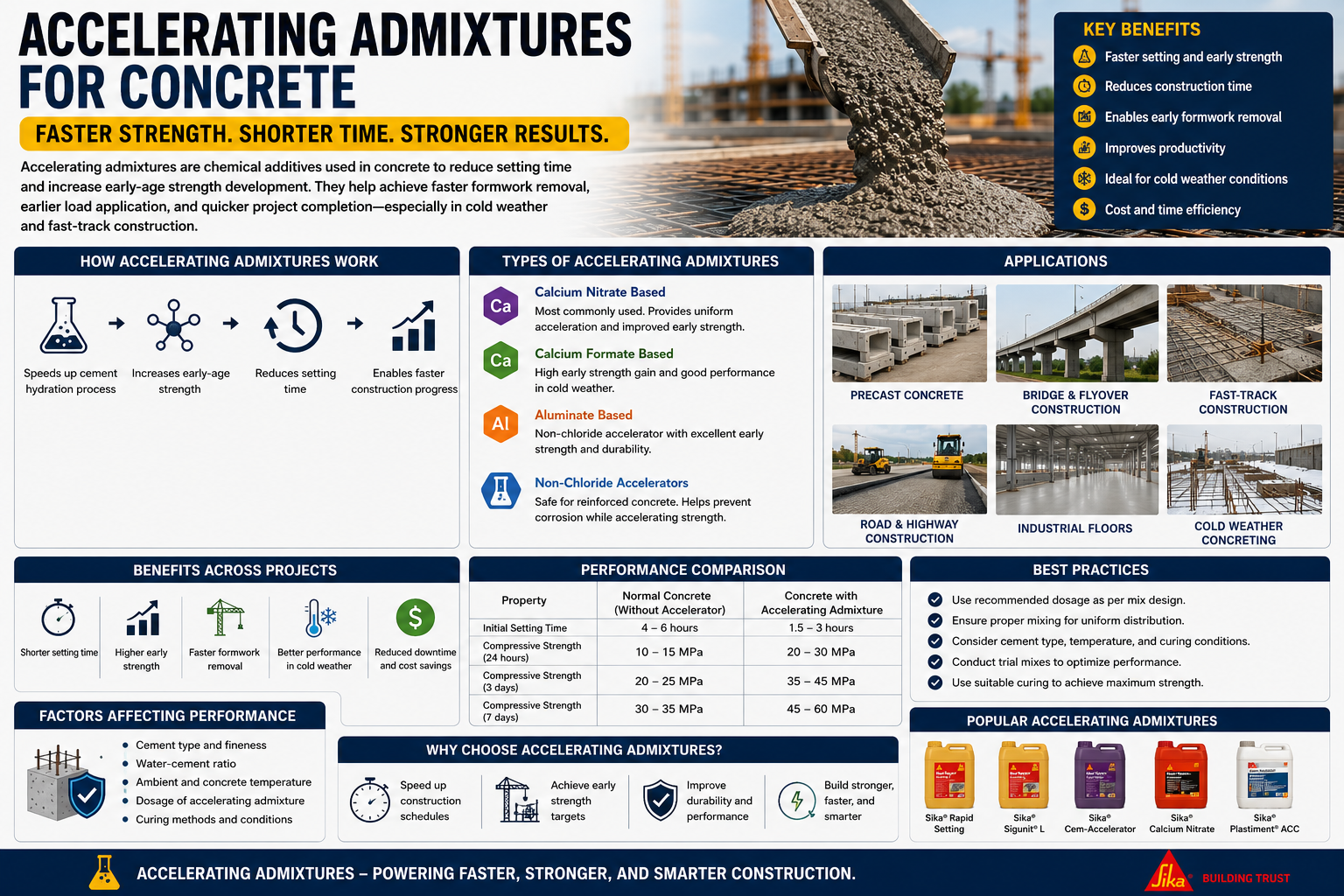
Accelerating admixtures for concrete are chemical additives specifically designed to speed up the hydration process of cement, reduce setting time, and increase early-age strength development. These admixtures are widely used in construction projects where rapid strength gain, faster formwork removal, and shorter project completion times are critical.
Accelerators are particularly valuable in cold weather concreting, precast concrete manufacturing, road repairs, bridge construction, and fast-track infrastructure projects where delays can significantly impact costs and schedules.
What Are Accelerating Admixtures for Concrete?
Accelerating admixtures are materials added to concrete during mixing to increase the rate of cement hydration. By speeding up the chemical reactions within the concrete, these admixtures help concrete set faster and achieve higher early compressive strength.
Unlike water reducers or retarders, accelerators focus primarily on reducing the time required for concrete to develop sufficient strength for construction activities.
How Accelerating Admixtures Work
When added to a concrete mix, accelerating admixtures:
- Increase cement hydration speed
- Reduce initial setting time
- Improve early-age compressive strength
- Allow earlier finishing operations
- Enable faster formwork removal
- Enhance cold-weather concrete performance
These effects help contractors complete projects more efficiently while maintaining concrete quality.
Types of Accelerating Admixtures
Calcium Nitrate-Based Accelerators
Calcium nitrate admixtures are widely used because they provide reliable early strength development while minimizing corrosion concerns.
Benefits include:
- Faster setting time
- Improved early compressive strength
- Good cold-weather performance
Calcium Formate Accelerators
Calcium formate promotes rapid cement hydration and is commonly used in precast and winter concreting applications.
Advantages:
- High early strength gain
- Improved productivity
- Enhanced low-temperature performance
Non-Chloride Accelerators
Non-chloride accelerators are preferred for reinforced concrete because they do not promote steel reinforcement corrosion.
Benefits:
- Corrosion protection
- Fast strength development
- Suitable for structural concrete
Aluminate-Based Accelerators
These admixtures provide rapid setting and strength development for specialized construction applications.
Benefits of Accelerating Admixtures for Concrete
Faster Setting Time
Accelerators significantly reduce the time required for concrete to begin hardening.
Increased Early Strength
Concrete achieves higher compressive strength within the first 24 to 72 hours.
Reduced Construction Schedules
Earlier strength gain allows construction activities to proceed more quickly.
Earlier Formwork Removal
Forms can be removed sooner, increasing productivity and reducing labor costs.
Improved Cold Weather Performance
Accelerators help offset slower hydration rates caused by low temperatures.
Faster Return to Service
Roads, pavements, bridges, and industrial floors can often be reopened sooner.
Applications of Accelerating Admixtures
Precast Concrete Manufacturing
Accelerators shorten production cycles and improve plant efficiency.
Highway and Road Construction
Enable faster repair and reopening of transportation infrastructure.
Bridge Construction
Reduce project delays by accelerating concrete strength development.
Industrial Flooring
Allow earlier use of floors exposed to heavy equipment and traffic.
Cold Weather Concreting
Maintain concrete performance when temperatures slow hydration.
Emergency Repair Projects
Support rapid-strength concrete for urgent infrastructure repairs.
Factors Affecting Accelerator Performance
Several factors influence the effectiveness of accelerating admixtures:
Cement Type
Different cement compositions respond differently to accelerators.
Temperature
Higher temperatures generally increase accelerator effectiveness.
Water-Cement Ratio
Lower water-cement ratios often improve strength development.
Dosage Rate
Proper admixture dosage is essential for achieving desired results.
Curing Conditions
Adequate curing ensures maximum strength gain and durability.
Accelerating Admixtures vs Normal Concrete
| Property | Normal Concrete | Concrete with Accelerator |
|---|---|---|
| Initial Set Time | 4–6 Hours | 1.5–3 Hours |
| Early Strength Development | Moderate | Rapid |
| Formwork Removal | Delayed | Earlier |
| Cold Weather Performance | Limited | Improved |
| Project Completion Speed | Standard | Faster |
Best Practices for Using Accelerating Admixtures
- Follow manufacturer dosage recommendations.
- Conduct trial mixes before large-scale use.
- Monitor ambient temperature conditions.
- Ensure thorough mixing and uniform distribution.
- Maintain proper curing procedures.
- Verify compatibility with other admixtures.
Why Use Accelerating Admixtures?
Modern construction projects often operate under tight deadlines and challenging environmental conditions. Accelerating admixtures help contractors achieve faster strength development, reduce downtime, improve productivity, and lower overall project costs. Their ability to accelerate construction schedules while maintaining concrete performance makes them an essential tool in today’s construction industry.
Conclusion
Accelerating admixtures for concrete provide a reliable solution for reducing setting times and increasing early-age strength development. Whether used in precast production, infrastructure projects, cold-weather construction, or emergency repairs, these admixtures improve efficiency, shorten construction schedules, and help concrete achieve superior early performance. Proper selection and application ensure maximum benefits and long-term durability.