The accelerating admixtures market is becoming increasingly important as construction companies, ready-mix producers, precast manufacturers, and infrastructure contractors look for ways to shorten concrete setting times and achieve early-age strength more efficiently. Accelerating admixtures help modify the hydration and hardening behavior of cement-based materials, making them useful when construction schedules are tight or environmental conditions slow strength development.
The growing use of ready-mix concrete, precast elements, shotcrete, rapid infrastructure repairs, and high-performance concrete is creating new demand for concrete accelerators. At the same time, concerns about reinforcement corrosion and long-term durability are encouraging a shift from traditional chloride-based products toward non-chloride accelerating technologies.
Market research from Market Intelo and IndustryARC highlights several important segments of the accelerating admixtures market, including calcium chloride and non-chloride products, liquid and powder forms, ready-mix and precast concrete, infrastructure, structural concrete, and regional markets such as Asia Pacific.
What Are Accelerating Admixtures?
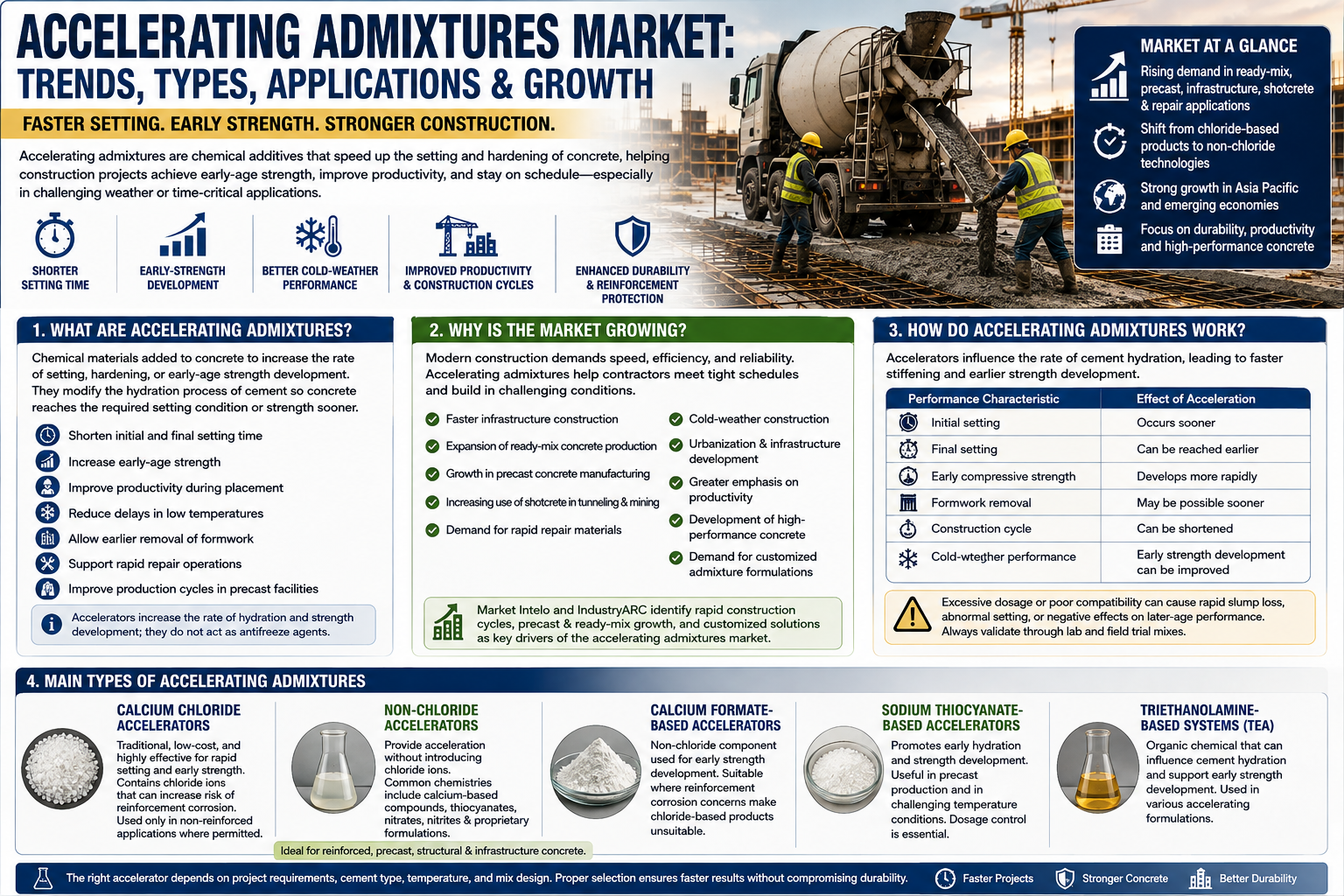
Accelerating admixtures are chemical materials added to concrete to increase the rate of setting, hardening, or early-age strength development.
Concrete normally gains strength through the hydration of cement. When cement comes into contact with water, hydration reactions produce compounds such as calcium silicate hydrate, which forms a major part of the hardened cement matrix.
An accelerator modifies this process so that concrete can reach a required setting condition or early strength level sooner.
Depending on the formulation, an accelerator may primarily:
- Shorten initial and final setting time
- Increase early-age strength
- Improve productivity during concrete placement
- Reduce delays caused by low temperatures
- Allow earlier removal of formwork
- Support rapid repair operations
- Improve production cycles in precast facilities
Accelerating admixtures should not be confused with antifreeze products. An accelerator increases the rate of hydration and strength development; it does not simply prevent water from freezing.
Why Is the Accelerating Admixtures Market Growing?
Several construction trends are supporting demand for accelerating technologies.
Modern projects increasingly operate under strict schedules. Contractors may need to reopen roads quickly, remove forms earlier, increase precast production cycles, or complete structural work during colder periods.
Accelerating admixtures can contribute to these objectives when they are properly selected and incorporated into an appropriate concrete mix design.
Key market drivers include:
- Faster infrastructure construction
- Expansion of ready-mix concrete production
- Growth in precast concrete manufacturing
- Increasing use of shotcrete in tunneling and mining
- Demand for rapid repair materials
- Cold-weather construction
- Urbanization and infrastructure development
- Greater emphasis on construction productivity
- Development of high-performance concrete
- Demand for customized admixture formulations
Market Intelo identifies rapid construction cycles, infrastructure modernization, precast production, ready-mix concrete, and customized formulations as important factors influencing the accelerating admixtures market.
How Do Accelerating Admixtures Work?
The performance of an accelerating admixture depends on its chemical composition, dosage, cement chemistry, temperature, water-cement ratio, and interaction with other materials in the mix.
The basic mechanism involves influencing the rate of cement hydration.
When an accelerator increases hydration activity, more hydration products can develop during the early stages of concrete hardening. This can result in faster stiffening and earlier strength development.
The practical effect can include:
| Performance characteristic | Effect of acceleration |
| Initial setting | Occurs sooner |
| Final setting | Can be reached earlier |
| Early compressive strength | Develops more rapidly |
| Formwork removal | May be possible sooner |
| Construction cycle | Can be shortened |
| Cold-weather performance | Early strength development can be improved |
However, acceleration does not mean that every concrete property automatically improves. Excessive dosage or poor compatibility can cause rapid slump loss, difficult finishing, abnormal setting, or undesirable effects on later-age performance.
For this reason, accelerators should be evaluated through laboratory and field trial mixes before large-scale application.
Main Types of Accelerating Admixtures
The accelerating admixtures market contains several chemical technologies. Product selection depends on the required setting time, early strength, reinforcement conditions, temperature, cement type, and project specifications.
Calcium Chloride Accelerators
Calcium chloride is one of the traditional accelerating materials because it can produce rapid setting and early strength development at relatively low cost.
Its major limitation is the presence of chloride ions.
Chlorides can increase the risk of corrosion of embedded steel reinforcement under suitable exposure conditions. Consequently, calcium chloride is generally unsuitable for many reinforced or prestressed concrete applications.
It may be considered for specific non-reinforced applications where project specifications permit its use.
Non-Chloride Accelerators
Non-chloride accelerators are becoming increasingly important because they provide acceleration without intentionally introducing chloride ions into the concrete.
Common chemistries include calcium-based compounds, thiocyanates, nitrates, nitrites, and other proprietary formulations.
These products are particularly relevant to:
- Reinforced concrete
- Precast elements
- Structural concrete
- Infrastructure projects
- Repair applications
- High-performance concrete
Market Intelo identifies non-chloride products as an important growth segment as construction stakeholders place greater emphasis on durability and reinforcement protection.
Calcium Formate-Based Accelerators
Calcium formate can be used as a non-chloride accelerating component and is particularly relevant to formulations designed for early strength development.
Its use may be beneficial where reinforcement corrosion concerns make chloride-based accelerators unsuitable.
Performance still depends on cement composition, temperature, dosage, and the overall admixture system.
Sodium Thiocyanate-Based Accelerators
Sodium thiocyanate is used in certain accelerating formulations because it can promote early hydration and strength development.
It can be useful in specialized concrete applications, including precast production and construction carried out under challenging temperature conditions.
Dosage control is essential because accelerator performance is strongly dependent on the chemistry and proportions of the complete concrete mixture.
Triethanolamine-Based Systems
Triethanolamine, commonly abbreviated as TEA, is an organic chemical used in cement and concrete chemistry.
It can influence cement hydration and is included in some accelerating or multifunctional admixture formulations.
Its effect can vary depending on concentration and cement composition, so formulations must be optimized rather than assuming that increasing dosage will always increase acceleration.
Accelerating Admixtures by Physical Form
The accelerating admixtures market can also be divided by physical form.
Liquid Accelerating Admixtures
Liquid products are widely used in ready-mix and batching operations because they can be accurately dosed through automated dispensing systems.
Advantages include:
- Easy metering
- Rapid dispersion
- Convenient batching
- Consistent dosage control
- Compatibility with automated concrete plants
IndustryARC identifies liquid products as an important form because of their handling and mixing advantages.
Powder Accelerating Admixtures
Powder accelerators can be useful where transportation, storage, formulation flexibility, or specific application requirements favor a dry product.
They may be particularly relevant to:
- Precast production
- Dry-mix systems
- Certain shotcrete applications
- Remote construction operations
- Specialty repair products
The choice between liquid and powder should consider storage conditions, dosing equipment, product stability, site requirements, and the concrete production process.
Major Applications of Accelerating Admixtures
Accelerators are used across multiple segments of the construction industry.
Ready-Mix Concrete
Ready-mix producers need consistent setting and strength development while concrete is transported and placed.
Accelerating admixtures can be used when faster setting or early strength is required, particularly during colder conditions or time-sensitive construction operations.
Precast Concrete
Precast manufacturing depends heavily on production efficiency.
Faster early strength development can help manufacturers remove forms earlier and potentially shorten production cycles.
This makes accelerators relevant to:
- Concrete pipes
- Precast panels
- Structural elements
- Concrete blocks
- Utility products
- Other factory-produced concrete components
Shotcrete
Shotcrete is commonly used in tunneling, mining, slope stabilization, underground construction, and repair work.
Accelerating admixtures can be especially important because sprayed concrete often needs to gain sufficient early strength rapidly after application.
Infrastructure Construction
Infrastructure projects frequently have strict deadlines and substantial operational consequences when construction causes road closures or other disruptions.
Accelerators may be used in:
- Bridges
- Roads
- Tunnels
- Airports
- Dams
- Transportation structures
- Utility infrastructure
Concrete Repair and Rehabilitation
Rapid-setting and early-strength concrete systems are useful for repair projects where downtime must be minimized.
Examples include:
- Pavement repairs
- Bridge repairs
- Industrial floors
- Damaged structural elements
- Emergency infrastructure repairs
Accelerating Admixtures and the China Concrete Admixtures Market
China represents an important part of the global concrete admixture industry because of its large construction base, extensive infrastructure development, manufacturing capacity, and established ready-mix and precast sectors.
The China concrete admixtures market is influenced by demand for higher-performing concrete, construction efficiency, infrastructure modernization, and increasingly sophisticated concrete formulations.
Local construction projects can require different admixture characteristics depending on:
- Cement type
- Aggregate properties
- Climate
- Transportation distance
- Construction method
- Required setting time
- Strength class
- Reinforcement density
- Project specifications
This creates opportunities for manufacturers that can provide application-specific formulations rather than one universal accelerator.
China’s large chemical manufacturing ecosystem also supports the development and supply of raw materials used in construction chemical formulations.
APAC Concrete Admixtures Market Outlook
The APAC concrete admixtures market is supported by construction activity across China, India, Southeast Asia, Japan, South Korea, Australia, and other developing economies.
IndustryARC identifies Asia Pacific as the fastest-growing regional market in its accelerating admixtures analysis, with demand supported by increased concrete consumption and construction activity.
Several regional trends are particularly relevant:
Rapid Urbanization
Growing cities require residential buildings, transportation infrastructure, commercial facilities, utilities, and industrial developments.
Infrastructure Investment
Large road, bridge, rail, airport, tunnel, and energy projects create demand for concrete technologies that improve construction efficiency.
Precast Construction
Factory-produced concrete components can benefit from faster strength development because production efficiency directly affects manufacturing capacity.
Climate Diversity
The APAC region contains extremely diverse climatic conditions. Concrete admixture requirements in cold northern regions can differ substantially from those in tropical or high-temperature environments.
This increases demand for formulations designed around specific temperature and concrete production conditions.
Accelerating Admixtures in the Concrete Admixtures Additive Market
Accelerators represent one segment of the broader concrete admixtures additive market.
Concrete producers use many different admixture technologies to modify fresh and hardened concrete properties.
These include:
| Admixture type | Primary purpose |
| Water reducers | Reduce water demand while maintaining workability |
| Superplasticizers | Provide high flowability and significant water reduction |
| Accelerators | Speed setting and early strength development |
| Retarders | Delay setting and extend placement time |
| Air-entraining admixtures | Improve resistance to freeze-thaw exposure |
| Corrosion inhibitors | Reduce reinforcement corrosion risk |
| Shrinkage-reducing admixtures | Help control drying shrinkage |
| Waterproofing/permeability-reducing admixtures | Reduce water penetration |
This broader product ecosystem is part of the cement and concrete additives market, where manufacturers increasingly develop multifunctional products that address several performance requirements simultaneously.
Key Factors Driving Product Selection
Choosing an accelerator should never be based solely on the fastest setting time or lowest purchase price.
Engineers and concrete producers should evaluate the complete performance profile.
Cement Compatibility
Different cement compositions can respond differently to the same accelerator.
Testing should therefore be performed using the actual cement and supplementary cementitious materials intended for production.
Temperature
Temperature has a major influence on cement hydration.
Cold conditions can slow hydration, while high temperatures can accelerate setting independently of the admixture.
Required Early Strength
The required strength should be clearly defined.
For example, the objective might be:
- Earlier formwork removal
- Earlier traffic opening
- Faster precast demolding
- Rapid shotcrete stabilization
- Emergency repair completion
Reinforcement
For reinforced and prestressed concrete, chloride content is a critical consideration.
Non-chloride accelerator technologies are generally more appropriate where reinforcement corrosion must be controlled.
Compatibility With Other Admixtures
Accelerators may be used alongside water reducers, superplasticizers, retarders, air-entraining agents, and other admixtures.
Compatibility should be verified through testing rather than assumed.
Benefits of Accelerating Admixtures
When correctly selected and dosed, accelerating admixtures can provide several practical benefits.
Faster Construction
Earlier setting and strength development can help contractors move to subsequent construction stages sooner.
Improved Cold-Weather Productivity
Low temperatures can slow hydration and extend construction cycles. Acceleration can help compensate for reduced hydration rates when combined with appropriate temperature-control measures.
Earlier Formwork Removal
Faster early strength can potentially allow formwork to be removed earlier, subject to structural requirements and project specifications.
Reduced Downtime
Rapid repair materials can help reopen roads, industrial areas, and other facilities sooner.
Higher Precast Productivity
Accelerated strength development can help precast manufacturers optimize mold utilization and production schedules.
Limitations and Potential Risks
Accelerating admixtures are powerful tools, but they are not a substitute for sound concrete technology.
Corrosion Risk
Chloride-containing accelerators can increase corrosion risk in reinforced concrete.
Rapid Slump Loss
Some accelerator systems can cause concrete to lose workability quickly, particularly when dosage or temperature is not properly controlled.
Premature Setting
Excessive acceleration may make concrete difficult to place, compact, pump, or finish.
Variable Performance
Results can change with cement chemistry, water-cement ratio, temperature, aggregate characteristics, and other admixtures.
Long-Term Performance
A product that produces excellent early strength is not automatically the best choice for long-term durability.
The complete performance profile should be considered.
Accelerating Admixtures Market: What Buyers Should Consider
For industrial buyers, contractors, and concrete manufacturers, purchasing decisions should consider more than unit price.
A practical evaluation framework includes:
| Evaluation factor | Key question |
| Performance | Does the product achieve the required setting and early strength? |
| Compatibility | Does it work with the project’s cement and other admixtures? |
| Reinforcement | Is the chloride level appropriate for the structure? |
| Dosage | What dosage range provides reliable performance? |
| Temperature | How does the product perform under expected site conditions? |
| Storage | Can the product be stored safely under local conditions? |
| Quality control | Are specifications and batch consistency documented? |
| Technical support | Is application guidance available when required? |
| Total cost | Does faster construction justify the overall admixture cost? |
This approach helps buyers compare products based on actual project value rather than simply comparing prices per kilogram or liter.
Frequently Asked Questions
What is the purpose of accelerating admixtures?
Accelerating admixtures are used to speed up concrete setting and early-age strength development. They are particularly useful when construction schedules require faster hardening or when low temperatures slow cement hydration.
What are the main types of accelerating admixtures?
Common accelerator technologies include calcium chloride, calcium formate, sodium thiocyanate, calcium nitrite, triethanolamine-based systems, and proprietary non-chloride formulations. The appropriate choice depends on the concrete mix, reinforcement, temperature, and performance requirements.
Are accelerating admixtures suitable for reinforced concrete?
Yes, but the formulation must be selected carefully. Chloride-containing accelerators can increase reinforcement corrosion risk, so non-chloride technologies are generally preferred for many reinforced and prestressed concrete applications.