Concrete is widely used in foundations, tunnels, basements, bridges, water tanks, and other structures exposed to moisture. However, concrete contains microscopic pores and capillary channels that can allow water to penetrate over time. Waterproofing admixtures in concrete are designed to reduce this water movement and improve the durability of the finished structure.
Growing infrastructure development, urban construction, and demand for longer-lasting buildings are increasing interest in integral waterproofing technologies. As a result, waterproofing admixtures are becoming an important segment of the broader concrete admixtures industry.
What Are Waterproofing Admixtures?
Waterproofing admixtures are materials added to concrete during mixing to reduce water absorption and penetration.
Unlike a surface coating or membrane, an integral waterproofing admixture becomes part of the concrete mixture. Depending on its chemistry, it can work by blocking pores, modifying capillary pathways, creating hydrophobic surfaces, or promoting crystalline formation.
The main objective is to produce concrete with lower permeability and improved resistance to water ingress.
How Do Waterproofing Admixtures Work?
The mechanism depends on the type of admixture being used.
Crystalline Technology
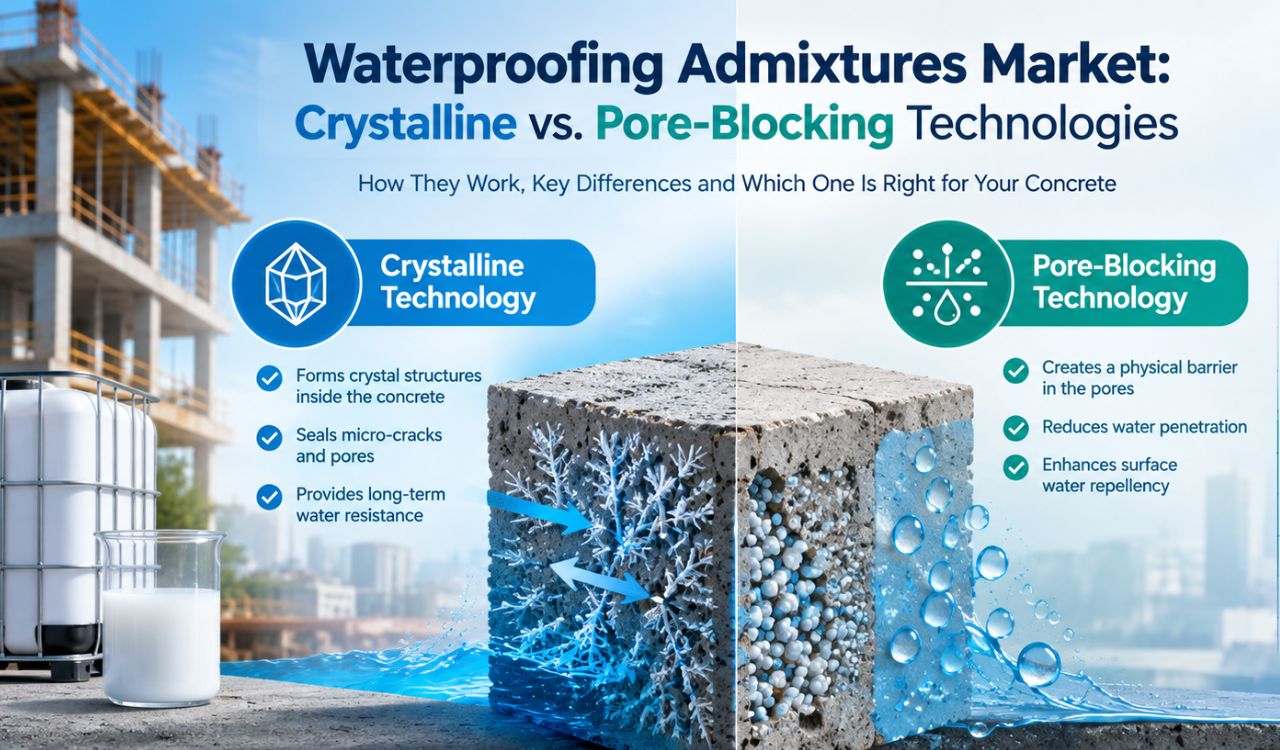
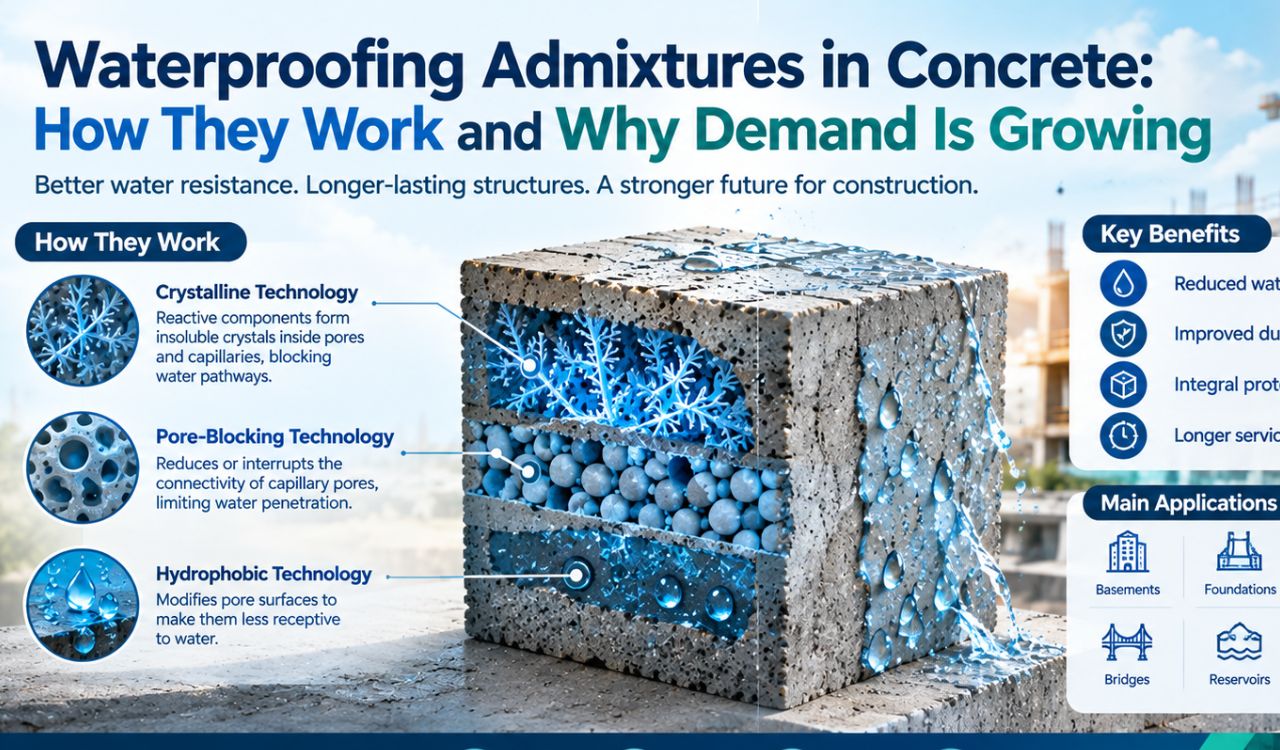
Crystalline waterproofing admixtures contain reactive components that interact with the cementitious matrix in the presence of moisture. This reaction can form insoluble crystalline structures within pores and capillaries.
These structures help restrict pathways through which water can move.
Pore-Blocking Technology
Pore-blocking admixtures work by reducing or interrupting the connectivity of capillary pores. By restricting these pathways, they can reduce water absorption and penetration.
Hydrophobic Technology
Hydrophobic admixtures modify the internal surfaces of pores, making them less receptive to water. This can help reduce capillary absorption, particularly in concrete exposed to repeated wetting and drying.
Why Is Demand Growing?
Several factors are contributing to the growing demand for waterproofing admixtures in concrete.
Infrastructure Development
Modern infrastructure projects require concrete that can perform under demanding environmental conditions.
Tunnels, bridges, reservoirs, transportation facilities, water treatment plants, and underground structures can all benefit from concrete with controlled permeability.
Urban Construction
Increasing urbanization is driving construction of high-rise buildings, underground parking facilities, basements, and other structures where groundwater and moisture protection are important.
Focus on Durability
Construction companies and asset owners are paying greater attention to service life and maintenance costs.
Reducing water penetration can help protect concrete from moisture-related deterioration and support longer-lasting structures.
Growth of Ready-Mix Concrete
The increasing use of ready-mix concrete is supporting demand for specialized concrete admixtures that allow producers to control concrete properties more precisely.
Waterproofing admixtures can be incorporated during batching without requiring a separate application after concrete placement.
Main Applications
Waterproofing admixtures are used across many construction sectors.
| Application | Why Waterproofing Matters |
| Basements | Protection against groundwater |
| Foundations | Reduced moisture penetration |
| Tunnels | Resistance to groundwater pressure |
| Water tanks | Reduced water leakage |
| Reservoirs | Improved water resistance |
| Parking structures | Protection from moisture and salts |
| Marine structures | Reduced water and chloride ingress |
| Wastewater facilities | Improved durability in wet environments |
These applications are contributing to continued development of the waterproofing admixtures market.
Benefits of Waterproofing Admixtures
When properly selected and used, waterproofing admixtures can provide several benefits.
Reduced Water Penetration
The primary benefit is reduced movement of water through the concrete matrix.
Improved Durability
Lower permeability can help limit the movement of moisture and dissolved substances that may contribute to deterioration.
Integral Protection
Because the admixture is incorporated into the concrete, the water-resistance mechanism is distributed throughout the treated concrete rather than being limited to an external surface.
Simplified Construction
Integral waterproofing can reduce dependence on certain additional waterproofing steps, depending on the project design.
Support for Longer Service Life
Better moisture control can contribute to improved long-term concrete performance when combined with proper mix design and construction practices.
Waterproofing Admixtures and Concrete Quality
An admixture alone cannot produce high-quality waterproof concrete.
The final performance also depends on:
- Water-cement ratio
- Cementitious materials
- Aggregate quality
- Concrete compaction
- Curing
- Crack control
- Joint detailing
- Admixture dosage
- Compatibility with other admixtures
Poorly compacted concrete, honeycombing, uncontrolled cracks, and defective joints can still allow water to enter even when a waterproofing admixture is present.
Choosing the Right Waterproofing Admixture
Engineers and contractors should evaluate the product according to the actual project requirements.
Important considerations include:
Exposure Conditions
Identify whether the concrete will face groundwater, hydrostatic pressure, marine exposure, chemicals, or repeated wetting and drying.
Concrete Composition
The admixture should be compatible with the cement, aggregates, supplementary cementitious materials, and other chemical admixtures being used.
Required Performance
Consider the project’s requirements for water penetration, absorption, permeability, strength, setting time, and durability.
Dosage and Testing
Follow the manufacturer’s recommended dosage and conduct trial batching with the actual concrete materials before large-scale production.
Regional Demand Trends
Demand for waterproofing admixtures is closely connected to the wider concrete admixtures market.
Asia-Pacific
Asia-Pacific remains an important market because of rapid urbanization, infrastructure investment, residential construction, and industrial development.
China, India, and Southeast Asian markets are contributing to demand for modern concrete technologies, particularly in large infrastructure and urban construction projects.
North America
Demand is supported by infrastructure upgrades, commercial construction, residential development, and renovation of aging structures.
Europe
European markets are increasingly focused on durability, sustainable construction, renovation, and extending the service life of infrastructure.
Middle East
Large-scale construction, water infrastructure, and challenging environmental conditions are creating opportunities for specialized waterproofing technologies.
Emerging Trends
The waterproofing admixture industry is moving toward more advanced and application-specific solutions.
Key trends include:
- Advanced crystalline formulations
- Improved pore-blocking technologies
- Greater focus on low-permeability concrete
- Growth of underground construction
- Increasing use of ready-mix and precast concrete
- Greater emphasis on concrete durability
- Demand for longer service life
- More integrated waterproofing systems
The broader APAC concrete admixtures market is also benefiting from increased construction activity and adoption of performance-enhancing admixture technologies.
The Role of Luke Chemicals
Modern concrete producers require admixture solutions that offer consistent quality, predictable performance, and compatibility with different mix designs.
Luke Chemicals develops construction chemical and concrete admixture technologies for applications where concrete performance, workability, strength, and durability are important considerations.
For waterproofing applications, the appropriate admixture should be selected based on project conditions and validated through suitable testing rather than relying solely on general product claims.
Best Practices
For better results with waterproofing admixtures:
- Select the product according to exposure conditions.
- Maintain the recommended dosage.
- Conduct laboratory trial mixes.
- Check compatibility with other admixtures.
- Control the water-cement ratio.
- Ensure proper placement and compaction.
- Maintain effective curing.
- Control cracks and construction joints.
- Follow the manufacturer’s technical instructions.
- Evaluate waterproofing as part of the complete concrete system.
Conclusion
Waterproofing admixtures in concrete provide an integral approach to reducing water penetration and improving concrete durability. Crystalline, pore-blocking, hydrophobic, and other technologies can address different moisture-control requirements.
Demand is growing as infrastructure development, urbanization, ready-mix concrete production, and durability-focused construction continue to expand. From basements and foundations to tunnels, reservoirs, marine structures, and industrial facilities, waterproofing admixtures can play an important role in modern concrete design.
However, the best performance comes from combining the right admixture with proper mix design, curing, compaction, crack control, and construction practices.
FAQs
What are waterproofing admixtures in concrete?
Waterproofing admixtures are additives mixed into concrete to reduce water absorption and penetration through capillary pores and pathways.
How do waterproofing admixtures work?
They can work by blocking pores, reducing capillary connectivity, forming crystalline structures, or making internal pore surfaces more water-repellent.
Why is demand for waterproofing admixtures growing?
Demand is increasing because of infrastructure development, urbanization, underground construction, water-retaining structures, and the growing focus on concrete durability and service life.
Where are waterproofing admixtures used?
Common applications include basements, foundations, tunnels, reservoirs, water tanks, parking structures, wastewater facilities, and marine infrastructure.
Do waterproofing admixtures make concrete completely waterproof?
No. They help reduce permeability and water penetration but cannot compensate for major cracks, poor compaction, defective joints, or improper curing.
Can waterproofing admixtures be used with other concrete admixtures?
Yes, many can be used with water reducers, superplasticizers, accelerators, and other admixtures, but compatibility should be confirmed through trial mixes.
How do I choose the right waterproofing admixture?
Consider the project’s water exposure, concrete composition, required permeability, dosage, compatibility, application conditions, and relevant performance testing.