Concrete is widely used in structures exposed to moisture, groundwater, and water pressure. However, its natural pore structure can allow water to penetrate through capillary pathways. This makes permeability control an important part of concrete durability.
The waterproofing admixtures market includes several technologies designed to reduce water absorption and penetration. Among them, crystalline waterproofing admixtures and pore-blocking admixtures are two important approaches.
Although both aim to improve concrete’s resistance to water, they work through different mechanisms. Understanding these differences can help engineers, contractors, and concrete manufacturers select the appropriate technology for a particular application.
What Are Waterproofing Admixtures?
Waterproofing admixtures are materials added to concrete during mixing to reduce water penetration through the hardened concrete.
Depending on their formulation, they may:
- Block or reduce capillary pathways
- Modify pore surfaces
- Promote crystalline formation
- Reduce water absorption
- Improve resistance to moisture ingress
These materials are also commonly called integral waterproofing admixtures because they are incorporated into the concrete rather than applied only to its surface.
However, waterproofing performance depends on the entire concrete system. Mix design, water-cement ratio, compaction, curing, cracking, and joint detailing all influence the final result.
What Are Crystalline Waterproofing Admixtures?
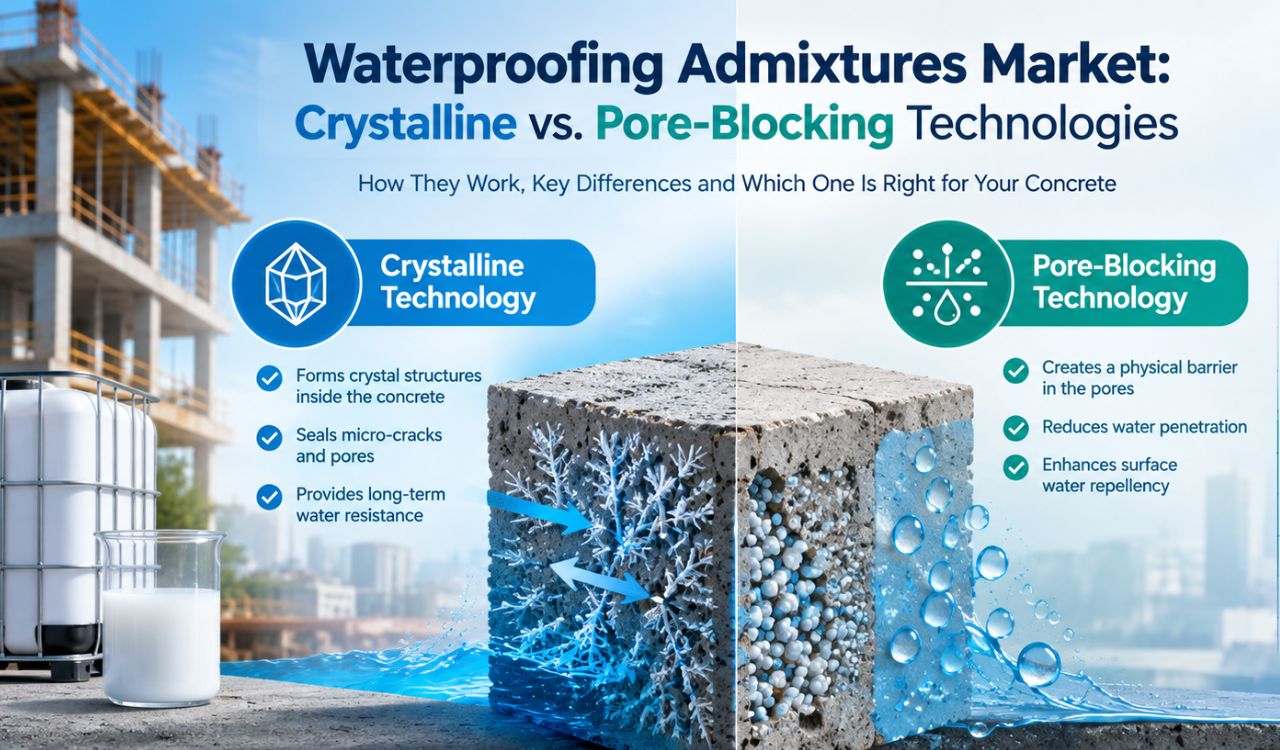
Crystalline waterproofing admixtures use reactive chemicals that interact with components of the cementitious matrix.
When moisture is present, the active ingredients can promote the formation of insoluble crystalline structures within pores and capillary pathways. These structures can help restrict water movement through the concrete.
How Crystalline Technology Works
The general process can be summarized as:
Moisture + reactive compounds → crystalline formation → restricted capillary pathways → reduced water penetration
The technology is particularly useful in concrete structures where moisture exposure is expected throughout the service life.
Common Applications
Crystalline admixtures are commonly considered for:
- Basements
- Foundations
- Tunnels
- Water tanks
- Reservoirs
- Swimming pools
- Retaining structures
- Wastewater facilities
One advantage of this technology is that the active mechanism is incorporated throughout the treated concrete rather than being limited to a surface layer.
What Are Pore-Blocking Admixtures?
Pore-blocking admixtures are designed to reduce the movement of water by restricting or interrupting capillary pathways within concrete.
Instead of relying primarily on crystalline growth, these systems may use materials that occupy, narrow, or otherwise modify pores and capillaries.
How Pore-Blocking Technology Works
Concrete contains a network of pores formed during hydration and drying. If these pores remain sufficiently connected, water can move through the concrete.
Pore-blocking technology works by reducing this connectivity.
The simplified mechanism is:
Pore modification → reduced capillary connectivity → lower water movement → improved water resistance
The exact mechanism depends on the chemistry and formulation of the particular product.
Crystalline vs. Pore-Blocking Technologies
While both technologies target concrete permeability, their mechanisms are different.
| Factor | Crystalline Technology | Pore-Blocking Technology |
| Main mechanism | Crystalline formation | Pore restriction or blocking |
| Primary target | Capillary pathways | Pore connectivity |
| Moisture involvement | Often important to activation | Depends on formulation |
| Typical purpose | Reduce water penetration | Reduce absorption and permeability |
| Common applications | Tanks, tunnels, basements | Foundations, slabs, infrastructure |
| Performance factors | Concrete chemistry and moisture | Mix design and product formulation |
Neither technology should automatically be considered superior. The appropriate choice depends on the project requirements and the specific product formulation.
Key Benefits of Crystalline Technology
Crystalline waterproofing admixtures can offer several advantages when correctly formulated and applied.
Reduced Water Penetration
Crystalline structures can restrict pathways through which water travels inside concrete.
Integral Protection
Because the admixture is mixed into the concrete, the waterproofing mechanism is distributed throughout the treated material.
Long-Term Performance Potential
Some crystalline systems can remain reactive when suitable moisture becomes available, depending on their chemistry and application conditions.
Suitable for Water-Exposed Structures
Their use in tanks, tunnels, basements, and other water-related structures makes them an important technology within the waterproofing admixtures market.
Key Benefits of Pore-Blocking Technology
Pore-blocking systems also provide important advantages.
Lower Water Absorption
By restricting capillary pathways, these admixtures can reduce the amount of water absorbed by concrete.
Reduced Permeability
Less-connected pores can make it more difficult for water and dissolved substances to move through the concrete.
Flexible Application
Different pore-modifying formulations can be developed for different concrete compositions and exposure conditions.
Support for Concrete Durability
Reducing moisture movement can help limit the transport of substances that contribute to concrete deterioration and reinforcement corrosion.
Which Technology Should You Choose?
The decision should be based on project conditions rather than the technology name alone.
Consider the following factors:
Exposure Conditions
Determine whether the structure will experience groundwater, hydrostatic pressure, marine exposure, repeated wetting and drying, or water-retaining conditions.
Required Performance
Define whether the project primarily requires reduced water absorption, lower permeability, resistance to water pressure, or a combination of durability properties.
Concrete Mix
The cement type, supplementary cementitious materials, aggregates, water-cement ratio, and other admixtures can influence performance.
Compatibility
Waterproofing admixtures may be used with superplasticizers, water reducers, accelerators, retarders, and other concrete admixtures. Compatibility should be confirmed through trial batching.
Construction Conditions
Proper mixing, placement, compaction, finishing, and curing remain essential regardless of the waterproofing technology selected.
Can Waterproofing Admixtures Prevent Cracks?
Waterproofing admixtures are primarily designed to control water penetration through the concrete matrix. They should not be viewed as a complete solution for structural or construction-related cracking.
Water can enter through:
- Structural cracks
- Construction joints
- Movement joints
- Honeycombing
- Poorly compacted concrete
- Defective penetrations
Therefore, waterproof concrete design should also include appropriate reinforcement, crack control, joint detailing, waterstops, curing, and construction practices.
Market Trends in Waterproofing Admixture Technology
The waterproofing admixtures market is increasingly focused on technologies that provide durable performance while fitting efficiently into modern concrete production.
Important trends include:
- Growing use of integral waterproofing
- Development of advanced crystalline formulations
- Improved pore-blocking technologies
- Greater focus on concrete durability
- Increasing underground construction
- Growth of water infrastructure
- Greater use of ready-mix and precast concrete
- Demand for longer service life
- Increased focus on lifecycle performance
These trends are encouraging manufacturers to develop more specialized admixture solutions for different concrete environments.
Applications Across Modern Construction
Both crystalline and pore-blocking technologies can be relevant to a wide range of applications.
Underground Structures
Basements, tunnels, foundations, and underground parking areas can experience groundwater and hydrostatic pressure.
Water-Retaining Structures
Reservoirs, tanks, swimming pools, and water treatment facilities require effective control of water movement through concrete.
Infrastructure
Bridges, retaining structures, transportation facilities, and other infrastructure can benefit from concrete with controlled permeability.
Industrial Construction
Factories, wastewater facilities, processing plants, and industrial floors may require improved resistance to moisture and aggressive environments.
Best Practices for Waterproofing Admixtures
For reliable performance, engineers and contractors should:
- Select the technology according to exposure conditions.
- Follow the manufacturer’s recommended dosage.
- Conduct trial mixes using project materials.
- Check compatibility with other admixtures.
- Maintain an appropriate water-cement ratio.
- Ensure proper concrete compaction.
- Follow appropriate curing procedures.
- Control cracks and construction joints.
- Test hardened concrete where required.
- Evaluate the complete waterproofing system rather than relying on one product.
The Role of Manufacturers
The performance of waterproofing admixtures depends heavily on formulation quality, consistency, dosage guidance, and compatibility with different concrete systems.
Manufacturers such as Luke Chemicals can support modern concrete production by developing specialized admixture technologies for different performance requirements. For industrial buyers and concrete producers, technical documentation, quality control, product consistency, and application support are important factors when evaluating suppliers.
Conclusion
The waterproofing admixtures market includes several technologies designed to reduce water penetration and improve concrete durability. Crystalline waterproofing admixtures primarily rely on reactions that form crystalline structures within suitable cementitious environments, while pore-blocking admixtures focus on restricting or modifying capillary pathways.
Both technologies can be valuable for basements, tunnels, foundations, reservoirs, water treatment facilities, and other moisture-exposed structures.
The best choice depends on the concrete mix, exposure conditions, required performance, product formulation, and construction practices. In every case, waterproofing admixtures should be combined with proper mix design, curing, crack control, and joint detailing to achieve reliable long-term performance.
FAQs
What is the difference between crystalline and pore-blocking admixtures?
Crystalline admixtures use chemical reactions that can form insoluble crystalline structures within pores, while pore-blocking systems primarily work by restricting or modifying capillary pathways.
Are crystalline admixtures better than pore-blocking admixtures?
Neither technology is universally better. Selection should depend on the concrete composition, exposure conditions, required performance, and manufacturer’s test data.
Where are crystalline waterproofing admixtures used?
They are commonly used in basements, tunnels, foundations, water tanks, reservoirs, swimming pools, and other water-exposed structures.
What are pore-blocking admixtures used for?
They are used to reduce water absorption and permeability by restricting the movement of water through capillary pores in concrete.
Can waterproofing admixtures replace surface waterproofing?
Not always. Integral admixtures can reduce permeability within concrete, but membranes, coatings, waterstops, drainage, and joint treatments may still be necessary depending on the project.
Do waterproofing admixtures improve concrete durability?
They can contribute to durability by reducing water penetration and limiting moisture-related transport. However, overall durability also depends on concrete quality, curing, cracking, exposure, and construction practices.