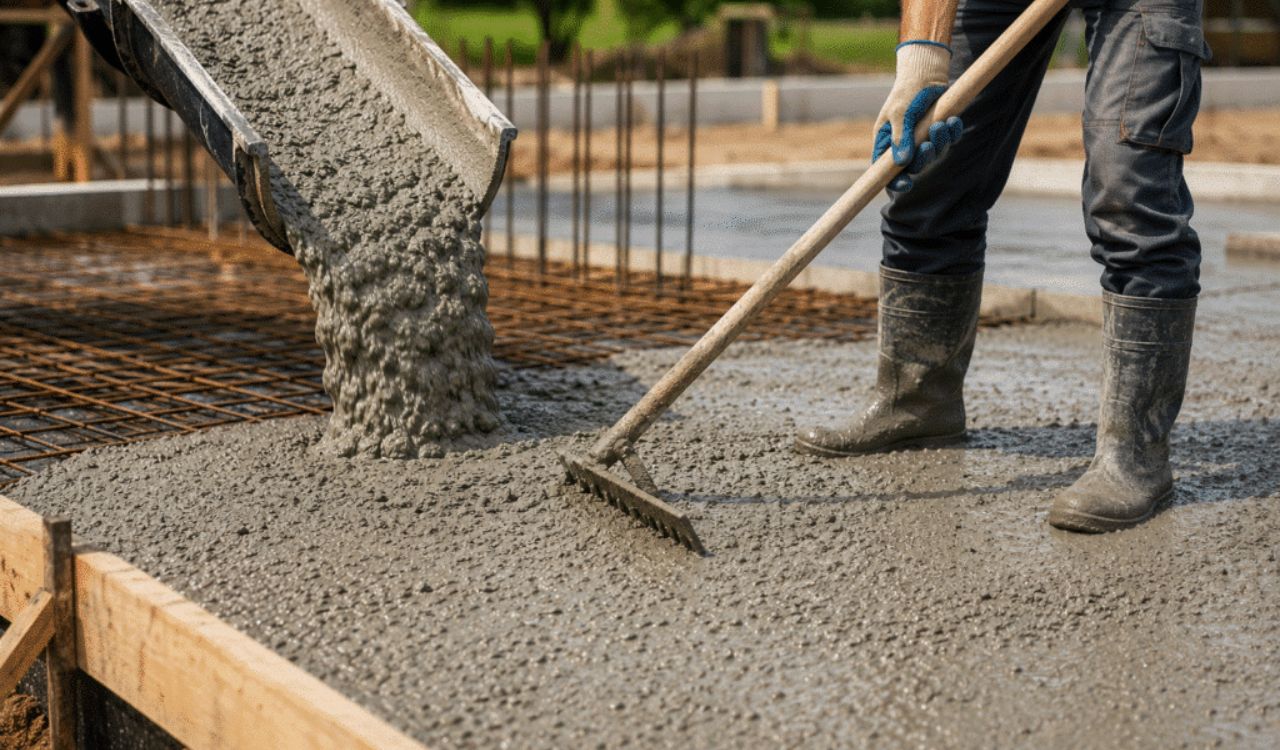
Concrete contains capillary pores that can allow water and aggressive substances to penetrate. A water-resistant concrete admixture can reduce these pathways and improve durability. Such solutions also contribute to concrete admixtures market sustainability by supporting longer-lasting concrete structures.
Understanding Concrete Permeability
Permeability describes how easily fluids can move through a porous material under a pressure difference. In concrete, permeability is influenced by the size, volume, and connectivity of pores within the cement paste.
A high water-cement ratio can leave more capillary pores after hydration. Poor compaction, inadequate curing, segregation, and cracking can also create additional pathways for water movement. Selecting suitable types of admixtures in concrete can help reduce permeability and improve durability when combined with proper mix design.
Reducing permeability therefore involves more than adding an admixture. The concrete must be properly proportioned, placed, compacted, and cured.
How Water Resistant Admixtures Control Water Movement
1. Blocking Capillary Pores
Some waterproofing admixtures introduce reactive or water-insoluble components that occupy or block portions of the capillary pore network. By reducing the continuity of these pathways, the admixture can make it more difficult for water to travel through the concrete.
This mechanism is particularly relevant where the objective is to reduce water penetration under pressure.
2. Creating Crystalline Structures
Crystalline waterproofing admixtures contain reactive components that can form insoluble crystalline products within suitable pores and capillary pathways.
When moisture is present, these reactions can contribute to filling or narrowing available pathways. The resulting structure can reduce water movement through the concrete and may provide additional protection around certain microcracks.
The actual performance depends on the formulation, concrete composition, moisture conditions, curing, and characteristics of the cracks.
3. Reducing Capillary Water Absorption
Some water-resistant technologies modify the internal pore surfaces and reduce their tendency to draw water through capillary action.
This is important for concrete exposed to rain, groundwater, damp soil, or repeated wetting and drying. Reducing absorption can also limit the amount of moisture available to transport dissolved salts and other contaminants into the concrete.
4. Supporting a Denser Concrete Matrix
Some admixture systems work indirectly by helping produce concrete with a lower water requirement while maintaining the necessary workability.
For example, water-reducing and high-range water-reducing admixtures can disperse cement particles and improve flow. When the mix is properly designed, this can allow a lower water-cement ratio and contribute to a denser hardened cement paste.
However, a water reducer should not automatically be considered a waterproofing admixture. Its primary function may be workability and water reduction rather than direct pore blocking.
Why Lower Permeability Matters
Reducing permeability can provide several durability advantages. When less water enters the concrete, there may also be less opportunity for dissolved salts and aggressive chemicals to penetrate toward reinforcement.
Lower permeability can therefore contribute to:
- Reduced water ingress
- Lower capillary absorption
- Improved resistance to moisture exposure
- Reduced movement of dissolved contaminants
- Better protection of embedded reinforcement
- Improved durability in suitable exposure conditions
The extent of these benefits depends on the complete concrete system and the surrounding environment.
Factors That Can Reduce the Effectiveness of Water Resistant Admixtures
An admixture cannot compensate for major construction defects. Even low-permeability concrete can experience leakage through cracks, poorly treated joints, honeycombing, or construction defects.
Important factors include:
Water-Cement Ratio
Controlling the water-cement ratio is fundamental to producing low-permeability concrete. Excess water can increase capillary porosity after hardening.
Proper Compaction
Inadequate vibration can leave voids and honeycombing, creating direct pathways for water.
Curing
Adequate curing supports cement hydration and helps develop a denser microstructure.
Crack Control
Structural cracks, shrinkage cracks, and poorly controlled joints can provide pathways for water regardless of the permeability of the surrounding concrete.
Admixture Compatibility
The waterproofing admixture should be compatible with the cement, supplementary cementitious materials, aggregates, water, and other chemical admixtures used in the concrete.
Best Practices for Reducing Water Ingress
For consistent results, contractors and engineers should:
- Select the admixture according to the project’s exposure conditions.
- Maintain the specified water-cement ratio.
- Conduct laboratory trial batches before production.
- Check compatibility with other admixtures.
- Follow the manufacturer’s recommended dosage and mixing procedure.
- Avoid uncontrolled addition of water at the jobsite.
- Ensure proper concrete consolidation.
- Provide adequate curing.
- Design and treat construction joints correctly.
- Address cracks as part of the overall waterproofing strategy.
- Test water penetration or absorption where project specifications require it.
Water-Resistant Concrete Requires a Complete System
A water-resistant concrete admixture can reduce permeability and water ingress, but it should not be treated as the only component of a waterproofing system. Concrete quality, mix design, curing, crack control, joints, drainage, and site conditions all influence the final result.
For applications such as basements, tunnels, foundations, reservoirs, water-retaining structures, and underground construction, an integral admixture can be considered as part of a broader durability and waterproofing strategy.
Conclusion
A water-resistant concrete admixture can help reduce permeability and limit water ingress by modifying capillary pores, blocking water pathways, reducing absorption, or promoting a denser cementitious structure. Different admixture technologies work through different mechanisms, so selection should be based on the concrete mix, exposure conditions, and required performance.
However, admixture technology is only one part of achieving durable, water-resistant concrete. A controlled water-cement ratio, proper compaction, adequate curing, effective crack control, and well-designed joints are equally important. Luke Chemicals provides concrete admixture solutions that can be considered alongside these factors when selecting materials for specific project requirements.
For demanding applications, trial batching and compatibility testing can help confirm that the selected admixture performs effectively with the proposed concrete materials. When these factors are considered together, water-resistant admixtures can form an important part of a comprehensive strategy for controlling moisture penetration and improving concrete durability.
Frequently Asked Questions
How does a water resistant concrete admixture reduce water ingress?
It can reduce water ingress by blocking or modifying capillary pores, reducing water absorption, promoting crystalline formation, or helping produce a denser concrete matrix. The specific mechanism depends on the admixture technology.
Does a water resistant admixture make concrete completely waterproof?
Not necessarily. Water-resistant admixtures can reduce permeability and water penetration, but they cannot compensate for major cracks, poorly constructed joints, honeycombing, or other defects. Critical structures may require a complete waterproofing system.
Does a lower water-cement ratio improve concrete water resistance?
Generally, a properly controlled lower water-cement ratio can help produce a denser cement paste with fewer interconnected capillary pores. However, workability, compaction, curing, and the overall mix design must also be properly controlled.
Can waterproofing admixtures be used with other concrete admixtures?
Many waterproofing admixtures can be combined with water reducers, superplasticizers, retarders, accelerators, and other admixture technologies. Compatibility should be confirmed through trial batches because performance can vary depending on the materials and dosage.
Where are water resistant concrete admixtures commonly used?
They can be used in applications exposed to significant moisture or water pressure, including basements, foundations, tunnels, reservoirs, water tanks, underground structures, water treatment facilities, and certain marine and infrastructure projects.
Can a water resistant admixture prevent concrete cracks?
A waterproofing admixture should not be considered a substitute for crack-control measures. Structural design, reinforcement, curing, shrinkage control, joint detailing, and proper construction practices remain important for minimizing cracks and potential water pathways.
How is the correct dosage of a water resistant concrete admixture determined?
Dosage depends on the specific product, cementitious materials, concrete formulation, exposure conditions, and required performance. The manufacturer’s technical documentation and representative trial-batch testing should be used to establish the appropriate dosage