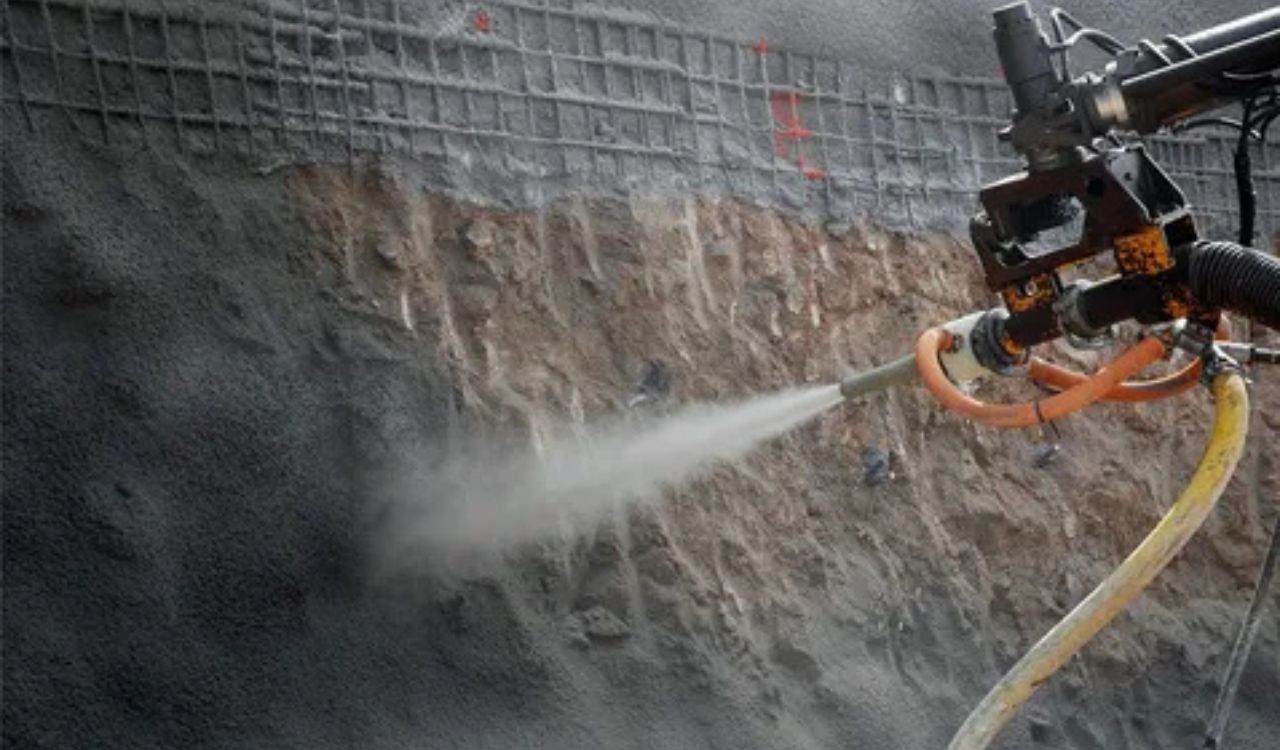
Shotcrete is sprayed onto rock, soil and formwork-free surfaces, so it has to do two opposite things: flow through a pump and hose, then stiffen almost instantly once it lands. Admixtures make that possible, and the right combination is what keeps a lining strong, tight and crack-resistant long after the spray crew has moved on.
The admixtures most often used in shotcrete for tunnels and slope support are set accelerators (usually alkali-free), polycarboxylate superplasticizers, hydration-control (stabilizing) admixtures, silica fume, and, depending on the project, air-entraining admixtures, fibres, shrinkage or cohesion modifiers and concrete expansion agents, which offset shrinkage so thin sprayed layers are less likely to crack.
Quick Answer: Shotcrete Admixtures at a Glance
| Admixture | Main job | Typical use |
| Alkali-free set accelerator | Fast stiffening and early strength after spraying | Tunnel linings, overhead work, wet or seeping rock |
| Alkaline accelerator (aluminate, silicate, hydroxide based) | Very fast set at lower cost | Mining, temporary support, mainly dry-mix |
| Polycarboxylate superplasticizer | Lower water-cement ratio with pumpable workability | Wet-mix shotcrete of all kinds |
| Hydration-control (stabilizing) admixture | Keeps the mix workable for hours without harming later setting | Long hauls, delays, long tunnel drives |
| Silica fume | Better adhesion, cohesion and durability | Thick layers, permanent linings, low rebound |
| Air-entraining admixture | Freeze-thaw resistance | Cold-climate slopes and portals |
| Fibres and shrinkage reducers | Crack control and toughness | Slope facing, linings replacing mesh |
Why Shotcrete Needs Admixtures
Conventional cast concrete sits in a form. Shotcrete has no form, so it must stick to the substrate, build thickness in layers and carry load early. Without admixtures, three problems appear quickly:
- Sagging or fall-out on walls and crowns because the mix stays plastic too long.
- High rebound, meaning material bounces off the surface and is wasted.
- Slow strength gain, which delays the next excavation round or leaves unsupported ground exposed.
Admixtures address these problems while keeping the mix pumpable, which is why modern wet-mix shotcrete is rarely placed without at least a superplasticizer and an accelerator.
Main Types of Shotcrete Admixtures
Set Accelerators
Accelerators are the defining admixture of shotcrete. They are added at the nozzle, not in the mixer, so the concrete stays workable until the moment of spraying. The result is rapid stiffening, fast early strength and thicker build-up per pass.
There are two families:
- Alkali-free accelerators. These are typically based on aluminium sulfate, often combined with organic acids and alkanolamines for stability. In European practice they are commonly defined by an alkali content of about 1% Na2O equivalent or less. They are far less caustic, keep later-age strength closer to the plain mix and are the standard choice for tunnels and any permanent lining.
- Alkaline accelerators. These are based on sodium aluminate, sodium silicate or alkali hydroxides. They set extremely fast and cost less, but they are caustic, raise the risk of skin, eye and lung irritation in enclosed spaces, and can reduce 28-day and long-term strength. They are mostly found in dry-mix and temporary support work.
Superplasticizers and Water Reducers
Polycarboxylate ether (PCE) superplasticizers let you cut the water-cement ratio while keeping the mix pumpable. A lower ratio gives higher strength, lower permeability and less shrinkage. Water reducers also help the mix survive the pump and hose with less segregation. Compatibility between the PCE and the accelerator matters: some combinations delay stiffening or reduce accelerator efficiency, so they should be tested together with the actual cement.
Hydration-Control (Stabilizing) Admixtures
Tunnel drives often involve long transport times, breakdowns and stop-start cycles. A hydration-control admixture holds the concrete in a workable state for several hours, then lets the accelerator take over at the nozzle. This avoids the loss of slump and the waste of discarded loads. It is not the same as a conventional retarder, because the goal is a clean, controlled restart of hydration rather than a permanent delay.
Silica Fume and Other Mineral Additions
Silica fume is technically a supplementary cementitious material rather than a chemical admixture, but it is almost always discussed alongside them. It improves cohesion and adhesion, reduces rebound and refines the pore structure, which helps durability in permanent linings. Fly ash and slag are also used for sulfate resistance and lower heat, though they can slow early strength and need accelerator trials.
Air-Entraining Admixtures
Where slopes, portals or tunnel entrances face freeze-thaw cycles, air entrainment improves frost resistance. In wet-mix shotcrete, part of the entrained air is lost during spraying, so the air content is usually measured before and after placement.
Fibres, Shrinkage Reducers and Cohesion Aids
Steel and macro-synthetic fibres are not admixtures in the strict sense, but they are specified in many shotcrete mixes to replace or reduce wire mesh and to improve toughness and crack control. Shrinkage-reducing admixtures and curing agents help limit cracking on large exposed slope faces. Viscosity or cohesion modifiers can improve stability in difficult pumping conditions.
How Shotcrete Accelerators Work
Cement setting is controlled by the reaction of tricalcium aluminate (C3A) with calcium sulfate. Accelerators disturb that balance on purpose. Aluminium sulfate based products drive rapid formation of ettringite, which stiffens the paste within minutes. They also speed up the silicate reactions that form calcium silicate hydrate (C-S-H), the phase that supplies strength.
The effect depends heavily on the cement: its C3A and sulfate content, fineness, and the presence of fly ash or slag all change setting time and early strength. That is why the same accelerator can behave differently from one batch plant to another, and why trials with the project cement are essential.
Admixtures for Tunnel Shotcrete
Tunnel shotcrete forms the primary support in NATM and sequential excavation methods, and also appears in mining roadways, hydropower tunnels and metro works. The priorities are:
- Fast, reliable early strength so the lining carries load before the next advance.
- Low rebound and good overhead adhesion to protect safety and reduce waste.
- Better working conditions in confined, poorly ventilated spaces, which is the main reason alkali-free accelerators dominate.
- Workability retention over long transport and unplanned stops.
A typical tunnel wet-mix therefore combines a PCE superplasticizer, a hydration-control admixture when hauls are long, silica fume where durability is needed, and a liquid alkali-free accelerator dosed at the nozzle. Fibres often replace some or all of the mesh.
Admixtures for Slope Support and Slope Stabilization
Slope support uses shotcrete as a facing over rock bolts, soil nails, drainage and sometimes mesh. The conditions differ from tunnels in useful ways:
- Application is often on open, vertical or inclined faces, so very fast setting is less critical than in a crown. Lower accelerator doses, or none at all, may be enough on dry, stable faces.
- Weather is a bigger factor. Heat, wind and sun drive plastic shrinkage and early drying, so hydration control, shrinkage reduction and proper curing become more important.
- Seepage and groundwater may still require a stronger accelerator in wet zones.
- Cold climates call for air entrainment and frost-resistant mixes.
- Long-term durability matters because slope shotcrete stays exposed for decades. Low permeability from a low water-cement ratio and silica fume, plus fibre reinforcement, is usually the right direction.
Emergency or remedial slope stabilization after a failure is the main case where accelerators are pushed hard, because early stiffening protects workers and the exposed face.
Wet-Mix vs. Dry-Mix: How It Changes Admixture Choice
| Factor | Wet-mix | Dry-mix |
| Water added | At the batching plant | At the nozzle |
| Superplasticizer and stabilizer | Widely used | Rarely relevant |
| Accelerator | Liquid, alkali-free preferred | Powder or liquid, alkaline more common |
| Rebound | Generally lower | Generally higher |
| Typical use | Tunnels, large slope jobs, mechanised spraying | Small repairs, remote sites, intermittent work |
Most modern tunnel and large slope projects use wet-mix with automated spraying and dosing pumps, which is why alkali-free liquid accelerators and PCE-based admixtures are the dominant combination today.
Key Factors When Choosing Shotcrete Admixtures
- Cement type and supplier. Test the actual cement. Compatibility is the biggest single variable.
- Required early strength. Specifications often use early-age strength classes (for example J1, J2 and J3 in EN 14487). Match the class to the layer thickness and the substrate.
- Temperature. Cold slows setting and calls for higher doses or different chemistries. Heat shortens workability and may call for stabilizers.
- Transport time and logistics. Long hauls favour hydration-control admixtures.
- Aggregate and mix design. Fines content and maximum size affect pumpability and rebound.
- Application equipment. Pump capacity, hose length and dosing accuracy at the nozzle decide how consistent the accelerator effect will be.
- Environmental and health rules. Drainage water quality, worker exposure limits and local standards may rule out alkaline products.
- Service life. Permanent linings need alkali-free systems and low permeability. Temporary support can tolerate more compromise.
Limitations and Common Risks
- Overdosing an accelerator can reduce later-age strength and raise permeability, and it speeds up equipment wear.
- Underdosing causes sagging, fall-out and delayed support.
- Incompatibility between cement, superplasticizer and accelerator can lead to flash set, delayed stiffening or poor early strength.
- Alkaline accelerators bring health risks and can lower long-term performance.
- Dose is not a fixed number. Alkali-free liquid accelerators are commonly used at a few percent by mass of cement, but the correct figure depends on the product, cement and temperature, so it must come from trials and the manufacturer’s data sheet rather than a rule of thumb.
- Admixtures do not fix poor application. Nozzle distance, angle, surface preparation and operator skill still drive quality.
Best Practices for Specifying and Using Shotcrete Admixtures
- Run trial mixes with the project cement, aggregate and the full admixture package, at the expected site temperature.
- Specify performance, not only product names: setting time, early strength development, 28-day strength, rebound limit and alkali content.
- Dose accelerator at the nozzle through a calibrated pump linked to the concrete output, and check the dosage regularly.
- Test on site. Common checks include setting time by penetration resistance (ASTM C1117), early strength by penetrometer or stud driving, and cores for compressive strength. Standards such as EN 14487, EN 14488, ASTM C1436 and ACI 506 provide the framework.
- Measure rebound to confirm that the mix and technique are working.
- Cure properly, especially on slopes exposed to sun and wind.
- Store admixtures correctly: sealed, out of direct sun, protected from frost, and within shelf life. Tanks and lines should be corrosion-resistant.
- Protect workers. Even alkali-free accelerators can irritate skin and eyes, so use gloves, eye protection and good ventilation.
Choosing a Supplier
If you are sourcing shotcrete admixtures for a tunnel or slope project, look for a concrete admixtures supplier that provides full technical data sheets, safety data sheets, test results against your cement type, and support during site trials. Luke Chemicals can help you compare product options against your mix design and application conditions before you commit to a full-scale pour.
Frequently Asked Questions
What is the most important admixture in shotcrete?
The set accelerator is the most characteristic one because it allows concrete to stick, build thickness and gain strength quickly after spraying. In practice, though, it works best together with a PCE superplasticizer that keeps the water-cement ratio low and the mix pumpable.
What is the difference between alkali-free and alkaline shotcrete accelerators?
Alkali-free accelerators are usually aluminium sulfate based and have very low alkali content, so they are less caustic and tend to preserve later-age strength. Alkaline accelerators use aluminates, silicates or hydroxides, set faster and cost less, but are more hazardous and can reduce long-term strength.
Do all slope stabilization projects need an accelerator?
No. On dry, stable faces with good weather, shotcrete may perform well with little or no accelerator. They are more useful on wet faces, overhead sections, cold conditions or emergency repairs where early stiffening is needed.
What is a hydration-control admixture in shotcrete?
It keeps wet-mix shotcrete workable for hours during long transport or delays, then allows normal setting to resume when an accelerator is added at the nozzle. It reduces wasted loads and keeps the mix consistent across a long drive.
Does silica fume count as a shotcrete admixture?
Strictly, it is a mineral addition rather than a chemical admixture, but it is widely used in shotcrete to improve cohesion, adhesion, rebound and durability, so it is normally part of the same mix-design conversation.
How do I choose the right dosage?
Dosage depends on the product, cement, temperature, layer thickness and required early strength. Use the manufacturer’s recommended range as a starting point and confirm it through trial mixes and site testing, not by copying a figure from another project.
Are alkali-free accelerators completely safe?
They are much safer than caustic alkaline products, but they are still chemicals that can irritate skin and eyes. Always follow the safety data sheet and use appropriate protective equipment.
Conclusion
The admixtures used in shotcrete for tunnels and slope support work as a system: an alkali-free accelerator for rapid setting, a PCE superplasticizer for low water content and pumpability, a hydration-control admixture for long hauls, and silica fume, air entrainment or fibres where durability and crack control demand them. Tunnels push the system toward speed, safety and early strength. Slopes push it toward durability, weather resistance and crack control. Trial mixes with the real cement, correct dosing at the nozzle and on-site testing turn that chemistry into reliable results.