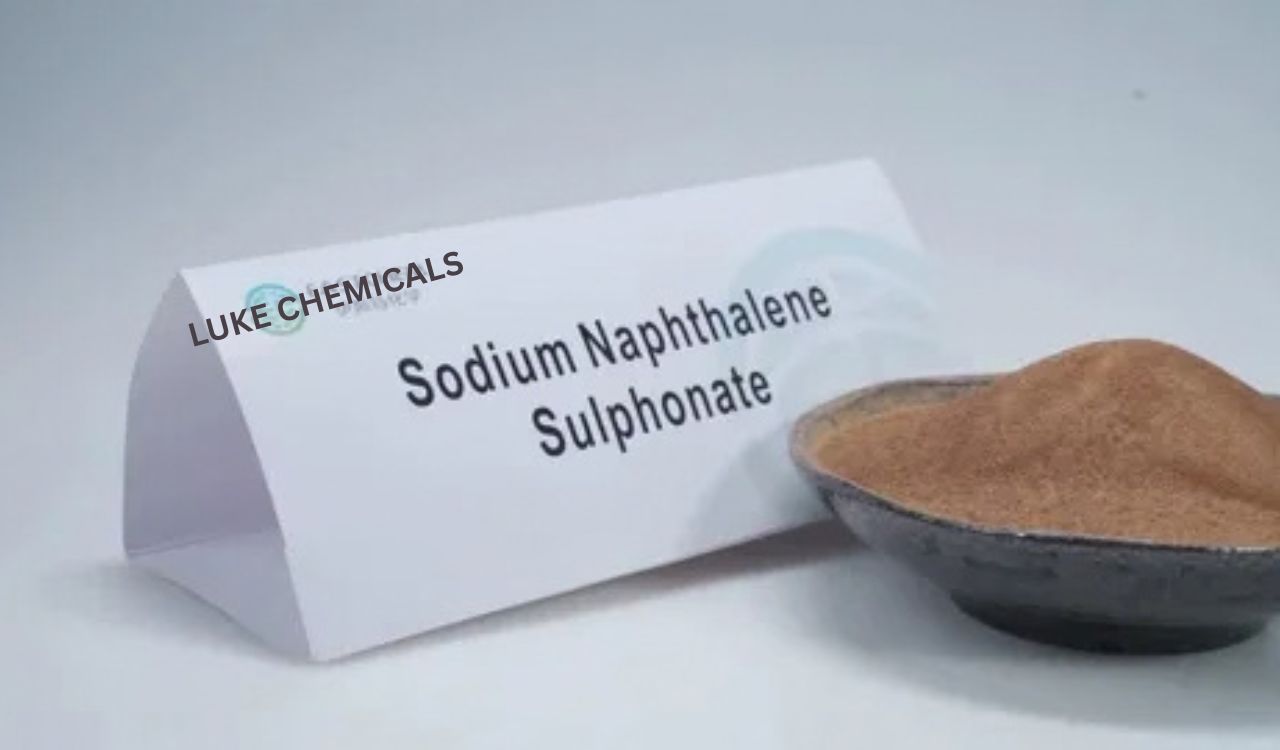
Sodium naphthalene sulfonate (SNF) has been used as a high-range water reducer in concrete for decades. Newer polycarboxylate (PCE) products now take much of the high-end market, but SNF is still widely used because it is predictable, cost-effective, and well suited to precast plants, steam-cured elements, and many ready-mix applications.
This guide covers the properties of sodium naphthalene sulfonate (SNF) superplasticizer: what it is, how it works, its typical specifications, where it performs well, and where its limits begin. If you are choosing a concrete water reducer for a specific mix, these are the details to check first.
What Is Sodium Naphthalene Sulfonate (SNF) Superplasticizer?
SNF is a synthetic anionic polymer made by sulfonating naphthalene, condensing it with formaldehyde, and neutralizing it with sodium hydroxide. The result is a polymer chain with many negatively charged sulfonate groups. It is sold as a brown to yellowish-brown powder or as a dark liquid.
You will see it under several names:
- Naphthalene sulfonate formaldehyde condensate (NSF)
- Sodium polynaphthalene sulfonate (PNS)
- Naphthalene-based superplasticizer
- Naphthalene-based high-range water reducing agent
It belongs to the group of high-range water reducers (HRWR). Under ASTM C494 these are classed as Type F (water-reducing, high range) or Type G (water-reducing, high range, and retarding).
How Does SNF Work in Concrete?
Cement particles in water carry opposite surface charges and tend to clump into flocs. These flocs trap part of the mixing water, so the paste stays stiff and needs more water to flow.
SNF fixes this in three steps:
- Adsorption: The polymer chains attach to the surfaces of cement particles, mainly the aluminate phases and hydration products.
- Charge build-up: The sulfonate groups give each particle a strong negative surface charge, which raises its zeta potential.
- Electrostatic repulsion: The particles repel each other and break up the flocs, releasing trapped water so the paste flows.
The practical result is higher workability at the same water content, or the same workability at a much lower water-cement ratio. SNF works almost entirely through electrostatic repulsion. PCE superplasticizers add steric hindrance from their side chains, which is why they hold dispersion longer.
Key Properties of SNF Superplasticizer
Exact values vary by manufacturer and grade, so always check the technical data sheet and certificate of analysis for the batch you buy. The ranges below are typical for powder products.
| Property | Typical range or description |
| Appearance | Light brown to dark brown free-flowing powder (liquid grades are dark brown) |
| Chemical type | Anionic polymer, sodium salt of naphthalene sulfonate formaldehyde condensate |
| Solid content (powder) | About 92–95% |
| pH (1% solution) | About 7–9 |
| Sodium sulfate content | About 5–20% depending on grade; low-sulfate grades are available |
| Chloride content | Low, usually ≤0.3–0.5% |
| Water reduction | Roughly 15–25% in typical mixes |
| Typical dosage | About 0.5–1.5% of cement weight (powder) |
| Air entrainment | Low |
| Setting behavior | Little retardation at normal dosage, but some at high dosage |
| Standards | ASTM C494 Type F/G; EN 934-2 high-range water reducer |
Why the sodium sulfate content matters
Sodium sulfate is a by-product of neutralizing the sulfonated product. Higher levels reduce cost, but they add soluble alkali and sulfate to the mix. In sensitive applications, such as architectural concrete or mixes with alkali-silica reaction concerns, a low-sulfate grade is the safer choice.
Benefits of SNF as a Concrete Water Reducer
- Strong water reduction: Lower water-cement ratios increase compressive strength and reduce porosity.
- Higher early strength: Dense, low-water mixes gain strength faster, which suits demolding schedules in precast plants.
- Flowing concrete: SNF produces high slump without segregation when the mix is well proportioned (see ASTM C1017).
- Compatibility with heat curing: It performs reliably in steam-cured precast, pipes, and blocks.
- Cost-effectiveness: It is usually cheaper per cubic meter than PCE for moderate-performance needs.
- Easy handling: The powder stores well, and the liquid mixes easily.
SNF and Concrete Durability: Is It a Waterproofing Admixture?
SNF is not a waterproofing admixture for concrete. It improves water tightness indirectly: by cutting the water-cement ratio, it reduces capillary porosity, and lower permeability slows water and chloride ingress.
For concrete with strict water-resistance requirements, designers usually combine SNF with dedicated crystalline or pore-blocking products. Treating SNF as a concrete waterproof admix on its own overstates what it does. It is best viewed as the dispersion and water-reduction component of a durability-focused mix.
Where Is SNF Used?
- Precast and prestressed concrete: Beams, slabs, hollow-core planks, and railway sleepers, where fast strength gain is valuable.
- Ready-mix concrete: Pumpable and flowing mixes for general construction.
- Steam-cured products: Pipes, blocks, and pavers.
- High-strength mixes: Lower water-cement ratio mixes where PCE is not essential.
- Gypsum products and dry-mix mortars: Powder SNF is also used as a dispersant in gypsum boards, self-leveling compounds, and other powder formulations.
- Non-construction uses: Dye and pigment dispersion, agrochemical formulations, and similar industrial dispersant roles.
SNF vs. Other Water Reducing Agents
| Feature | Lignosulfonate | SNF | PCE |
| Category | Normal-range water reducer | High-range | High-range, often called a new-generation HRWR |
| Typical water reduction | About 5–12% | About 15–25% | About 25–40% |
| Dispersion mechanism | Electrostatic | Electrostatic | Electrostatic and steric |
| Slump retention | Moderate | Limited | Good to excellent, can be designed |
| Retardation risk | Higher at overdose | Low to moderate | Varies by design |
| Cost | Lowest | Moderate | Highest |
| Typical use | Everyday ready-mix | Precast, steam curing | SCC, high-performance and long-haul concrete |
The comparison also shows why the market is shifting. Reports on the China concrete admixtures market generally point to rising PCE adoption alongside continued use of naphthalene products in cost-sensitive segments. The Japan concrete admixtures market is largely oriented toward high-performance and air-entraining water reducers, while the US concrete admixtures market remains diverse, with lignosulfonate, naphthalene, and PCE products all in regular use. The lignosulfonate-based concrete admixtures market also continues to hold a stable position because of its low cost, particularly as a mid-range water reducer admixture. Check current market reports for exact shares, since these change year to year.
Limitations of SNF Superplasticizer
Knowing the limits matters as much as knowing the strengths.
1. Rapid slump loss
SNF disperses cement well at first, but the effect fades as hydration continues and the polymer is consumed. Slump retention is typically in the range of 30–60 minutes, depending on temperature, cement, and dosage. Long hauls, hot weather, and delayed placement are the main trouble spots.
2. Lower water-reduction ceiling
SNF generally cannot match PCE at very low water-cement ratios. For self-compacting concrete or ultra-high-performance mixes, it is usually not the best fit.
3. Cement compatibility sensitivity
Performance depends on cement chemistry, including C3A content, alkali content, sulfate balance, and fineness. Some cements show weak response or unexpected slump behavior. Always run trial mixes with your actual cement.
4. Overdose problems
Too much SNF can cause bleeding, segregation, delayed setting, and surface issues. Measured dosing is essential.
5. Sulfate and alkali contribution
The sodium sulfate content adds soluble salts. In sensitive environments this should be checked against the specification.
6. Limited tailoring
PCE molecules can be engineered for specific performance, such as early strength, slump retention, or low viscosity. SNF is a more fixed chemistry.
7. Environmental and raw-material considerations
Naphthalene is derived from coal tar or petroleum. Producers should control residual formaldehyde and naphthalene, and buyers should confirm product safety data and local regulatory requirements.
Best Practices for Using SNF
- Run trial mixes first. Test with your actual cement, aggregates, and SCMs such as fly ash or slag.
- Choose the right grade. Use low-sulfate grades where alkali or sulfate content is critical.
- Control dosing. Follow a validated dosage window, typically 0.5–1.5% by cement weight for powder, and adjust by slump and temperature.
- Add at the right time. Delayed addition to the mixer can improve dispersion efficiency in some systems. Confirm by testing.
- Plan for slump loss. In warm weather or on long hauls, consider re-dosing on site or blending with a retarder, subject to compatibility testing.
- Test performance. Evaluate slump, setting time, strength, and air content under ASTM or EN procedures.
Storage and handling
SNF powder is hygroscopic and cakes when exposed to humidity. Keep bags sealed, raised off the floor, and in a dry area. Liquid products need clean, covered tanks and protection from freezing or heavy crystallization. For bulk storage, concrete additive storage sensors, such as level, temperature, and flow sensors on tanks and dosing lines, help prevent overdosing, stock-outs, and temperature-related quality drift. Linking sensors to batching software gives the plant better traceability of every admixture dose.
Choosing an SNF Supplier
A reliable supplier should provide:
- Consistent solid content, sulfate level, and pH from batch to batch
- A certificate of analysis for each shipment
- A technical data sheet with recommended dosages
- Test reports against ASTM C494 or EN 934-2
- Packaging suited to humid or long-distance shipping
Luke Chemicals supplies concrete admixture raw materials, including superplasticizers and water-reducing agents, and can help match product grade to application and cement type.
Frequently Asked Questions
1. What are the main properties of sodium naphthalene sulfonate (SNF) superplasticizer?
It is an anionic, sulfonated polymer supplied as a brown powder or liquid. It typically has a solid content around 92–95% in powder form, a near-neutral pH, low chloride, and a water-reduction capability of roughly 15–25%. It works through electrostatic repulsion.
2. What is the typical dosage of SNF superplasticizer?
Powder SNF is commonly dosed at about 0.5–1.5% by weight of cement. The right dose depends on the cement, target slump, water-cement ratio, and temperature, so trial mixes are required.
3. Is SNF a waterproofing admixture for concrete?
No. SNF reduces water demand, which lowers permeability and supports durability, but it does not seal pores or block capillaries by itself. For high water-tightness requirements, pair it with a dedicated waterproofing admixture for concrete.
4. What is the difference between SNF and PCE superplasticizers?
PCE offers higher water reduction, better slump retention, and more design flexibility because of its steric hindrance mechanism. SNF is cheaper and well suited to precast and steam-cured work but has faster slump loss.
5. Why does concrete with SNF lose slump quickly?
SNF is gradually adsorbed and consumed as cement hydrates, and it provides only electrostatic repulsion. High temperatures and reactive cements speed this up.
6. Can SNF be used with lignosulfonate or other water reducers?
Often yes. Blending is a common practice, but compatibility and performance should be confirmed with trial mixes, since combinations can affect setting time and air content.
7. How should SNF powder be stored?
Keep it in sealed bags in a dry, ventilated area, off the ground and away from moisture. Use it within its shelf life and check for caking before use.