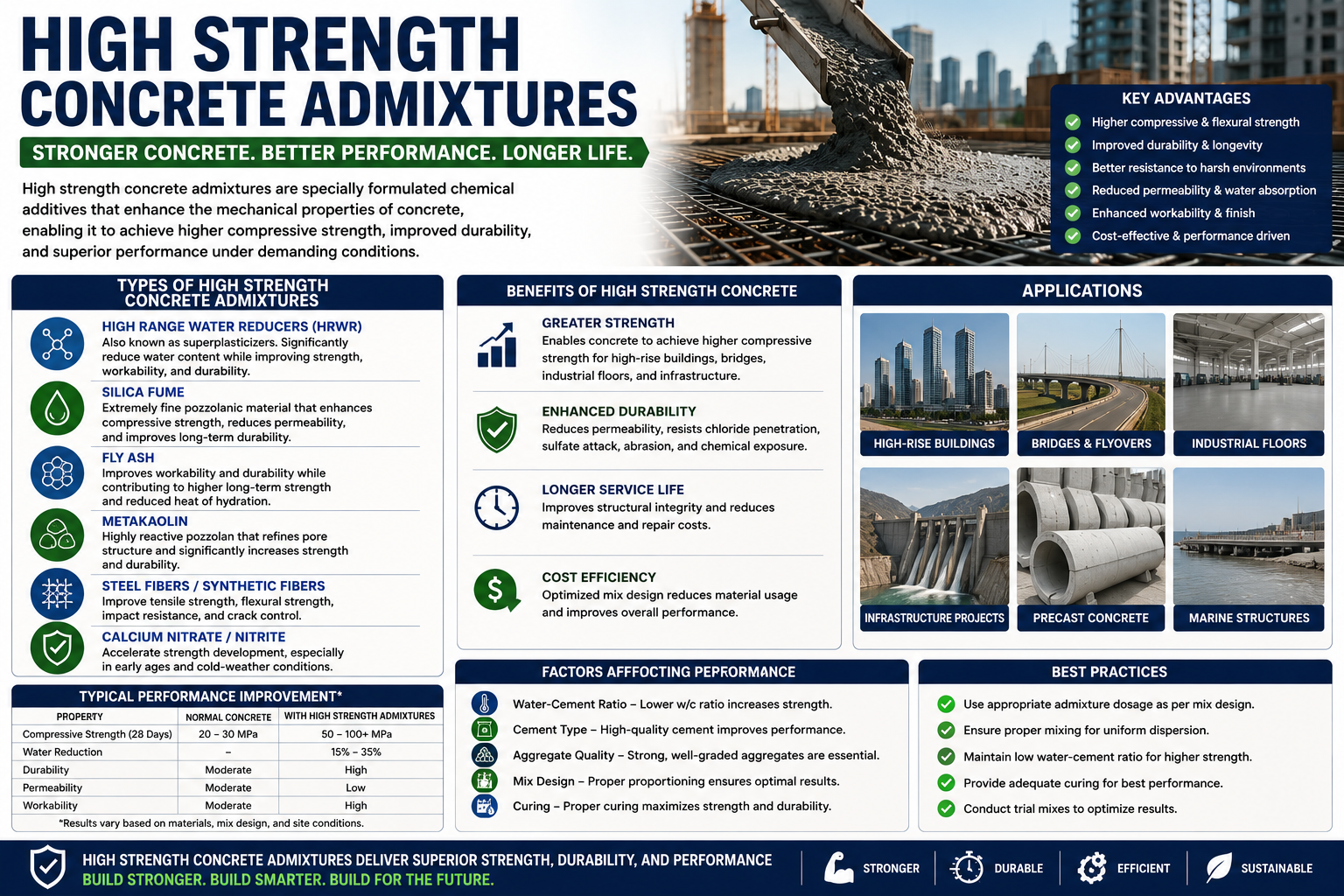
High strength concrete admixtures are specialized chemical and mineral additives designed to significantly improve the compressive strength, durability, and overall performance of concrete. These admixtures help produce high-performance concrete capable of withstanding heavy loads, harsh environmental conditions, and long-term structural demands.
Widely used in high-rise buildings, bridges, marine structures, industrial floors, precast concrete products, and infrastructure projects, high strength concrete admixtures enable engineers and contractors to achieve superior structural performance while maintaining workability and durability.
What Are High Strength Concrete Admixtures?
High strength concrete admixtures are materials added to concrete during mixing to enhance its mechanical properties and increase compressive strength. These admixtures optimize cement hydration, reduce water demand, refine pore structure, and improve the bond between cement paste and aggregates.
By improving the concrete matrix, these additives help create stronger, denser, and more durable concrete structures.
How High Strength Concrete Admixtures Work
Concrete strength is largely influenced by the water-cement ratio and hydration process. High strength admixtures work by:
- Reducing water content without sacrificing workability
- Enhancing cement hydration
- Improving particle packing density
- Refining concrete microstructure
- Minimizing porosity and permeability
- Increasing long-term strength development
These mechanisms contribute to stronger and more durable concrete.
Types of High Strength Concrete Admixtures
High-Range Water Reducers (Superplasticizers)
High-range water reducers significantly lower water content while maintaining excellent workability.
Benefits include:
- Higher compressive strength
- Improved flowability
- Better pumpability
- Reduced segregation
Silica Fume
Silica fume is an ultra-fine pozzolanic material that reacts with calcium hydroxide to form additional cementitious compounds.
Advantages:
- Increased compressive strength
- Reduced permeability
- Enhanced chemical resistance
- Improved durability
Fly Ash
Fly ash improves workability and contributes to long-term strength development.
Benefits include:
- Better concrete finish
- Reduced heat of hydration
- Increased durability
- Improved sustainability
Metakaolin
Metakaolin is a highly reactive pozzolan used to improve concrete strength and durability.
Key advantages:
- Higher early and long-term strength
- Reduced permeability
- Improved resistance to aggressive environments
Fibers
Steel, synthetic, or basalt fibers enhance tensile and flexural performance.
Benefits:
- Crack control
- Improved toughness
- Increased impact resistance
- Enhanced durability
Benefits of High Strength Concrete Admixtures
Greater Compressive Strength
High strength admixtures enable concrete to achieve significantly higher compressive strength than conventional concrete.
Enhanced Durability
Dense concrete structures resist:
- Chloride penetration
- Sulfate attack
- Freeze-thaw cycles
- Chemical exposure
Reduced Permeability
Lower permeability minimizes moisture penetration and improves long-term structural integrity.
Longer Service Life
Improved durability reduces maintenance costs and extends the lifespan of concrete structures.
Improved Structural Performance
High strength concrete supports larger loads and allows more efficient structural designs.
Cost Efficiency
Although admixtures may increase material costs, they often reduce maintenance and lifecycle expenses.
Applications of High Strength Concrete Admixtures
High-Rise Buildings
Used to achieve high load-bearing capacity while reducing column sizes.
Bridges and Flyovers
Provide superior strength and durability for transportation infrastructure.
Industrial Floors
Support heavy machinery, equipment, and warehouse operations.
Precast Concrete Products
Improve production efficiency and structural performance.
Marine Structures
Enhance resistance to saltwater exposure and corrosion.
Dams and Infrastructure Projects
Deliver long-term durability in demanding environments.
Factors Affecting Concrete Strength
Several factors influence the effectiveness of high strength admixtures:
Water-Cement Ratio
Lower water-cement ratios generally result in higher concrete strength.
Cement Quality
High-quality cement contributes to improved performance.
Aggregate Properties
Strong, well-graded aggregates support higher compressive strength.
Proper Mixing
Uniform admixture dispersion ensures consistent results.
Curing Conditions
Adequate curing is essential for maximizing concrete strength development.
Best Practices for Using High Strength Concrete Admixtures
- Follow manufacturer dosage recommendations.
- Maintain proper water-cement ratios.
- Ensure thorough mixing.
- Conduct trial batches before production.
- Implement proper curing procedures.
- Monitor quality control throughout construction.
Why Choose High Strength Concrete Admixtures?
Modern construction projects demand stronger, more durable, and longer-lasting concrete structures. High strength concrete admixtures help engineers achieve superior performance while improving efficiency and reducing long-term maintenance costs. Their ability to enhance compressive strength, durability, and structural reliability makes them an essential component of advanced concrete technology.
Conclusion
High strength concrete admixtures play a vital role in producing high-performance concrete for demanding construction applications. By improving strength, durability, permeability resistance, and overall structural performance, these admixtures help create safer, stronger, and longer-lasting infrastructure. Whether used in skyscrapers, bridges, marine structures, or industrial facilities, high strength concrete admixtures provide a reliable solution for modern construction challenges.