Introduction
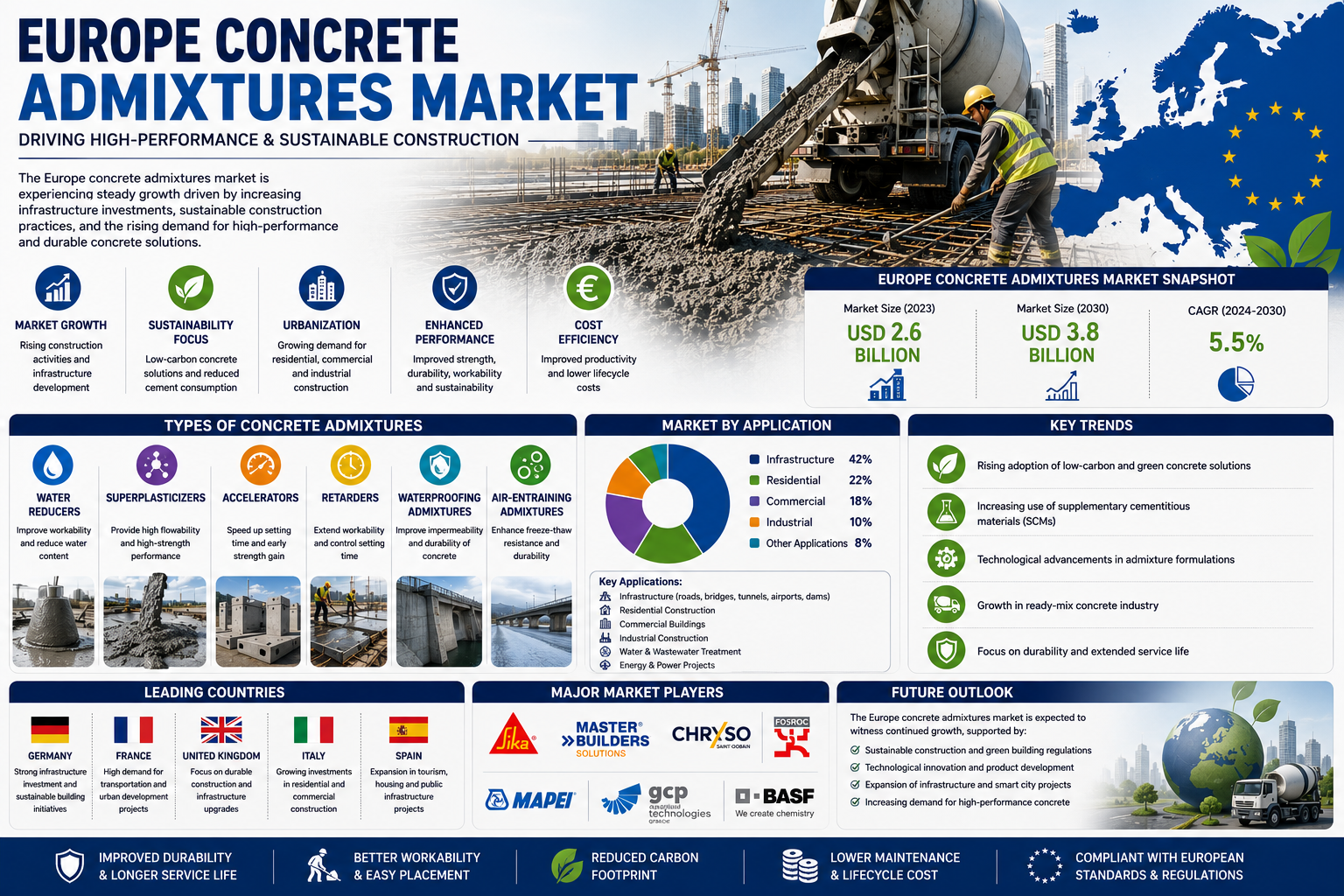
The Europe Concrete Admixtures Market is experiencing steady growth due to increasing infrastructure investments, sustainable construction practices, and the growing demand for high-performance concrete solutions. Concrete admixtures have become an essential component in modern construction, helping improve workability, durability, strength, waterproofing, and environmental performance.
Countries across Europe are focusing on green building initiatives, transportation infrastructure upgrades, energy-efficient construction, and urban redevelopment projects. These factors continue to drive the adoption of advanced concrete admixture technologies throughout the region.
What Is the Europe Concrete Admixtures Market?
The Europe concrete admixtures market encompasses the production, distribution, and utilization of chemical and mineral admixtures used to enhance concrete performance in construction projects across European countries.
Concrete admixtures are widely used to:
- Improve workability
- Increase strength
- Enhance durability
- Reduce water consumption
- Improve waterproofing
- Control setting times
- Reduce carbon emissions
- Extend service life
The market serves residential, commercial, industrial, and infrastructure sectors throughout Europe.
Key Drivers of Europe Concrete Admixtures Market Growth
Sustainable Construction Initiatives
European governments and construction companies are increasingly adopting sustainable building practices.
Benefits:
- Lower carbon emissions
- Reduced cement consumption
- Improved resource efficiency
- Enhanced environmental compliance
Green construction remains one of the strongest growth drivers for the admixtures industry.
Infrastructure Modernization
Many European countries are investing heavily in:
- Highways
- Bridges
- Rail networks
- Airports
- Ports
- Tunnels
- Water infrastructure
These projects require durable and high-performance concrete solutions.
Growing Demand for High-Performance Concrete
Modern infrastructure projects require concrete that offers:
- Higher strength
- Improved durability
- Better workability
- Extended service life
Advanced admixtures help achieve these performance goals.
Urban Redevelopment Projects
Population growth and urban expansion continue to create demand for:
- Residential buildings
- Commercial developments
- Mixed-use projects
- Smart city infrastructure
Major Types of Concrete Admixtures Used in Europe
Water-Reducing Admixtures
Water reducers improve concrete strength while maintaining workability.
Applications:
- Residential construction
- Commercial buildings
- Infrastructure projects
Superplasticizers
Superplasticizers provide exceptional flowability and high-strength performance.
Benefits:
- Improved pumpability
- Reduced water demand
- Enhanced concrete quality
Accelerating Admixtures
Accelerators increase early strength development and reduce construction timelines.
Applications:
- Precast concrete
- Cold-weather construction
- Fast-track projects
Retarding Admixtures
Retarders extend workability during transportation and placement.
Applications:
- Large concrete pours
- Hot-weather concreting
Waterproofing Admixtures
Waterproofing admixtures improve resistance to water penetration.
Applications:
- Basements
- Tunnels
- Water treatment facilities
- Underground structures
Air-Entraining Admixtures
These admixtures improve freeze-thaw durability in harsh climates.
Applications:
- Bridges
- Roads
- Pavements
Europe Concrete Admixtures Market by Application
Residential Construction
Housing projects continue to generate strong demand for concrete admixtures throughout Europe.
Commercial Buildings
Office complexes, retail centers, hotels, and mixed-use developments increasingly utilize advanced concrete technologies.
Infrastructure Projects
Infrastructure remains one of the largest market segments.
Key Areas:
- Transportation
- Utilities
- Public works
- Water management systems
Industrial Construction
Factories, warehouses, logistics centers, and manufacturing facilities require durable concrete solutions.
Energy Sector
Concrete admixtures are widely used in renewable energy and conventional energy infrastructure projects.
Market Trends Shaping Europe Concrete Admixtures Industry
Low-Carbon Concrete Solutions
Manufacturers are developing admixtures that support reduced cement content and lower carbon footprints.
Increased Use of Supplementary Cementitious Materials (SCMs)
The use of fly ash, slag, and other SCMs is growing across Europe.
Benefits:
- Improved sustainability
- Reduced environmental impact
- Better resource efficiency
Smart Construction Technologies
Digitalization and advanced concrete technologies are driving innovation in admixture formulations.
Growth of Ready-Mix Concrete
Ready-mix concrete production continues to expand due to efficiency and quality advantages.
Leading Countries in the Europe Concrete Admixtures Market
Germany
Germany remains one of Europe’s largest construction and infrastructure markets.
France
Strong investment in transportation and urban development projects supports market growth.
United Kingdom
The UK construction sector continues to drive demand for innovative concrete solutions.
Italy
Infrastructure modernization and commercial construction contribute to admixture consumption.
Spain
Residential and tourism-related developments create additional market opportunities.
Benefits of Concrete Admixtures in European Construction
Improved Durability
Structures achieve longer service lives and reduced maintenance requirements.
Enhanced Sustainability
Lower material consumption supports environmental objectives.
Better Construction Efficiency
Improved workability simplifies placement and finishing operations.
Reduced Lifecycle Costs
Durable concrete lowers repair and maintenance expenses.
Compliance with European Standards
Advanced admixtures help projects meet strict performance and sustainability regulations.
Challenges Facing the Europe Concrete Admixtures Market
Raw Material Cost Volatility
Fluctuating material prices can impact production costs.
Regulatory Compliance
Manufacturers must meet strict environmental and product quality standards.
Competitive Market Environment
The industry includes numerous global and regional suppliers competing for market share.
Economic Uncertainty
Construction activity can be influenced by economic conditions and investment trends.
Future Outlook
The Europe concrete admixtures market is expected to continue expanding due to increasing infrastructure spending, sustainable construction initiatives, and demand for advanced concrete technologies.
Key growth opportunities include:
- Green building projects
- Smart city developments
- Transportation infrastructure
- Renewable energy construction
- Low-carbon concrete technologies
As the construction industry evolves, admixtures will play a critical role in improving performance, sustainability, and cost efficiency.
Frequently Asked Questions
What is the Europe concrete admixtures market?
The Europe concrete admixtures market includes the production, distribution, and use of admixtures that improve concrete performance across European construction sectors.
What drives market growth in Europe?
Infrastructure investment, sustainable construction, urban redevelopment, and demand for high-performance concrete are major growth drivers.
Which admixtures are most commonly used?
Water reducers, superplasticizers, accelerators, retarders, waterproofing admixtures, and air-entraining admixtures.
Why are admixtures important in European construction?
They improve durability, strength, sustainability, and compliance with modern building standards.
Which industries use concrete admixtures?
Residential, commercial, industrial, infrastructure, transportation, energy, and water management sectors all utilize concrete admixtures.
Conclusion
The Europe Concrete Admixtures Market continues to grow as construction companies seek stronger, more durable, and sustainable concrete solutions. Driven by infrastructure modernization, environmental regulations, and technological advancements, admixtures remain a key component of modern European construction. As demand for high-performance concrete increases, the market is expected to offer significant opportunities for manufacturers, suppliers, and construction professionals throughout the region.