The concrete admixtures market is closely connected to how concrete is produced, transported, placed, and used. While admixture products are often classified by their chemical function, such as water reduction, acceleration, retardation, or waterproofing, another useful way to understand the industry is by application.
Different construction applications impose different requirements on concrete. Ready-mix producers need consistent workability and reliable performance during transportation and placement. Precast manufacturers prioritize production speed, early strength, dimensional consistency, and surface quality. Infrastructure projects often demand long-term durability and resistance to severe environmental exposure. Commercial construction can require pumpability, flowability, strength, and efficient placement in complex structures.
This application-based demand is an important part of the global market. Recent market research identifies infrastructure, residential, commercial, and industrial construction among the major application segments, while ready-mix and precast remain important concrete-production environments for admixture consumption. These requirements are also increasing demand for high-performance water-reducing technologies, including polycarboxylate-based products. In particular, a Polycarboxylate Superplasticizer Powder Supplier can support manufacturers and formulators seeking powdered admixture solutions for applications that require high water reduction, improved flowability, and efficient concrete production.
Understanding these differences helps manufacturers, engineers, contractors, and industrial buyers select admixture technologies according to the actual concrete application rather than treating every project as the same.
What Does the Concrete Admixtures Market by Application Mean?
The concrete admixtures market by application describes demand according to the type of construction or concrete-production environment in which admixtures are used.
A simplified segmentation includes:
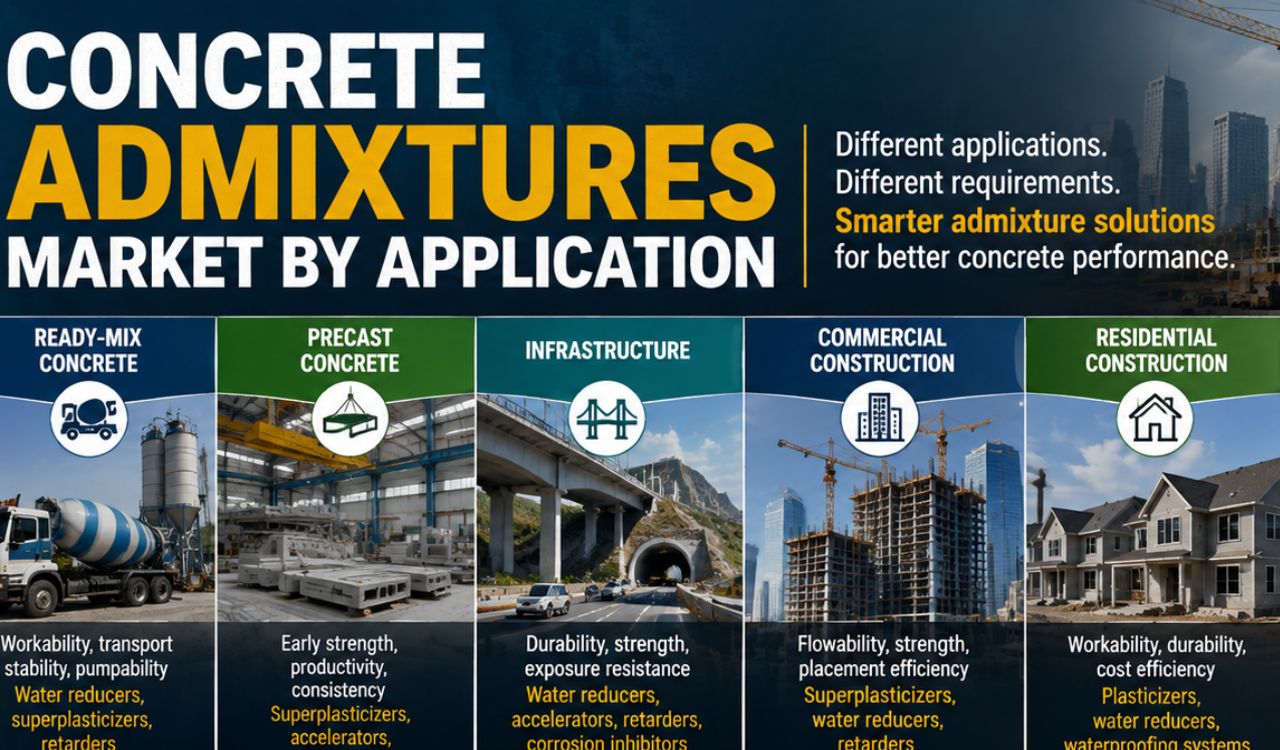
| Application | Typical concrete requirements | Common admixture needs |
| Ready-mix concrete | Workability, transport stability, pumpability | Water reducers, superplasticizers, retarders |
| Precast concrete | Early strength, productivity, consistency | Superplasticizers, accelerators, water reducers |
| Infrastructure | Durability, strength, exposure resistance | Water reducers, accelerators, retarders, corrosion inhibitors |
| Commercial construction | Flowability, strength, placement efficiency | Superplasticizers, water reducers, retarders |
| Residential construction | Workability, durability, cost efficiency | Plasticizers, water reducers, waterproofing systems |
| Industrial construction | Strength, durability, specialized performance | Superplasticizers, shrinkage reducers, corrosion inhibitors |
| Specialized concrete | Specific performance requirements | Customized admixture systems |
The exact product combination depends on the mix design, cement chemistry, aggregate properties, climate, construction method, and performance specification.
Why Application Matters in the Concrete Admixtures Market
An admixture does not operate independently of the concrete system. The same chemical formulation can behave differently depending on the cementitious materials, water content, temperature, aggregate grading, mixing equipment, and placement conditions.
For example, a ready-mix producer transporting concrete over a long distance may prioritize slump retention, whereas a precast manufacturer may prioritize early strength and rapid demolding. An infrastructure contractor working on a bridge in a cold climate may have completely different requirements from a commercial contractor placing concrete slabs inside a high-rise building.
These differences are closely related to the types of admixtures in concrete and their intended functions. Water-reducing admixtures may be selected to lower water demand and improve workability, while accelerating admixtures can support faster strength development. Retarding admixtures may help control setting in hot weather or during extended transportation, whereas waterproofing, corrosion-inhibiting, and expansion admixtures can address specific durability and performance requirements.
This is why application-specific admixture selection is becoming increasingly important as concrete specifications become more performance-oriented. Rather than choosing an admixture based solely on its chemical category, concrete producers and contractors increasingly need to consider how the product will interact with the complete concrete mixture and the conditions under which it will be produced, transported, placed, and cured.
Ready-Mix Concrete Admixtures Market
Ready-mix concrete is one of the most important application areas for admixtures because concrete is produced at a batching plant and transported to the construction site before placement.
During this process, concrete must maintain appropriate consistency and performance despite transportation time, temperature changes, mixing, pumping, and site conditions.
Why Admixtures Are Important in Ready-Mix Concrete
Ready-mix producers commonly use admixtures to control:
- Water demand
- Slump
- Slump retention
- Pumpability
- Setting time
- Strength development
- Air content
- Durability
Water reducers and superplasticizers are particularly important because they can improve workability without requiring the same increase in mixing water.
This is important for maintaining a suitable water-cement ratio while achieving the required concrete consistency.
Slump Retention and Transportation
Transportation time is a major consideration for ready-mix operations.
Concrete may travel considerable distances between the batching plant and job site. Traffic, weather, project delays, and pumping requirements can extend the time between batching and placement.
An admixture system designed for workability retention can help producers maintain the required consistency for longer periods.
However, the required formulation depends on cement chemistry, ambient temperature, transportation time, dosage, and the desired setting profile.
Ready-Mix and High-Performance Concrete
Ready-mix producers are also supplying increasingly sophisticated concrete systems, including high-strength and self-compacting concrete.
These applications can require advanced water-reducing technologies capable of producing high flowability while maintaining a controlled water-cement ratio.
The growth of ready-mix and performance-oriented concrete is therefore an important factor supporting admixture demand.
Precast Concrete Admixtures Market
Precast concrete is manufactured under controlled factory conditions before being transported to the construction site.
This production environment creates different priorities from conventional site-cast concrete.
Manufacturers often need to achieve predictable strength development, efficient production cycles, consistent appearance, and reliable dimensional quality.
Role of Admixtures in Precast Production
Admixtures can help precast producers control:
- Early strength
- Demolding time
- Workability
- Water demand
- Surface finish
- Production consistency
- Setting behavior
Early strength can be particularly important because faster strength development may allow manufacturers to remove forms sooner and move components through the production cycle more efficiently.
Superplasticizers in Precast Concrete
Superplasticizers can provide high flowability at controlled water contents, which is valuable when concrete must fill complex molds or densely reinforced sections.
Improved flow can also reduce the need for excessive mechanical vibration in suitable applications.
For self-compacting precast concrete, rheology control becomes especially important because the mixture must flow through the form while maintaining stability.
Accelerating Admixtures and Precast Production
Accelerating technologies may also be used when earlier strength development is required.
The goal is not simply to make concrete set as quickly as possible. The admixture system must provide a suitable balance between setting, strength development, finishing requirements, heat generation, and final performance.
This makes laboratory trials and production-scale validation important before changing an established precast formulation
Infrastructure Applications in the Concrete Admixtures Market
Infrastructure is one of the most significant application segments for concrete admixtures. MarketsandMarkets currently identifies infrastructure as the application expected to register the highest growth rate through 2031, while other market research also places infrastructure among the largest end-use segments.
Infrastructure construction includes:
- Roads
- Bridges
- Tunnels
- Airports
- Railways
- Metro systems
- Ports
- Dams
- Water treatment facilities
- Sewage infrastructure
- Reservoirs
- Energy infrastructure
These structures often face demanding service conditions and long design lives.
Admixtures for Roads and Pavements
Road and pavement concrete may require controlled setting, workability, strength development, durability, and resistance to environmental exposure.
Accelerating admixtures can be useful when rapid opening to traffic is required, while water reducers can support workability and strength targets without unnecessary increases in mixing water.
Admixtures for Bridges
Bridge concrete can be exposed to moisture, temperature variations, deicing chemicals, chloride penetration, and repeated loading.
The admixture system may therefore be selected as part of a broader durability strategy.
Water reduction, permeability control, corrosion protection, and suitable strength development can all be important depending on the structure.
Admixtures for Tunnels
Tunnel construction can involve difficult access, pumping, rapid construction cycles, and demanding environmental conditions.
Concrete may need controlled setting and high workability while maintaining the required mechanical and durability characteristics.
Specialized admixture systems can help address these requirements.
Water Infrastructure
Reservoirs, water tanks, treatment plants, and other water-related structures require careful control of permeability, cracking, durability, and concrete quality.
Waterproofing admixtures may form part of the overall water-resistance strategy, but they should be combined with proper mix design, curing, joint detailing, crack control, and construction practices.
Commercial Construction and Concrete Admixture Demand
Commercial construction includes offices, shopping centers, hotels, hospitals, educational facilities, warehouses, mixed-use developments, and other non-residential buildings.
These projects often involve large concrete volumes and complex structural elements.
Concrete may need to be pumped vertically, placed around dense reinforcement, or delivered according to tightly controlled construction schedules.
High-Rise Commercial Buildings
High-rise construction can create demanding requirements for concrete pumping and placement.
Concrete must often travel significant vertical distances while retaining appropriate workability.
Superplasticizers and other water-reducing admixtures can help produce flowable concrete while maintaining the desired water-cement ratio.
Commercial Floor Slabs
Floor slabs may require controlled shrinkage, strength development, workability, and finishing characteristics.
The admixture system should therefore be selected together with the cementitious materials, aggregate grading, curing method, and environmental conditions.
Hospitals and Institutional Buildings
Hospitals, universities, government facilities, and similar buildings may require concrete designed for long service life.
Depending on the application, durability-enhancing admixtures, water reducers, corrosion inhibitors, or specialized systems may be incorporated into the mix.
Residential Construction and Admixture Demand
Residential construction generates significant concrete demand through foundations, slabs, columns, walls, precast elements, and other structural components.
Although residential projects may not always require highly specialized admixture systems, consistent workability, cost efficiency, strength development, and durability remain important.
In larger housing developments, ready-mix concrete can be used extensively, increasing the importance of reliable admixture systems.
Water reducers and plasticizers may be used to improve concrete workability, while waterproofing technologies can be considered for foundations, basements, water-retaining areas, and other moisture-exposed components.
Market research also identifies residential construction as an important growth area, particularly in regions experiencing urbanization and housing development.
Industrial Construction and Specialized Concrete
Industrial construction includes factories, warehouses, logistics centers, manufacturing plants, power facilities, processing facilities, and other specialized structures.
Concrete requirements can vary significantly depending on the facility.
For example, a warehouse floor may prioritize dimensional stability and abrasion resistance, while a chemical-processing facility may require concrete designed for specific exposure conditions.
Data Centers and Modern Industrial Facilities
Large data centers and advanced industrial facilities are increasingly important construction projects.
These projects can involve substantial concrete volumes and strict requirements for structural performance, floor quality, dimensional control, and construction schedules.
This creates opportunities for admixtures that support predictable concrete production and placement.
Heavy-Duty Industrial Floors
Industrial floors may be exposed to heavy equipment, forklifts, repeated loading, abrasion, and environmental stresses.
Admixtures cannot replace proper structural design or surface treatment, but they can form part of a concrete mix designed to achieve the required strength, workability, and durability.
Application-Specific Admixture Selection
One of the most important principles in the concrete admixtures market is that admixture selection should follow the application requirement.
A practical selection process can begin with five questions:
1. How Will the Concrete Be Produced?
Determine whether the concrete will be produced as:
- Ready-mix
- Precast
- Site-batched
- Prestressed
- Self-compacting
- High-performance concrete
The production environment affects the required admixture characteristics.
2. How Will the Concrete Be Placed?
Pumping, conventional placement, slip forming, vibration, and specialized placement methods can create different rheological requirements.
3. How Long Must the Concrete Remain Workable?
Transportation and placement duration determine whether normal setting, extended workability, or accelerated setting is required.
4. What Performance Is Required?
The specification may focus on:
- Compressive strength
- Flexural strength
- Water permeability
- Durability
- Early strength
- Setting time
- Slump
- Flowability
- Freeze-thaw resistance
- Corrosion protection
5. What Environmental Conditions Apply?
Temperature, humidity, exposure to chlorides, freeze-thaw cycles, chemical exposure, and moisture can all affect admixture selection.
Application vs Admixture Type
It is useful to distinguish between where an admixture is used and what the admixture does.
| Application | Primary concern | Potential admixture technologies |
| Ready-mix | Workability during transportation | Water reducers, superplasticizers, retarders |
| Precast | Production speed and early strength | Superplasticizers, accelerators |
| Infrastructure | Durability and service life | Water reducers, corrosion inhibitors, waterproofing systems |
| Commercial | Pumpability and placement | Superplasticizers, water reducers, retarders |
| Residential | Consistency and cost efficiency | Plasticizers, water reducers |
| Industrial | Specialized performance | Superplasticizers, shrinkage reducers, corrosion inhibitors |
This distinction matters because the same admixture category can be used across multiple applications, but the required formulation and dosage may differ.
Factors Influencing Admixture Demand Across Applications
Several industry trends are increasing demand for application-specific admixture solutions.
Higher Performance Requirements
Modern projects increasingly specify concrete based on measurable performance rather than simply nominal strength.
This encourages the use of admixtures that provide controlled workability, water reduction, durability, and setting characteristics.
Faster Construction
Precast manufacturing, rapid infrastructure repairs, and accelerated construction schedules increase the value of predictable early strength and setting behavior.
Ready-Mix Expansion
The increasing use of factory-produced concrete requires consistent control over fresh and hardened concrete properties.
Urbanization
Urban development increases demand across residential, commercial, transportation, and utility construction.
Sustainability
Admixtures can contribute to more efficient concrete formulations by helping control water demand, improve durability, and optimize concrete performance. However, sustainability outcomes depend on the complete mix design and project lifecycle rather than admixture use alone.
Climate and Environmental Exposure
Extreme temperatures and aggressive exposure conditions increase the need for concrete that can maintain performance under specific environmental stresses.
Challenges in Application-Specific Admixture Use
Application-specific formulation also introduces challenges.
Cement Compatibility
The same admixture may not produce identical results with different cement sources.
Changes in cement composition can influence slump, setting, air content, and strength development.
Aggregate Variation
Aggregate grading, shape, moisture, and mineralogy can affect concrete rheology and admixture response.
Temperature
Concrete behavior can change substantially with temperature, affecting setting time and workability retention.
Dosage Control
Incorrect dosage can reduce performance or create undesirable effects.
This is especially important with concentrated high-performance admixtures.
Field Conditions
Laboratory performance does not always perfectly represent field conditions.
For this reason, field trials are valuable before implementing a new admixture across large construction projects.
Best Practices for Using Admixtures Across Different Applications
Successful admixture use starts with testing rather than assumptions.
The concrete producer should evaluate the admixture using the actual cement, aggregates, water, supplementary cementitious materials, and other components intended for production.
Testing should examine the properties that matter for the application.
For ready-mix concrete, this may include slump retention, setting time, pumpability, and compressive strength.
For precast concrete, early strength, demolding time, surface quality, and production consistency may receive greater attention.
For infrastructure projects, durability indicators, permeability, strength development, and exposure resistance can become more important.
For commercial and residential construction, workability, placement efficiency, strength, and cost-performance balance may dominate the selection process.
The supplier should also provide appropriate technical documentation and maintain consistent batch quality. For manufacturers such as Luke Chemicals, understanding the relationship between admixture chemistry and application conditions is essential when developing or supplying products for different concrete-production environments.
Future Outlook for Application-Based Concrete Admixture Demand
The future of the concrete admixtures market will increasingly be shaped by application-specific performance requirements.
Infrastructure development is expected to remain a major source of demand, particularly for bridges, roads, tunnels, rail systems, airports, and water infrastructure. At the same time, precast construction is attracting attention because factory-controlled production can support construction productivity, consistency, and reduced site labor. Commercial and residential construction will continue to generate substantial volume demand, while industrial projects are creating specialized requirements for high-performance concrete.
This trend is likely to encourage manufacturers to develop more tailored admixture systems rather than relying solely on broad product categories.
Future formulations may increasingly be optimized for specific combinations of cementitious materials, construction methods, environmental conditions, and performance specifications.
The result is a market where technical formulation, testing, application knowledge, and supply reliability become just as important as product availability.
Conclusion
The concrete admixtures market by application demonstrates why admixture selection cannot be separated from the way concrete is produced and used.
Ready-mix concrete requires control over workability, transportation, pumping, and setting. Precast production places greater emphasis on early strength, productivity, consistency, and surface quality. Infrastructure projects require concrete capable of meeting demanding durability and service-life requirements. Commercial, residential, and industrial construction each introduce their own combinations of structural, environmental, and scheduling requirements.
As construction projects become more performance-driven, the role of admixtures is moving beyond simply modifying concrete properties. Admixture systems are increasingly selected as part of an integrated concrete mix design intended to achieve specific performance, productivity, and durability objectives.
For engineers, contractors, concrete producers, and industrial buyers, the most effective approach is therefore to select admixtures according to application, mix design, placement method, environmental conditions, and required performance rather than choosing products based solely on their category or price.
FAQs
What is the application segmentation of the concrete admixtures market?
The market can be analyzed across residential, commercial, infrastructure, industrial, ready-mix, and precast applications. Different market research firms use slightly different segmentation structures, so application categories may vary between reports.
Why are admixtures important in ready-mix concrete?
Admixtures help ready-mix producers control properties such as workability, water demand, setting time, slump retention, pumpability, and strength development during transportation and placement.
What admixtures are commonly used in precast concrete?
Precast producers commonly use water reducers and superplasticizers, while accelerators may be used where early strength or faster production cycles are required. The appropriate system depends on the mix design and production process.
Why is infrastructure important to the concrete admixtures market?
Infrastructure projects consume large quantities of concrete and often require high durability, controlled strength development, workability, and resistance to demanding environmental conditions. Current market research identifies infrastructure as one of the largest application segments.
Are the same admixtures suitable for every construction application?
Not necessarily. An admixture that performs well in ready-mix concrete may require different dosage or formulation considerations in precast, infrastructure, or specialized concrete. Cement chemistry, aggregates, temperature, placement method, and performance requirements all matter.
How do commercial buildings use concrete admixtures?
Commercial buildings can use admixtures to improve concrete pumpability, flowability, water efficiency, setting control, strength development, and durability. These requirements become particularly important in high-rise buildings and heavily reinforced structural elements.
What should buyers consider when selecting an admixture?
Buyers should evaluate the concrete mix design, required performance, cement and aggregate compatibility, dosage, transportation and placement conditions, climate, technical support, quality consistency, applicable standards, and total project cost.