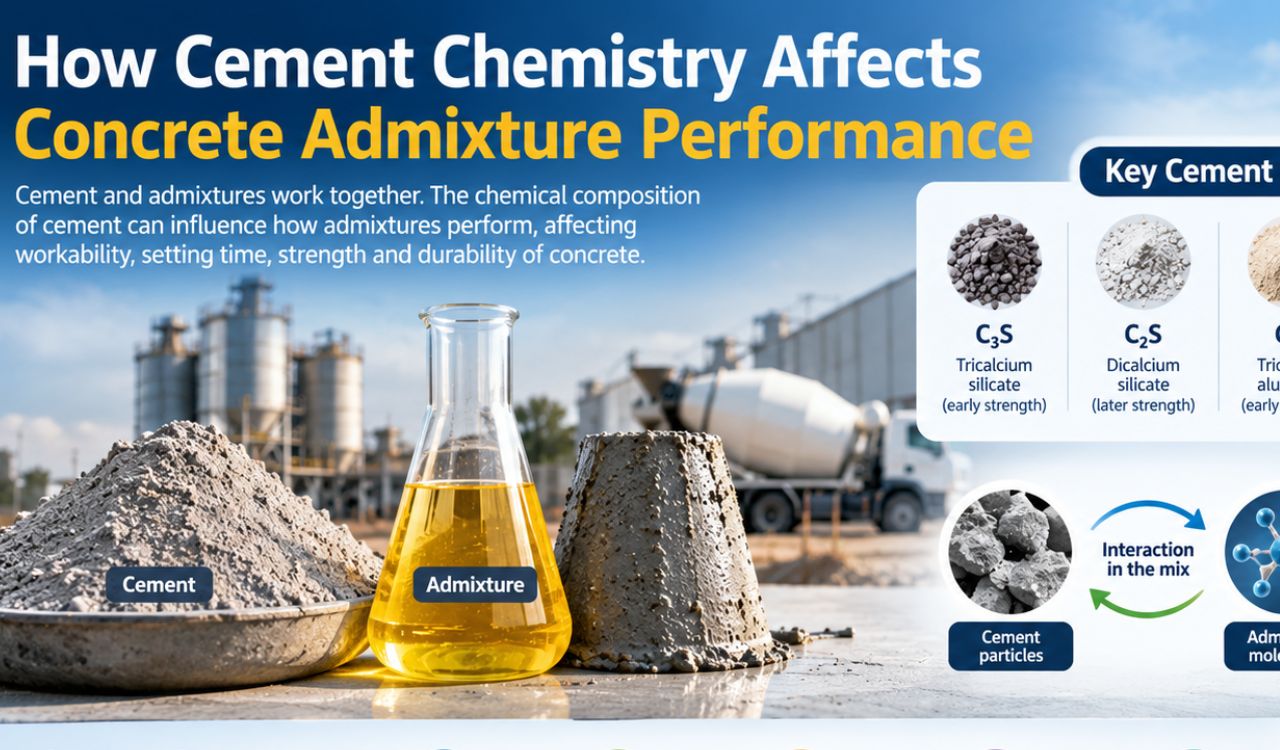
Concrete admixtures are designed to modify specific properties of fresh or hardened concrete, but their performance does not depend on the admixture alone. The chemical and physical characteristics of the cement can strongly influence how an admixture behaves after it is introduced into a concrete mixture.
Two concrete mixes containing the same admixture and similar dosage can sometimes produce noticeably different results when different cement sources are used. Changes in clinker composition, sulfate balance, alkali content, fineness, mineral additions, and hydration behavior can affect workability, setting time, water demand, slump retention, and strength development.
Understanding this relationship is therefore important for concrete producers, admixture formulators, engineers, contractors, and industrial buyers. Proper evaluation of cement chemistry and concrete admixtures can help improve mixture consistency and reduce unexpected changes in performance.
What Is Cement Chemistry?
Cement chemistry refers to the chemical composition and reactions that occur within cement, particularly during hydration.
Portland cement primarily contains clinker phases that react with water to form hydration products responsible for the development of strength and other concrete properties.
The principal clinker phases include:
| Cement phase | Common notation | General role |
| Tricalcium silicate | C₃S | Important contributor to early strength development |
| Dicalcium silicate | C₂S | Contributes more strongly to later-age strength |
| Tricalcium aluminate | C₃A | Strongly influences early reactions and sulfate interaction |
| Tetracalcium aluminoferrite | C₄AF | Influences hydration and contributes to cement color and chemistry |
| Calcium sulfate | Gypsum and related forms | Helps regulate cement setting |
The exact proportions of these components vary between cement products and manufacturing conditions. These differences can influence how chemical admixtures interact with cement particles and hydration products.
Why Cement Chemistry Matters for Concrete Admixtures
Many admixtures work through interactions with cement particles and the aqueous phase of concrete. Understanding these interactions is important when evaluating the types-of-admixtures-in-concrete, because different admixture categories are designed to influence specific properties such as workability, setting time, strength development, durability, or water resistance.
For example, a water-reducing admixture may adsorb onto cement particles and improve particle dispersion, helping reduce the amount of water required to achieve a desired level of workability. Superplasticizers can further reduce particle flocculation, allowing concrete to maintain high flowability while using less mixing water.
However, the extent and speed of these interactions depend partly on the characteristics of the cement. Factors such as:
- mineral composition
- cement fineness
- sulfate availability
- alkali concentration
- clinker content
- supplementary cementitious materials
- temperature
- hydration rate
can all influence how an admixture performs.
This interaction becomes particularly important across different types of admixtures in concrete. For instance, an accelerating admixture must interact effectively with the cement system to influence setting and early strength, while a water-reducing admixture primarily targets particle dispersion and water demand. Similarly, corrosion inhibitors and waterproofing admixtures may require specific compatibility with the cementitious system to deliver consistent durability performance.
As a result, an admixture formulation that performs well with one cement may require adjustment when used with another. Manufacturers and concrete producers therefore commonly consider cement chemistry, admixture dosage, temperature, and the presence of supplementary cementitious materials when selecting or optimizing an admixture formulation. This compatibility-focused approach helps achieve more predictable concrete performance across different projects and mix designs.
How C₃S and C₂S Influence Admixture Performance
C₃S and C₂S are major silicate phases in Portland cement.
C₃S generally reacts relatively quickly and plays an important role in early hydration and strength development. C₂S reacts more slowly and contributes significantly to later strength.
Changes in the relative proportions of these phases can alter hydration behavior and the development of concrete properties.
For admixture users, this can affect:
- early strength development
- heat generation
- water demand
- setting behavior
- workability development
- required admixture dosage
For example, a cement with different hydration characteristics may require adjustments to the concrete mixture to maintain the desired fresh-concrete performance.
Therefore, admixture selection should consider the actual cement being used rather than relying exclusively on performance obtained with another cement source.
The Role of C₃A in Admixture Compatibility
C₃A is particularly important when evaluating the interaction between cement and chemical admixtures.
C₃A reacts relatively quickly with water and interacts with sulfate supplied through gypsum and other sulfate-bearing materials. The balance between these reactions can influence early hydration and setting behavior.
Cement with different C₃A characteristics may therefore show different responses to certain admixture formulations.
This can become particularly important when using water reducers or superplasticizers where the required workability must be maintained for a specific period.
Changes in C₃A-related reactions can influence:
- initial setting
- early hydration
- admixture adsorption
- workability retention
- slump loss
- early-age rheology
For this reason, cement chemistry should be considered during admixture compatibility testing.
Sulfate Balance and Admixture Response
Sulfate balance is another important part of cement chemistry.
Calcium sulfate is added during cement manufacturing to regulate the reaction of aluminate phases. The amount and form of available sulfate can influence early hydration.
If sulfate conditions change, the response of certain chemical admixtures may also change.
This can contribute to differences in:
- setting time
- slump retention
- early hydration
- rheological behavior
- admixture demand
In practical concrete production, sulfate balance can become more complicated when different cement sources or supplementary cementitious materials are introduced.
Consequently, maintaining consistent raw materials and conducting mixture trials are important when a particular workability or setting profile is required.
Cement Fineness and Its Effect on Admixture Demand
Cement fineness describes the size distribution and specific surface area of cement particles.
Finer cement generally provides greater surface area for interaction with water and admixture molecules. This can influence hydration rate and the amount of admixture required to achieve a particular concrete performance.
Changes in cement fineness can affect:
- water demand
- early hydration
- heat evolution
- setting
- workability
- admixture consumption
A concrete producer may therefore notice a change in admixture performance even when the admixture itself has not changed.
If cement becomes finer or its particle-size distribution changes, the concrete mixture may require reevaluation.
Alkali Content and Admixture Behavior
Cement contains alkali compounds, primarily associated with sodium and potassium.
The alkali content of cement can influence the chemical environment of the concrete mixture and hydration reactions.
Changes in alkali concentration can contribute to variations in:
- setting characteristics
- hydration
- admixture interaction
- workability retention
Alkali chemistry is also important when considering the overall durability and material compatibility of concrete.
For complex formulations, concrete producers should evaluate cement chemistry together with aggregate characteristics, supplementary cementitious materials, water quality, and admixture composition.
Cement Hydration and Admixture Performance
Hydration begins when cement comes into contact with water. During hydration, cement compounds react and form products such as calcium silicate hydrate and calcium hydroxide.
Chemical admixtures can modify the rate or behavior of these processes.
Water reducers and superplasticizers, for example, primarily affect the dispersion and rheology of cement particles. Other admixtures can influence setting, air entrainment, corrosion protection, or other concrete characteristics.
Because cement hydration is affected by temperature, particle size, mineral composition, water availability, and other variables, admixture performance must be evaluated within the complete concrete system.
Why the Same Admixture Can Perform Differently With Different Cement
One of the most important practical lessons is that admixture performance is system-dependent.
Consider two cement products with different:
- C₃A contents
- fineness
- sulfate levels
- alkali concentrations
- clinker compositions
The same admixture may produce different results in each mix.
Possible differences include:
- higher or lower water reduction
- faster or slower slump loss
- different setting times
- changes in air content
- different early-strength development
- changes in required dosage
This does not necessarily mean that one admixture is better or worse. It may simply indicate that the chemical interaction between the admixture and cement has changed.
Cement Chemistry and Superplasticizers
Superplasticizers are particularly sensitive to the characteristics of the cementitious system.
Modern PCE-based superplasticizers work primarily through dispersion mechanisms involving adsorption onto cement particles and steric effects that help keep particles separated.
Their performance can be influenced by:
- cement mineralogy
- particle surface characteristics
- sulfate availability
- cement fineness
- supplementary cementitious materials
- water chemistry
- admixture molecular structure
This is why PCE products may be formulated differently for specific concrete applications and raw-material combinations.
Instead of selecting a superplasticizer based solely on its general product category, producers should evaluate its performance with the cement and other materials used in the intended concrete mix.
Cement Chemistry and Water-Reducing Admixtures
Conventional water-reducing admixtures can also respond differently depending on cement characteristics.
Lignosulfonate-based systems, for example, interact with cement particles and can provide water reduction and improved workability. Their effectiveness can vary depending on cement composition and mixture conditions.
The required dosage should therefore be established through testing rather than assumed solely from a standard dosage range.
This is especially important when switching:
- cement suppliers
- cement grades
- clinker sources
- supplementary cementitious materials
- admixture formulations
How Supplementary Cementitious Materials Change the System
Modern concrete frequently incorporates supplementary cementitious materials (SCMs) such as fly ash, slag, or other mineral components.
These materials can alter the overall chemistry and physical characteristics of the cementitious system.
They may affect:
- particle-size distribution
- water demand
- hydration rate
- setting
- rheology
- early strength
- later strength
- admixture demand
As the proportion of supplementary materials changes, the response of the concrete to chemical admixtures may also change.
This is particularly relevant for concrete producers developing lower-clinker or lower-carbon mixtures.
Key Factors to Evaluate Before Selecting an Admixture
A practical evaluation should consider the entire cementitious system rather than looking at the admixture in isolation.
Important factors include:
- Cement composition — Review major clinker phases and relevant chemical characteristics.
- Cement fineness — Consider particle size and specific surface area.
- Sulfate balance — Evaluate the available sulfate and its effect on early hydration.
- Alkali content — Consider its influence on the chemical environment.
- SCM content — Identify fly ash, slag, calcined materials, or other additions.
- Concrete temperature — Temperature can significantly affect hydration and setting.
- Water quality — Dissolved ions can influence concrete chemistry.
- Aggregate characteristics — Aggregate grading and surface characteristics affect admixture demand.
- Required performance — Define target slump, setting time, strength, and durability.
- Admixture chemistry — Select a formulation appropriate for the cementitious system.
Best Practices for Evaluating Cement-Admixture Compatibility
Laboratory testing should be performed whenever significant changes are made to the cementitious system.
A practical compatibility program can include:
Check Fresh Concrete Properties
Measure:
- slump
- slump retention
- air content
- setting time
- temperature
- workability
Evaluate Strength Development
Test compressive strength at appropriate ages according to the intended application.
Compare Multiple Dosages
Testing several admixture dosages can help identify the effective operating range rather than relying on a single dosage.
Test With Actual Production Materials
Whenever possible, use the actual cement, aggregates, water, SCMs, and admixture that will be used in production.
Monitor Changes in Raw Materials
Even if an admixture formulation remains unchanged, changes in cement supply can justify a new compatibility assessment.
For manufacturers and industrial users evaluating concrete admixture systems, Luke Chemicals provides chemical solutions and admixture-related materials that can be evaluated according to specific concrete formulation and performance requirements.
Common Problems Caused by Cement-Admixture Interactions
Poor compatibility can sometimes appear as:
- rapid slump loss
- excessive retardation
- unexpected acceleration
- inconsistent air content
- poor water reduction
- abnormal setting
- increased admixture demand
- segregation
- inconsistent batch-to-batch performance
These symptoms should not automatically be attributed to the admixture.
The underlying cause may involve cement chemistry, aggregate properties, water quality, temperature, mixing procedure, or interactions among several materials.
A systematic investigation is therefore more reliable than simply increasing or decreasing admixture dosage.
How to Improve Admixture Performance
To achieve consistent results, concrete producers can follow several practical principles:
- Maintain consistent cement sources where possible.
- Characterize significant changes in cement chemistry.
- Perform laboratory compatibility tests before full-scale production.
- Monitor cement fineness and relevant chemical properties.
- Evaluate admixture dosage based on actual mixture performance.
- Test slump retention when concrete must remain workable during transportation.
- Consider SCMs as part of the complete cementitious system.
- Keep production conditions consistent.
- Monitor concrete temperature.
- Document changes in cement, aggregates, water, and admixture batches.
These practices can reduce unexpected changes in concrete performance and make mix optimization more predictable.
The Relationship Between Cement Chemistry and Concrete Admixture Performance
Cement chemistry is one of the fundamental variables controlling how concrete admixtures behave.
The interaction involves far more than simply adding a chemical product to cement and water. Clinker composition, C₃A and sulfate balance, silicate phases, cement fineness, alkali content, hydration behavior, SCMs, and other mixture variables can all influence the final response.
Understanding these relationships allows engineers and concrete producers to make better decisions when selecting and optimizing admixtures.
The most reliable approach is to evaluate the cementitious system as a whole, test the selected admixture with actual production materials, and monitor performance when raw materials or operating conditions change.
FAQs
Does cement chemistry affect concrete admixture dosage?
Yes. Changes in cement composition, fineness, sulfate balance, and other characteristics can change the amount of admixture required to achieve a specific level of workability, water reduction, or setting performance.
Why can the same admixture behave differently with different cement?
Different cements can have different mineral compositions, particle sizes, sulfate availability, alkali contents, and hydration characteristics. These differences can change how admixture molecules interact with cement particles.
How does cement fineness affect admixture performance?
Cement fineness changes the available particle surface area and can influence hydration and water demand. As a result, changes in fineness may affect admixture demand and concrete workability.
What is the role of C₃A in cement-admixture compatibility?
C₃A participates in early hydration and interacts with sulfate. Variations in C₃A and sulfate conditions can influence setting, early hydration, and the response of certain chemical admixtures.
Do supplementary cementitious materials affect admixture performance?
Yes. Materials such as fly ash and slag can change the physical and chemical characteristics of the cementitious system, potentially affecting workability, setting, strength development, and admixture demand.
How can cement-admixture compatibility be tested?
Compatibility can be evaluated through laboratory concrete or mortar trials that measure properties such as slump, slump retention, setting time, air content, water reduction, and strength development.