Concrete admixtures allow engineers and concrete producers to modify specific properties of a mixture without redesigning every component of the concrete system. Depending on the formulation, an admixture can reduce water demand, control setting time, increase early strength development, improve workability, or provide a specialized performance function.
For professionals working with concrete, understanding ASTM C494 admixture types is useful because the classification links admixture functions to standardized performance requirements. However, ASTM classification should not replace project-specific testing. The same admixture can behave differently depending on cement chemistry, supplementary cementitious materials, aggregates, temperature, dosage, and batching conditions.
This guide explains the ASTM C494 classification, how the different types function, where they are commonly used, and what engineers and contractors should evaluate before selecting an admixture.
What Is ASTM C494?
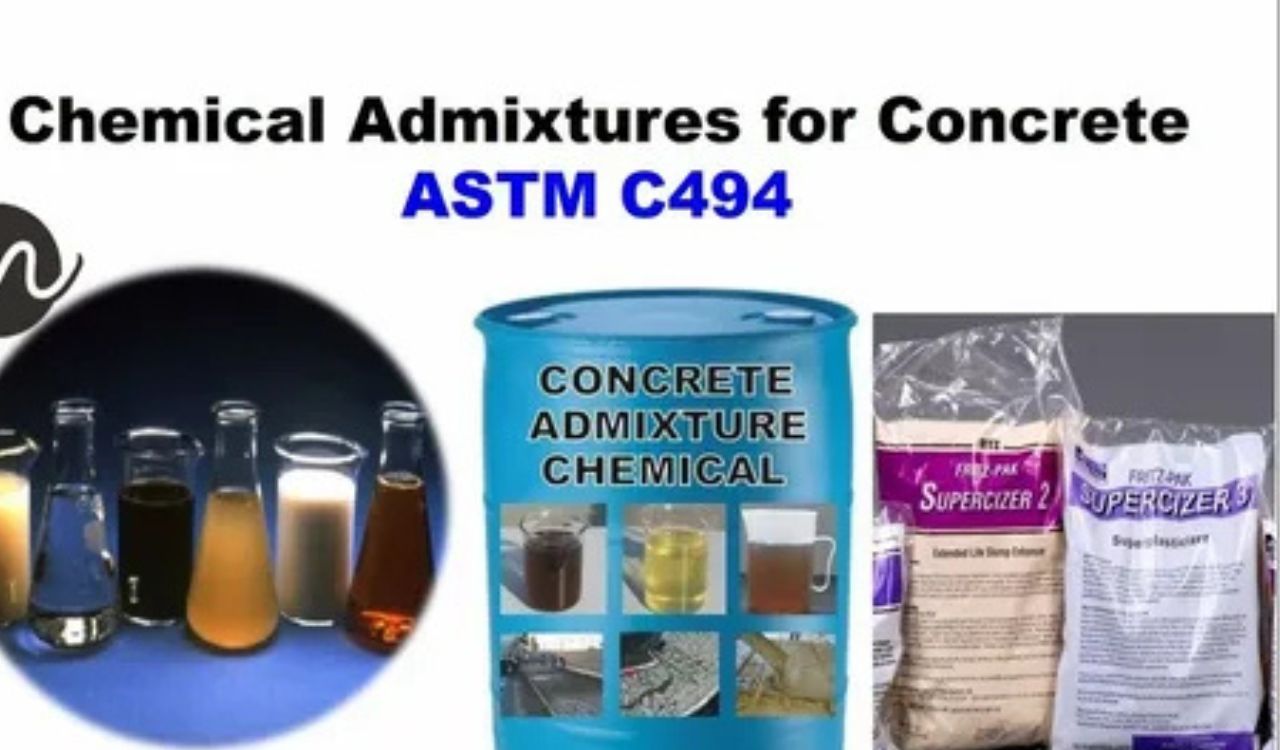
ASTM C494/C494M is a specification covering chemical admixtures used in hydraulic-cement concrete. It establishes categories based on the primary performance function of the admixture and includes requirements and test methods used for qualification.
The classification is particularly useful when comparing products because it provides a common technical language between admixture manufacturers, concrete producers, engineers, contractors, and purchasing teams.
However, an ASTM classification does not mean that every product within a category will produce identical results. Concrete performance depends on the interaction between the admixture and the complete mixture.
Important variables include:
- Cement type and chemistry
- Supplementary cementitious materials
- Aggregate characteristics
- Water-cementitious materials ratio
- Concrete temperature
- Mixing sequence
- Admixture dosage
- Placement conditions
- Curing conditions
- Other admixtures in the mixture
ASTM C494 Admixture Types at a Glance
| ASTM Type | Primary Function | Typical Purpose |
| Type A | Water reducing | Reduce water demand while maintaining workability |
| Type B | Retarding | Delay setting and extend working time |
| Type C | Accelerating | Increase setting or early strength development |
| Type D | Water reducing and retarding | Reduce water while extending setting time |
| Type E | Water reducing and accelerating | Reduce water while accelerating setting or strength development |
| Type F | High-range water reducing | Achieve substantial water reduction or high workability |
| Type G | High-range water reducing and retarding | Combine high-range water reduction with extended setting |
| Type S | Specific performance | Address a defined performance requirement not covered by the other categories |
The ASTM classification should be considered alongside the actual technical data for the product and the requirements of the concrete mixture.
Type A: Water-Reducing Admixtures
Type A admixtures are designed to reduce the amount of mixing water required to achieve a specified level of workability.
Reducing water while maintaining suitable workability can allow the concrete producer to lower the water-cementitious materials ratio or improve flow without simply adding more water.
How Type A Admixtures Work
Many conventional water reducers disperse cement particles that would otherwise tend to form agglomerates. Better particle dispersion can release water trapped between cement particles and improve the efficiency of the mixture.
Depending on the formulation, the result may include:
- Lower water demand
- Improved workability
- Reduced water-cement ratio
- Higher strength potential
- Lower permeability
- Better finishing characteristics
The actual result depends on the cement and admixture combination.
Where Type A Admixtures Are Used
Typical applications include:
- General structural concrete
- Foundations
- Commercial buildings
- Pavements
- Precast components
- Infrastructure construction
Type A products should not be selected solely because they reduce water. The required slump, strength class, setting behavior, and compatibility with the cement system should also be considered.
Type B: Retarding Admixtures
Type B admixtures are used when concrete needs a longer period before setting.
They are particularly useful when high temperatures, long transportation times, large placements, or complex construction sequences could otherwise reduce available working time.
Common Applications
Retarding admixtures can be useful for:
- Hot-weather concrete
- Long-distance ready-mix transportation
- Large foundations
- Mass concrete
- Bridge decks
- Large slabs
- Complex placements
The objective is not simply to delay setting as much as possible. Excessive retardation can create finishing and scheduling problems. The dosage therefore needs to be established through testing under expected site conditions.
Type C: Accelerating Admixtures
Type C admixtures are designed to accelerate setting or early-age strength development.
They can be useful when construction schedules require earlier finishing, faster formwork turnover, or rapid strength development.
Applications of Accelerating Admixtures
Typical applications include:
- Cold-weather construction
- Precast production
- Emergency repairs
- Fast-track construction
- Pavement repair
- Projects requiring early strength
The accelerator selected must be compatible with the reinforcement system and other mixture components. Chloride-containing accelerator systems require particular attention in reinforced concrete because chloride exposure can contribute to reinforcement corrosion.
This is one reason non-chloride accelerator technologies are important for many structural applications.
Type D: Water-Reducing and Retarding Admixtures
Type D combines two functions:
- Reduction of water demand
- Retardation of setting
This combination can be useful when a project needs both improved mixture efficiency and additional placement time.
When Is Type D Useful?
Type D admixtures can be considered for:
- Hot-weather concrete
- Long transportation distances
- Large placements
- Infrastructure projects
- High-workability concrete requiring extended working time
The advantage is that the producer does not necessarily need to treat water reduction and setting control as completely separate objectives.
Type E: Water-Reducing and Accelerating Admixtures
Type E combines water reduction with acceleration.
This makes the category relevant when concrete needs efficient water usage while also requiring faster setting or early-age strength development.
Potential Applications
Type E admixtures may be considered for:
- Cold-weather concrete
- Precast manufacturing
- Industrial construction
- Fast-track structural work
- Concrete requiring early loading
The actual balance between water reduction and acceleration should be verified through trial batches because cement chemistry and temperature can significantly affect setting behavior.
Type F: High-Range Water-Reducing Admixtures
Type F admixtures are high-range water reducers, commonly called superplasticizers.
Compared with conventional water reducers, high-range products are designed to provide substantially greater water reduction and/or workability improvement.
Modern high-range water-reducing technologies include polycarboxylate ether systems, commonly known as PCE superplasticizers.
Why Are Type F Admixtures Important?
Type F admixtures can support concrete mixtures requiring:
- Low water-cementitious materials ratios
- High strength
- High flowability
- Dense reinforcement
- Pumpability
- Self-consolidating concrete
- Improved durability
For example, a high-range water reducer can allow a concrete producer to achieve a high slump without simply increasing the water content.
PCE and High-Range Water Reduction
PCE-based admixtures work through adsorption and steric stabilization mechanisms that help disperse cement particles.
Their performance can be influenced by:
- PCE molecular structure
- Cement composition
- Sulfate balance
- Supplementary cementitious materials
- Temperature
- Dosage
- Mixing sequence
This is why product selection should be based on actual concrete trials rather than relying only on a generic dosage range.
Type G: High-Range Water-Reducing and Retarding Admixtures
Type G combines high-range water reduction with retarding behavior.
It is particularly relevant when a project needs both high workability and extended placement time.
Typical Applications
Type G may be useful for:
- Large infrastructure projects
- Bridges
- Long-haul ready-mix deliveries
- Large structural placements
- Hot-weather construction
- High-performance concrete
One important consideration is slump retention. A concrete mixture may initially achieve a high slump but lose workability rapidly if the admixture is not suited to the cement system and environmental conditions.
Type S: Specific Performance Admixtures
Type S is used for specific performance admixtures that do not fit neatly into the primary functional categories above.
This category is important because modern concrete technology increasingly requires targeted performance rather than only conventional water reduction or setting control.
Potential performance objectives can include specialized durability or fresh- and hardened-concrete characteristics, depending on the product and specification.
Examples of specialty admixture technologies used in concrete include:
- Corrosion-inhibiting admixtures
- Shrinkage-reducing admixtures
- Permeability-reducing admixtures
- Alkali-silica reaction mitigation systems
- Specialized rheology modifiers
- Other project-specific performance technologies
The exact performance claim should always be supported by product-specific technical data and appropriate testing.
How Are ASTM C494 Types Different From Other Admixture Categories?
One common source of confusion is that ASTM classification and commercial product categories are not always the same thing.
For example, engineers may talk about:
- Air-entraining admixtures
- Waterproofing admixtures
- Corrosion inhibitors
- Shrinkage reducers
- Superplasticizers
- Accelerators
- Retarders
These descriptions identify the function or technology of an admixture, while ASTM C494 provides a performance-based classification for specified chemical admixture categories.
Therefore, a product’s commercial name should not be used as the only basis for determining its technical classification.
What About Air-Entraining Admixtures?
Air-entraining admixtures deserve separate consideration because they intentionally create and stabilize a system of microscopic air voids in concrete.
They are especially important where concrete is exposed to repeated freezing and thawing.
Air entrainment can also influence:
- Workability
- Pumpability
- Bleeding
- Segregation
- Density
- Compressive strength
The target air content should be appropriate for the exposure condition and mixture design. Excessive air can reduce strength, so air content needs to be controlled during production and placement.
How Do Waterproofing Admixtures Fit Into Concrete Admixture Classification?
Waterproofing is a performance objective rather than a single universal admixture category.
A concrete waterproof admix may work by reducing capillary permeability, blocking or refining pore pathways, reacting within the cementitious system, or providing another mechanism that reduces water penetration.
Different technologies include:
- Permeability-reducing admixtures
- Crystalline systems
- Hydrophobic systems
- Pore-blocking technologies
A hydrophobic concrete admixture, for example, may alter the interaction between water and the pore structure, while other systems focus on reducing permeability through different mechanisms.
For contractors and engineers, the correct question is not simply whether a product is labeled “waterproof.” It is how the product changes water absorption, permeability, hydrostatic water resistance, crack behavior, and long-term durability under the intended exposure.
What Is the Admixture Ratio in Concrete?
The admixture ratio in concrete is generally expressed as a dosage relative to the cementitious material content or according to the manufacturer’s specified dosing method.
There is no universal dosage that works for every concrete mixture.
Dosage can be affected by:
- Cement content
- Cement chemistry
- Concrete temperature
- Desired slump
- Water-cementitious materials ratio
- Aggregate grading
- Supplementary cementitious materials
- Required setting time
- Other admixtures
- Mixing equipment
For this reason, dosage should be established through laboratory and field trials rather than copied from an unrelated concrete mix.
Why Cement-Admixture Compatibility Matters
Two products can individually perform well but produce unexpected results when combined in the same concrete mixture.
Compatibility problems can appear as:
- Rapid slump loss
- Excessive retardation
- Unexpected acceleration
- Air instability
- Poor finishing
- Increased bleeding
- Segregation
- Inconsistent strength development
Compatibility becomes particularly important in complex concrete systems containing multiple admixtures and supplementary cementitious materials.
Before commercial production, trial batching should reproduce the actual cement, aggregates, admixtures, batching sequence, temperature, and mixing conditions as closely as practical.
How Should Engineers Select an ASTM C494 Admixture?
The selection process should begin with the required concrete performance rather than the product name.
1. Define the concrete requirement
Determine whether the project primarily requires:
- Water reduction
- High flowability
- Setting control
- Early strength
- Extended workability
- Durability improvement
- Specialized performance
2. Evaluate environmental conditions
Consider:
- Ambient temperature
- Concrete temperature
- Transportation time
- Placement duration
- Freeze-thaw exposure
- Chloride exposure
- Water exposure
3. Review the cementitious system
The admixture should be evaluated with the actual cement and supplementary cementitious materials intended for production.
4. Establish the dosage
Start within the manufacturer’s recommended range and determine the optimum dosage through controlled testing.
5. Perform compatibility testing
Evaluate the admixture with all other chemical and mineral components used in the mix.
6. Validate field performance
Laboratory results should be confirmed under realistic batching, transportation, placement, and curing conditions.
ASTM Classification and Concrete Admixture Markets
The classification of admixtures also helps explain why different regional markets have different product requirements.
The US concrete admixtures market, for example, includes demand from infrastructure, commercial construction, ready-mix concrete, precast production, and high-performance concrete applications.
Similar performance requirements appear across the Canada concrete admixtures market and Japan concrete admixtures market, although climate, construction practices, standards, raw materials, and project specifications can influence product selection.
At the broader industry level, chemical admixtures form part of the cement & concrete additive market and the wider concrete mortar and construction chemicals market.
Other segments, such as the dry mix mortar additives and chemicals market, involve related construction chemical technologies but should not be confused with ASTM C494 concrete admixture classifications.
Emerging Technologies Beyond Conventional Admixtures
Concrete chemistry continues to develop beyond conventional water reducers, accelerators, and retarders.
Research and commercial development increasingly involve:
- Advanced PCE polymers
- Nano-engineered additives
- Carbon-based materials
- Rheology modifiers
- Low-carbon concrete technologies
- Specialized durability admixtures
- Smart dosing systems
The carbon nanotube based concrete additives market, for example, represents a more specialized technology area focused on modifying concrete performance through nanoscale materials. Such technologies should be evaluated according to their specific mechanism and verified performance rather than automatically grouped with conventional ASTM C494 categories.
Best Practices for Admixture Use
For consistent concrete production, manufacturers and contractors should establish a controlled admixture management process.
Use the actual project materials for trials
Testing with generic laboratory materials may not reproduce the behavior of the final concrete mixture.
Control dosing accuracy
Small dosage variations can influence slump, setting time, air content, and strength.
Maintain consistent batching procedures
Changes in the order or timing of admixture addition can affect performance, especially with complex PCE-based systems.
Monitor fresh concrete
Important parameters include:
- Slump
- Slump retention
- Air content
- Concrete temperature
- Setting time
- Unit weight
- Bleeding and segregation
Evaluate hardened concrete
Depending on the project, testing may include:
- Compressive strength
- Flexural strength
- Permeability
- Shrinkage
- Freeze-thaw resistance
- Durability indicators
Document every adjustment
Batch records should identify the admixture product, dosage, lot, concrete temperature, cementitious materials, and observed performance.
How Manufacturers Can Support Consistent Admixture Performance
For admixture manufacturers and industrial buyers, consistency begins before the product reaches the concrete plant.
Important controls include:
- Raw material quality
- Polymer or chemical composition
- Manufacturing consistency
- Storage conditions
- Batch-to-batch uniformity
- Product testing
- Technical documentation
- Application support
Luke Chemicals works within the broader construction chemicals sector, where consistent formulation and application-specific performance are important considerations when supplying admixture technologies to concrete producers and construction professionals.
ASTM C494 Admixture Types: Practical Selection Table
| Project Requirement | Potential Admixture Category | Main Objective |
| Reduce water demand | Type A | Improve efficiency and maintain workability |
| Extend working time | Type B | Delay setting |
| Accelerate setting or early strength | Type C | Support faster construction |
| Reduce water and extend setting | Type D | Combine water reduction and retardation |
| Reduce water and accelerate | Type E | Combine efficiency and early-age performance |
| High flow or high water reduction | Type F | High-range water reduction |
| High flow plus extended working time | Type G | High-range reduction with retardation |
| Specific performance requirement | Type S | Address specialized performance needs |
The appropriate choice should always be verified against the project specification and actual concrete mixture.
FAQs About ASTM C494 Admixture Types
What are the main ASTM C494 admixture types?
ASTM C494/C494M classifies chemical admixtures into Types A, B, C, D, E, F, G, and S. The categories cover water reduction, retardation, acceleration, combined functions, high-range water reduction, and specific performance requirements.
What is the difference between Type F and Type G admixtures?
Type F is a high-range water-reducing admixture. Type G combines high-range water reduction with retarding performance, making it useful where high flowability and extended working time are both required.
Which ASTM admixture type is used for accelerating concrete?
Type C is the accelerating category. Type E also provides acceleration but combines it with water-reducing performance.
Are waterproofing admixtures classified under one ASTM C494 type?
Not necessarily. Waterproofing is a performance objective rather than one universal ASTM C494 category. The appropriate classification depends on the chemistry and specific performance characteristics of the product.
How is admixture dosage determined?
Dosage should be established through laboratory and field trials using the actual cementitious materials, aggregates, concrete proportions, environmental conditions, and other admixtures intended for the project.
Can different admixtures be used together?
Yes, multiple admixtures can be used in one concrete mixture when their compatibility has been demonstrated. Trial batching is important because interactions can affect setting, slump retention, air content, and strength.
Why is ASTM C494 important when buying concrete admixtures?
It provides a standardized framework for evaluating specified chemical admixture functions and performance. However, buyers should also review technical data, project requirements, compatibility results, quality documentation, and application-specific test results.
Final Takeaway
Understanding the ASTM C494 admixture types provides a practical framework for selecting chemical admixtures according to their primary performance functions. Type A through Type G cover common combinations of water reduction, setting control, and high-range water reduction, while Type S addresses specific performance requirements.
The most important point is that ASTM classification is only one part of admixture selection. Concrete performance depends on the interaction between the admixture, cementitious materials, aggregates, water, temperature, dosage, mixing procedure, and curing conditions.
For engineers, contractors, manufacturers, and industrial buyers, the most reliable approach is to combine the applicable ASTM classification with product-specific technical data and project-specific trial testing. This approach supports more predictable workability, setting behavior, strength development, durability, and long-term concrete performance.