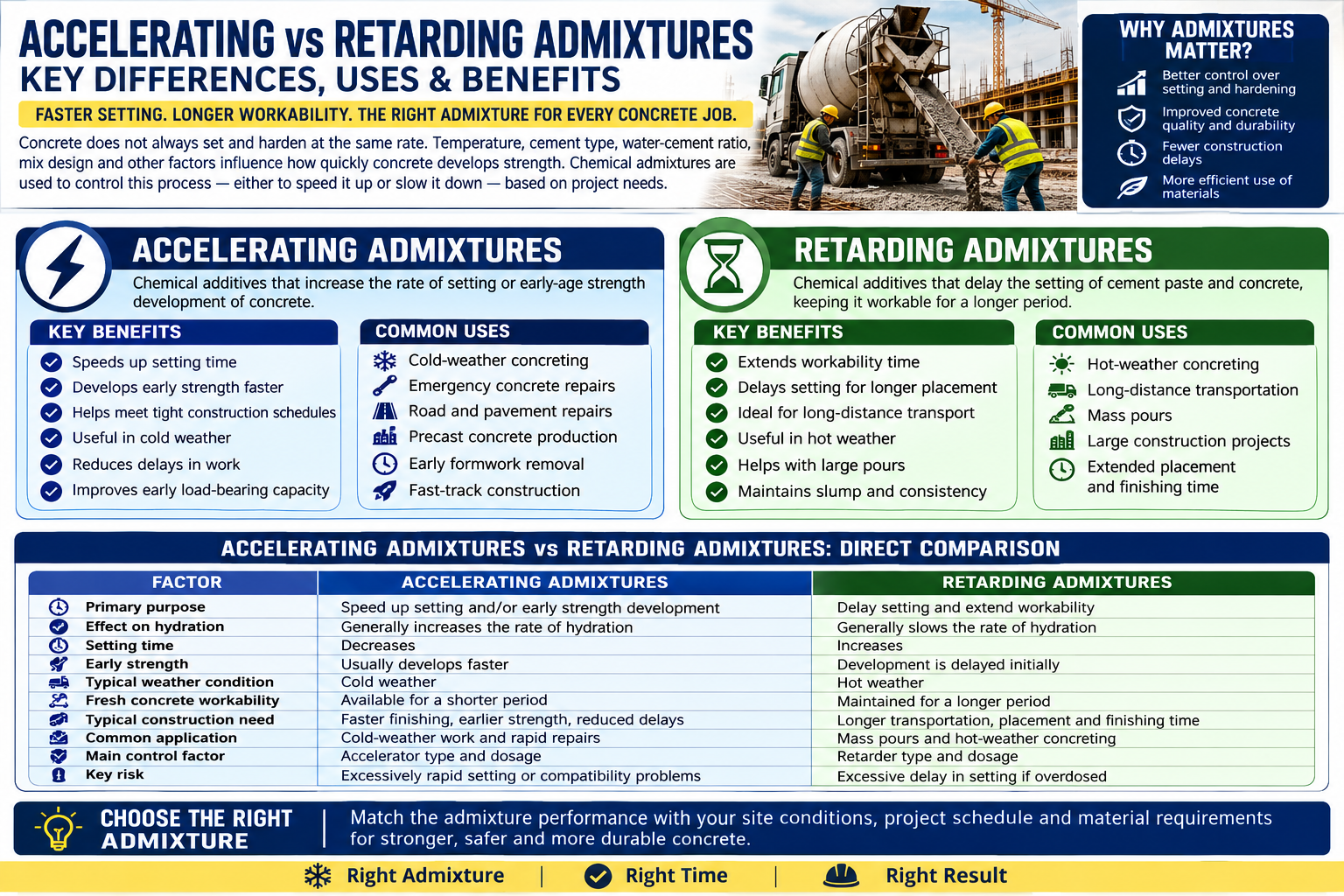
Concrete does not always set and harden at the same rate. Ambient temperature, cement composition, water-cement ratio, mix design, placement conditions, and admixture dosage can all influence the rate at which cement hydrates and concrete develops strength.
Two important categories of chemical admixtures are accelerating admixtures and retarding admixtures. Although both are used to modify the behavior of concrete, they solve almost opposite problems.
An accelerating admixture is selected when a project needs faster setting or earlier strength development. A retarding admixture is used when the concrete needs to remain workable for longer and setting needs to be delayed.
Understanding accelerating admixtures vs retarding admixtures is therefore important for concrete producers, contractors, engineers, and construction-material buyers who need to match admixture performance with actual site conditions.
What Are Accelerating Admixtures?
Accelerating admixtures are chemical additives designed to increase the rate of setting or early-age strength development of concrete.
During cement hydration, water reacts with cement compounds and produces hydration products that gradually transform fresh concrete into a hardened material. Accelerating admixtures modify this process so that setting and, depending on the formulation, early strength development occur more quickly.
Accelerators are particularly useful when low temperatures slow hydration or when construction schedules require earlier finishing, formwork removal, traffic opening, or loading.
However, an important distinction should be made between setting acceleration and strength acceleration. An admixture may primarily shorten setting time, increase early strength, or provide both effects.
Luke Chemicals’ existing technical guide similarly distinguishes setting accelerators from hardening accelerators and notes that selection depends on temperature, required early strength, reinforcement, dosage, and project conditions.
Common Uses of Accelerating Admixtures
Accelerating admixtures may be considered for:
- Cold-weather concreting
- Emergency concrete repairs
- Road and pavement repairs
- Precast concrete production
- Early formwork removal
- Fast-track construction
- Certain underground and tunneling applications
- Applications requiring rapid early-age strength development
What Are Retarding Admixtures?
Retarding admixtures are chemical additives that delay the setting of cement paste and concrete.
Their primary purpose is to extend the time during which fresh concrete remains workable before significant setting occurs. This can be particularly useful when concrete must be transported over long distances, placed in hot weather, or used for large pours where continuous placement and finishing are important.
Retarders do not simply “make concrete weaker” or stop hydration. Instead, they modify the rate of hydration so that setting occurs later.
Depending on their formulation, some retarding admixtures can also influence water demand, slump retention, and other fresh-concrete properties.
Accelerating Admixtures vs Retarding Admixtures: Direct Comparison
The simplest way to understand the difference is to compare their effect on the rate of concrete setting and hydration.
| Factor | Accelerating Admixtures | Retarding Admixtures |
| Primary purpose | Speed up setting and/or early strength development | Delay setting and extend workability |
| Effect on hydration | Generally increases the rate of hydration | Generally slows the rate of hydration |
| Setting time | Decreases | Increases |
| Early strength | Usually develops faster | Development is delayed initially |
| Typical weather condition | Cold weather | Hot weather |
| Fresh concrete workability | Available for a shorter period | Maintained for a longer period |
| Typical construction need | Faster finishing, earlier strength, reduced delays | Longer transportation, placement, and finishing time |
| Common application | Cold-weather work and rapid repairs | Mass pours and hot-weather concreting |
| Main control factor | Accelerator type and dosage | Retarder type and dosage |
| Key risk | Excessively rapid setting or compatibility problems | Excessive delay in setting if overdosed |
The comparison is consistent with the fundamental distinction identified by construction references: accelerators shorten setting time and are commonly useful in cold conditions, while retarders increase setting time and are particularly useful when hot conditions or large pours create a need for extended workability.
Key Difference 1: Effect on Cement Hydration
The most fundamental difference between the two admixture categories is their influence on cement hydration.
Accelerating Admixtures
Accelerators increase the rate at which hydration-related reactions proceed. This can help concrete transition from a plastic state toward setting and early hardening more rapidly.
The practical result can include:
- Earlier setting
- Faster early-age strength development
- Earlier finishing
- Earlier formwork removal when required strength has been achieved
- Reduced exposure time for freshly placed concrete in cold conditions
Retarding Admixtures
Retarders slow the rate of hydration-related reactions responsible for setting.
This provides additional time for:
- Transportation
- Placement
- Consolidation
- Finishing
- Large-scale continuous pours
The purpose is not to permanently prevent hydration but to control its timing.
Key Difference 2: Setting Time
Setting time is another major difference.
An accelerating admixture is used when the initial or final setting of concrete needs to occur sooner. This can be valuable when a construction team has a narrow working window or needs concrete to reach an appropriate early condition quickly.
A retarding admixture has the opposite objective. It extends the time before setting becomes significant.
This is especially important when concrete would otherwise begin setting before workers can properly place and finish it.
Why Setting Time Matters
Setting time affects:
- Transportation schedules
- Pumping operations
- Placement
- Surface finishing
- Joint formation
- Formwork operations
- Construction productivity
- Protection of freshly placed concrete
Choosing the wrong admixture can therefore create serious practical problems even when the concrete mixture itself is otherwise properly designed.
Key Difference 3: Weather Conditions
Temperature is one of the most important factors when deciding between an accelerator and a retarder.
Accelerating Admixtures in Cold Weather
Low temperatures generally slow cement hydration. This can increase setting time and delay early strength development.
Accelerating admixtures can help compensate for this slower reaction rate.
They may be useful when:
- Concrete is placed during winter
- Overnight temperatures are low
- Early strength is required
- Construction schedules cannot tolerate long setting periods
- Fresh concrete needs to reach sufficient strength before exposure to freezing conditions
An accelerator, however, does not replace proper temperature protection or curing. Luke Chemicals’ existing guide specifically emphasizes that accelerators complement—not replace—appropriate curing and cold-weather protection.
Retarding Admixtures in Hot Weather
High temperatures can accelerate setting and reduce the available time for transporting, placing, and finishing concrete.
A retarding admixture can help extend workability under these conditions.
This can be valuable for:
- Hot-weather concrete placement
- Long-distance ready-mix transportation
- Large slabs
- Mass concrete
- Large foundations
- Continuous pours
- Projects where finishing requires additional time
The correct solution depends on more than air temperature alone. Concrete temperature, cement type, mix composition, travel time, placement method, and expected finishing conditions should all be evaluated.
Key Difference 4: Construction Applications
The two admixture types are often selected for very different construction requirements.
Applications of Accelerating Admixtures
Accelerators can be useful where rapid setting or early strength development is important.
Examples include:
Cold-Weather Construction
Cold temperatures can slow hydration and delay strength development. An accelerator can help maintain the desired construction schedule when used with appropriate thermal protection and curing.
Rapid Repairs
Roads, industrial floors, bridges, and other facilities may need to return to service quickly. Accelerating admixtures can support faster early-age performance when the mix is properly designed.
Precast Concrete
Precast manufacturers often work with controlled production cycles. Faster strength development can potentially allow earlier handling or formwork operations.
Early Formwork Removal
Where project requirements permit, faster early strength development can help shorten the time before forms are removed. Strength requirements must always be verified rather than assuming a particular time period is sufficient.
Applications of Retarding Admixtures
Retarders are particularly useful when concrete needs to remain workable for an extended period.
Hot-Weather Concrete
Retarding admixtures can help compensate for faster setting caused by elevated concrete temperatures.
Mass Concrete
Large concrete placements can involve substantial heat generation from cement hydration. Controlling the rate of hydration and setting can help construction teams manage placement and finishing requirements.
Long Transportation Times
Ready-mix concrete may need to travel considerable distances from a batching plant to a construction site. A retarding admixture can provide additional working time when appropriately formulated and dosed.
Large Continuous Pours
Large foundations, slabs, and other continuous placements may require more time for consolidation and finishing than a conventional small pour.
Types of Accelerating Admixtures
Accelerating admixtures vary in chemistry and performance.
Calcium Chloride-Based Accelerators
Calcium chloride is a well-known accelerator because of its strong accelerating effect.
However, chloride-containing admixtures require careful consideration in reinforced concrete because chloride ions can contribute to reinforcement corrosion under suitable conditions.
For this reason, chloride restrictions and project specifications must be checked before use.
Non-Chloride Accelerators
Non-chloride formulations are commonly considered for reinforced concrete applications where chloride-related corrosion risk must be avoided.
Examples of accelerator chemistries used in commercial formulations include calcium formate and certain thiocyanate-based systems.
The appropriate chemistry depends on the cement system, required performance, reinforcement, temperature, dosage, and applicable standards.
Types of Retarding Admixtures
Retarding admixtures are also available in different chemical formulations.
Common retarding components or chemistries can include:
- Hydroxycarboxylic acids and their salts
- Lignosulfonates
- Gluconates
- Phosphates
- Certain carbohydrate-derived compounds
- Proprietary blended admixture systems
The actual performance depends heavily on formulation, cement chemistry, dosage, temperature, and interaction with other admixtures.
A material that performs well with one cement system may not provide identical results with another.
Accelerating vs Retarding Admixtures: Which Should You Choose?
There is no universal “better” admixture.
The correct choice depends on what the concrete needs to accomplish.
Choose an accelerating admixture when the primary requirement is:
- Faster setting
- Faster early strength
- Cold-weather placement
- Earlier finishing
- Faster formwork cycles
- Rapid repair
- Reduced waiting time
Choose a retarding admixture when the primary requirement is:
- Extended workability
- Longer transportation time
- Hot-weather placement
- Large concrete pours
- Extended finishing time
- Better control of setting during high-temperature conditions
The decision should be based on actual concrete and project conditions rather than simply selecting an admixture according to the season.
Factors to Consider Before Selecting an Admixture
1. Concrete Temperature
Measure the actual concrete temperature rather than relying only on ambient air temperature.
2. Cement Type and Composition
Different cements and supplementary cementitious materials can respond differently to chemical admixtures.
3. Required Setting Time
Determine the required initial and final setting characteristics based on transportation, placement, finishing, and construction scheduling.
4. Required Early Strength
If the project requires early formwork removal or rapid reopening, evaluate early-age strength rather than setting time alone.
5. Reinforcement
For reinforced or prestressed concrete, chloride-containing accelerator systems require particular attention.
6. Other Admixtures
Accelerators and retarders may interact with:
- Water reducers
- Superplasticizers
- Air-entraining admixtures
- Supplementary cementitious materials
- Other specialty admixtures
Compatibility should be verified through testing.
7. Dosage
Admixture dosage should follow the manufacturer’s technical recommendations and project specifications.
Overdosing can produce undesirable changes in setting, workability, air content, strength development, or durability.
8. Curing Conditions
Neither accelerators nor retarders eliminate the need for proper curing.
Curing remains essential for controlling moisture and temperature conditions while concrete develops its intended properties.
Can Accelerating and Retarding Admixtures Be Used Together?
In some specialized mix designs, multiple admixtures may be used to achieve different performance objectives. However, combining accelerating and retarding systems is not something that should be done simply to “balance” their effects.
Their interaction can be complex.
A concrete producer should evaluate:
- Chemical compatibility
- Cement composition
- Dosage
- Setting behavior
- Slump retention
- Air content
- Early-age strength
- Long-term strength
- Temperature response
Trial batching is the safest way to establish how a combination performs before full-scale placement.
Common Mistakes When Using Accelerators or Retarders
Choosing Based Only on Weather
Cold weather often suggests an accelerator and hot weather often suggests a retarder, but temperature is only one variable.
Confusing Setting Time With Strength
A concrete mix can set quickly without necessarily achieving the required structural strength equally quickly.
Ignoring Admixture Compatibility
Changing one admixture can affect the behavior of another. Compatibility testing is especially important when modifying an established concrete mix.
Overdosing
More admixture does not necessarily mean better performance. Excessive dosage can create rapid setting, excessive retardation, workability problems, or unexpected strength behavior.
Replacing Good Concrete Practice With Chemicals
Admixtures are tools for modifying concrete performance. They do not replace appropriate mix design, temperature control, placement procedures, curing, or quality control.
Best Practices for Using Accelerating and Retarding Admixtures
For reliable performance:
- Define the required setting and strength characteristics before selecting the admixture.
- Evaluate actual concrete temperature and environmental conditions.
- Check cement and supplementary cementitious material compatibility.
- Review interactions with water reducers and other admixtures.
- Use manufacturer-recommended dosage ranges as the starting point.
- Conduct laboratory or field trial mixes before large-scale placement.
- Measure setting time and early-age strength rather than relying on assumptions.
- Follow project specifications and applicable standards.
- Maintain appropriate curing and temperature protection.
- Document admixture dosage, batch conditions, concrete temperature, and test results for quality control.
For manufacturers and industrial buyers, product selection should also consider consistency between batches, technical documentation, storage requirements, quality control, and supply reliability.
Accelerating vs Retarding Admixtures in the Concrete Market
The broader concrete admixtures market includes products designed to modify setting, workability, strength development, durability, air content, water demand, and other concrete properties.
Accelerators and retarders occupy different positions within this market because they address opposite timing requirements.
Demand for admixture technologies is influenced by factors such as:
- Infrastructure development
- Urban construction
- Precast concrete production
- Ready-mix concrete
- High-performance concrete
- Climate conditions
- Construction productivity requirements
- Durability requirements
- Faster construction cycles
The APAC concrete admixtures market is particularly relevant to construction-material manufacturers and suppliers because the region contains major infrastructure, residential, commercial, and industrial construction activities. However, product requirements differ significantly between countries and individual projects.
The broader cement and concrete additives market also includes water reducers, superplasticizers, air-entraining agents, waterproofing admixtures, corrosion inhibitors, shrinkage-control products, and other specialty technologies.
This makes application-specific selection increasingly important: rather than choosing an admixture simply because it is classified as an accelerator or retarder, buyers should evaluate the performance requirement the product is expected to solve.
A Simple Decision Guide
If you need to make the decision quickly, use this basic framework:
Need concrete to set sooner?
Consider an accelerating admixture.
Need concrete to remain workable longer?
Consider a retarding admixture.
Working in cold conditions?
An accelerator may help compensate for slower hydration, subject to the complete mix and temperature-control strategy.
Working in hot conditions?
A retarder may help maintain workable time and control premature setting.
Need faster early strength?
Evaluate an accelerator specifically designed for early-strength development rather than assuming every accelerator provides the same effect.
Need longer transportation or finishing time?
Evaluate a retarding admixture and verify its performance under actual delivery and placement conditions.
Using reinforced concrete?
Check chloride content and project requirements carefully before selecting an accelerator.
How Luke Chemicals Can Support Concrete Admixture Selection
Selecting the right admixture requires more than comparing product names. Cement chemistry, temperature, dosage, mix design, required setting time, strength development, and compatibility all influence the final result.
Luke Chemicals works with concrete admixture technologies and chemical materials, making technical evaluation and application-specific product selection important considerations for construction and industrial buyers.
Conclusion
The difference between accelerating admixtures vs retarding admixtures comes down primarily to controlling the timing of concrete setting and hydration.
Accelerating admixtures are used when construction requires faster setting or earlier strength development, making them particularly valuable for cold-weather work, rapid repairs, precast production, and projects with demanding schedules.
Retarding admixtures take the opposite approach. They delay setting and extend workable time, making them useful for hot-weather concreting, long transportation distances, mass concrete, large pours, and situations where additional finishing time is required.
Neither category is universally better. The right choice depends on concrete temperature, cement chemistry, mix design, required setting time, early-strength requirements, reinforcement, other admixtures, and curing conditions.
Frequently Asked Questions
What is the main difference between accelerating and retarding admixtures?
Accelerating admixtures are used to speed up concrete setting and/or early strength development, while retarding admixtures are used to delay setting and maintain workability for a longer period.
Are accelerating admixtures used only in cold weather?
No. Cold weather is one of their most common applications because low temperatures can slow cement hydration. Accelerators can also be used when faster setting or early strength is required regardless of season.
Are retarding admixtures used only in hot weather?
No. Hot weather is a major application because higher temperatures can accelerate setting, but retarders can also be selected when extended workability or longer placement time is required for other reasons.
Do accelerating admixtures increase concrete strength?
They can increase the rate of early-age strength development, but an accelerator should not automatically be assumed to increase ultimate concrete strength. Final performance depends on the complete mix design, materials, dosage, curing, and environmental conditions.
Can calcium chloride be used in reinforced concrete?
Calcium chloride can accelerate concrete, but chloride-containing admixtures may increase the risk of reinforcement corrosion under suitable conditions.
Can accelerating and retarding admixtures be combined?
Multiple admixtures can sometimes be used in the same concrete mixture, but compatibility and dosage must be established through appropriate testing.
How do I select between an accelerator and a retarder?
Start with the required concrete performance. If you need faster setting or early strength development, evaluate an accelerator. If you need extended workability and delayed setting, evaluate a retarder.