How do you test concrete impermeability? You expose a cured concrete specimen to pressurized water for a set time, then measure how far the water travels or how much passes through. The first approach gives the water penetration depth; the second gives the permeability coefficient. A smaller depth and a lower coefficient both show that the concrete has a denser, less connected pore structure and will resist water better in service.
Which method you choose depends on the structure and the specification. Penetration depth suits quick quality checks and mix comparisons. The permeability coefficient suits design work and the evaluation of high-performance mixes. Whichever you use, the result is only reliable when the specimens are prepared and cured correctly and compared against a control mix. The sections below explain each method, the standards behind them, how to read the results, and how a water-reducing agent in concrete, including a high range water reducer (superplasticizer), and a proven waterproofing admixture change them.
What Is Concrete Impermeability?
Concrete impermeability is the ability of hardened concrete to resist the passage of water under pressure. Concrete is porous, and water moves through its capillary pores, microcracks and the interfacial transition zone (ITZ) around aggregate particles. The more connected and larger these pores are, the more water passes through.
It helps to separate three related terms:
- Permeability is how easily a fluid flows through the concrete under a pressure difference.
- Absorption and sorptivity describe how fast concrete takes in water by capillary suction without pressure.
- Diffusion describes how dissolved ions, such as chlorides, move through the pore solution.
Water is also the carrier of corrosion. Once it brings chlorides to the steel, rust forms, cracks the cover and lets in even more water. Low permeability is the first line of defence, and in aggressive exposure a product like VF-24 Concrete Anticorrosion Inhibitor adds protection at the reinforcement itself.
Why Does Impermeability Testing Matter?
Water is the carrier for almost every durability problem in concrete. It brings chlorides that corrode reinforcement, sulfates that attack the paste, and moisture that drives freeze-thaw damage and efflorescence. In water-retaining and below-grade structures, it also means leakage and costly repair.
Testing matters for four practical reasons:
- Specification compliance: many tender documents for tanks, basements, tunnels and dams name a test method and an acceptance limit.
- Mix approval: trial mixes with and without concrete admixtures can be compared with real data instead of supplier claims.
- Quality control: routine specimens show whether production stays consistent from batch to batch.
- Dispute resolution: test records give a factual basis when leakage appears and responsibility must be assigned.
Which Methods Are Used to Test Concrete Impermeability?
| Method | What it measures | Typical standard | Best used for |
| Water penetration depth under pressure | Depth the water front reaches in a fixed time and pressure | EN 12390-8, ISO 7031 | Specification checks and mix comparison |
| Progressive pressure (impermeability grade) | Highest pressure resisted, reported as grade P6, P8, P10, P12 | GB/T 50082 | Water-retaining structures, projects following Chinese standards |
| Relative permeability coefficient (penetration height method) | Coefficient estimated from penetration height at constant pressure | GB/T 50082 | Comparing mixes numerically |
| Steady-state water permeability (Darcy) | Coefficient of permeability k in m/s | Darcy-based lab methods, DIN 1048-5 (older) | Research, high-performance and low-permeability concrete |
| Capillary absorption (sorptivity) | Rate of water uptake without pressure | ASTM C1585 | Splash zones, cover concrete, admixture evaluation |
| Rapid chloride permeability | Charge passed through the specimen | ASTM C1202 | Marine and de-icing salt exposure |
| Air permeability on site | Surface permeability of cover concrete | Torrent method (SIA 262/1) | Non-destructive checks on finished structures |
No single test describes every durability risk. For water-retaining structures, pressure-based water tests are the primary choice, supported by sorptivity or chloride tests where aggressive exposure applies.
How Does the Water Penetration Depth Test Work?
The water penetration depth test applies water pressure to one face of a hardened specimen for a set time, then splits the specimen to measure how far water travelled. It is the most widely used concrete permeability test in specifications because the equipment is simple and the result is easy to interpret.
How Is the Test Performed (EN 12390-8)?
- Prepare specimens. Cast 150 mm cubes or cylinders, or cut cores of similar size, and cure them as specified, usually for 28 days.
- Mount in the test cell. Clean the test face with a wire brush to remove laitance, then seal the specimen in the pressure cell so water contacts a defined area.
- Apply pressure. Hold the water at 500 kPa (5 bar) for 72 hours.
- Split the specimen. Break it in half perpendicular to the test face, immediately after removal from the cell.
- Mark and measure. When the surface dries slightly, the water front becomes visible. Mark it and record the maximum penetration depth in millimetres.
Results are reported as the maximum depth of penetration, and often also as a mean depth. Some national guidance for water-impermeable concrete sets limits such as a maximum depth of around 50 mm, but the acceptance value always comes from the project specification and not from the test standard itself.
What Does the Water Penetration Depth Result Tell You?
A smaller depth indicates a denser, less connected pore network. A deep penetration usually points to a high water-cement ratio, poor compaction, inadequate curing, cracks or a high-permeability paste. The test shows relative quality well, but it does not directly measure flow, so compare it against a control mix and a specification limit rather than treating it as an absolute material property.
How Does the Impermeability Grade (P6, P8, P10, P12) Test Work?
The progressive pressure method, used under GB/T 50082, produces an impermeability grade. It is common in China and in international projects that follow Chinese standards, and it is the reason the china concrete admixtures market and many waterproofing admix suppliers state results as P6, P8 or P12.
- Six truncated-cone specimens (about 175 mm top diameter, 185 mm bottom diameter and 150 mm high) are cured for 28 days.
- Water pressure starts at 0.1 MPa and rises by 0.1 MPa every 8 hours.
- The test stops when water appears on the top surface of three of the six specimens.
- The grade is calculated from the pressure at that point, using the formula in the standard (the grade is 10 times the pressure in MPa at which the third specimen leaks, minus 1).
A grade of P8, for example, means the specimens resisted 0.8 MPa without leakage in at least four of six specimens. Higher grades such as P10 and P12 are specified for deep basements, underground structures and large water tanks.
How Is the Permeability Coefficient Determined?
The coefficient of permeability turns a test into a number that can be used in design and comparison. There are two main routes.
What Is the Darcy Permeability Coefficient?
For saturated concrete under steady flow, Darcy’s law gives the coefficient of permeability k in metres per second:
k = \frac{Q \cdot L}{A \cdot \Delta H}
where Q is the steady volumetric flow rate (m³/s), L is the specimen thickness (m), A is the exposed area (m²) and ΔH is the hydraulic head (m of water). Well-made, low water-cement ratio concrete typically falls in the range of 10⁻¹⁰ to 10⁻¹² m/s, while poorly compacted or high water-cement ratio concrete is orders of magnitude higher. These ranges are approximate and depend on age, curing and moisture state.
The practical difficulty is time. Dense concrete can take many days or weeks to reach steady flow, and small leaks around the specimen seal distort the result. For that reason, Darcy-type testing is mostly used in laboratories and research.
What Is the Relative Permeability Coefficient from Penetration Height?
GB/T 50082 also allows an estimated coefficient from the penetration height after constant pressure, usually 0.8 MPa for 24 hours:
K_r = \frac{\alpha \cdot D_m^2}{2 \cdot T \cdot H}
Here D_m is the mean penetration height, T is the test duration, H is the pressure head and α is a water absorption coefficient of the concrete (taken as 0.03 in the standard). Check units and constants against the current edition before reporting results. A similar logic appears in the Valenta equation, which estimates a coefficient from penetration depth, test time, head and an assumed effective porosity. Both approaches give comparative estimates, not a substitute for a true Darcy measurement.
What Factors Control Concrete Impermeability?
| Factor | Effect on permeability | Practical action |
| Water-cement ratio | Strongest single factor: lower ratio gives finer, less connected capillary pores | Keep it low, and use a water reducing agent in concrete to maintain workability |
| Supplementary cementitious materials | Fly ash, slag and silica fume refine pore structure with age | Use at proven replacement levels and cure long enough for the reaction |
| Curing | Poor curing leaves a permeable skin and incomplete hydration | Moist cure early and continuously |
| Compaction | Voids and honeycombing form direct flow paths | Use proper vibration and workable mixes |
| Aggregate and ITZ | Weak, porous zones around aggregate carry water | Use clean, well-graded aggregate and low-bleed mixes |
| Cracks and joints | Bypass the matrix entirely and dominate leakage | Control shrinkage, detail joints and use water stops |
| Admixtures | Waterproofing admixtures reduce absorption and block pores | Verify with a control comparison test |
One point deserves attention: laboratory tests on intact specimens measure the matrix. A real structure often leaks at cracks and joints, so a good test result does not remove the need for crack control and sound detailing.
How Do Admixtures Improve Test Results?
Concrete admixtures act on impermeability through different mechanisms:
- Water reducing agent in concrete (plasticizers and PCE superplasticizers): cut mixing water, which lowers the water-cement ratio and capillary porosity.
- Crystalline waterproofing admixture: reacts with water and cement by-products to form insoluble crystals that partly fill pores and microcracks.
- Hydrophobic or pore-lining concrete waterproof admix: makes pore walls water repellent, mainly cutting capillary absorption.
- Pore-blocking and fine mineral additives: fill the finest voids and refine the pore structure.
To prove the effect, run a controlled comparison: same cement, aggregate, slump and curing, with and without the admixture, using the same impermeability test. EN 934-2 sets requirements for water-resisting admixtures based on reduced capillary absorption compared with a control. Be aware that some hydrophobic products reduce absorption strongly but have less effect on pressurised water penetration, so the test must match the service condition.
When Should You Test, and What Specimens Are Needed?
- Mix design stage: run the full test on trial mixes before approval, comparing the control and admixed versions.
- During production: take routine specimens at an agreed frequency, for example per pour or per volume of concrete placed, according to the specification.
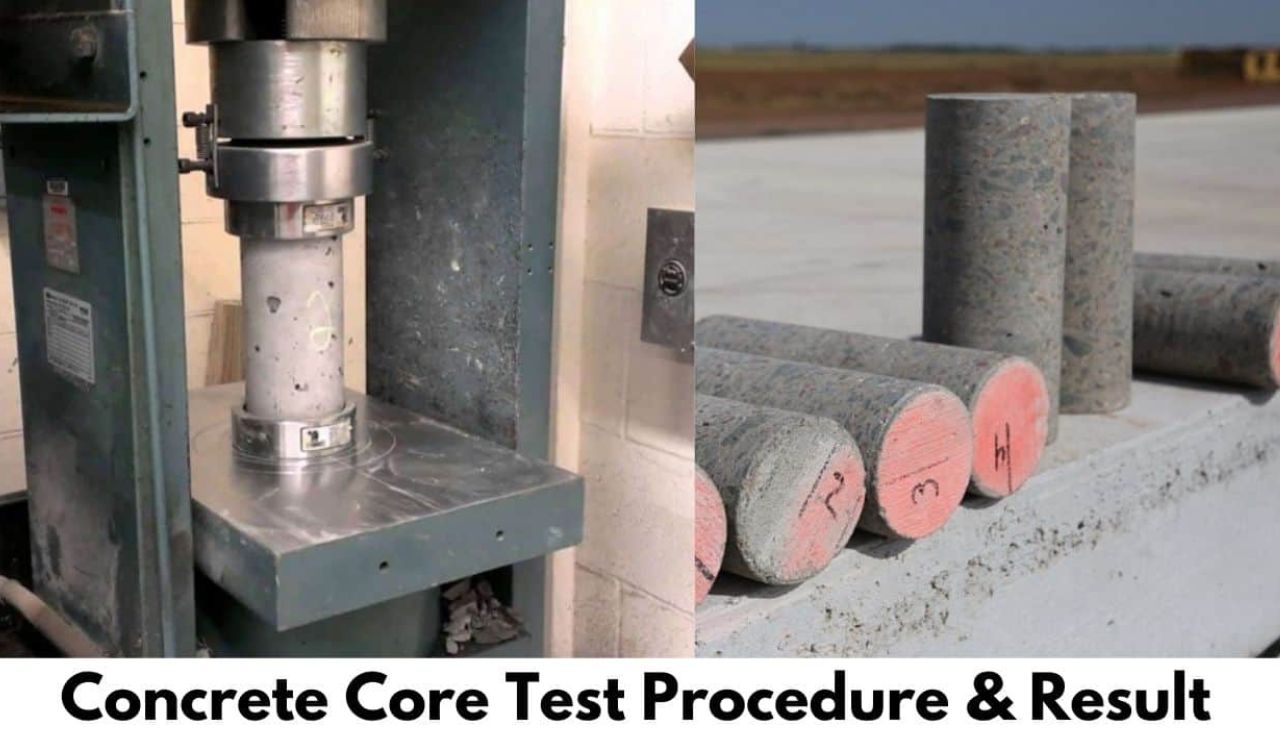
- On existing structures: extract cores for laboratory testing, or use non-destructive surface permeability methods for screening.
- For shotcrete: cast or cut panels from sprayed concrete. This also applies to dry mix sprayed concrete, where rebound, compaction and moisture control strongly affect the results.
Report the specimen age, curing regime, test method, pressure, duration, number of specimens and individual results. Do not report only an average, as one outlier often reveals a compaction or sealing problem.
What Are the Common Testing Mistakes and Limitations?
- Testing cubes cast and cured differently from the structure, which overstates real-world performance.
- Poor sealing around the specimen, which causes false leakage on the sides.
- Not removing laitance from the test face, which can mask the true permeability of the concrete.
- Reading the water front late, after the specimen has dried and the line has faded.
- Comparing results from different methods as if they were interchangeable.
- Ignoring cracking, joints and penetrations, which govern leakage in service.
- Treating a coefficient from a penetration-depth formula as an exact material constant.
How Do Batching Control and Material Quality Affect Test Results?
A single good test result means little if the next truck is batched differently. Impermeability depends on consistent water content, admixture dosage and cement quality. Plants that monitor admixture tanks with concrete additive storage sensors, covering level, temperature and flow, can verify that dosing matched the mix design and keep records that link a failed specimen to a specific batch. Raw material variability matters as well. The consistency of each specialty chemical manufacturing raw material used in an admixture, such as polycarboxylate monomers or crystalline actives, directly influences how repeatable the admixture performance is between production lots.
What Should Buyers Know About the Concrete Admixtures Market and Test Data?
Buyers comparing suppliers in the concrete admixtures additive market, the broader cement additive market or the china concrete admixtures market will find that marketing claims are easy to make and hard to compare. Asking for test data is the quickest way to separate them. Useful evidence includes:
- Results from a recognised method (EN 12390-8, GB/T 50082, ASTM C1585 or similar), with the mix design, cement type and curing conditions stated.
- A control-versus-admixed comparison on the same materials, not a single result.
- Third-party or accredited laboratory reports where possible.
- Batch-to-batch quality records and technical support for site trials.
Luke Chemicals supplies concrete admixtures and construction chemicals, and the same principle applies to any supplier: results should be reproducible with your own cement and aggregates.
What Are the Best Practices for Reliable Impermeability Testing?
- Choose the test method that matches the service condition: pressurised water for tanks and basements, sorptivity for splash zones, chloride tests for marine exposure.
- State the acceptance limit, specimen age and method in the specification before the project starts.
- Use accredited laboratories and calibrated pressure equipment.
- Test a control mix alongside the admixed mix whenever you evaluate a waterproofing admixture.
- Keep the water-cement ratio low, and cure at least as carefully as the specification demands.
- Pair laboratory results with crack control, joint design and water stops.
- Record batch data, admixture dosage and curing conditions for every set of specimens.
Frequently Asked Questions
What is the standard test for concrete water penetration depth?
EN 12390-8 is the standard most often used. It applies 500 kPa water pressure for 72 hours to a specimen face, then splits the specimen and measures the maximum depth of water penetration. ISO 7031 describes a similar approach.
What does P8 mean in concrete impermeability?
P8 is an impermeability grade under the progressive pressure method of GB/T 50082. It means the specimens resisted water pressure of 0.8 MPa before leakage appeared on enough specimens, based on the grade calculation in the standard. P10 and P12 indicate higher resistance.
What is a good permeability coefficient for concrete?
Low values indicate better impermeability. Dense, low water-cement ratio concrete often falls near 10⁻¹⁰ to 10⁻¹² m/s. The acceptable value depends on the structure and specification, so always use the project requirement.
How is the permeability coefficient different from water penetration depth?
Penetration depth is a direct measurement of how far water travelled under set conditions. The permeability coefficient expresses flow resistance as a rate and is either measured under steady flow or estimated from penetration depth with a formula.
Can a waterproofing admixture improve test results?
Yes, when it is suited to the mix and dosed correctly. A concrete waterproof admix can reduce capillary absorption and water penetration, but the improvement should always be confirmed against a control mix with the same test method and curing.
Is a high-strength concrete always impermeable?
No. Higher strength often goes with a lower water-cement ratio and therefore lower permeability, but the link is not guaranteed. Poor compaction, cracking and weak curing can leave a strong concrete that still leaks.
How long does a concrete impermeability test take?
Plan for the 28-day curing period plus the test itself. A penetration depth test under EN 12390-8 takes 72 hours under pressure, and a progressive grade test can run several days, depending on the pressure at which leakage occurs.
Conclusion
A reliable concrete impermeability test combines the right method, a clear acceptance limit and well-prepared specimens. Water penetration depth shows relative quality quickly, the impermeability grade fits water-retaining design, and the permeability coefficient gives a numerical basis for comparison. Pairing these results with low water-cement ratio mixes, a verified waterproofing admixture, good curing and controlled batching is what turns a passing laboratory result into a watertight structure.