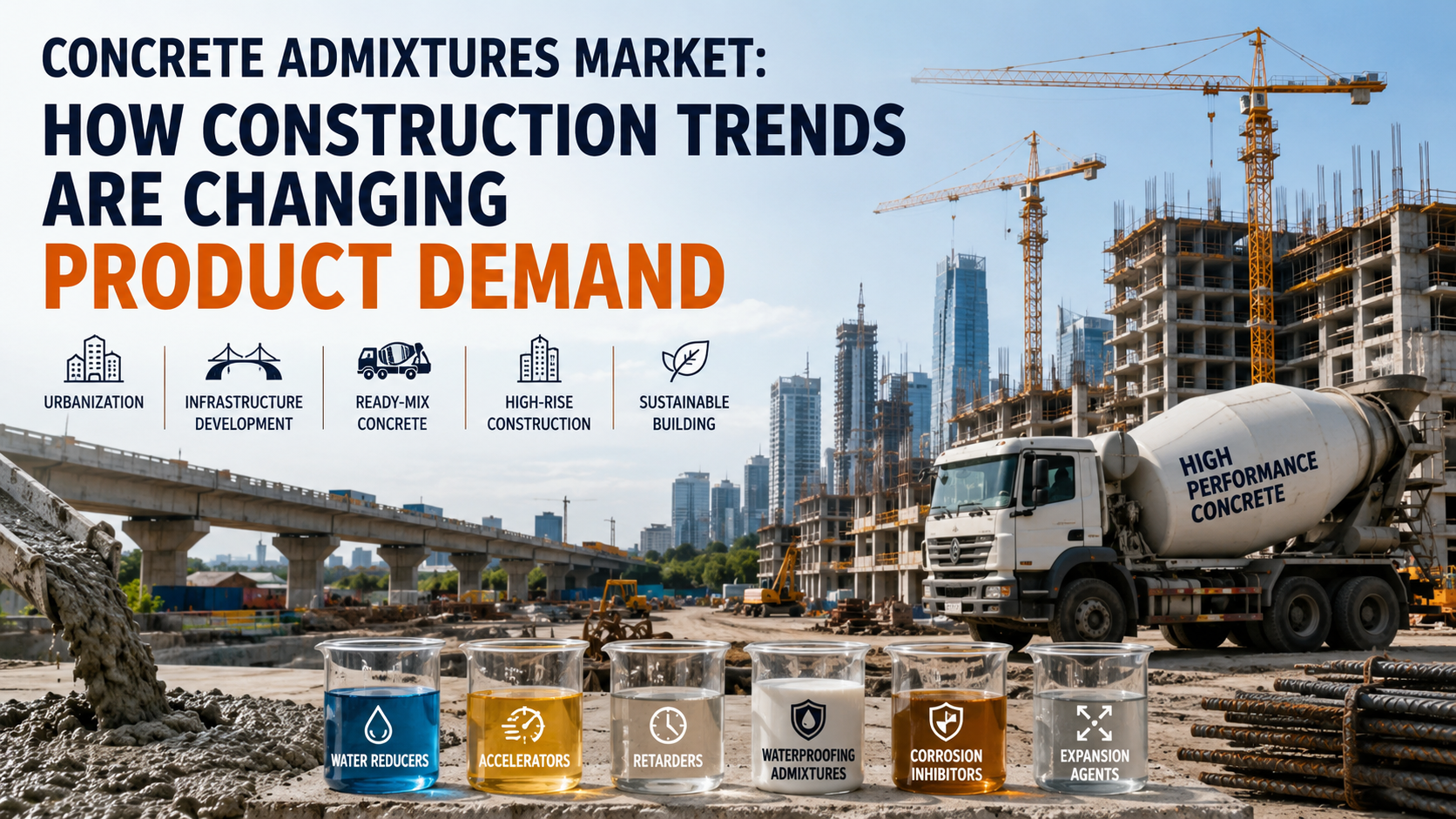
The construction industry is changing rapidly as projects become larger, more technically demanding, and increasingly focused on durability, efficiency, and sustainability. These changes are directly influencing the concrete admixtures market because modern concrete must often meet performance requirements that cannot be achieved through cement, aggregates, and water alone.
Construction trends such as urbanization, infrastructure development, high-rise construction, ready-mix concrete, precast production, modular construction, and sustainable building practices are creating new requirements for concrete performance. As a result, demand is shifting from conventional admixtures toward products that provide greater water reduction, improved workability retention, faster strength development, durability, and specialized protection.
The growing use of performance-oriented concrete is therefore changing not only the volume of admixtures required by the construction industry but also the types of technologies preferred by concrete producers and contractors. This includes water-reducing admixtures, accelerating and retarding admixtures, waterproofing technologies, corrosion protection products, and expansion agents designed to address specific performance and durability requirements.
Urbanization Is Increasing Demand for High-Performance Concrete
Rapid urbanization is one of the major factors supporting construction activity worldwide. Growing cities require residential buildings, commercial developments, transportation networks, utilities, parking structures, and other infrastructure. This continued development is also influencing concrete admixture factory trends, as manufacturers increasingly focus on producing performance-oriented admixtures for the changing requirements of modern urban construction.
Many urban projects involve high-density construction where concrete must provide reliable strength while remaining workable during pumping and placement. High-rise buildings, for example, frequently require concrete to be transported vertically over considerable distances. This increases the importance of admixtures that can maintain workability while supporting low water-to-cement ratios.
Water-reducing admixtures and high-range water reducers are particularly important in these applications. They allow concrete producers to achieve the required flow and workability without unnecessarily increasing the amount of mixing water. This can help improve strength and durability while making concrete easier to place.
As urban construction becomes more complex, concrete admixture factories are increasingly developing specialized formulations, improving production consistency, and expanding product ranges to meet specific construction requirements. This includes technologies for water reduction, workability retention, early strength, durability, waterproofing, and controlled expansion. As a result, demand is moving toward admixture solutions designed for specific performance requirements rather than basic workability improvement.
Infrastructure Development Is Expanding Admixture Applications
Infrastructure remains one of the most important areas influencing the concrete admixtures market. Roads, bridges, tunnels, airports, rail systems, dams, ports, and water infrastructure require concrete capable of performing under demanding mechanical and environmental conditions.
Infrastructure projects often have long service-life requirements. Concrete may be exposed to moisture, freeze-thaw cycles, chlorides, aggressive chemicals, temperature fluctuations, and heavy loading. These conditions increase the need for admixtures that contribute to durability and resistance.
Water reducers can support lower water-to-cement ratios, while air-entraining admixtures can improve resistance to freeze-thaw conditions where appropriate. Corrosion-inhibiting admixtures may be used where reinforcement protection is an important consideration. Waterproofing admixtures can also become relevant in structures exposed to continuous moisture or water pressure.
The expansion and modernization of infrastructure therefore increases demand for performance-based admixture systems capable of addressing specific service conditions.
Ready-Mix Concrete Is Changing Admixture Requirements
The growth of ready-mix concrete has significantly influenced admixture demand. Ready-mix producers must manufacture concrete that remains consistent from batching through transportation, pumping, placement, and finishing.
Transportation time can vary depending on project location, traffic conditions, weather, and construction schedules. Concrete may therefore require controlled workability retention for extended periods.
This creates demand for admixtures that can maintain consistency without negatively affecting setting, strength development, or finishing characteristics. Polycarboxylate-based technologies have become particularly important for modern high-performance concrete because they can provide strong water reduction and allow concrete producers to adjust performance according to project requirements.
The increasing use of ready-mix concrete is consequently encouraging more precise admixture selection and dosing rather than relying on a single conventional product for different construction conditions.
Precast and Modular Construction Are Driving Faster Performance
Precast concrete production operates differently from conventional cast-in-place construction. Concrete elements are manufactured in controlled factory environments and then transported to construction sites.
Production efficiency is a major consideration in this environment. Manufacturers may need concrete to achieve sufficient early strength quickly so that molds can be released and reused. Faster production cycles can increase manufacturing efficiency and reduce delays.
This trend is increasing interest in admixtures that support early strength development, controlled setting, workability, and consistent surface quality. Accelerating admixtures can be particularly useful when rapid strength development is required, while water-reducing technologies can help produce dense, high-strength concrete with controlled workability.
Modular construction is reinforcing this trend because factory-produced concrete components must meet strict dimensional, mechanical, and quality requirements before they are delivered to the construction site.
High-Rise Construction Is Increasing Demand for Flowable Concrete
Modern cities are increasingly using high-rise buildings to accommodate population growth and commercial activity within limited land areas. These projects often involve complex reinforcement arrangements, long pumping distances, and demanding placement conditions.
Concrete used in high-rise structures must be sufficiently flowable to move through pumping systems and around reinforcement while maintaining the required strength and durability.
This has increased the importance of high-range water-reducing admixtures and other technologies that improve concrete workability without requiring excessive water. In some applications, admixtures also help control setting characteristics so that concrete remains suitable for transportation and placement.
The trend toward taller and more technically complex structures therefore supports continued demand for advanced admixture technologies.
Sustainable Construction Is Influencing Product Development
Sustainability has become an increasingly important consideration in construction. Concrete producers are looking for ways to reduce material consumption, lower embodied carbon, improve durability, and make structures last longer.
Admixtures can contribute to these objectives by improving concrete efficiency. Water-reducing technologies can help achieve required performance with optimized cement and water contents. Improved durability can also extend the service life of concrete structures, potentially reducing the need for repairs and replacement.
The growing use of supplementary cementitious materials and alternative cementitious components is another factor influencing admixture development. Changes in binder composition can affect setting, workability, strength development, and compatibility. Admixtures therefore need to perform effectively with increasingly diverse concrete formulations.
This is encouraging manufacturers to develop more adaptable products capable of maintaining performance across changing mix designs.
Data Centers and Industrial Construction Are Creating Specialized Demand
The expansion of data centers, manufacturing facilities, warehouses, logistics centers, and other industrial buildings is creating another source of demand for specialized concrete.
These facilities can involve large floor areas, heavy equipment, strict construction schedules, and demanding durability requirements. Industrial floors may require controlled shrinkage, high strength, abrasion resistance, and reliable finishing characteristics.
Data center construction can also involve large structural elements and extensive foundations where concrete performance and construction speed are important. As investment in digital infrastructure grows, admixture requirements may increasingly be influenced by the technical specifications of these specialized projects.
This trend demonstrates how new construction sectors can create demand for admixtures designed around particular performance requirements.
Extreme Weather Is Increasing the Importance of Concrete Performance
Weather conditions can significantly affect concrete production and placement. Hot weather can accelerate moisture loss and setting, while cold conditions can slow strength development and extend construction schedules.
These challenges increase the importance of admixture technologies that help concrete producers manage changing environmental conditions. Retarding technologies may be useful where additional working time is needed, while accelerating technologies can support faster setting and early strength development under suitable conditions.
In regions exposed to severe weather, admixture selection is increasingly becoming part of broader concrete performance planning. This is particularly important for infrastructure projects where construction schedules and long-term durability must be carefully controlled.
Construction Efficiency Is Encouraging More Precise Admixture Selection
Modern construction projects are under pressure to reduce waste, control costs, and complete work within shorter schedules. These requirements are encouraging concrete producers to optimize mix designs rather than simply increasing cement content or water content to solve performance problems.
Admixtures can provide a more controlled way to modify concrete properties. Producers can select products according to required workability, strength development, setting behavior, durability, water reduction, or other characteristics.
This is contributing to greater demand for customized admixture solutions. Instead of treating admixtures as standard ingredients, many modern concrete operations consider them an important part of mix optimization.
Digitalization Is Improving Admixture Dosing and Quality Control
Digital technologies are also influencing concrete production. Automated batching systems, sensors, laboratory testing, and data-based quality control can help producers monitor concrete properties more closely.
More accurate dosing can improve consistency and reduce the risk of over- or under-dosing. It can also allow producers to adjust admixture levels according to changes in raw materials, temperature, moisture, and mix requirements.
As concrete production becomes increasingly automated, admixture manufacturers may face greater expectations for predictable performance and compatibility with modern batching and quality-control systems.
Regional Construction Trends Are Creating Different Demand Patterns
Construction trends do not develop at the same pace in every region. This creates differences in admixture demand across the global market.
Asia-Pacific continues to experience significant construction activity driven by urbanization, infrastructure development, industrial expansion, and residential construction. Mature markets in Europe and North America are also generating demand through infrastructure modernization, renovation, energy-related construction, and advanced building projects.
Developing markets may place greater emphasis on basic water reduction, workability, and construction efficiency, while technologically advanced markets can have stronger demand for specialized products supporting durability, sustainability, high-performance concrete, and complex construction methods.
These differences mean that admixture manufacturers increasingly need regional strategies rather than a single global product approach.
The Shift From Conventional to Performance-Based Admixtures
One of the most important changes in the concrete admixtures market is the movement from conventional products toward performance-based solutions.
Traditional admixtures continue to have an important role in many applications because cost, availability, and basic concrete requirements remain important considerations. However, complex construction projects increasingly require admixtures capable of delivering several benefits simultaneously.
For example, a modern admixture system may need to provide high water reduction while maintaining workability, supporting strength development, and remaining compatible with changing cementitious materials.
This is encouraging manufacturers to invest in improved formulations and application-specific technologies.
Future Outlook for the Concrete Admixtures Market
Construction trends are expected to remain a major influence on the future development of the concrete admixtures market. Urban expansion, infrastructure investment, ready-mix production, precast construction, modular building, industrial development, and sustainability requirements are all changing the performance expectations placed on concrete.
Future demand is likely to increasingly favor admixtures that provide multiple performance benefits while remaining compatible with lower-carbon and more diverse concrete formulations. Manufacturers that can provide reliable performance across different raw materials, climates, construction methods, and project requirements may be better positioned to respond to changing market needs.
The market is therefore evolving beyond simple concrete modification toward integrated performance solutions. As construction becomes more specialized, admixture technology will continue to play an important role in improving concrete efficiency, durability, workability, and overall project performance.
Frequently Asked Questions
How are construction trends affecting the concrete admixtures market?
Construction trends are increasing demand for admixtures that provide improved workability, water reduction, early strength, durability, setting control, and compatibility with advanced concrete formulations.
Why is ready-mix concrete important for admixture demand?
Ready-mix concrete often requires controlled workability during transportation and placement. This creates demand for admixtures that can maintain consistency while supporting strength and durability requirements.
How does sustainable construction influence admixture development?
Sustainable construction encourages optimized concrete mixtures, reduced material consumption, lower environmental impact, and longer service life. Admixtures can support these goals through water reduction, durability improvement, and improved mix efficiency.
Why are precast manufacturers using specialized admixtures?
Precast production depends heavily on manufacturing speed and consistent quality. Specialized admixtures can help control setting, improve early strength, maintain workability, and support efficient mold turnover.
Are advanced admixtures replacing conventional products?
Not completely. Conventional admixtures remain important for many applications, but advanced products are gaining importance where projects require higher performance, greater water reduction, longer workability retention, or specialized durability characteristics.
Which construction sectors are creating new admixture demand?
Infrastructure, high-rise buildings, ready-mix concrete, precast and modular construction, industrial facilities, warehouses, data centers, and sustainable building projects are all influencing admixture demand.
What is the future direction of admixture technology?
The industry is moving toward more adaptable, multifunctional, and performance-oriented admixture systems that can work with modern concrete formulations and increasingly demanding construction requirements.