The performance of a concrete admixture depends on more than its formulation. For manufacturers and industrial buyers, a reliable supply chain is equally important. Raw materials must be available at the required specification, production needs to remain consistent, and finished products must reach customers under suitable storage and transportation conditions.
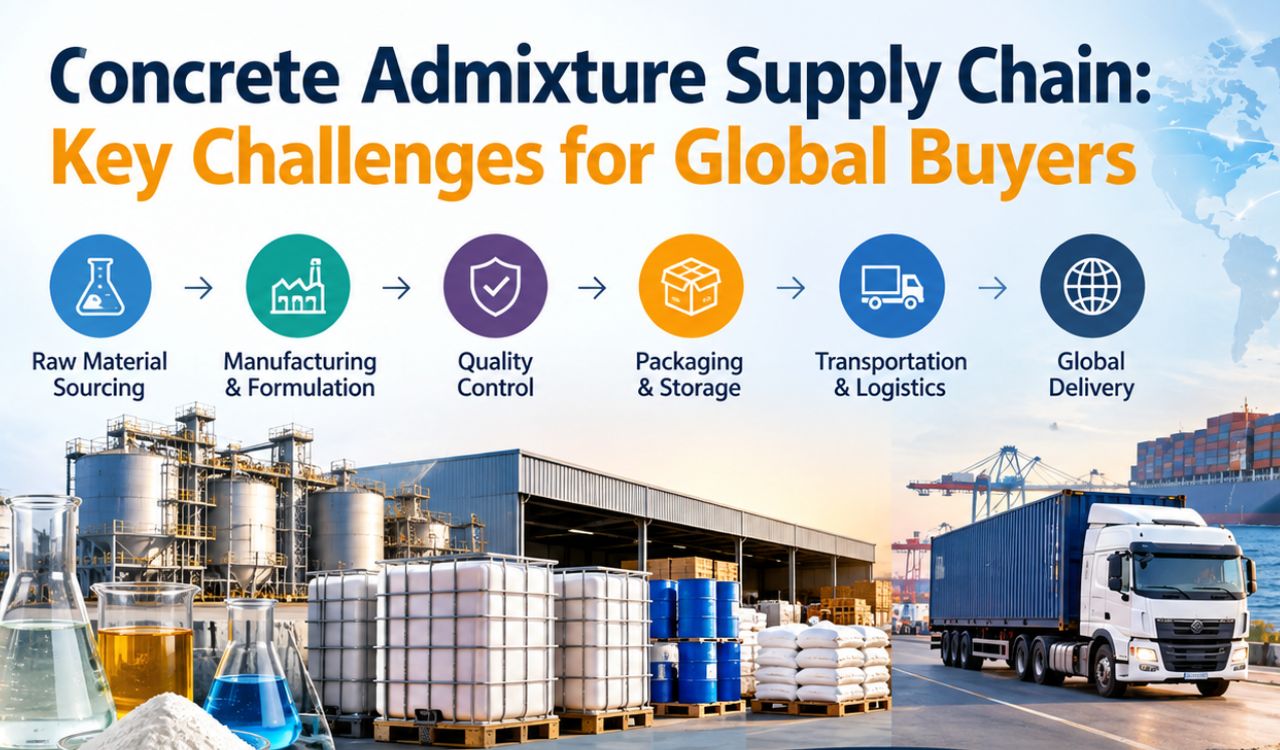
For companies purchasing chemical products internationally, the concrete admixture supply chain can involve several stages, including raw material sourcing, formulation, quality control, packaging, warehousing, transportation, documentation, and final delivery.
A disruption at any stage can affect production schedules, product consistency, delivery times, or procurement costs. Understanding these challenges can help concrete producers, distributors, contractors, and industrial purchasing teams develop more reliable sourcing strategies.
What Is the Concrete Admixture Supply Chain?
The concrete admixture supply chain is the network of processes, suppliers, manufacturers, and logistics partners involved in moving an admixture from its chemical raw materials to its final application in concrete.
A simplified supply chain typically follows this path:
Chemical raw materials → Manufacturing → Formulation → Quality control → Packaging → Storage → Transportation → Distribution → Concrete production
However, the supply chain is not identical for every product. The types-of-admixtures-in-concrete being produced can significantly influence the raw materials required, manufacturing methods, testing procedures, storage conditions, and transportation requirements. For example, water reducers and superplasticizers may require carefully controlled chemical formulations to achieve specific workability and water-reduction performance, while accelerating admixtures are designed to influence setting and early strength development. Corrosion inhibitors and waterproofing admixtures may require different chemical components and performance testing based on the protection they are intended to provide.
Depending on the product and customer requirements, additional stages may include blending, dilution, customization, technical testing, regulatory documentation, and customer-specific formulation. Manufacturers must also maintain consistent quality throughout these stages because variations in raw materials, formulation, or storage conditions can affect admixture performance in concrete.
Understanding the different types-of-admixtures-in-concrete therefore provides useful insight into why admixture supply chains can vary from one product category to another. A well-managed supply chain helps ensure that the right raw materials are available, formulations remain consistent, products meet quality specifications, and admixtures reach concrete producers in suitable condition and on schedule.
Why Supply Chain Reliability Matters
Concrete production often operates according to strict project schedules. Ready-mix plants, precast manufacturers, infrastructure contractors, and construction projects may require admixtures continuously.
A shortage or delayed delivery can affect production planning.
Supply-chain reliability matters because it can influence:
- production continuity
- inventory levels
- project schedules
- formulation consistency
- procurement planning
- transportation costs
- customer commitments
- product availability
For manufacturers, maintaining a stable supply of suitable chemical raw materials is particularly important because changes in raw-material quality can potentially affect the characteristics of the finished admixture.
Key Stages of the Admixture Supply Chain
Raw Material Sourcing
The supply chain begins with sourcing the chemicals and materials required to manufacture the admixture.
Depending on the formulation, these may include materials used for:
- water reduction
- dispersion
- setting control
- corrosion inhibition
- waterproofing
- air entrainment
- workability modification
The exact raw materials depend on the chemistry and intended performance of the final product.
For industrial buyers, the important issue is not simply whether a raw material is available. Its quality, consistency, specification, availability, and traceability also need to be considered.
Manufacturing and Formulation
After raw materials are received, manufacturers process or combine them according to the product formulation.
Manufacturing may involve:
- controlled blending
- chemical reactions
- neutralization
- dilution
- filtration
- temperature control
- concentration adjustment
- pH adjustment
- final homogenization
The manufacturing process needs to be controlled carefully because changes in processing conditions can influence the properties of the finished admixture.
Quality Control
Quality control is one of the most important stages in the supply chain.
Manufacturers may evaluate relevant physical and chemical properties according to product specifications and intended applications.
Depending on the product, quality checks can include:
- appearance
- concentration or solids content
- pH
- density
- viscosity
- moisture
- active component content
- particle characteristics for powder products
- performance-related parameters
A consistent quality-control system helps manufacturers identify deviations before products are released.
Packaging
Packaging protects the admixture during storage and transportation.
The appropriate packaging depends on whether the product is supplied as a powder, liquid, concentrate, or another formulation.
Packaging considerations may include:
- container compatibility
- moisture protection
- leakage prevention
- labeling
- handling requirements
- product identification
- batch traceability
For international shipments, packaging also needs to withstand extended transportation and handling.
Warehousing and Storage
Storage conditions can affect product stability.
Liquid and powder admixtures may have different storage requirements. Factors such as temperature, moisture, exposure to contamination, and container integrity can be important.
Buyers should therefore understand the manufacturer’s recommended storage conditions before establishing inventory levels.
Poor storage can create avoidable problems such as:
- changes in physical properties
- contamination
- sedimentation
- agglomeration in powders
- packaging damage
- reduced usability
Major Challenges for Global Buyers
1. Raw Material Availability
One of the fundamental challenges in the global supply chain is maintaining access to suitable raw materials.
Chemical raw materials can be affected by:
- production capacity
- regional supply
- transportation constraints
- energy costs
- manufacturing shutdowns
- changes in demand
- regulatory requirements
A disruption affecting an upstream chemical producer can eventually influence the availability of downstream admixture products.
2. Batch-to-Batch Consistency
Industrial buyers need products that perform consistently from one shipment to another.
Variations in raw-material characteristics or manufacturing conditions can potentially produce differences between batches.
This is particularly important for concrete admixtures because the finished product may be incorporated into carefully controlled concrete formulations.
Buyers should consider whether suppliers have appropriate:
- batch testing
- quality-control procedures
- traceability systems
- manufacturing controls
- technical documentation
3. Long International Lead Times
International sourcing can introduce longer lead times than domestic procurement.
The actual delivery period can depend on:
- manufacturing schedules
- production capacity
- order quantities
- port availability
- shipping schedules
- customs processing
- inland transportation
- seasonal disruptions
Long lead times make inventory planning more important.
A buyer relying entirely on just-in-time purchasing may face production risks if unexpected transportation delays occur.
4. Transportation and Logistics
Admixtures can be shipped across multiple transportation stages before reaching the final customer.
For example:
Manufacturer → Export warehouse → Port → Ocean freight → Import port → Distribution center → Customer
Each additional stage creates opportunities for delay or handling problems.
International buyers should therefore evaluate the supplier’s logistics capabilities as well as the product itself.
5. Storage Stability
Storage stability is another consideration when purchasing admixtures in bulk.
The buyer needs to understand:
- recommended temperature range
- shelf life
- container requirements
- protection from contamination
- moisture sensitivity
- mixing or agitation requirements where applicable
Correct storage can help preserve product quality throughout the procurement cycle.
6. Documentation Requirements
International chemical procurement often involves technical and commercial documentation.
Depending on the product and destination, buyers may require documents such as:
- technical data sheets
- safety data sheets
- certificates of analysis
- product specifications
- batch information
- packing lists
- commercial invoices
- shipping documentation
Complete and accurate documentation can make procurement, receiving, quality control, and regulatory processes easier.
How Supplier Qualification Reduces Supply-Chain Risk
Selecting a supplier based only on price can create additional risks.
A more comprehensive supplier evaluation should consider:
Manufacturing Capability
Determine whether the supplier has suitable production capacity for the required product and order volume.
Quality Management
Review how raw materials and finished products are tested and controlled.
Technical Support
For technical chemical products, the supplier should be able to provide meaningful product information and respond to formulation or application questions.
Production Consistency
Ask about batch control, traceability, specifications, and quality procedures.
Delivery Capability
Evaluate production lead times, packaging options, shipping experience, and delivery reliability.
Communication
Clear communication becomes especially important in international B2B procurement.
Buyers should establish clear expectations regarding:
- specifications
- quantities
- delivery schedules
- packaging
- documentation
- payment terms
- quality requirements
Price Is Not the Only Procurement Factor
The lowest quoted price does not necessarily represent the lowest total procurement cost.
Industrial buyers should consider the total cost of ownership, which may include:
- product price
- shipping
- customs and import costs
- storage
- handling
- testing
- inventory carrying costs
- rejected batches
- production delays
- emergency sourcing
A slightly higher unit price from a dependable supplier may sometimes provide better overall value if it reduces supply interruptions and quality-related problems.
How Global Buyers Can Improve Admixture Procurement
A structured procurement strategy can reduce supply-chain uncertainty.
Establish Clear Specifications
Before purchasing, define the required product characteristics and performance requirements.
Specifications should be sufficiently clear to ensure that different batches can be evaluated consistently.
Approve Suppliers Before Large Orders
Conduct supplier qualification before committing to significant production volumes.
This can include reviewing:
- manufacturing capabilities
- quality systems
- product documentation
- production capacity
- previous supply experience
- technical support
Test Samples
Where appropriate, evaluate samples using the actual materials and application conditions in which the admixture will be used.
Laboratory testing can help identify compatibility or performance issues before large-scale procurement.
Maintain Appropriate Inventory
Inventory requirements depend on consumption rate, lead time, shelf life, storage capacity, and supply risk.
Critical materials may justify a suitable safety stock, particularly when international lead times are long.
Maintain Alternative Supply Options
Depending on the importance of the product, buyers may benefit from having qualified alternative suppliers or raw-material sources.
However, switching suppliers should not be treated as a simple purchasing decision. Changes in chemical composition or product characteristics may require technical evaluation.
The Importance of Traceability
Traceability allows a manufacturer or buyer to identify where a product or raw material came from and which production batch it belongs to.
Useful information can include:
- raw-material batch
- manufacturing date
- finished-product batch number
- production lot
- testing records
- shipment information
Good traceability makes it easier to investigate quality issues and manage products throughout the supply chain.
Supply Chain Considerations for Different Admixture Products
Different admixture categories can present different sourcing considerations.
| Admixture category | Important supply-chain considerations |
| Water reducers | Raw-material consistency, liquid stability, performance consistency |
| PCE superplasticizers | Polymer chemistry, formulation consistency, storage and transportation |
| Lignosulfonate-based products | Raw-material consistency, concentration, powder or liquid handling |
| Accelerating admixtures | Chemical stability, packaging, storage and transportation |
| Corrosion inhibitors | Active chemical concentration, specifications, documentation |
| Waterproofing admixtures | Powder quality, moisture protection, packaging and storage |
| Specialty admixtures | Customized specifications, technical testing and supplier capability |
The exact requirements depend on the formulation and intended application.
How Supply-Chain Challenges Affect the Concrete Admixtures Market
Supply-chain conditions can influence the broader concrete admixtures market by affecting product availability, manufacturing costs, purchasing decisions, and regional sourcing patterns.
When upstream chemical supplies become constrained, manufacturers may need to:
- adjust procurement strategies
- qualify alternative raw materials
- modify inventory levels
- optimize production planning
- develop alternative formulations
- diversify suppliers
For buyers, these changes reinforce the importance of evaluating both technical performance and supply reliability.
What Global Buyers Should Ask an Admixture Supplier
Before entering a long-term purchasing relationship, buyers can ask:
- What are the product’s key technical specifications?
- What quality-control tests are performed?
- Can batch-specific documentation be provided?
- What is the normal production lead time?
- What packaging options are available?
- What are the recommended storage conditions?
- What is the expected shelf life?
- What production capacity is available?
- Can the supplier support recurring orders?
- What technical information is available for product evaluation?
These questions help buyers evaluate suppliers from both a commercial and technical perspective.
Best Practices for a More Resilient Admixture Supply Chain
A resilient supply strategy generally combines several measures rather than depending on one solution.
1. Qualify suppliers carefully.
Evaluate manufacturing, quality, technical support, and logistics capabilities.
2. Define product specifications.
Clear specifications make quality evaluation more consistent.
3. Test before scaling.
Use laboratory trials before adopting a new product or supplier for large-scale production.
4. Monitor inventory.
Align safety stock with consumption, lead times, shelf life, and supply risk.
5. Maintain traceability.
Record relevant batch and shipment information.
6. Review logistics regularly.
Consider transportation routes, lead times, and potential bottlenecks.
7. Avoid unnecessary supplier switching.
A new supplier may introduce chemical or performance differences that require additional testing.
8. Develop contingency plans.
Identify alternative sources for strategically important products or raw materials.
Conclusion
The concrete admixture supply chain extends well beyond manufacturing the final chemical product. It begins with the sourcing of suitable chemical raw materials and continues through formulation, quality control, packaging, storage, transportation, and delivery.
For global buyers, the major challenges include raw-material availability, batch consistency, international lead times, logistics, storage, documentation, and supplier reliability.
A strong procurement strategy should therefore evaluate suppliers based on quality, consistency, technical capability, production capacity, documentation, logistics, and total procurement cost, rather than focusing exclusively on unit price.
For manufacturers, contractors, ready-mix producers, and industrial buyers, understanding these supply-chain factors can support more reliable sourcing decisions and help reduce avoidable disruptions in concrete production.
FAQs
What is the concrete admixture supply chain?
It is the complete process through which concrete admixtures move from raw-material sourcing and manufacturing to quality control, packaging, storage, transportation, distribution, and final use.
What are the biggest challenges in sourcing concrete admixtures internationally?
Common challenges include raw-material availability, long lead times, transportation delays, batch consistency, storage requirements, documentation, customs procedures, and supplier reliability.
Why is raw-material quality important for concrete admixtures?
Raw-material characteristics can influence the consistency and properties of the finished admixture. Consistent inputs and controlled manufacturing help support consistent finished-product quality.
How should buyers evaluate a concrete admixture supplier?
Buyers should evaluate manufacturing capacity, quality-control procedures, technical documentation, product specifications, testing capabilities, delivery performance, packaging, storage requirements, and technical support.
Is the cheapest concrete admixture supplier always the best option?
No. Unit price is only one part of total procurement cost. Shipping, quality problems, delays, testing, storage, and production interruptions can significantly affect the actual cost of sourcing.
How can buyers reduce concrete admixture supply-chain risks?
Useful strategies include supplier qualification, sample testing, clear specifications, inventory planning, traceability, logistics monitoring, and maintaining qualified alternative supply options where appropriate.
What documents should buyers request from an admixture supplier?
Depending on the product and market, buyers may request technical data sheets, safety data sheets, certificates of analysis, product specifications, batch information, and relevant shipping or commercial documentation.