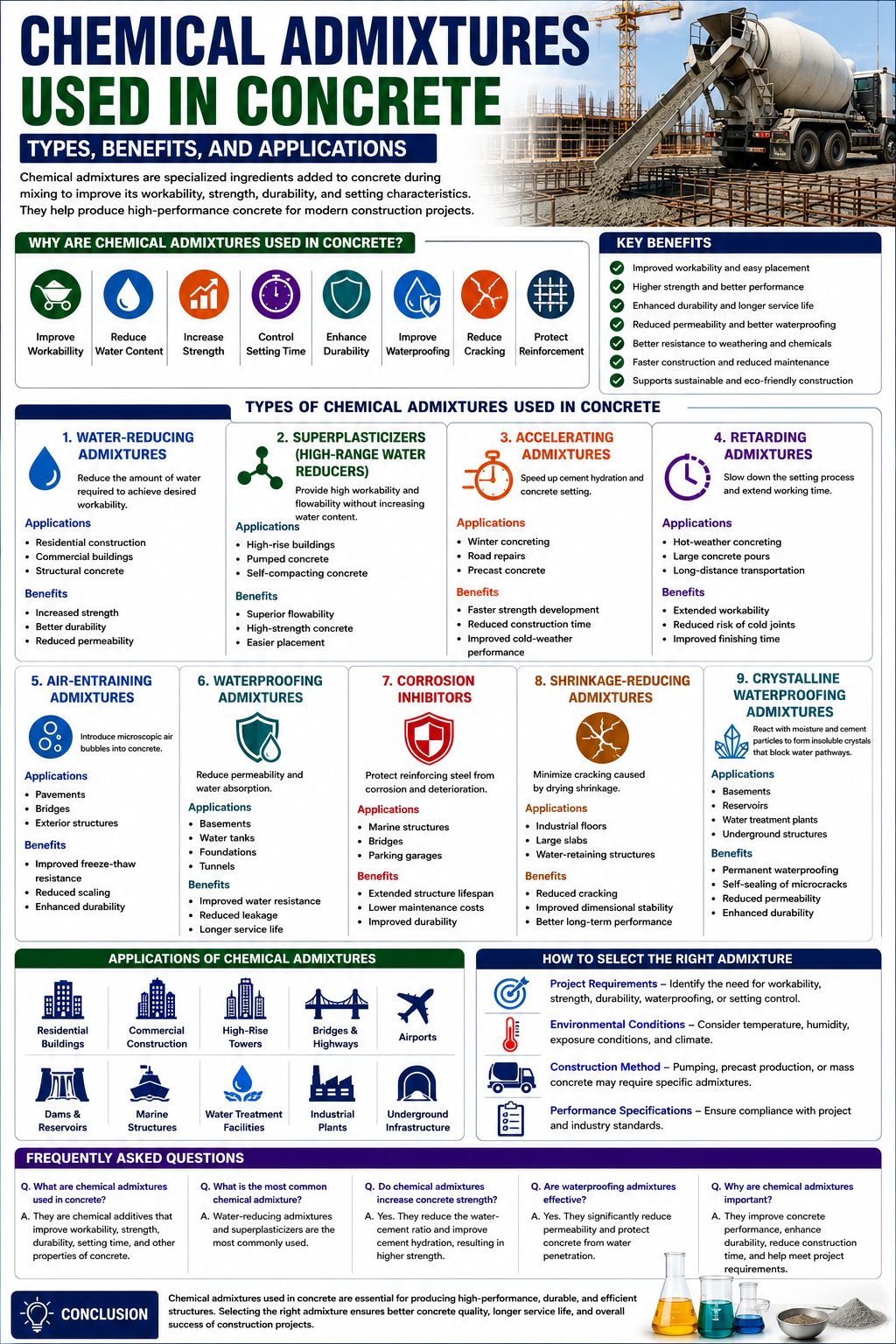
Introduction
Chemical admixtures used in concrete are specialized ingredients added during the mixing process to improve the performance, workability, durability, strength, and setting characteristics of concrete. These admixtures have become essential in modern construction, helping engineers and contractors achieve specific concrete properties while improving construction efficiency and long-term structural performance.
From residential buildings and commercial developments to bridges, highways, tunnels, and water-retaining structures, chemical admixtures play a vital role in producing high-quality concrete that meets demanding project requirements.
What Are Chemical Admixtures Used in Concrete?
Chemical admixtures are substances added to concrete before or during mixing in relatively small quantities compared to cement. Their purpose is to modify one or more properties of fresh or hardened concrete.
Chemical admixtures are commonly used to:
- Improve workability
- Reduce water demand
- Increase strength
- Control setting time
- Enhance durability
- Improve waterproofing
- Reduce cracking
- Protect reinforcement steel
Today, most ready-mix and precast concrete contains at least one type of chemical admixture.
Why Are Chemical Admixtures Used in Concrete?
Improve Workability
Chemical admixtures make concrete easier to place, compact, pump, and finish.
Benefits:
- Better flowability
- Easier placement
- Reduced segregation
- Improved surface finish
Reduce Water Content
Water-reducing admixtures allow contractors to maintain workability while using less water.
Benefits:
- Higher compressive strength
- Lower permeability
- Improved durability
Increase Concrete Strength
By reducing the water-cement ratio, chemical admixtures help increase both early and long-term concrete strength.
Benefits:
- Faster strength gain
- Improved load-bearing capacity
- Enhanced structural performance
Control Setting Time
Some projects require faster or slower concrete setting depending on weather conditions and construction schedules.
Benefits:
- Better project scheduling
- Improved cold-weather performance
- Enhanced hot-weather concreting
Types of Chemical Admixtures Used in Concrete
Water-Reducing Admixtures
Water reducers decrease the amount of water required to achieve desired workability.
Applications:
- Residential construction
- Commercial buildings
- Structural concrete
Benefits:
- Increased strength
- Better durability
- Reduced permeability
Superplasticizers (High-Range Water Reducers)
Superplasticizers provide exceptional workability without increasing water content.
Applications:
- High-rise buildings
- Pumped concrete
- Self-compacting concrete
Benefits:
- Superior flowability
- High-strength concrete
- Easier placement
Accelerating Admixtures
Accelerators speed up cement hydration and concrete setting.
Applications:
- Winter concreting
- Road repairs
- Precast concrete
Benefits:
- Faster strength development
- Reduced construction time
- Improved cold-weather performance
Retarding Admixtures
Retarders slow down the setting process and extend working time.
Applications:
- Hot-weather concreting
- Large concrete pours
- Long-distance concrete transportation
Benefits:
- Extended workability
- Reduced risk of cold joints
- Improved finishing time
Air-Entraining Admixtures
Air-entraining agents introduce microscopic air bubbles into concrete.
Applications:
- Pavements
- Bridges
- Exterior structures
Benefits:
- Improved freeze-thaw resistance
- Reduced scaling
- Enhanced durability
Waterproofing Admixtures
Waterproofing admixtures reduce concrete permeability and water absorption.
Applications:
- Basements
- Water tanks
- Foundations
- Tunnels
Benefits:
- Improved water resistance
- Reduced leakage
- Longer service life
Corrosion Inhibitors
Corrosion inhibitors protect steel reinforcement from rust and deterioration.
Applications:
- Marine structures
- Bridges
- Parking garages
Benefits:
- Extended structure lifespan
- Lower maintenance costs
- Improved durability
Shrinkage-Reducing Admixtures
These admixtures minimize cracking caused by drying shrinkage.
Applications:
- Industrial floors
- Large slabs
- Water-retaining structures
Benefits:
- Reduced cracking
- Improved dimensional stability
- Better long-term performance
Crystalline Waterproofing Chemical Admixtures
Crystalline waterproofing admixtures react with moisture and unhydrated cement particles to form insoluble crystals within concrete.
Benefits:
- Permanent waterproofing
- Self-sealing of microcracks
- Reduced permeability
- Enhanced durability
Applications:
- Basements
- Reservoirs
- Water treatment plants
- Underground structures
Advantages of Chemical Admixtures Used in Concrete
Improved Concrete Quality
Chemical admixtures optimize both fresh and hardened concrete properties.
Enhanced Durability
Structures become more resistant to environmental damage and chemical attack.
Faster Construction
Improved workability and strength development accelerate project completion.
Reduced Maintenance Costs
Durable concrete requires fewer repairs throughout its service life.
Sustainable Construction
Many admixtures reduce cement and water consumption, supporting environmentally responsible construction.
Applications of Chemical Admixtures in Concrete
Chemical admixtures are widely used in:
- Residential buildings
- Commercial construction
- High-rise towers
- Bridges and highways
- Airports
- Dams and reservoirs
- Marine structures
- Water treatment facilities
- Industrial plants
- Underground infrastructure
How to Select the Right Chemical Admixture
Project Requirements
Determine whether workability, strength, waterproofing, or durability is the priority.
Environmental Conditions
Temperature, humidity, and exposure conditions influence admixture selection.
Construction Method
Placement methods such as pumping or precast production may require specialized admixtures.
Performance Specifications
Ensure the admixture meets project and industry standards.
Frequently Asked Questions
What are chemical admixtures used in concrete?
Chemical admixtures are additives used to improve concrete workability, strength, durability, waterproofing, and setting characteristics.
What is the most common chemical admixture?
Water-reducing admixtures and superplasticizers are among the most commonly used chemical admixtures in modern concrete.
Do chemical admixtures increase concrete strength?
Yes. Many chemical admixtures increase strength by reducing the water-cement ratio and improving cement hydration.
Are waterproofing admixtures considered chemical admixtures?
Yes. Waterproofing admixtures are a common type of chemical admixture used to reduce concrete permeability.
Why are chemical admixtures important?
They improve concrete performance, increase durability, reduce construction time, and help meet specific project requirements.
Conclusion
Chemical admixtures used in concrete are essential for producing high-performance, durable, and efficient concrete structures. From improving workability and strength to enhancing waterproofing and durability, these admixtures help construction professionals meet the demands of modern building projects. Choosing the right chemical admixture can significantly improve concrete quality, service life, and overall project success.