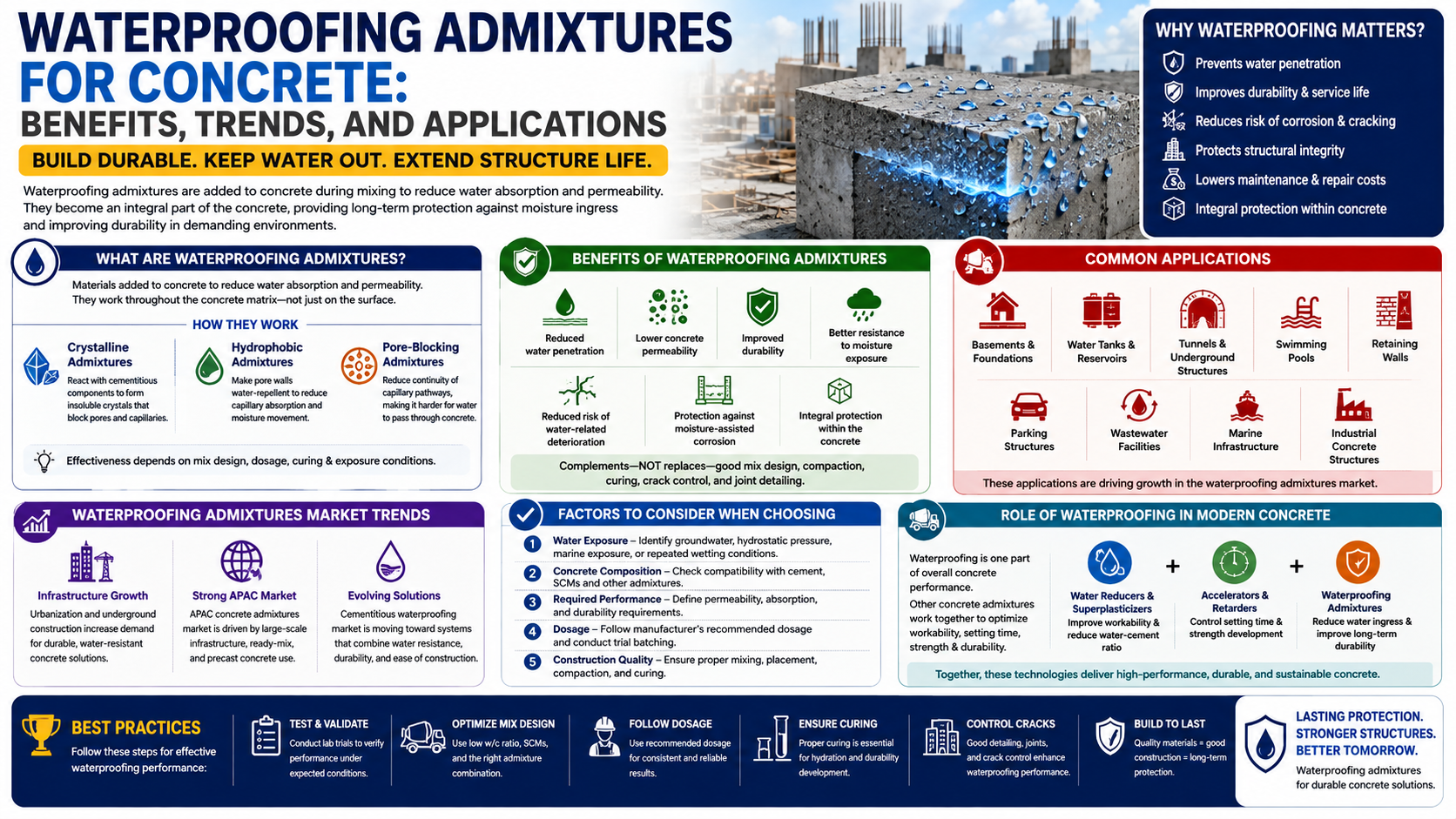
Concrete is strong and durable, but its natural porosity allows water and moisture to enter through capillary pores and micro-pathways. Over time, water penetration can contribute to corrosion, cracking, efflorescence, and other durability problems. Waterproofing admixtures for concrete are designed to reduce this water movement and improve the long-term performance of concrete structures.
What Are Waterproofing Admixtures for Concrete?
Waterproofing admixtures are materials added to concrete during mixing to reduce water absorption and permeability. Depending on their formulation, they can block capillary pores, create water-repellent surfaces, or promote reactions that reduce pathways for moisture.
Unlike surface coatings, integral waterproofing admixtures become part of the concrete mix, providing water-resistance throughout the treated concrete.
How Do Waterproofing Admixtures Work?
Different technologies use different mechanisms to control water penetration.
Crystalline Admixtures
Crystalline systems react within the cementitious matrix and can form insoluble crystalline structures in pores and capillaries. They are commonly considered for basements, tunnels, tanks, foundations, and other water-exposed structures.
Hydrophobic Admixtures
These materials make internal pore surfaces more water-repellent, helping reduce capillary absorption and moisture movement.
Pore-Blocking Admixtures
Pore-blocking technologies reduce the continuity of capillary pathways, making it more difficult for water to pass through the concrete.
The effectiveness of each technology depends on the concrete mix, dosage, curing, and project exposure conditions.
Benefits of Waterproofing Admixtures
Using the right waterproofing admixture can provide several advantages:
- Reduced water penetration
- Lower concrete permeability
- Improved durability
- Better resistance to moisture exposure
- Reduced risk of water-related deterioration
- Protection against moisture-assisted corrosion
- Integral protection within the concrete
However, admixtures should complement—not replace—proper mix design, compaction, curing, crack control, and joint detailing.
Common Applications
Waterproofing admixtures are used in concrete structures where controlling moisture ingress is important.
Common applications include:
- Basements and foundations
- Water tanks and reservoirs
- Tunnels and underground structures
- Swimming pools
- Retaining walls
- Parking structures
- Wastewater facilities
- Marine infrastructure
- Industrial concrete structures
These applications are helping support demand across the growing waterproofing admixtures market.
Waterproofing Admixtures Market Trends
The broader concrete admixtures market is increasingly focused on durability, high-performance concrete, and longer service life. Infrastructure development, urbanization, and underground construction are also creating demand for concrete technologies that can withstand demanding exposure conditions.
The APAC concrete admixtures market is particularly important because of continued infrastructure development and increasing use of ready-mix and precast concrete.
At the same time, the cementitious waterproofing market is evolving toward systems that combine water resistance with improved durability and easier construction.
Waterproofing Admixtures: Technology Comparison
Different waterproofing admixture technologies control moisture in different ways. Selecting the right option depends on the concrete application, exposure conditions, and required level of water resistance.
| Technology | Main Function | Common Applications |
|---|---|---|
| Crystalline | Forms water-resistant crystalline structures | Basements, tanks, tunnels |
| Hydrophobic | Reduces water absorption | Foundations, walls, general concrete |
| Pore-Blocking | Reduces capillary pathways | Underground and water-exposed structures |
The table provides a quick comparison, while actual performance depends on the admixture formulation, concrete mix design, dosage, curing, and construction quality.
Factors to Consider When Choosing an Admixture
Before selecting a waterproofing admixture, engineers and contractors should consider:
- Water exposure – Identify groundwater, hydrostatic pressure, marine exposure, or repeated wetting conditions.
- Concrete composition – Check compatibility with cement, supplementary cementitious materials, and other admixtures.
- Required performance – Define permeability, absorption, and durability requirements.
- Dosage – Follow the manufacturer’s recommended dosage and conduct trial batching.
- Construction quality – Ensure proper mixing, placement, compaction, and curing.
Role of Waterproofing in Modern Concrete
Waterproofing is only one part of modern concrete performance. Other concrete admixtures such as water reducers, superplasticizers, accelerators, and retarders can be used to control workability, setting time, strength development, and durability.
For example, reducing the water-cement ratio can help produce a denser concrete matrix, while specialized waterproofing technologies can further reduce water ingress. Luke Chemicals provides concrete admixture technologies that can support different performance requirements in modern concrete production.
Conclusion
Waterproofing admixtures for concrete offer an effective way to reduce water absorption and permeability from within the concrete mix. Crystalline, hydrophobic, and pore-blocking technologies can be used across foundations, tunnels, water-retaining structures, marine infrastructure, and other moisture-exposed applications.
As demand for durable and long-lasting construction continues to grow, waterproofing admixtures are becoming an increasingly important part of modern concrete design. The best results come from combining the appropriate admixture with sound mix design, proper curing, crack control, and quality construction practices.
FAQs
1. What are waterproofing admixtures for concrete?
They are additives incorporated into concrete to reduce water absorption and penetration through the hardened concrete matrix.
2. Are waterproofing admixtures the same as waterproofing coatings?
No. Admixtures are incorporated into the concrete, while coatings and membranes are generally applied to the surface.
3. Where are waterproofing admixtures used?
They are commonly used in basements, foundations, tunnels, tanks, reservoirs, retaining walls, and other water-exposed structures.
4. Do waterproofing admixtures prevent all water leakage?
No. Cracks, joints, poor compaction, and construction defects can still allow water to enter.
5. How should a waterproofing admixture be selected?
Consider exposure conditions, concrete composition, required performance, dosage, compatibility, and project-specific testing.