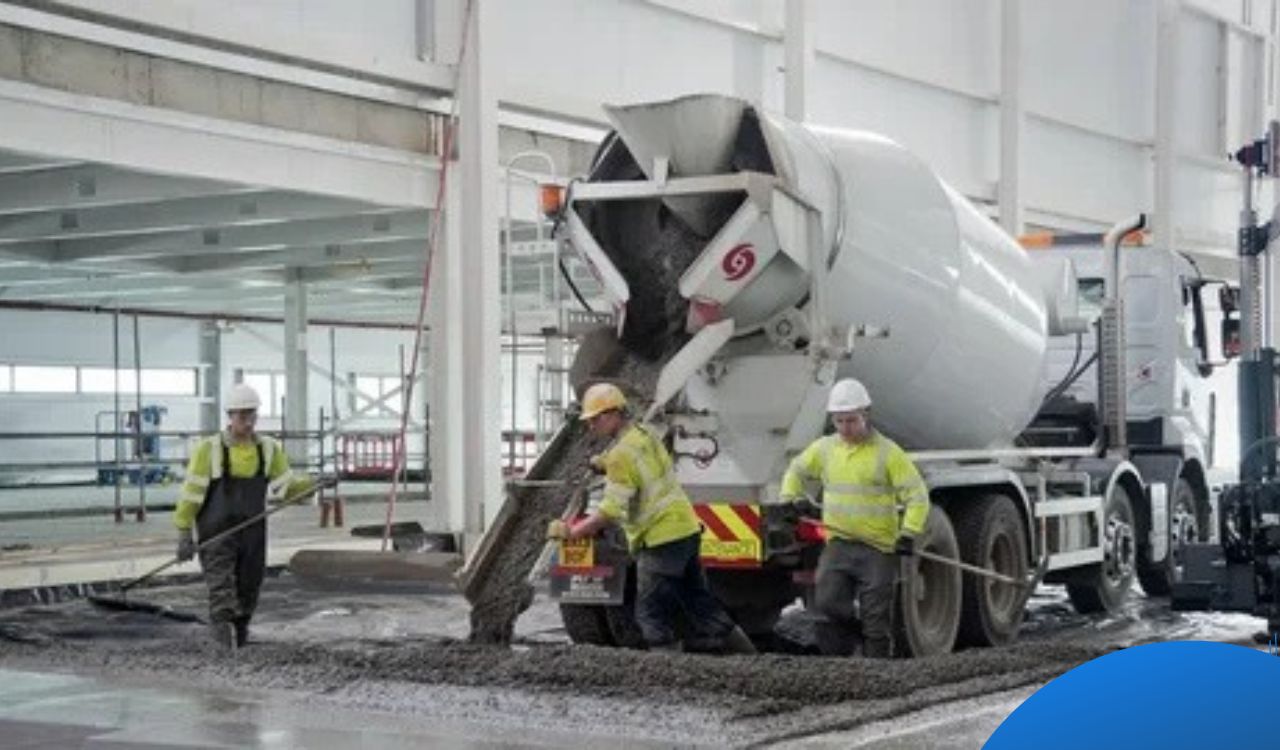
Long slabs crack because shrinkage pulls them shorter while walls, piles, and the subgrade hold them in place. Joints are the usual solution, but every joint creates a potential point for leaks, edge damage, and ongoing maintenance. An expansion agent offers another approach: it causes concrete to expand slightly during the early curing stage, helping compensate for later shrinkage and reduce the tensile stress that can lead to cracking. Alongside proper mix design and protection measures, concrete anticorrosion inhibitor can also help protect embedded steel reinforcement against corrosion, supporting long-term concrete durability. This guide answers the key questions engineers, contractors, and buyers ask about expansion agents, their benefits, and their role in producing more durable concrete structures.
What Are Seamless Slabs?
A seamless (or jointless) slab has far fewer saw-cut control joints than a conventional slab. It does not have zero joints. Isolation joints at columns and walls, construction joints between pours and movement joints in very long structures are still needed. The aim is to remove the closely spaced control joints and the cracks that form between them.
What Is an Expansion Agent, and What Does It Do in a Slab?
An expansion agent is a mineral additive, usually based on calcium sulfoaluminate, lime or magnesia, that produces a controlled early volume increase. Shrinkage-compensating concrete is concrete that expands by at least as much as the volume change expected from drying shrinkage. Reinforcement restrains that expansion and puts the slab into slight compression, which later shrinkage must first relieve before cracking can start.
For the mechanism, dosage and mixing details, see our guide to expansion agent dosage, mixing and 14-day curing.
Why Do Long Basements and Floors Crack?
| Cause | What happens |
| Drying shrinkage | The slab loses moisture and tries to shorten |
| Early-age shrinkage | Low water-binder mixes shrink as they hydrate |
| Thermal contraction | The slab cools after the heat of hydration |
| Restraint | Walls, piles, columns and subgrade friction resist movement |
| Poor curing | The surface dries early and cracks |
| Curling | The top dries faster than the bottom |
Basement slabs are especially exposed, because walls and foundations add restraint and groundwater turns every crack into a leak path.
Why Use an Expansion Agent Instead of More Joints?
- Fewer joints mean fewer leak paths and less sealant maintenance
- Reduced cracking and curling can improve floor flatness and forklift performance
- Larger pours can speed up construction
- Basements gain better watertightness when cracks are limited
The trade-off is more demanding design, reinforcement and curing control.
How Large Can a Seamless Slab Be?
Published guidance shows the scale. ACI 223 has reported slabs as large as 1,850 square metres, equal to a joint spacing of about 43 m if square, though spacings over 36 m are rare in normal practice. The same source notes that the method requires special knowledge and attention to detail. The final limit always comes from the engineer’s design, not a general rule.
How Do You Design a Seamless Slab?
Reinforcement
Expansion only helps when it is restrained. Guidance for shrinkage-compensating slabs calls for a minimum reinforcement ratio of 0.15% in each direction, placed in the upper third of the slab. Design sources also warn that subgrade friction can restrain the slab more than the reinforcement does, which is why expansion tests during construction are recommended.
Subgrade
Compact and level the subgrade, and use the slip layer the design specifies, keeping it intact. Friction that is too high or inconsistent changes how much the slab can expand.
Panel Geometry
Compact shapes work better than long, narrow ones. Reported guidance recommends a maximum panel length-to-width ratio of 1.5 to 1.
Joints
| Joint type | Role |
| Isolation joints | Still needed at columns, walls and fixed elements |
| Construction joints | Placed where pours stop |
| Saw-cut control joints | Greatly reduced or removed where the design allows |
| Post-pour strips or expansion bands | Used in very long basements to manage early movement |
Some designs replace open post-pour strips with expansion reinforcing bands, which use a higher-expansion mix in a narrow zone. This is an engineering decision that needs code approval.
How Do You Sequence the Pours?
Expansion needs room to develop. In wall construction, practice is to pour adjoining wall sections at least five days apart so the initial expansion can occur. The same logic applies to adjacent slab panels. Plan the sequence so each pour can expand before it is locked in.
How Do You Mix, Place and Cure It?
| Topic | Guidance |
| Dosage | Set by the datasheet and trial mixes |
| Superplasticizer | Test the pair; expansion agents raise demand and speed slump loss (see our guide to expansion agent superplasticizer compatibility) |
| Mixing | Dry blend the agent evenly; keep the sequence constant |
| Placing | Continuous placing; never add water to restore slump |
| Finishing | Avoid over-troweling and finishing in bleed water |
| Curing | Start early and keep continuously moist, commonly 14 days or as specified |
| Temperature | Control concrete temperature, since heat speeds slump loss and ettringite formation |
Curing is critical. Expansion needs water, and a slab that dries early loses the compensation it was designed for.
How Do You Check That It Worked?
- Expansion tests: guidance recommends ASTM C878 for concrete expansion and ASTM C806 for mortar expansion of Type K cements, and for a packaged agent used with Portland cement, test the real cement and agent combination
- Fresh properties: slump, air content, temperature
- Strength: 7 and 28 day compressive strength
- Records: batch, dose, temperature and curing log for each pour
Which Method Is Right? Comparing Wide-Slab Options
| Method | How it reduces joints | Main trade-off |
| Expansion agent (shrinkage-compensating) | Expansion offsets shrinkage | Needs reinforcement, control and curing |
| Heavy distributed reinforcement | Steel holds cracks tight | More steel, restricts access |
| Post-tensioning | Compression keeps cracks closed | Specialist design, cost rises with length |
| Steel fibres | Controls crack width | Does not offset shrinkage |
| Conventional joints | Pre-planned cracks | Many joints to maintain |
Some projects combine methods. The choice depends on cost, loading, equipment access and the designer’s experience.
Where Is It Used?
- Basement car parks and underground structures
- Metro stations and tunnels
- Logistics warehouses and distribution centres
- Industrial and cold-store floors
- Water tanks and reservoirs
- Podium decks and large transfer slabs
Where Does Waterproofing Fit?
An expansion agent reduces cracking but does not make concrete impermeable. For high watertightness, pair it with a crystalline or hydrophobic waterproof additive for cement and correct waterstops. Test the combination, since waterproofing powders can change flow and set. For sulfate or chloride exposure, see our guide to sulfate attack on concrete.
When Should You Use It, and When Not?
Good fit
- Large slabs where joints are costly or problematic
- Basements and tanks where leakage risk matters
- Floors needing high flatness with minimal joints
- Projects with an experienced designer, contractor and supplier
Poor fit
- Small slabs where conventional joints are cheaper and simple
- Projects without control over curing or reinforcement placement
- Sites with no ability to test expansion or monitor pours
- Teams without experience in shrinkage-compensating concrete
Who Is Responsible for What?
| Role | Responsibility |
| Structural engineer | Slab design, reinforcement, panel size, joint layout, expansion target |
| Contractor | Subgrade, reinforcement placement, pour sequence, finishing, curing |
| Ready-mix producer | Mix proportioning, dose control, temperature, consistency |
| Admixture supplier | Product data, dose guidance, compatibility advice, trial support |
| Testing lab or inspector | Expansion, strength and fresh-property tests, records |
Luke Chemicals supplies concrete admixtures and can help buyers match an expansion agent and water reducer to their cement and project conditions. Within the wider cement and concrete additives market, buyers do best when the supplier can show test data on the real cement and a recommended superplasticizer.
What Are the Limitations?
- Seamless does not mean crack-free. Fine, tight cracks can still occur
- Results depend on reinforcement, subgrade, geometry and curing, not on the agent alone
- Overdosing can cause excess expansion, and underdosing leaves shrinkage uncompensated
- Cement chemistry, temperature and other admixtures change the outcome
- Very long structures can still need movement joints
- The method demands experienced supervision
What Should the Specification Include?
- Target expansion and test method
- Maximum panel size and aspect ratio, set by the engineer
- Reinforcement ratio and position
- Subgrade and slip layer details
- Pour sequence and minimum interval between adjacent pours
- Agent type, dosage and dosing basis (solids or as-supplied)
- Compatible superplasticizer and trial results
- Curing method and duration
- Joint and waterstop details
- Inspector and record format\
Conclusion
An expansion agent can reduce the number of joints in long basements and floors, but only as part of a designed system: reinforcement, subgrade, pour sequence, compatible superplasticizer and continuous curing. Define who is responsible for each step, test the mix with your own materials, and verify expansion on site.
Frequently Asked Questions
What is a seamless slab?
A slab designed with far fewer control joints than a conventional slab, typically using shrinkage-compensating concrete, heavy reinforcement, post-tensioning or fibres. Isolation and construction joints are still required.
Why do long basement slabs crack?
Shrinkage and cooling try to shorten the slab, while walls, piles and subgrade friction restrain it. The tension that builds causes cracks, and groundwater makes them leak.
How does an expansion agent reduce cracking?
It makes the concrete expand slightly in the early days. Reinforcement restrains that expansion and puts the slab into compression, which offsets later shrinkage.
How big can the pour be?
It depends on the design. ACI 223 has reported slabs up to about 1,850 m², but spacings above about 36 m are uncommon. The engineer sets the limit.
When should the slab be cured, and for how long?
Curing should start immediately after finishing and continue without interruption for the specified period, commonly up to 14 days for expansion mixes.
Who decides the dosage?
The dosage comes from the product datasheet and trial mixes, confirmed by the engineer and the ready-mix producer, using the real cement and superplasticizer.
Does it make a basement waterproof?
Not by itself. It limits cracking, which helps. For high watertightness, combine it with a waterproofing admixture, waterstops and proper detailing.